Larung Paglangan
Authors: Youla Azkarrula, Susanne M Hoffmann


Larung Paglangan is an Oceanic name from Bali (Indonesia). The lintang of larung paglangan is found in intersection of Saniscara (Saturday, in saptawara) and Kliwon (in pancawara) in a series of palelintangan. Lintang Larung paglangan means throwing ashes of cremation constellation.[1]
Etymology and History
This constellation term is consisted of two words, "larung" (IPA: [laˈruŋ]) and "paglangan" (IPA: [paˈɡəla.ŋan]).
Spelling Variants
- kirim
- djampana (old spelling)
- jampana (enhanced spelling)
- gotong majit (old spelling)
- gotong mayit (enhanced spelling)
- Pagělangan
- Lahru Pagalangan
- těmbaga
- Rarung pagělangan
Origin of Constellation
In Balinese Hindu tradition, according to the Yama Purwana Tattwa lontar, every dead person (pitra) must perform a sacred offering (Yadnya). After doing cremation, the ashes will thrown into sea.
General information

The astronomical identification of the constellation is taken from Maaß (1929)[2] who explains in general that these constellations and the according ritual practice
"sind seit alten Zeiten in einem Werk ,,wariga" niedergelegt, in dem wir zwei Kulturschichten, nämlich indische und malaio-polynesische Bestandteile wiederfinden."
English: "are written down in a work called "wariga" since old times; there we recognise two cultural layers, i.e. the Indian and the Malayo-Polynesian."
He also quotes other scholars[3][4][5][6] and his earlier work[7][8] reporting that this work dates back to the 9th century CE when Bali was part of a Hindu empire on the neighbouring island of Java.[2] Neubronner van der Tuuk even uses the Old Javanese spelling.
Identification
The identifications, Maaß (1929) gives according to the aforementioned and his own studies during visits of the country and in European and Batavian libraries (p.150).[2]
Maaß (1929), p. 144:
kirim;~djampana; _; ein Mann, der die Asche einer verbrannten Leiche in das Wasser wirft; - die Totenbahre.
English: kirim;~djampana; _; a man who throws the ashes of a cremated corpse into the water; - the bier.
Transfer and Transformation of the Constellation
Mythology / Religion

Larung paglangan is one of the Pitra Yadnya rituals intended for the dead person. This Pitra Yadnya ceremony is known as Ngaben. Historical evidence of the Ngaben ceremony in the past can be found in various ancient Balinese manuscripts, such as the Lontar Yama Tattwa, the Lontar Pitra Yadnya, and the Lontar Atma Prasangsa. These manuscripts explain that the spirit of the deceased needs to be purified so it can return to its origin, namely Sang Hyang Paramatma, or the One and Only God. The spirit must undergo a process of "liberation" or moksha, and one way to achieve this is through the Pitra Yadnya ceremony, one of which is the Ngaben.
This ceremony consists of several sacred stages that must be completed before, during, and after the cremation of the body. Larung paglangan is a ritual performed after the cremation of the body. The cremation of the body produces ashes, which are then scattered into a river, sea, or lake. However, in modern Bali, the scattering of ashes is more often done at sea. This process means returning the body's elements to nature, namely to release the Atma (spirit) from the shackles of the world so that it can easily unite with God (Mokshatam Atmanam).[9]
Image Variants
-
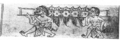 Lintang Djampana (CC-BY Alfred Maaß, (1929), Astrologische Kalender der Balinesen)
 -
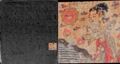 Lintang Laru Paglangan in the cloth (CC-BY UPTD Museum Bali Inventary no. 09.746)
 -
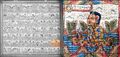 Lintang Laru Paglangan in the cloth (CC-BY UPTD Museum Bali Inventary no. 09.752)
 -
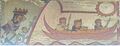 Lintang Larung Paglangan (CC-BY Youla Azkarrula taken in the ceiling of Taman Gili Klungkung Palace Bali)


Cultural Beliefs
Numerology (Neptu/Urip)
Saniscara (Saturday, in saptawara) has a value of 9 and Kliwon (in pancawara) has a value of 8. Thus, the total urip on this lintang is 17.[10]
Astrological Characteristics
Never ending sorrow, if a woman will be sought for a honey, if a man his wife will have an affair, not considered to exist by his siblings and other relatives. Home is like hell. They are friendly to others, have a soft heart. Unfortunately, they are often trapped in their cowardly hearts and a sense of despair that is too fast.[10]
Matching Gemstones
Mirah (ruby), Nila (Saphire), Kecubung (amethyst).[10]
Weblinks
All HIP Stars within this constellation
Stars within the Constellation Area
| id | Label | IAU design. | description | Vmag |
|---|---|---|---|---|
| 1 | Alioth | HIP 62956 | within constellation lines | 1.77 |
| 2 | Alkaid | HIP 67301 | within constellation lines | 1.86 |
| 3 | Mizar | HIP 65378 | within constellation lines | 2.22 |
| 4 | Phecda | HIP 58001 | within constellation lines | 2.44 |
| 5 | Megrez | HIP 59774 | within constellation lines | 3.32 |
| 6 | 73 UMa | HIP 60795 | Inside the Hull | 5.7 |
| 7 | - | HIP 59920 | Inside the Hull | 5.81 |
| 8 | - | HR 4917 | Inside the Hull | 6.02 |
| 9 | 1 CVn | HIP 59708 | Inside the Hull | 6.171 |
| 10 | - | HIP 61053 | Inside the Hull | 6.2 |
| 11 | - | HIP 65754 | Inside the Hull | 6.417 |
| 12 | - | HIP 65698 | Inside the Hull | 6.43 |
References
- References (general)
- ↑ Maass, Alfred, “Astrologische Kalender der Balinesen,” in Koninklijk Bataviaasch Genootschap van Kunsten en Wetenschappen, Feestbundel bij gelegenheid van zijn 150 jarig bestaan 1778-1928, 2 vols. (Weltevreden, 1929), Vol. 2, 126-157.
- ↑ 2.0 2.1 2.2 Cite error: Invalid
<ref>tag; no text was provided for refs named:1 - ↑ Friedrich, R. (1849). Voorloopig verslag van het eiland Bali, Batavia, Verb. Bat Gen. Deel 23, Nr. 13
- ↑ HINLOOPEN LABBERT0N, D. VAN (1910). Geillustreerd handboek van Insulinde. Amsterdam: "Vivat"
- ↑ PIGEAUD, TH. (1925). Een stuk over sterrenkunde uit het Anggastyaparwwa ...... Weltevreden: Albrecht. Tijdsch. v. lnd, T.-, L.- en Vk. deel LXV
- ↑ Nieuwenkamp, W. O. J. (1905), Schetsen van Bali en Lombok. (Eigen Haard)
- ↑ MAASS, ALFRED (1920). Sterne und Sternbilder im malaiischen Archipel. Berlin. Zeitschrift für Ethnologie Jg. 1920/21, H. 1
- ↑ MAASS, ALFRED (1924). Sternkunde und Sterndeuterei im malaiischen Archipel. Batavia, den Haag. Tijdsch. v. T.-, L.-en Vk. deel LX IV
- ↑ Kusumawardani, Olivia Salsabilla & Winata, Nadia Ayu Ardi, "KEBUDAYAAN BALI DENGAN TRADISI UPACARA NGABEN DALAM AGAMA HINDU," TANDA:Jurnal Kajian Budaya, Bahasa dan Sastra, (2022), Vol. 02 No. 06, 10-17.
- ↑ 10.0 10.1 10.2 Tim Kajian Palelintangan, “Gabungan Kajian Palelintangan,” Museum Bali (2021), 1-149.





