Hydra
From All Skies Encyclopaedia

One of the 88 IAU constellations.
Etymology and History
The Greek constellation of the Water Snake is a derivative of the Babylonian constellation of the MUŠ-Dragon, a dog-headed creature with the body of a gigantic snake with front legs and wings.
Origin of Constellation
The Babylonian constellation is mentioned ...
Aratus
Hipparchus mentions the constellation rising and setting. The first star rising is , the last star rising is the oneat the tip of the tail (ὁ ἐν ἄκρᾳ τῇ οὐρᾷ)
Almagest
Transfer and Transformation of the Constellation
-
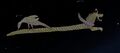 the Babylonian version of the "Hydra and Corvus" super-constellation does not contain a cup or jar. visualized in Stellarium (drawing by Jessica Gullberg)
 -
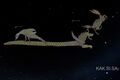 the lonely star in front of the dragon-head (Procyon) rised simultaneously with the faint stars of The Crab in ancient Babylon. Procyon and the head / foot of the dragon may serve as a replacement for Cancer
 -
 The Greeks introduced a Crater atop the snake. On the Farnese Globe, the body of the snake forms a vessel for Corvus and Crater.
 -


Mythology
Greek/ Greco-Roman folklore
Babylonian belief
IAU WGSN
The star pi Hydrae is very important in history as it is one of the keywitnesses for transfer from Hipparchus to Ptolemy.
- name in Hipparchus: ὁ ἐν ἄκρᾳ τῇ οὐρᾷ (the one at the farthest point of the tail)
- name in the Almagest: ὁ ἐπ᾽ἄκρας τῆς οὐρᾶς (the one at the end of the tail)
The Greek term ἄκρᾳ can be translated as "at the farthest point" or "at the end" or "hightest".





