Octans
Authors: Susanne M Hoffmann, Youla Azkarrula, Ian Ridpath

One of the 88 IAU constellations. The constellation was invented by Lacaille in the 1750s. The constellation Octans is located exactly at the south celestial pole. The image of the instrument therefore indicates the position of the south pole, just like its real counterpart, the navigator. Lacaille thus shortened the small water snake Hydrus, which had shown Dutch navigators the south celestial pole in the 17th century by star hopping. There is no ‘southern star’ – at least not one with the brightness of the North Star (Polaris). The faint, barely visible star σ Octantis (Polaris Australis), with a magnitude of 5.5, is relatively close to the celestial pole. It is located exactly next to Bayer's (1603) end of the Hydrus, and the celestial pole lies on the line connecting β Hyi and δ Oct: a survey mark.[1]
Etymology and History

Origin of Constellation
In ancient times, entire circles were used to measure the sky. Ptolemy describes two armillary spheres that were complex to manufacture – one in Geography, one in Almagest – which have different numbers of nested rings.
Subdivisions such as the octant are a modern invention; in particular, the eighth circle was not invented until the early 18th century. John Hadley in England, a mathematician and respected member of the Royal Astronomical Society, claimed credit for the invention in 1732. In America, Thomas Godfrey, also a respected mathematician but a rather demanding contemporary of Benjamin Franklin, also invented an octant. Godfrey's octant dates back to 1730, two years earlier, which Hadley was unaware of.
Invention or not, it does not take much imagination to halve the existing quadrant (quarter circle) again. This invention may not be as sensational as the telescope or microscope, but the mere fact that this octant was invented during the time of Lacaille (1713-1762) qualifies it to be placed in the heavens as a contemporary invention. According to Lacaille's reasoning in 1756, the octant or mirror quadrant was the main instrument used by navigators.
Transfer and Transformation of the Constellation
-
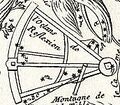 Octans in Lacaille (1756)
 -
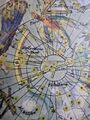 Octans in Bode (1782, 1805)
 -
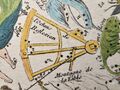 Octans in Fortin's Atlas Céleste, 3rd edition (1795).
 -
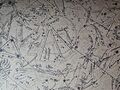 Octans in Goldbach (1799)


Mythology
Weblinks
References
- ↑ Hoffmann, Susanne M. Wie der Löwe an den Himmel kam. Franckh Kosmos Verlag, Stuttgart 2021





