Sculptor
Authors: Susanne M Hoffmann, Youla Azkarrula, IanRidpath

One of the 88 IAU constellations. The constellation was invented by Lacaille in the 1750s.
Etymology and History

Origin of Constellation
[1]In his description from 1756, Nicolas Louis de Lacaille writes that the sculptor's workshop consists of a stool supporting a model and a block of marble on which a wooden hammer and a chisel have been placed.
The long name ‘Sculptor's Workshop’ was shortened in the course of the IAU's definition of the constellations, and the block of marble is no longer drawn in modern times. Bode had already omitted the marble block in his Uranographia (1801) and replaced it with a new constellation, ‘electric machine’. However, this did not catch on: the air pump already existed as a symbol for physics, and Lacaille's constellations are already so small that it is not worth splitting them up any further.
In addition to painting, technical drawing, ocean navigation, experimental physics and chemistry, the French mathematician and astronomer has thus immortalised another profession among the stars.
Transfer and Transformation of the Constellation
-
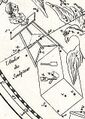 Scl in Lacaille (1756)
 -
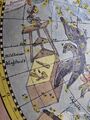 Scl in Bode (1782,1805)
 -
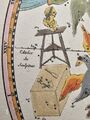 Sculptor in Fortin's Atlas Céleste, 3rd edition (1795).
 -
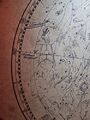 Scl in Goldbach (1799)


Mythology
Weblinks
References
- ↑ Hoffmann, Susanne M. Wie der Löwe an den Himmel kam. Franckh Kosmos Verlag, Stuttgart 2021