Banyak Angrem
Authors: Youla Azkarrula, Susanne M Hoffmann


Banyak Angrěm is an Oceanic name from Bali (Indonesia). The lintang of banyak angrěm is found in intersection of Sukra (Friday, in saptawara) and Umanis (in pancawara) in a series of palelintangan. Lintang banyak angrěm means brooding goose constellation.[1]
Etymology and History
This constellation term consists of two words, “banyak” (IPA: /ˈbaɲaʔ/ [ˈba.ɲaʔ]) and “angrem” (IPA: /aŋrəm/).
Spelling Variants
- Běnjak kangrěm
- Banjak angrěm
- Banyak ngěrěm
- Angsa měngěram
Origin of Constellation
Banyak is a term for swan, while angrem is incubating eggs. In some areas, this aves is believed to bring peace to those who keep it. Swans are usually closely related to Hindu religious ceremonies in Bali. For certain ceremonies, it is usually required to use their eggs or meat. From a philosophical perspective, swan is likened to being able to distinguish between good and bad. This is proven when the goose looks for food in the mud, this aves can sort it out well.
General information

The astronomical identification of the constellation is taken from Maaß (1929)[1] who explains in general that these constellations and the according ritual practice
"sind seit alten Zeiten in einem Werk ,,wariga" niedergelegt, in dem wir zwei Kulturschichten, nämlich indische unq malaio-polynesische Bestandteile wiederfinden."
English: "are written down in a work called "wariga" since old times; there we recognise two cultural layers, i.e. the Indian and the Malayo-Polynesian."
He also quotes other scholars[2][3][4][5] and his earlier work[6][7] reporting that this work dates back to the 9th century CE when Bali was part of a Hindu empire on the neighbouring island of Java.[1] Neubronner van der Tuuk even uses the Old Javanese spelling.
Identification
The identifications, Maaß (1929) gives according to the aforementioned and his own studies during visits of the country and in European and Batavian libraries (p.150).[1]

Maaß (1929) p. 40:
"benjak kangrem; - banjak angrem, stillsitzende, (brütende) Gans; - ein Paar brütender Gänse, - die brütende Gans."
English: benjak kangrem; - banjak angrem, sitting still, (brooding) goose; - a pair of brooding geese, - the brooding goose.
Transfer and Transformation of the Constellation
Mythology / Religion
The swan is a vehicle for the God Brahma and the magic of the Goddess Saraswati as a symbol of widya which can filter to separate from impurities or things that can lead astray in science.
In keris art, "Banyak angrem" refers to a spear with a unique, asymmetrical blade. Unlike ordinary spears, which emphasize symmetry, this uniqueness makes it often kept as an heirloom rather than a weapon of war. Considered to have esoteric or magical value for protection, neutralizing negative energy, and protecting one's family from harm, it is often sought after for its ability to neutralize negative auras.
Image Variants
-
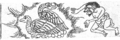 Lintang Benjak Kangrem (CC-BY Alfred Maaß, (1929), Astrologische Kalender der Balinesen)
 -
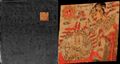 Lintang Banyak Anggrem in the cloth (CC-BY UPTD Museum Bali Inventary no. 09.746)
 -
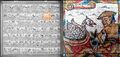 Lintang Banyak Anggrem in the cloth (CC-BY UPTD Museum Bali Inventary no. 09.752)
 -
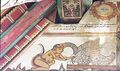 Lintang Banyak Angrem (CC-BY Youla Azkarrula taken in the ceiling of Taman Gili Klungkung Palace Bali)


Cultural Beliefs
Numerology (Neptu/Urip)
Sukra (Friday, in saptawara) has a value of 6 and Umanis (in pancawara) has a value of 5. Thus, the total urip on this lintang is 11.[8]
Astrological Characteristics
Often lost, everything sought is difficult to find results, but they are classified as patient people, they are observant and loving people. They are honest and always straightforward. Unfortunately, they find it difficult to forgive people they consider wrong, so they find it difficult to have friends for a long time.[8]
Matching Gemstones
Mirah (ruby), Biduri bulan (moonstone), kecubung (amethyst).[8]
Weblinks
References
- References (general)
- ↑ 1.0 1.1 1.2 1.3 Maass, Alfred, “Astrologische Kalender der Balinesen,” in Koninklijk Bataviaasch Genootschap van Kunsten en Wetenschappen, Feestbundel bij gelegenheid van zijn 150 jarig bestaan 1778-1928, 2 vols. (Weltevreden, 1929), Vol. 2, 126-157.
- ↑ Friedrich, R. (1849). Voorloopig verslag van het eiland Bali, Batavia, Verb. Bat Gen. Deel 23, Nr. 13
- ↑ HINLOOPEN LABBERT0N, D. VAN (1910). Geillustreerd handboek van Insulinde. Amsterdam: "Vivat"
- ↑ PIGEAUD, TH. (1925). Een stuk over sterrenkunde uit het Anggastyaparwwa ...... Weltevreden: Albrecht. Tijdsch. v. lnd, T.-, L.- en Vk. deel LXV
- ↑ Nieuwenkamp, W. O. J. (1905), Schetsen van Bali en Lombok. (Eigen Haard)
- ↑ MAASS, ALFRED (1920). Sterne und Sternbilder im malaiischen Archipel. Berlin. Zeitschrift für Ethnologie Jg. 1920/21, H. 1
- ↑ MAASS, ALFRED (1924). Sternkunde und Sterndeuterei im malaiischen Archipel. Batavia, den Haag. Tijdsch. v. T.-, L.-en Vk. deel LX IV
- ↑ 8.0 8.1 8.2 Palelintangan Museum Study Team (Tim Kajian Palelintangan Museum), “Gabungan Kajian Palelintangan,” Museum Bali (2021), 1-149.





