Cetus
Authors: Susanne M Hoffmann, Youla Azkarrula, Doris Vickers, Ian Ridpath

| Asterism Info | |
| Native | Κῆτος |
|---|---|
| Romanisation | Ketos |
| Translation | A Sea Monster |
| Position (2000) | |
| Right ascension | 4.856976645 to 45.56988780000003 |
| Declination | -21.07783167 to 8.907385888 |
| Area | 777.11 sq. deg. |
| Stars | |
| Bright stars | 123 |
| Bayer/Flamsteed stars | 112 |
| Stars brighter than 3.00m | 2 |
| Brightest star | Diphda (2.01m) |
| Taxonomy | |
| category of asterism | Almagest constellation |
| IAU- constellations | Cet, Psc |
One of the 88 IAU constellations. It is related to the group of constellations around the constellation Andromeda and highly likely originates from the Mediterranean coast, definitely not from Mesopotamia (as this region was covered by the constellation SIM.MAH). There is a comprehensive paper on this constellation.[1] The Greek constellation probably originates from the east coast of the Mediterranean as the mythology of this seamonster either includes it in the tale of princess Andromeda threatened by a seamoster and rescued by the hero Perseus, or princess Hesione exposed to another seamonster and rescued by Hercules. The Andromeda saga is related to a rock in the ancient habour of Old Jaffa (Tel Aviv) while Hesione is a princess of Troy (Anatolia). In both cases, the seamonster is home to the Mediterranean.
Etymology and History
The Greek name κῆτος (ketos) does not in any case refer to a real animal, but only to a mythological creature. Its Latinized version "cetus", however, may also designate a whale. "Though archaeological findings of whale remains are uncommon in Greece, there exist few examples of ancient whalebones in the Aegean Sea, probably originating from stranded whales. ... Combined with archaeological artifacts as the bones of prehistorical giant sea creatures in the Wādī al-Ḥītān (Valley of Whales) in today's Egypt, this might have triggered traveller's imagination and have led to further stories (and cock-and-bull story)."[1]
Name variants
- Ketos (Κῆτος)
- Cetus (Latin)
- Belua (Latin: monster)
- Pistrix/ Pistris (Latin: fish)
- Balena (Latin: whale)
- ... and translations of these terms to European languages (see Hoffmann, Vickers and Geymeier 2022)[1]; in Germanic languages (Dutch, German) also the oxymoron "whale-fish" (wallevis, Walfisch)
Origin of Constellation
[2]As this constellation does not have a Babylonian equivalent, we suspect that it was taken from another culture in order to diversify the sky culture in Alexander's new empire.
Ketos (Cetus) is one of the classical Greek constellations: it belongs to the Andromeda group, which dates back to a tragedy by Sophocles (5th century BCE). In English texts from earlier centuries, the word was often mistakenly translated as ‘whale’. Apart from the fact that whales are not fish, Ketos is neither a whale nor a fish: it is the name of a sea monster, a terrifying mythical creature – it is best to leave the word untranslated, as with the names Cassiopeia, Andromeda and Cepheus.
The depiction on the Farnese Globe shows a dragon-like animal with a monstrous head with a kind of hump and a protruding tongue. It has a snake-like, coiled tail with a fish-like tail fin at the end. The creature has front legs with fins and claws. So it is definitely not a real animal.
Greek uranography ends below Ketos, i.e. there are no more constellations south of it because there are no more bright stars visible in the Mediterranean region. East of this area of the sky, too, there are only faint stars in a wide arc – there is a void of stars all the way to the Milky Way in Orion. From a few faint stars between Ketos and Orion, which do not form a distinctive pattern, a unimaginative chain of stars was formed, which was called ‘river’ (Eridanus). On the Farnese Globe, Ketos holds its front legs in this river. The tail fin touches the spout of Aquarius, and above the dorsal fin is the band of the little fish.
Most likely, the poet Aratos meant this combination of water currents around Ketos when he wrote about the stars under Ketos' tail fin and up to the spout of Aquarius, ‘all of which are called water’. On the Farnese Globe, it looks as if the sculptor understood the winding water lines as the shores of a large star ocean in which Ketos romps. In Ptolemy, it is the monster's chest rather than its front legs that shares a star with the river: the concept that Ketos represents this connection between these waters seems to have become canonical in antiquity.
The constellation has no Babylonian roots: according to MUL.APIN, the constellation of the giant swallow (SIM.MAḪ), or rather its head and wings, was located in its place (see the constellation Pisces).
It is interesting to note that Aratos, Eratosthenes and Ptolemy mention only two bright stars: α and β Ceti, which are visually 2.0 and 2.5 mag bright, respectively. The variable star Mira does not appear in any of the ancient star lists, although this star also sometimes reaches 2 mag. However, the star fluctuates in brightness between visible and invisible, so it is sometimes there and sometimes gone within its cycle of 332 days (approx. 11 months). It is disputed whether Hipparchus observed the star, as Hipparchus' original data has not been preserved. If the star was seen and recorded by an observer, this observation was no longer verifiable a few weeks later, so it was not noted in catalogues.
Babylonian
"In the case of the constellation Ketos, it is certain that this constellation has no Babylonian roots"[1]
- see SIM.MAH
Topos of the Sea-Monster
Hoffmann, Vickers and Geymeier (2022)[1] elaborate on three stories: Andromeda rescued by Perseus in Jaffa, Hesione rescued by Herakles/ Hercules in Troy, and Jona and the Whale in the Mediterranean as told in the Talmut/ Bible/ Quran.
Andromeda at Jaffa
The constellation of Cetus forms part of the Andromeda group. The version of the story that is most popular today reports that princess Andromeda was exposed to a sea-monster in order to rescue her country from a catastrophe caused by the monster (Ridpath 1988, Fasching & Wertner 2000). The monster is called Ketos. After Ketos was defeated by hero Perseus, the whole group of actors (Andromeda, her parents, her groom and the threatening monster) are elevated to the sky by the goddess Athena as reported by Pseudo-Eratosthenes (Pamiàs & Geus 2007, 134/5 on Ketos, 112,118 on the initiative of Athena).
Andromeda traditionally is the daughter of King Kepheus and Queen Kassiepeia, who reign over a land named Αἰθιοπία (Aithiopia). The story plays in the mythological era before the Trojan War and does not provide any historical information; it is unknown whether the acting persons have ever lived. The name of the people Αἰθίοψ (Aithiops) in Ancient Greek only means that the country's inhabitants have ``burned'' faces: This land could lay anywhere from India to North Africa. Today, it is commonly assumed (and touristically sold) that ``Andromeda's Rock'' is at the coast of Jaffa, the oldest part of the city of Tel Aviv, Israel. This narrative goes back to antiquity for it is mentioned by the Romano-Jewish historian Flavius Josephus who reports that the fossilized bones of the sea monster were exposed in the city of Jaffa and that in his time Andromeda's chains were still hanging at the rock (Fasching 1998). [...]
The story and concept of the sea-monster rather resembles Greek and Phoenician ideas of good spirits and various daemons of the sea with whom they interacted as sailors.
Hesione of Troy
The concept of a maiden that is rescued from a sea-monster by a hero is also included in the myth of Herakles: In this story the king of Troy refuses to pay the gods Apollo and Poseidon for building the city walls. They therefore send several plagues, including a sea-monster and he is told to sacrifice his daughter to rescue the country. When princess Hesione is exposed to the monster, Herakles happens to come along. He kills the monster and rescues both the country and the Trojan princess. Her father again refuses to pay him out. This brings Herakles to a siege of the city and finally to kill the king and most of his sons (all but Priam, the next king). His daughter is married (or given as slave) to one of Herakles' companions.
As this story plays at the mythological city of Troy but before the Trojan War (Paris was a son of Priam), it is certainly one of the originals from which the Greco-Roman version of the starlore of Andromeda was created, when the Near Eastern gods and goddesses were equalled as constellations in the sky. Interestingly, in some accounts Herakles is swallowed by the monster and hacked at its innards for three days before it died. These three days of a hero in the belly of the monster also appear in the Hebrew story of Jonah.
Jona
The story of Jonah is part of the Hebrew Bible, whose texts partially go back to the time between the -10th and the -7th century, was written down in the middle of the -1st millennium and form the basis for the Jewish Talmut, the Christian Old Testament and the Islamic Quran. The prophet Jonah receives God's command to preach in the city of Nineveh but he flees in the opposite direction: Instead of leaving Israel towards the east, he enters a ship at the Mediterranean taking him westward. While he is at sea, God sends a big storm that is strong enough to kill the whole crew of the ship until Jonah offers to sacrifice himself. When the sea-people throw him into the water, he is swallowed by a huge fish for three days and three nights, constantly praying before God commands the fish to spit him out on land and repeats his command to Jonah to go to Nineveh. This time, he obeys and prophesies to the Ninevites that ``In forty days Nineveh shall be overthrown''. This terrible fate is then averted by the complete change of behaviour of the inhabitants of the city and Jonah leaves the city.
The important element here is the huge fish that swallows and later vomits the man.
Concordance
Greco-Roman
Aratus
Although she lies no small distance away, Andromeda is threatened by the approach of the great Sea-monster. [355] For in her course she lies exposed to the blast of the north wind from Thrace, while the southerly brings against her the hostile Monster, below the Ram and the two Fishes, and positioned a little above the starry River. For under the gods’ feet that too moves as a separate group, [360] a remnant of Eridanus, river of much weeping. It extends below the left foot of Orion. The tail-chains, by which the extremities of the Fishes are held, both come together as they descend from the tail-parts, and behind the Monster’s back-fin move jointly [365] as they converge, and terminate in a single star that lies close to the top of the Monster’s spine. (Kidd 1997)
Eratosthenes
Pamias and Zucker (2013,[3] 108-109)
Var. 1: This is the sea monster that Poseidon sent to Cepheus because Cassiopeia had challenged the Nereids to a contest of beauty. Perseus slew it, and that is why he was placed amongst the constellations to perpetuate the memory of the hero’s feat. Sophocles, the tragedian, relates these events in his *Andromeda*. The Sea Monster has two faint stars on its tail, five from the tail to the bulge on its flank, and six beneath its belly. Thirteen in all.
Var. 2: This is the monster that Poseidon sent to Cepheus because Cassiopeia had challenged the Nereids to a beauty contest. Perseus slew it, and that is why it was placed amongst the constellations to perpetuate the memory of the hero’s feat. Sophocles, the tragedian, recounts these events in his Andromeda. The sea monster has two dim stars on its tail, five from the tail to the bulge on its flank, and six beneath its belly. Thirteen in all.
Eratosthenes's star catalogue can be reconstructed from the list of stars he mentions in the last section of each of the constelllation descriptions. Hoffmann (2017)[4] made such a catalogue and used it for computational comparison with Hipparchus's, Ptolemy's and Babylonian data; it is based on the edition and translation by Pamias and Geus (2007)[5] and presented here in English translation.
| erat.Cat.ID | constStarID | starName | ident.Bayer | ident.HIP | certainty |
|---|---|---|---|---|---|
| 580 | 1 | two dim stars on the tail fin | 30 Psc | 154 | 2 |
| 581 | 2 | two dim stars on the tail fin | 27 Psc | 118209 | 2 |
| 582 | 3 | five on the curve of the back from the tail to the flank | iota Cet | 1562 | 1 |
| 583 | 4 | five on the curve of the back from the tail to the flank | eta Cet | 5364 | 1 |
| 584 | 5 | five on the curve of the back from the tail to the flank | theta Cet | 6537 | 1 |
| 585 | 6 | five on the curve of the back from the tail to the flank | xi2 Cet | 11484 | 1 |
| 586 | 7 | five on the curve of the back from the tail to the flank | alpha Psc | 9487 | 1 |
| 587 | 8 | six below the belly | beta Cet | 3419 | 1 |
| 588 | 9 | six below the belly | tau Cet | 8102 | 1 |
| 589 | 10 | six below the belly | zeta Cet | 8645 | 1 |
| 590 | 11 | six below the belly | delta Cet | 12387 | 1 |
| 591 | 12 | six below the belly | gam Cet | 12706 | 1 |
| 592 | 13 | six below the belly | alpha Cet | 14135 | 1 |
Hipparchus
Rising (Lib III Cap I §8)
The Rising of ...
| east | south | |||
|---|---|---|---|---|
| lam1 | lam2 | lam1 | lam2 | |
| Psc 20 | Tau 7 | Sgr 23 1/2 | Cap 21 1/2 | |
| star | the northern one of those in the tail (iota) | Among the bright ones in the quadrilateral, the southern one of the rear (tau) | ||
| duration | 2 hours = 120 min = 30 degree | |||
Setting (Lib III Cap II §8)
| west | south | |||
|---|---|---|---|---|
| lam1 | lam2 | lam1 | lam2 | |
| Aqr 26 1/2 | Ari 14 | Tau 22 | Cnc 14 1/2 | |
| star | the southern one of those in the tail (bet) | the rear one of those in the northern curvature of the head | ||
| duration | 3 7/8 hours = 232 1/2 min = 58 1/8° | |||
Hipparchus's "lost" star Catalogue
The star catalogue of Hipparchus is not preserved. Yet, several scholars have reconstructed it in the past century: Vogt (1925)[6], Grasshoff (1990)[7], Hoffmann (2017)[8] and Glover (2026)[9]. Grasshoff's catalogue and computations are not published digitally, Hoffmann published three versions of the Manitius+Hoffmann[10] star lists in the CDS VizieR "catalog of catalogs", and Glover printed the star lists constellationwise in his book.
| hipp.Cat.ID | constStarID | starName | ident.Bayer | ident.HIP | concordance |
|---|---|---|---|---|---|
| 192 | 1 | α Cet | 14135 | CPAE | |
| 193 | 2 | β Cet | 3419 | CPAE | |
| 194 | 3 | γ Cet | 12706 | CPAE | |
| 195 | 4 | δ Cet | 12387 | CPAE | |
| 196 | 5 | ε Cet (Eri) | 12390 | CPAE | |
| 197 | 6 | ζ Cet | 8645 | CPAE | |
| 198 | 7 | η Cet | 5364 | CPAE | |
| 199 | 8 | θ Cet | 6537 | CPAE | |
| 200 | 9 | ι Cet | 1562 | CPAE | |
| 201 | 10 | λ Cet | 13954 | CPAE | |
| 202 | 11 | μ Cet (Ari) | 12828 | CPAE | |
| 203 | 12 | ξ Cet (ξ1)* | 10324 | CPAE | |
| 204 | 13 | ξ Cet (ξ2)* | 11484 | CPAE | |
| 205 | 14 | ο Cet | 10826 | CPAE | |
| 206 | 15 | π Cet (Eri) | 12770 | CPAE | |
| 207 | 16 | ρ Cet (Eri) | 11345 | CPAE | |
| 208 | 17 | σ Cet (Eri) | 11783 | CPAE | |
| 209 | 18 | τ Cet | 8102 | CPAE | |
| 210 | 19 | φ1 Cet | 3455 | CPAE | |
| 211 | 20 | φ2 Cet | 3909 | CPAE | |
| 212 | 21 | φ3 Cet | 4371 | CPAE | |
| 213 | 22 | φ4 Cet | 4587 | CPAE | |
| 214 | 23 | 54 Cet | 8588 | non-CPAE |
Hyginus, Astronomica
Whale. With regard to the Sea-Monster, they say that it was sent by Neptune to kill Andromeda, about whom we have already spoken. But because it was killed by Perseus, on account of its huge size and his valour it was placed amongst the constellations. (Mary Ward 1960)
Geminos
Almagest Κῆτος
| id | Greek
(Heiberg 1898) |
English
(Toomer 1984) |
ident. |
|---|---|---|---|
| Κήτους ἀστερισμόρ | |||
| 1 | ὁ ἐπ’ ἄκρου τοῦ μυκτῆρος | The star on the tip of the nostrils | lam Cet |
| 2 | τῶν ἐν τῷ ῥύγχει ἢ ὁ ἑπόμενος ἐπ’ ἄκρας τῆς σιαγόνος | The three stars in the snout: the rearmost, on the end of the jaw | alf Cet |
| 3 | ὁ μέσος αὐτῶν καὶ ἐν μέσῳ τῷ στόματι | The three stars in the snout: the middle one, in the middle of the mouth | gam Cet |
| 4 | ὁ προηγούμενος τῶν ν’ καὶ ἐπὶ τῆς γένυος | The three stars in the snout: the most advanced of the 3, on the cheek | del Cet |
| 5 | ὁ ἐπὶ τῆς ὀφρόος καὶ τοῦ ὀφθαλμοῦ | The star on the eyebrow and the eye | nu Cet |
| 6 | ὁ τούτου βορειότερος ὡς ἐπὶ τῆς τριχός | The one to the north of this, about on the hair | xi2 Cet |
| 7 | ὁ τούτων προηγούμευος ὡς ἐπὶ τῆς χαίτης | The one in advance of this, about on the mane | xi1 Cet |
| 8 | τοῦ ἐῃ τῷ στήθει τετραπλεύρου τῆς ἠγουμένης πλευρᾶς ὁ βόρειος | The quadrilateral in the chest: the northernmost star on the advance side | rho Cet |
| 9 | ὁ νότιος τῆς ἠγουμένης πλευρᾶς | The quadrilateral in the chest: the southernmost one on the advance side | sig Cet |
| 10 | τῆς ἐπομένης πλευρᾶς ὁ βόρειος | The quadrilateral in the chest: the northernmost one on the rear side | eps Cet |
| 11 | ὁ νότιος τῆς ἐπομένης πλευρᾶς | The quadrilateral in the chest: the southernmost one on the rear side | pi Cet |
| 12 | τῶν ἐν τῷ σώματι ἢ’ ὁ μέσος | The midmost of the 3 stars in the body | tau Cet |
| 13 | ὁ νότιος αὐτῶν | The southernmost of them | ups Cet |
| 14 | ὁ βόρειος τῶν τριῶν | The northernmost of the three | zet Cet |
| 15 | τῶν πρὸς τῷ παρούρῳ β ὁ ἐπόμενος | The rearmost of the 2 stars by the section next to the tail | tet Cet |
| 16 | ὁ προηγούμευος αὐτῶν | The more advanced of them | eta Cet |
| 17 | τοῦ ἐν τῷ παρούρῳ τετραπλεύρου τῆς ἐπομένης πλευρᾶς ὁ βόρειος | The quadrilateral in the section next to the tail: the northernmost star on the rear side | phi2 Cet |
| 18 | ὁ νότιος τῆς ἐπομένης πλευρᾶς. | The quadrilateral in the section next to the tail: the southernmost one on the rear side | HR 227 |
| 19 | τῆς προηγουμένης πλευρᾶς ὁ βόρειος | The quadrilateral in the section next to the tail: the northernmost one on the advance side | phi Cet |
| 20 | ὁ νότιος τῆς προηγουμένης πλευρᾶς | The quadrilateral in the section next to the tail: the southernmost one on the advance side | HR 190 |
| 21 | τῶν ἐν ἄκροις τοῦς οὐραίοις ᾑ ὁ ἐπὶ τοῦ βορείου. | The 2 stars at the ends of the tail-fins: the one on the northern [tail-fin] | iot Cet |
| 22 | ὁ ἐπ’ ἄκρου τοῦ φοτίου οὐραέου | The 2 stars at the ends of the tail-fins: the one on the end of the southern tail-fin | bet Cet |
| ἀστέρες πβ, ὥν γ’ μεγέδους ἰ, δ’ ἢ, εἱ δ. | {22 stars, 10 of the third magnitude, 8 of the fourth, 4 of the fifth} |

Stars within the Constellation Area
| id | Label | IAU design. | description | Vmag |
|---|---|---|---|---|
| 1 | Diphda | HIP 3419 | Constellation lines (Vertex) | 2.01 |
| 2 | Menkar | HIP 14135 | Constellation lines (Vertex) | 2.53 |
| 3 | η Ceti | HIP 5364 | Constellation lines | 3.45 |
| 4 | Kaffaljidhma | HIP 12706 | Constellation lines | 3.47 |
| 5 | τ Ceti | HIP 8102 | Inside the hull | 3.5 |
| 6 | ι Ceti | HIP 1562 | Constellation lines (Vertex) | 3.55 |
| 7 | θ Ceti | HIP 6537 | Constellation lines | 3.59 |
| 8 | Baten Kaitos | HIP 8645 | Constellation lines | 3.72 |
| 9 | υ Ceti | HIP 9347 | Constellation lines (Vertex) | 4.02 |
| 10 | δ Ceti | HIP 12387 | Constellation lines | 4.07 |
| 11 | Alrescha A | HIP 9487 | Inside the hull | 4.11 |
| 12 | π Ceti | HIP 12770 | Constellation lines (Vertex) | 4.236 |
| 13 | ξ2 Ceti | HIP 11484 | Constellation lines | 4.3 |
| 14 | ξ1 Ceti | HIP 10324 | Constellation lines (Vertex) | 4.35 |
| 15 | ξ Piscium | HIP 8833 | Inside the hull | 4.604 |
| 16 | χ Ceti | HIP 8497 | Inside the hull | 4.68 |
| 17 | λ Ceti | HIP 13954 | Constellation lines (Vertex) | 4.7 |
| 18 | σ Ceti | HIP 11783 | Constellation lines | 4.75 |
| 19 | ϕ1 Ceti | HIP 3455 | Constellation lines | 4.767 |
| 20 | ρ Ceti | HIP 11345 | Constellation lines | 4.866 |
| 21 | ϵ Ceti | HIP 12390 | Constellation lines | 4.87 |
| 22 | ν Ceti | HIP 12093 | Constellation lines | 4.871 |
| 23 | 46 Cet | HIP 6670 | Inside the hull | 4.907 |
| 24 | 175 G. Cet | HIP 7999 | Inside the hull | 4.982 |
| 25 | 37 Cet | HIP 5799 | Inside the hull | 5.13 |
| 26 | ϕ2 Ceti | HIP 3909 | Constellation lines | 5.19 |
| 27 | 259 G. Cet | HIP 11738 | Inside the hull | 5.269 |
| 28 | 69 Cet | HIP 11021 | Inside the hull | 5.287 |
| 29 | ϕ3 Ceti | HIP 4371 | Inside the hull | 5.326 |
| 30 | 179 G. Cet | HIP 8230 | Inside the hull | 5.34 |
| 31 | 75 Cet | HIP 11791 | Inside the hull | 5.358 |
| 32 | 50 Cet | HIP 7450 | Inside the hull | 5.402 |
| 33 | 25 Cet | HIP 4914 | Inside the hull | 5.408 |
| 34 | 238 G. Cet | HIP 11029 | Inside the hull | 5.421 |
| 35 | 70 Cet | HIP 11046 | Inside the hull | 5.421 |
| 36 | 60 Cet | HIP 9589 | Inside the hull | 5.423 |
| 37 | 39 Cet | HIP 5951 | Inside the hull | 5.428 |
| 38 | 57 Cet | HIP 9326 | Inside the hull | 5.429 |
| 39 | 67 Cet | HIP 10642 | Inside the hull | 5.499 |
| 40 | 47 Cet | HIP 6748 | Inside the hull | 5.505 |
| 41 | AR Cet | HIP 9372 | Inside the hull | 5.51 |
| 42 | 80 Cet | HIP 12107 | Inside the hull | 5.535 |
| 43 | 28 Cet | HIP 5164 | Inside the hull | 5.565 |
| 44 | 232 G. Cet | HIP 10723 | Inside the hull | 5.59 |
| 45 | 81 G. Cet | HIP 3849 | Inside the hull | 5.594 |
| 46 | 49 Cet | HIP 7345 | Inside the hull | 5.607 |
| 47 | 203 G. Cet | HIP 9622 | Inside the hull | 5.609 |
| 48 | ϕ4 Ceti | HIP 4587 | Inside the hull | 5.614 |
| 49 | 64 Cet | HIP 10212 | Inside the hull | 5.623 |
| 50 | 81 Cet | HIP 12247 | Inside the hull | 5.647 |
| 51 | 66 Cet | HIP 10305 | Inside the hull | 5.66 |
| 52 | 38 Cet | HIP 5833 | Inside the hull | 5.69 |
| 53 | 78 G. Cet | HIP 3717 | Inside the hull | 5.693 |
| 54 | 30 Cet | HIP 5296 | Inside the hull | 5.705 |
| 55 | 84 Cet | HIP 12530 | Inside the hull | 5.71 |
| 56 | 77 Cet | HIP 12002 | Inside the hull | 5.731 |
| 57 | 165 G. Cet | HIP 7276 | Inside the hull | 5.76 |
| 58 | - | HIP 7916 | Inside the hull | 5.77 |
| 59 | BK Cet | HIP 8778 | Inside the hull | 5.782 |
| 60 | 286 G. Cet | HIP 12444 | Inside the hull | 5.79 |
| 61 | - | HIP 12114 | Inside the hull | 5.79 |
| 62 | 272 G. Cet | HIP 12148 | Inside the hull | 5.811 |
| 63 | AB Cet | HIP 11348 | Inside the hull | 5.83 |
| 64 | 93 G. Cet | HIP 4346 | Inside the hull | 5.85 |
| 65 | 202 G. Cet | HIP 9572 | Inside the hull | 5.864 |
| 66 | 42 Cet | HIP 6226 | Inside the hull | 5.87 |
| 67 | - | HIP 9353 | Inside the hull | 5.87 |
| 68 | 131 G. Psc | HIP 8404 | Inside the hull | 5.904 |
| 69 | 34 Cet | HIP 5594 | Inside the hull | 5.918 |
| 70 | 137 G. Cet | HIP 6564 | Inside the hull | 5.92 |
| 71 | 63 Cet | HIP 10234 | Inside the hull | 5.933 |
| 72 | 61 Cet | HIP 9631 | Inside the hull | 5.942 |
| 73 | 305 G. Cet | HIP 13679 | Inside the hull | 5.963 |
| 74 | 256 G. Cet | HIP 11687 | Inside the hull | 5.99 |
| 75 | 219 G. Cet | HIP 10215 | Inside the hull | 5.999 |
| 76 | 71 G. Cet | HIP 3436 | Inside the hull | 6.02 |
| 77 | 297 G. Cet | HIP 12862 | Inside the hull | 6.031 |
| 78 | 289 G. Cet | HIP 12584 | Inside the hull | 6.049 |
| 79 | 213 G. Cet | HIP 9999 | Inside the hull | 6.056 |
| 80 | 27 Cet | HIP 5121 | Inside the hull | 6.088 |
| 81 | - | HR 492 | Inside the hull | 6.14 |
| 82 | 128 G. Cet | HIP 6272 | Inside the hull | 6.147 |
| 83 | 18 Cet | HIP 3559 | Inside the hull | 6.15 |
| 84 | 21 Cet | HIP 4257 | Inside the hull | 6.161 |
| 85 | 264 G. Cet | HIP 12022 | Inside the hull | 6.163 |
| 86 | 138 G. Cet | HIP 6605 | Inside the hull | 6.164 |
| 87 | 139 G. Cet | HIP 6589 | Inside the hull | 6.183 |
| 88 | 176 G. Cet | HIP 8094 | Inside the hull | 6.19 |
| 89 | 44 Cet | HIP 6539 | Inside the hull | 6.21 |
| 90 | 149 G. Cet | HIP 6822 | Inside the hull | 6.21 |
| 91 | EH Cet | HIP 13756 | Inside the hull | 6.21 |
| 92 | 279 G. Cet | HIP 12318 | Inside the hull | 6.237 |
| 93 | 170 G. Cet | HIP 7580 | Inside the hull | 6.24 |
| 94 | - | HIP 12318 | Inside the hull | 6.24 |
| 95 | 127 G. Cet | HIP 6283 | Inside the hull | 6.246 |
| 96 | 285 G. Cet | HIP 12447 | Inside the hull | 6.26 |
| 97 | 207 G. Cet | HIP 9827 | Inside the hull | 6.295 |
| 98 | 71 Cet | HIP 11261 | Inside the hull | 6.335 |
| 99 | 209 G. Cet | HIP 9862 | Inside the hull | 6.39 |
| 100 | 276 G. Cet | HIP 12272 | Inside the hull | 6.39 |
| 101 | 32 Cet | HIP 5485 | Inside the hull | 6.394 |
| 102 | 186 G. Cet | HIP 8664 | Inside the hull | 6.41 |
| 103 | - | HIP 9094 | Inside the hull | 6.42 |
| 104 | 227 G. Cet | HIP 10396 | Inside the hull | 6.42 |
| 105 | 144 G. Cet | HIP 6717 | Inside the hull | 6.426 |
| 106 | 166 G. Cet | HIP 7362 | Inside the hull | 6.43 |
| 107 | 205 G. Cet | HIP 9655 | Inside the hull | 6.43 |
| 108 | 171 G. Cet | HIP 7597 | Inside the hull | 6.44 |
| 109 | 57 G. Cet | HIP 2846 | Inside the hull | 6.444 |
| 110 | 187 G. Cet | HIP 8688 | Inside the hull | 6.45 |
| 111 | 193 G. Cet | HIP 9237 | Inside the hull | 6.46 |
| 112 | 101 G. Cet | HIP 4801 | Inside the hull | 6.47 |
| 113 | Mira | HIP 10826 | Inside the hull | 6.47 |
| 114 | 293 G. Cet | HIP 12720 | Inside the hull | 6.48 |
| 115 | 133 G. Cet | HIP 6427 | Inside the hull | 6.487 |
| 116 | 63 G. Cet | HIP 3175 | Inside the hull | 6.49 |
| 117 | - | HIP 10233 | Inside the hull | 6.49 |
| 118 | 221 G. Cet | HIP 10273 | Inside the hull | 6.49 |
| 119 | - | HIP 10854 | Inside the hull | 6.491 |
| 120 | - | HR 206 | Inside the hull | 6.498 |
| 121 | 76 G. Cet | HIP 3576 | Inside the hull | 6.499 |
| 122 | - | HIP 6687 | Inside the hull | 6.5 |
| 123 | - | HIP 13482 | Inside the hull | 6.74 |
Transfer and Transformation of the Constellation
-
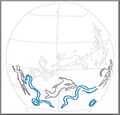 An apparent vessel for Cetus on the Kugel-Globe (drawing SMH 2024), 2nd or 1st century BCE
 -
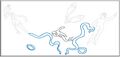 Map of the Kugel Globe, Cetus in the center of two lines with rings, drawing by SMH 2024, 2nd or 1st century BCE
 -
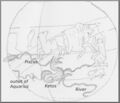 Some lines forming a stream of water in which Cetus is centered on the Farnese Globe (drawing by SMH 2021), 2nd or 1st century CE with Hellenistic predecessor
 -
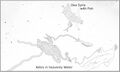 Figures of the Farnese Globe mapped to the Stellarium star chart (drawing and implementing by SMH 2021). Cetus-region.
 -
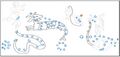 Map of the Mainz Globe with Cetus in the center, surrounded by many dots (star symbols), perhaps representing The Water (drawing by SMH 2023), 2nd century CE
 -
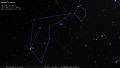 (1952) H.A. Rey's stick figure of Cetus
 -
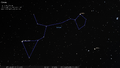 (1988) O. Hlad's stick figure of Cetus
 -
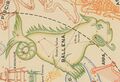 Cetus at Planisferio celeste (Carlos Simón 1894)
 -
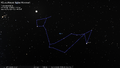 Reconstruction of Stickfigure based on the depiction of Almagest (100-170 CE). CC-BY Susanne Hoffmann in Stellarium.
 -
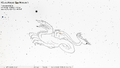 Image of the Farnese Globe (2nd century CE) taken by Susanne Hoffmann and imported into Stellarium.


Mythology
Greek
The monster was placed among the stars because it was a creature of Poseidon, god of the sea, and is intended to commemorate the glorious deed of Perseus. Since Andromeda was to be sacrificed to the monster, Perseus successfully fought the mythical creature and earned the gratitude of the beautiful princess, her parents and the country.
Weblinks
- Warburg Institute Iconographic Database – Cetus
- Ridpath, Ian, Star Tales – Cetus
References
- ↑ 1.0 1.1 1.2 1.3 1.4 Hoffmann, S.M., Vickers, D. and Geymeier, M. (2022). Constellation Cetus: Whale or Monster?, in Hoffmann and Wolfschmidt (eds.). Astronomy in Culture – Cultures of Astronomy, tredition Hamburg/ OpenScienceTechnology Berlin, 287-340
- ↑ Hoffmann, Susanne M. Wie der Löwe an den Himmel kam. Franckh Kosmos Verlag, Stuttgart 2021
- ↑ Pamìas, Jordi und Zucker, Arnaud (2013). Ératosthènes de Cyrène: Catastérrismes, Belles Lettres, Paris
- ↑ Hoffmann, S. M., <i>Hipparchs Himmelsglobus</i>. Springer Wiesbaden/ New York, 2017. doi:10.1007/978-3-658-18683-8.
- ↑ Eratosthenes: Sternsagen, übersetzt von Pamìas, Jordi und Geus, Klaus, Verlag Utopica, Oberhaid 2007
- ↑ Vogt, H., “Versuch einer Wiederherstellung von Hipparchs Fixsternver zeichnis”, <i>Astronomische Nachrichten</i>, vol. 224, no. 2, Wiley, p. 17, 1925. doi:10.1002/asna.19252240202.
- ↑ Graßhoff, G., <i>The History of Ptolemy's Star Catalogue</i>, Springer, New York, 1990
- ↑ Hoffmann, S. M., <i>Hipparchs Himmelsglobus</i>. Springer Wiesbaden/ New York, 2017. doi:10.1007/978-3-658-18683-8.
- ↑ Glover, E. (2026). The Astronomy of Hipparchus, Cambridge University Press
- ↑ Hipparchus's Lost Star Catalogue (1/2 reconstructed) (Hoffmann, 2017) in VizieR





