Tianbang (天棓)
Authors: Lyu Haocheng, Youla Azkarrula, Susanne M Hoffmann, Ian Ridpath

| Asterism Info | |
| Native | 天棓 |
|---|---|
| Translation | Celestial Flail |
| Position (2000) | |
| Right ascension | 264.8661954 |
| Declination | 46.00633138 |
| Area | 0 sq. deg. |
| Stars | |
| Bright stars | 1 |
| Bayer/Flamsteed stars | 1 |
| Stars brighter than 3.00m | 0 |
| Brightest star | Tianbang (3.8m) |
| Taxonomy | |
| category of asterism | IAU-Star Name |
| IAU- constellations | Her |
Tiān Bàng (Celestial Flail, 天棓), a Chinese constellation consisting of 5 stars located northeast of Nüchuang (女床) (Woman's Bed, 女床), spanning across Draco and Hercules. Tiān Bàng is a big stick, similar to the Celestial Spear (Tiān Qiāng, 天枪), and also serves as a defensive weapon.
Tianbang is a modern star name, adopted on 20 June 2026 for the star ι Her in the constellation Hercules.
Concordance, Etymology, History
As a weapon, Tiān Bàng is an iron staff or a blunt striking weapon.The Records of the Grand Historian (史记, Shǐjì), Treatise on the Celestial Officials (天官书), written around 100 BCE, states:
The star to the left of the Purple Enclosure is called the Celestial Spear (天枪); the five stars to the right are called the Celestial Flail (天棓).
The Book of Jin (Treatise on Astronomy, 晋书·天文志) states:
It stores weapons, and is also used to ward off disasters.
The Kaiyuan Zhanjing (开元占经) says:
The flail (bàng) is a large staff used to strike bandits; both the spear (qiāng) and the flail are used to prepare for emergencies.
Therefore, together with Tiān Qiāng (Celestial Spear), Tiān Bàng is listed among the celestial army's weapons guarding the heavenly palace (Purple Forbidden Enclosure). Tiān Bàng oversees disputes, punishments, and those who secretly gather private troops, in order to prepare for emergencies.
Identification of stars
The 5 stars of Tiān Bàng have remained almost unchanged for over two thousand years, except that ν Dra, being a double star, was not deliberately distinguished in ancient times.
| Star Names or Orders(Qing) | Ho PENG YOKE[1] | Yi Shitong[2]
Based on catalogue in 18th century |
Pan Nai[3]
based on Xinyixiangfayao Star Map |
Pan Nai[4]
based on catalogues in Yuan dynasty |
SUN X. & J. Kistemaker[5]
Han Dynasty |
Boshun Yang[6]
before Tang dynasty |
Boshun Yang[6]
Song Jingyou(1034) |
|---|---|---|---|---|---|---|---|
| 1st | ξ Dra | ξ Dra | ξ Dra | ξ Dra | ξ Dra | ξ Dra | ξ Dra |
| 2nd | ν Dra | ν2 Dra | ν Dra | ν Dra | ν Dra | ν2 Dra | ν Dra |
| 3rd | β Dra | β Dra | β Dra | β Dra | β Dra | β Dra | β Dra |
| 4th | γ Dra | γ Dra | γ Dra | γ Dra | γ Dra | γ Dra | γ Dra |
| 5th (determinative) | ι Her | ι Her | ι Her | ι Her | ι Her | ι Her | ι Her |
Maps (Gallery)
- Guansuo
-
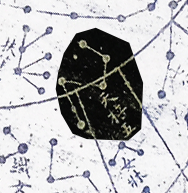 Tianbang on Cheonsang Yeolcha Bunyajido
 -
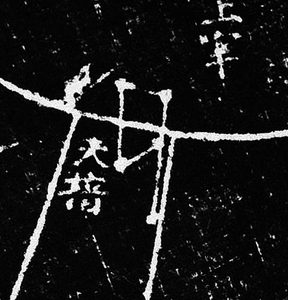 Tianbang on Suzhou Star Map
 -
 Tianbang on Yixiang Kaocheng star map (18th century)


IAU Working Group on Star Names
In 2026, the name of the historical constellation "Tianbang" was suggested to be used for one of the stars in this constellation. The star ι Her was recommended, for this star has been observed multiple times in history as the determinative star.
Decision: The IAU adopted the name Tianbang for ι Her on 20 June 2026.
References
- ↑ P.-Y. Ho, “Ancient And Mediaeval Observations of Comets and Novae in Chinese Sources,” Vistas in Astronomy, 5(1962), 127-225.
- ↑ Yi Shitong伊世同. Zhongxi Duizhao Hengxing Tubiao中西对照恒星图表1950. Beijing: Science Press.1981: 56.
- ↑ Pan Nai潘鼐. Zhongguo Hengxing Guance shi中国恒星观测史[M]. Shanghai: Xuelin Pree. 1989. p226.
- ↑ Pan Nai潘鼐. Zhongguo Hengxing Guance shi中国恒星观测史[M]. Shanghai: Xuelin Pree. 2009. p443.
- ↑ Sun Xiaochun. & Kistemaker J. The Chinese sky during the Han. Leiden: Brill. 1997, Pp241-6.
- ↑ 6.0 6.1 B.-S. Yang杨伯顺, Zhongguo Chuantong Hengxing Guance Jingdu ji Xingguan Yanbian Yanjiu 中国传统恒星观测精度及星官演变研究 (A Research on the Accuracy of Chinese Traditional Star Observation and the Evolution of Constellations), PhD thesis, (Hefei: University of Science and Technology of China, 2023). 261.





