Uttara Āṣāḍhā (उत्तर आषाढा)
Authors: Susanne M Hoffmann, Youla Azkarrula

| Asterism Info | |
| Native | उत्तर आषाढा |
|---|---|
| Romanisation | Uttara Ashadha |
| IPA | utt̪ɐɾɐ aːʂaːɖʱɑː |
| Translation | Uttara Āṣāḍhā |
| Position (2000) | |
| Right ascension | 281.4141231 to 286.735013 |
| Declination | -29.8800633 to -26.29672411 |
| Area | 8.91 sq. deg. |
| Stars | |
| Bright stars | 5 |
| Bayer/Flamsteed stars | 5 |
| Stars brighter than 3.00m | 2 |
| Brightest star | Nunki (2.067m) |
| Taxonomy | |
| category of asterism | constellation |
| IAU- constellations | Sgr |

Uttara Āṣāḍhā (उत्तर आषाढा), The Second Invincible, is an Indian name, used by the Indian Vedic tradition. Most of these names are roughly 3000 years old. They pre-date Hinduism but were taken over by it. Typically identified with ζ and σ Sagittarii.
Etymology and History
Name Variants
- Uttara Ashadha
- Vaiśvadeva
Origin of Constellation
Ashadha means The Invincible and refers to two asterisms in Sagittarius. The Latter (Uttara A.) is depcted as a group of two stars that are typically taken for ζ and σ Sagittarii but they actually form part of a recognizable quadrilateral which is not really logical. Yet, the identification is certain because of given coordinates for σ Sagittarii in the 2nd millennium; whether it was a different asterism BCE, is, of course, not certain.
Stars within the Constellation Area
| id | Label | IAU design. | description | Vmag |
|---|---|---|---|---|
| 1 | Nunki | HIP 92855 | Constellation lines (Vertex) | 2.067 |
| 2 | Ascella | HIP 93506 | Constellation lines (Vertex) | 2.59 |
| 3 | ϕ Sagittarii | HIP 92041 | Constellation lines (Vertex) | 3.14 |
| 4 | τ Sagittarii | HIP 93864 | Constellation lines (Vertex) | 3.31 |
| 5 | 109 G. Sgr | HIP 92635 | Inside the hull | 6.29 |
Transfer and Transformation of the Constellation
-
 Uttara Ashadha,
 -
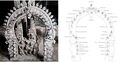 Display of all 28th nakshatras in silver arch with candles in Tirupperunthurai (Athmanathaswamy temple) near Aranthangi, India, 10th century CE. (SMH 2025).
 -
 Display of all 28th nakshatras in a door frame in Tirupperunthurai (Athmanathaswamy temple) near Aranthangi, India, 10th century CE. (SMH 2025).
 -
 Uttara Ashada, Tibetean
 -
 Uttara Ashadha
 -
 Uttara Ashadha, reconstructed by Jones (1720)


Mythology
mnemonic tales and cultural significance
Weblinks
References
- References (general)





