al-Mighzal, al-Miġzal (المِغْزَل)
Al-Miġzal
Authors: Khalid Al-Ajaji, Susanne M Hoffmann

al-Miġzal (Arabic: المِغْزَل), “the wool spindle” is an Arabic name for the stars forming a cross shape in Cygnus.
Provenance, Etymology, History
The name al-Miġzal is used regionally in central Saudi Arabia.

-
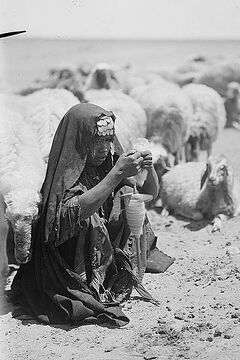 Bedouin shepherdess spinning. Source: Library of Congress, Prints and Photographs Division. Digital ID: matpc 03790 https://hdl.loc.gov/loc.pnp/matpc.03790 Original image on loc.gov

Etymology
al-Miġzal (Arabic: المِغْزَل)is derived from the Arabic root (غزل), referring to a wool spindle, and ultimately from the verb “أُغْزِلَ,” meaning “to be twisted and rotated”.
Sources and Identification
The name comes from local oral tradition, recorded by Khalid al-Ajaji in October 2016 during a star-gazing session in the dunes of Ṯuwayrāt in the al-Zulfī region, northwest of Riyadh, Saudi Arabia. The identification was made directly at the time, when the informant pointed to the cross-shaped stars of Cygnus, visible from shortly after sunset until after midnight.
The research is documented and published in Stellarium software,[1] available as a public dataset in the Stellarium GitHub Repository[2] and the description by Khalid AlAjaji is also published in paper form in the conference proceedings Hoffmann and Wolfschmidt (eds. 2022)[3]. In Stellarium it is written (by Khalid AlAjaji):
The Wool Spindle: The cross-shaped arrangement of α Cyg (Deneb), ε Cyg (Gienah), γ Cyg (Sadr), δ Cyg, and β1+β2 Cyg (Albireo). This comes from oral tradition in Zulfi, central Saudi Arabia [#1][4].
Stars Identification
The asterism of al-Miġzal is formed by the stars α, γ, β Cyg and ε, γ, δ Cyg.
The identification is considered secure, as the narrator of the name personally indicated these stars when describing al-Miġzal.
IAU Working Group Star Names
In 2026, the name al-Miġzal (or any spelling variant) was suggested as a star name in the area that is covered by the historical asterism. It is suggested to be used for ...
WGSN decided in ... 202x to name ... ...
This star is <a red giant or whatelse> ... here astrophysical data will be added (by Eric, most likely) after the decision.
Weblinks
- Stellarium https://stellarium.org/
Reference
- ↑ Zotti, G., Hoffmann, S. M., Wolf, A., Chéreau, F., & Chéreau, G. (2021). The Simulated Sky: Stellarium for Cultural Astronomy Research. Journal of Skyscape Archaeology, 6(2), 221–258. DOI: 10.1558/jsa.17822
- ↑ Stellarium Repo https://zenodo.org/records/20835040Stellarium's official Zenodo Digital Object Identifier (DOI) 10.5281/zenodo.20835040
- ↑ Khalid AlAjaji (2022). Stellarium Sky Culture "Arabian Peninsula", in Hoffmann, S. and Wolfschmidt, G. (eds.). Astronomy in Culture - Cultures of Astronomy, Featuring the Proceedings of a splinter meeting in the German Astronomical Society. tredition, Ahrensburg.
- ↑ Reference [#1] in this case is "Oral Tradition" documented by the author of this sky culture, Khalid AlAjaji.