Tongling: Difference between revisions
| (One intermediate revision by the same user not shown) | |||
| Line 67: | Line 67: | ||
==IAU Working Group on Star Names== | ==IAU Working Group on Star Names== | ||
The name has been proposed in November 2025 for the star at Vmag = 4.5, in | The name Tongling has been proposed in November 2025 for the star HIP 33694 at Vmag = 4.5. However, there is an asteroid name "Tongling" which is spelled differently in Chinese but not in transliteration (asteroid 12418铜陵星, as opposed to 桐陵 for the star). | ||
Thus, WGSN chose to adopt the name [[Tonglingxing]] for the star in Camelopardalis. The name was adopted on 22 February 2026. | |||
== References == | == References == | ||
Latest revision as of 07:05, 22 February 2026
Authors: Boshun YANG, Susanne M Hoffmann
Tóng Líng (Phoenix Tree Mound, 桐陵) is the sixth star on the right wall of the Zǐ Gōng (Purple Palace, 紫宮) or Zǐwēi Yuán (Purple Enclosure), counting northward from the southern gate. It lies within the modern constellation Camelopardalis.
Etymology and History of the Name
The name Tongling was current from the Han through the Tang dynasty but was later replaced by Shào Wèi (Junior Guard, 少衛) in the revised nomenclature of the Zigong. As a result, the original designation fell gradually into obscurity.
The term tong refers to the wutong tree (Firmiana simplex), which in Chinese mythology is the perch of the phoenix; líng denotes a “high mound” or “tumulus.” Thus, Tóng Líng may be interpreted as “Phoenix Tree Mound,” evoking a place of elevation and sanctity within the imperial celestial precinct.

Phoenix Tree (Botany)
"Phoenix" is the name of a genus of palm trees with 14 species.[1] It is native to the Eurasian and African subtropics from the Canary Islands to Southern China and Malaysia. This genus is mostly medium to robust in size, but also includes a few dwarf species.
A large number of fossil woods with anatomical features resembling the genus Phoenix have been excavated from Deccan Intertrappean formation in India of Maastrichtian–Danian age (65–67 my). Discovery of biocompounds from the fossil woods have affinity with the biocompounds known from modern Phoenix species.[2] A Phoenix seed from the latest Paleocene has been excavated from the Petit Pâtis quarry in Rivecourt, France.[3]
Phoenix (Term)
The generic name derives from φοῖνιξ (phoinix) or φοίνικος (phoinikos), the Greek word for the date palm used by Theophrastus and Pliny the Elder. It most likely referred to either the people of the Phoenicians, the (mythological) son of Amyntor and Cleobule in Homer's Iliad; or the phoenix, the sacred bird of Ancient Egypt.[4] In China, there are mythological birds called Fenghuang, occasionally labelled "Chinese phoenixes" which is misleading. There are actually no similarities with the Egyptian or Persian phoenixes, except for the fact that they are mythological birds.
Constellation & Star Name
The Cheonsang Yeolcha Bunyajido (Tianxiang Lieci Fenye zhi tu, Diagram of the Astrological Field Allocations) preserves the most ancient configuration of Chinese asterisms, allowing Tongling to be securely identified with HIP 33694.[5] The name is also explicitly labeled in another Tang-period star map, the Gezi Yuejin tu (Gridded Monthly Progress Diagram), confirming its position and continued recognition during that era.
See Zigong (紫宮) for more identification.
| Star Name | Ho PENG YOKE[6] | Yi Shitong[7]
Based on catalogue in 18th century |
Pan Nai[8]
based on Huangyou Star Catalogue |
Pan Nai[9]
based on catalogues in Yuan dynasty |
SUN X. & J. Kistemaker[10]
Han Dynasty |
Boshun Yang[11]
before Tang dynasty |
Boshun Yang[11]
Song Jingyou(1034) |
|---|---|---|---|---|---|---|---|
| Tongling (桐陵, 6th on the Right Wall ) | HIP 33694 | ||||||
| Shaowei (少衛, 6th on the Right Wall ) | α Cam | α Cam | BN Cam | γ Cam | BK Cam | HIP33694 |
Images
- Tongling
-
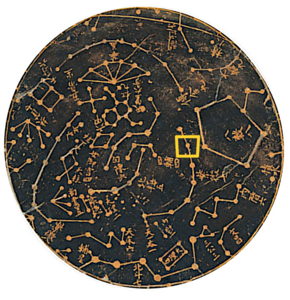 Tongling in Cheonsang Yeolcha Bunyajido
 -
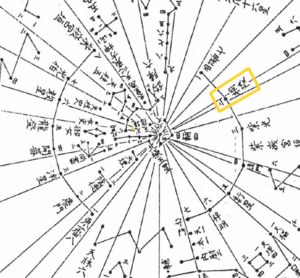 Tongling in Geziyuejintu


IAU Working Group on Star Names
The name Tongling has been proposed in November 2025 for the star HIP 33694 at Vmag = 4.5. However, there is an asteroid name "Tongling" which is spelled differently in Chinese but not in transliteration (asteroid 12418铜陵星, as opposed to 桐陵 for the star).
Thus, WGSN chose to adopt the name Tonglingxing for the star in Camelopardalis. The name was adopted on 22 February 2026.
References
- ↑ Phoenix (plant) in the en. Wikipedia
- ↑ Dinesh Chandra Sharma; Mohd Sajid Khan; M Salman Khan; Rashmi Srivastava; Ashwini Kumar Srivastava; Ritu Shukla (2014). "A report on biocompounds from palm fossil of India" (PDF). Bioinformation. 10 (5): 316–319. doi:10.6026/97320630010316. PMID 24966541
- ↑ Smith T, Quesnel F, De Plöeg G, De Franceschi D, Métais G, De Bast E, et al. (January 29, 2014). "First Clarkforkian Equivalent Land Mammal Age in the Latest Paleocene Basal Sparnacian Facies of Europe: Fauna, Flora, Paleoenvironment and (Bio)stratigraphy". PLOS ONE. 9 (1). e86229. Bibcode:2014PLoSO...986229S. doi:10.1371/journal.pone.0086229 The PLOS ONE Staff (March 25, 2014). "Correction: First Clarkforkian Equivalent Land Mammal Age in the Latest Paleocene Basal Sparnacian Facies of Europe: Fauna, Flora, Paleoenvironment and (Bio)stratigraphy". PLOS ONE. 9 (3). e93249. Bibcode:2014PLoSO...993249.. doi:10.1371/journal.pone.0093249
- ↑ Quattrocchi, Umberto (2000). CRC World Dictionary of Plant Names. Vol. III M-Q. CRC Press. p. 2046. ISBN 978-0-8493-2677-6.
- ↑ [1] Bo-Shun Yang and Susanne M. Hoffmann 2024 Res. Astron. Astrophys. 24 125004
- ↑ P.-Y. Ho, “Ancient And Mediaeval Observations of Comets and Novae in Chinese Sources,” Vistas in Astronomy, 5 (1962), 127-225.
- ↑ Yi Shitong [伊世同]. Zhongxi Duizhao Hengxing Tubiao [中西对照恒星图表1950]. Beijing: Science Press. 1981: p. 56.
- ↑ Pan Nai [潘鼐]. Zhongguo Hengxing Guance shi [中国恒星观测史]. Shanghai: Xuelin Pree. 1989. p. 226.
- ↑ Pan Nai [潘鼐]. Zhongguo Hengxing Guance shi [中国恒星观测史]. Shanghai: Xuelin Pree. 2009. p. 443.
- ↑ Sun Xiaochun & Kistemaker J. The Chinese sky during the Han. Leiden: Brill. 1997, pp. 241-6.
- ↑ 11.0 11.1 B.-S. Yang [杨伯顺], Zhongguo Chuantong Hengxing Guance Jingdu ji Xingguan Yanbian Yanjiu [中国传统恒星观测精度及星官演变研究] (A Research on the Accuracy of Chinese Traditional Star Observation and the Evolution of Constellations), PhD thesis, (Hefei: University of Science and Technology of China, 2023). p.238.





