Musca: Difference between revisions
No edit summary |
|||
| (2 intermediate revisions by the same user not shown) | |||
| Line 1: | Line 1: | ||
Authors: {{PAGEAUTHORS}} | |||
---- | |||
[[File:Musca IAU.svg|alt=star chart|thumb|Musca star chart (IAU and Sky & Telescope magazine, Roger Sinnott & Rick Fienberg)]] | [[File:Musca IAU.svg|alt=star chart|thumb|Musca star chart (IAU and Sky & Telescope magazine, Roger Sinnott & Rick Fienberg)]] | ||
One of the [[:Category:88_IAU-Constellations|88 IAU constellations]]. The constellation was invented by Dutch sailors in the 1590s, perhaps a navigation aid. | One of the [[:Category:88_IAU-Constellations|88 IAU constellations]]. The constellation Musca, The Fly, was invented by Dutch sailors in the 1590s, perhaps a navigation aid. The stars of this constellation were recognised by peoples indigenous to the Southern hemisphere, but the classical Greek Almagest star catalog does not record any them. They were only a few degrees above the horizon of Alexandria. | ||
==Etymology and History== | ==Etymology and History== | ||
| Line 6: | Line 8: | ||
=== Origin of Constellation === | === Origin of Constellation === | ||
The little asterism also forms part of Indigenous constellations and is, therefore, recognizable as a pattern. The interpretation of a fly might have mnemonic purpose. | The little asterism also forms part of Indigenous constellations and is, therefore, recognizable as a pattern. The interpretation of a fly might have mnemonic purpose: On their expedition to the East Indies, the Dutch took the route along the African coast to Madagascar in the southern hemisphere and from there back to the equatorial region of the Indonesian island of Java. | ||
==== Name Variants ==== | |||
When cataloging these southern stars, Pieter Keyser and Frederick de Houtman first thought of a fly (Dutch: Vlieghe). The reason for this is not known, but flies are found all over the world. When Plancius transferred the data from the two navigators to his celestial globe of 1598, he left the constellation unnamed. In Bayer's Uranometria (1603), it is called “Bee.” For reasons unknown, Plancius had introduced a constellation called “Bee” above the tail of Aries, next to the constellation Triangulum. This is missing in Bayer's work, which suggests that he may have transferred the word “Bee” from an accompanying book to the unnamed, nameless new image: after all, there is no need for another constellation name in the zodiac near [[Aries]]. | |||
Lacaille, who had lived in a Dutch trading post (Cape Town), renamed the constellation “Fly” in the 1750s and Latinized the name to Musca Australis. The Frenchman's work was also used by his compatriot Jean Fortin, who published a French version of Flamsteed's Atlas Coelestis (Atlas Céleste) in 1776. Therefore, the constellation was also called fly in French and Dutch, rather than bee, and was cultivated internationally in its Latin form. | |||
Via a detour through the Argentine Uranometria by astronomer B. Gould (19th century), this constellation was then included in the IAU list of names in the 1920s. With the elimination of the bee, wasp, or fly in Aries, the fly in Crux no longer needs a nickname. | |||
==== Recognition ==== | |||
The Southern Cross, today's constellation [[Crux]], had been used for almost a century by the time of the invention of Musca. A kite-like pattern of stars, however, is not unique in the sky, and sailors had occasionally misnavigated with the asterism of the False Cross (a pattern of stars in Vela). It is somehow striking that the same Dutch sailors who enlarged the body of The Ship, Argo, so that it contains the False Cross, also created this extra constellation next to the real cross (Crux). They do not give any explanation for their inventions but perhaps the little pattern of the Fly (Musca) contributed to distinguish Crux from the False Cross. | The Southern Cross, today's constellation [[Crux]], had been used for almost a century by the time of the invention of Musca. A kite-like pattern of stars, however, is not unique in the sky, and sailors had occasionally misnavigated with the asterism of the False Cross (a pattern of stars in Vela). It is somehow striking that the same Dutch sailors who enlarged the body of The Ship, Argo, so that it contains the False Cross, also created this extra constellation next to the real cross (Crux). They do not give any explanation for their inventions but perhaps the little pattern of the Fly (Musca) contributed to distinguish Crux from the False Cross. | ||
Latest revision as of 19:29, 24 February 2026
Authors: Susanne M Hoffmann, Eric Mamajek

One of the 88 IAU constellations. The constellation Musca, The Fly, was invented by Dutch sailors in the 1590s, perhaps a navigation aid. The stars of this constellation were recognised by peoples indigenous to the Southern hemisphere, but the classical Greek Almagest star catalog does not record any them. They were only a few degrees above the horizon of Alexandria.
Etymology and History

Origin of Constellation
The little asterism also forms part of Indigenous constellations and is, therefore, recognizable as a pattern. The interpretation of a fly might have mnemonic purpose: On their expedition to the East Indies, the Dutch took the route along the African coast to Madagascar in the southern hemisphere and from there back to the equatorial region of the Indonesian island of Java.
Name Variants
When cataloging these southern stars, Pieter Keyser and Frederick de Houtman first thought of a fly (Dutch: Vlieghe). The reason for this is not known, but flies are found all over the world. When Plancius transferred the data from the two navigators to his celestial globe of 1598, he left the constellation unnamed. In Bayer's Uranometria (1603), it is called “Bee.” For reasons unknown, Plancius had introduced a constellation called “Bee” above the tail of Aries, next to the constellation Triangulum. This is missing in Bayer's work, which suggests that he may have transferred the word “Bee” from an accompanying book to the unnamed, nameless new image: after all, there is no need for another constellation name in the zodiac near Aries.
Lacaille, who had lived in a Dutch trading post (Cape Town), renamed the constellation “Fly” in the 1750s and Latinized the name to Musca Australis. The Frenchman's work was also used by his compatriot Jean Fortin, who published a French version of Flamsteed's Atlas Coelestis (Atlas Céleste) in 1776. Therefore, the constellation was also called fly in French and Dutch, rather than bee, and was cultivated internationally in its Latin form.
Via a detour through the Argentine Uranometria by astronomer B. Gould (19th century), this constellation was then included in the IAU list of names in the 1920s. With the elimination of the bee, wasp, or fly in Aries, the fly in Crux no longer needs a nickname.
Recognition
The Southern Cross, today's constellation Crux, had been used for almost a century by the time of the invention of Musca. A kite-like pattern of stars, however, is not unique in the sky, and sailors had occasionally misnavigated with the asterism of the False Cross (a pattern of stars in Vela). It is somehow striking that the same Dutch sailors who enlarged the body of The Ship, Argo, so that it contains the False Cross, also created this extra constellation next to the real cross (Crux). They do not give any explanation for their inventions but perhaps the little pattern of the Fly (Musca) contributed to distinguish Crux from the False Cross.
The depiction of the Fly is, however, much closer to Chamaeleon than to any other constellation: On the early globes by Blaeu and Plancius the Fly is obvious the prey of the Chamaeleon: a second hunting scence neighboring Dorado and Volans.
The whole group might have served navigational purpose - or star hopping/ recognition purposes for the sake of navigation.
Transfer and Transformation of the Constellation
-
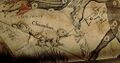 Musca, Chamaeleon and Crux on Blaeu's first globe (1602) that is a copy of Plancius/ Hondius (1598). RMG
 -
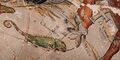 Musca, Chamaeleon and Crux on Blaeu (1603), the globe that is based on de Houtman's data. RMG
 -
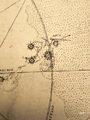 Musca labelled as "Apis", The Bee, in Bayer (1603).
 -
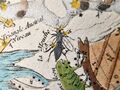 Musca in Fortin's Atlas Céleste, 3rd edition (1795).


Ian Ridpath has summarized the history of Musca in Star Tales at http://www.ianridpath.com/startales/musca.html.
The unnamed fly appeared on the globe of Plancius (1598), just above the new constellation Chamaeleon. For several years afterwards globes circulated which had the new Chamaeleon + unnamed fly. Globes produced by Jodocus Hondius which had the fly, still unnamed, were apparently used by Bayer to inform construction of the Uranometria (1603) - however he apparently did not know what insect it was supposed to represent, so considered a bee and called it "Apis" (not to be confused with "Apus" - the bird of paradise). In 1602 globe-maker Willem Janszoon Blaeu copied the constellation, but attached the name Musca. In 1603, de Houtman published a star catalog and maps which listed the tiny constellation as "De Vlieghe" - "the fly" - in Dutch.
Mythology
IAU WGSN Discussion
Following one of the principles of modern star naming, WGSN discussed the option of naming the brightest star of the constellation with the original Dutch constellation name. However, there is a Wardaman (Australian Aboriginal) name for this star, too: Burangalul, "forehead band" of the "Buran" [Boomerang = Musca] ("Dark Sparklers", Cairns & Harney 2003: p.202).
Other names that could be considered for stars in Musca
- "Vlieghe" - de Houtman's (1603) Dutch name for the constellation.
- "Apis" - while having a historical connection to the origins of the constellation Musca through Bayer's (1603) Uranometria, the name could be confusing as there is the IAU constellation "Apus" which sounds the same.