Scutum: Difference between revisions
No edit summary |
|||
| (3 intermediate revisions by the same user not shown) | |||
| Line 1: | Line 1: | ||
Authors: {{PAGEAUTHORS}} | |||
---- | |||
[[File:Scutum IAU.svg|thumb|star chart of Scutum (IAU and Sky & Telescope magazine, Roger Sinnott & Rick Fienberg)]] | [[File:Scutum IAU.svg|thumb|star chart of Scutum (IAU and Sky & Telescope magazine, Roger Sinnott & Rick Fienberg)]] | ||
One of the [[:Category:88_IAU-Constellations|88 IAU constellations]]. Scutum was invented by Hevelius (1687). | One of the [[:Category:88_IAU-Constellations|88 IAU constellations]]. Scutum was invented by Hevelius (1687). | ||
==Etymology and History== | ==Etymology and History == | ||
[[File:Sct Seiten aus Johannes-Hevelii-Prodromus-astronomiae-2.jpg|alt=historical map|thumb|Scutum in the original depiction by Hevelius (1687).]] | [[File:Sct Seiten aus Johannes-Hevelii-Prodromus-astronomiae-2.jpg|alt=historical map|thumb|Scutum in the original depiction by Hevelius (1687).]] | ||
=== Origin of Constellation === | === Origin of Constellation === | ||
The constellation was invented by Johannes Hevelius and first appeared in a scientific journal in 1684: it symbolises the victory of Christian defenders against the Muslim Turks who besieged Vienna. This is why illustrations in historical star catalogues often show a cross of Christ on the shield. | |||
Hevelius named the constellation Scutum Sobiescianum, as the decisive battle at Kahlenberg in September 1683 was led by Jan III Sobieski, the elected King of Poland-Lithuania (king's name Johann III). He led the so-called Catholic League with his elite cavalry (Polish: Hussaria), which was renowned at the time for its high tactical skills, and is considered the ‘savior of Vienna’ thanks to his victory. | |||
In this respect, the shield is a political constellation. All other political constellations (such as the Brandenburg sceptre and Frederick's honour for the King of Prussia or the Poniatowski bull for another Polish king) were abolished in 1930. The difference is that the others often honoured a specific king or patron of an astronomer. The shield, however, symbolises the victory of a religion, if one disregards the epithet. It stands for the victory of Christianity in Vienna – the same religion as that of the Belgian priest who was commissioned by the IAU in the 1920s to create canonical constellations. Alongside the Southern Cross ([[Crux]]) and the (Noah's) Dove ([[Columba]]), three [[Christianized (All Terms)|Christian constellations]] have thus been preserved in the sky. | |||
This region of the sky was also visible in ancient times from Egypt, Mesopotamia, Greece and Rome, but there are no bright stars here. Therefore, no constellation was created, but Ptolemy describes it only as a bright part of the Milky Way. Nevertheless, the shield is very easy to recognise as a figure: it gets its brightness from the impressively luminous Milky Way south of [[Aquila]], the Eagle. On clear nights in the summer sky, it is hard to miss; the numerous faint stars appear as a glowing cloud. | |||
=== Transfer and Transformation of the Constellation === | === Transfer and Transformation of the Constellation === | ||
<gallery> | <gallery> | ||
File:Sct Johannes-Hevel detail.jpg|Sct in Hevelius (1687) | |||
File:Scutum Fortin1776.jpg|Scutum depicted in Fortin's Atlas Céleste, 1st edition (1776) | File:Scutum Fortin1776.jpg|Scutum depicted in Fortin's Atlas Céleste, 1st edition (1776) | ||
File:Scutum Fortin1795.jpg|Scutum depicted in Fortin's Atlas Céleste, 3rd edition (1795) | File:Scutum Fortin1795.jpg|Scutum depicted in Fortin's Atlas Céleste, 3rd edition (1795) | ||
Latest revision as of 18:50, 26 February 2026
Authors: Susanne M Hoffmann

One of the 88 IAU constellations. Scutum was invented by Hevelius (1687).
Etymology and History

Origin of Constellation
The constellation was invented by Johannes Hevelius and first appeared in a scientific journal in 1684: it symbolises the victory of Christian defenders against the Muslim Turks who besieged Vienna. This is why illustrations in historical star catalogues often show a cross of Christ on the shield.
Hevelius named the constellation Scutum Sobiescianum, as the decisive battle at Kahlenberg in September 1683 was led by Jan III Sobieski, the elected King of Poland-Lithuania (king's name Johann III). He led the so-called Catholic League with his elite cavalry (Polish: Hussaria), which was renowned at the time for its high tactical skills, and is considered the ‘savior of Vienna’ thanks to his victory.
In this respect, the shield is a political constellation. All other political constellations (such as the Brandenburg sceptre and Frederick's honour for the King of Prussia or the Poniatowski bull for another Polish king) were abolished in 1930. The difference is that the others often honoured a specific king or patron of an astronomer. The shield, however, symbolises the victory of a religion, if one disregards the epithet. It stands for the victory of Christianity in Vienna – the same religion as that of the Belgian priest who was commissioned by the IAU in the 1920s to create canonical constellations. Alongside the Southern Cross (Crux) and the (Noah's) Dove (Columba), three Christian constellations have thus been preserved in the sky.
This region of the sky was also visible in ancient times from Egypt, Mesopotamia, Greece and Rome, but there are no bright stars here. Therefore, no constellation was created, but Ptolemy describes it only as a bright part of the Milky Way. Nevertheless, the shield is very easy to recognise as a figure: it gets its brightness from the impressively luminous Milky Way south of Aquila, the Eagle. On clear nights in the summer sky, it is hard to miss; the numerous faint stars appear as a glowing cloud.
Transfer and Transformation of the Constellation
-
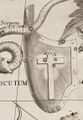 Sct in Hevelius (1687)
 -
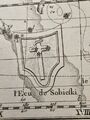 Scutum depicted in Fortin's Atlas Céleste, 1st edition (1776)
 -
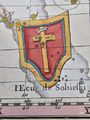 Scutum depicted in Fortin's Atlas Céleste, 3rd edition (1795)