Mensa: Difference between revisions
No edit summary |
No edit summary |
||
| (25 intermediate revisions by 4 users not shown) | |||
| Line 1: | Line 1: | ||
Authors: {{PAGEAUTHORS}} | |||
---- | |||
[[File:Mensa IAU.svg|alt=star chart|thumb|IAU Mensa chart (CC0)]] | [[File:Mensa IAU.svg|alt=star chart|thumb|IAU Mensa chart (CC0)]] | ||
Mensa, originally "Mons Mensae" (Table Mountain) is one of the 88 [https://en.wikipedia.org/wiki/International_Astronomical_Union IAU] constellations. There were no ancient ( | Mensa, originally "Mons Mensae" (Table Mountain), is one of the 88 [https://en.wikipedia.org/wiki/International_Astronomical_Union IAU] constellations. There were no ancient (Babylonian, Greek or Roman) constellations in this area, so early modern astronomers created names in the southern hemisphere. The region has no bright stars, the brightest star α Mensae is 5.1 mag, and has thus not been subject to any [[wikipedia:Gestalt_psychology|gestalt-seeing]]. | ||
==Etymology and History== | ==Etymology and History== | ||
=== Origin === | |||
<ref>Hoffmann, Susanne M. Wie der Löwe an den Himmel kam. Franckh Kosmos Verlag, Stuttgart 2021</ref>Nicolas Louis de Lacaille was an astronomer and surveyor in South Africa in the early 1750s. The landscape profile of Cape Town and its harbour is dominated by Table Mountain, which is usually shrouded in clouds. It therefore seemed logical to Lacaille that the area beneath the relatively elongated Large Magellanic Cloud must be the ‘Table Mountain’ for which Cape Town is famous. In his 1756 explanation, he quotes a navigators' weather rule that a white cloud covers Table Mountain like a tablecloth before a dangerous south-easterly wind arises. The dwarf galaxy, which astronomers then and now call the Large Magellanic Cloud, was therefore named the ‘Cape Cloud’ by the navigators of ocean-going ships at the time. Due to the weather rule, the mountain had a quasi-instrumental function. | |||
Cape Town was only a hundred years old at the time. A Dutch trading post was founded in 1652 and quickly became an important base for the Dutch East India Company. The natural bay, where a harbour had been established, served as a melting pot of cultures: the indigenous San and Khoi had been driven out by the Dutch. As they resisted enslavement, slaves were brought to Cape Town from other territories of the East India Company. However, during their occupation from 1652 to 1806, Dutch traders were only there for work, which is why there was a shortage of women and female slaves were used for work and entertainment. There was a strong mixing of European, African and Asian people imported from Indonesia. The British, who conquered Cape Town in 1806, abolished slavery. | |||
When Lacaille was there in the 1750s, the East India Company was still flourishing. In the 1760s and '70s, the famous British explorer and cartographer James Cook stopped in Cape Town on his first circumnavigation of the globe. On the first South Sea expedition, a transit of Venus across the sun was observed in Tahiti, which astronomy hoped would help determine the distance of the Earth from the sun more accurately. On Cook's second expedition, the new marine chronometer was successfully tested (see chapter on the constellation Horologium). | |||
A fellow traveller on Cook's second expedition painted Table Mountain while his ships, HMS Resolution and the escort ship HMS Adventure, were moored in Cape Town harbour. | |||
=== History === | |||
[[File:Lacaille text newConst1752 Men.JPG|alt=screenshot of text|thumb|Lacaille on Mensa 1752]] | |||
[[File:20240811 131538.jpg compressed-768x1024.jpg|alt=photograph|thumb|Table Mountain with table cloth (cloud) called "Cape Cloud" (SMH 2024).]] | [[File:20240811 131538.jpg compressed-768x1024.jpg|alt=photograph|thumb|Table Mountain with table cloth (cloud) called "Cape Cloud" (SMH 2024).]] | ||
In the 1750s, the French surveyor and mathematician Nicolas-Louis de Lacaille was based in the | |||
In the 1750s, the French surveyor and mathematician Nicolas-Louis de Lacaille was based in the trading station at the South African Cape of Good Hope that has developed into the city of Cape Town. He lived there for two years and measured positions of the land and the stars. In gaps of historical constellations, he invented new ones and named them after contemporary devices such as drawing tools, telescope, microscope, and a pendulum clock. The constellation of the Table Mountain seems to stand out as it is named after a geographical feature in Cape Town's landscape. However, Lacaille's reason is preserved in his [https://gallica.bnf.fr/ark:/12148/bpt6k35505/f787.item 1756 report for the French Academy of Science]. <blockquote>''Enfin, j’ai mis au dessous du grand nuage la Montagne de la Table, célèbre au cap de Bonne-espérance par sa figure de table, et principalement par un nuage blanc qui la vient couvrir en forme de nappe à l’approche d’un vent violent de sud-est; d’ailleurs la pluspart des Navigateurs appellent nuages du Cap, ce que nous appelons nuées de Magellan, ou le grand et le petit nuage.'' | |||
'''English''' | '''English''' | ||
Finally, I have placed below the large cloud the Table Mountain, famous at the Cape of Good Hope for its table-like shape, and mainly for a white cloud which covers it in the form of a tablecloth when a strong south-easterly wind approaches; moreover, most navigators call the Cape | Finally, I have placed below the large cloud the Table Mountain, famous at the Cape of Good Hope for its table-like shape, and mainly for a white cloud which covers it in the form of a tablecloth when a strong south-easterly wind approaches; moreover, most navigators call the Cape Clouds what we call Magellan's Clouds, or the Large and Small Clouds.</blockquote> | ||
=== Lacaille's Reason: Cape Cloud === | |||
[[File:20240816 173800.jpg compressed b-847x1024.jpg|alt=photograph from book|thumb|Illustration of the "Größeren Kapwolke" (‘Greater Cape Cloud’) in the ‘Bilderatlas der Sternenwelt’ by E. Weiss (1892).]] | [[File:20240816 173800.jpg compressed b-847x1024.jpg|alt=photograph from book|thumb|Illustration of the "Größeren Kapwolke" (‘Greater Cape Cloud’) in the ‘Bilderatlas der Sternenwelt’ by E. Weiss (1892).]] | ||
There are two easily recognisable, free-standing dwarf galaxies in the southern sky. Today, they are generally called the Magellanic Clouds (even though there is now an initiative to ask the IAU to rename them because Magellan, as a European | There are two easily recognisable, free-standing dwarf galaxies in the southern sky. Today, they are generally called the Magellanic Clouds (even though there is now an initiative to ask the IAU to rename them because Magellan, as a European explorer, did not always behave nicely towards the indigenous people he met - and they ended up having their own names for these celestial objects, which they were well aware of). In Lacaille's time, however, this was not yet firmly established terminology and so the Frenchman suggested that the Large Magellanic Cloud be called the ‘Cape Cloud’. | ||
"Cape Cloud" was the term with which navigators of the ocean-going ships referred to the cloud above the Table Mountain in Cape Town. Due to a weather rule, the mountain and its cloud had an instrumental function: Lacaille quotes a weather rule of the navigators, according to which a white cloud like a tablecloth on Table Mountain, before a dangerous south-easterly wind arises. | "Cape Cloud" was the term with which navigators of the ocean-going ships referred to the cloud above the Table Mountain in Cape Town. Due to a weather rule, the mountain and its cloud had an instrumental function: Lacaille quotes a weather rule of the navigators, according to which a white cloud like a tablecloth on Table Mountain, before a dangerous south-easterly wind arises. | ||
=== Indigenous term for the Mountain === | |||
[[File:CaptainGordon1779 hoerikwaggo.jpg|thumb|Captain Gordon's 1779 mentioning of the Khoekhoe term for the Table Mountain.]] | |||
Two Indigenous groups were native to the area of Cape Town: the hunter-gatherer San and the nomadic Khoekhoe (in old literature called "the Hottentots" which is today considered offensive). Of course, these peoples also had names for the mountain before the Europeans arrived. In the San and Khoekhoe language it was called '''Huriǂoaxa, the Sea Mountain''' (lit. 'sea-emerging'). | |||
This term is perhaps the earliest known (written) name for this mountain because it is mentioned in the journal of Captain Robert Jacob Gorden on his fourth journey in 1779:<ref>Robert Jacob Gordon’s fourth journey (27 June 1779 to 13 January 1780), appendix to ms 107/3/1/1, fol. 67a, [https://www.robertjacobgordon.nl/manuscripts/appendix-to-ms-107-3-1-1#page4 online]</ref><ref>G.S. Nienaber & P.E. Raper, ''Toponymica Hottentotica'' (1977- 1980), vol. A2, p. 560</ref><blockquote>"de Oude hottentotten hieten de Caap '''hoerie ḱwaggo''' of de zeeberg de emphasies op ieder der laatste syllabe van het woord”</blockquote>in translation <blockquote>“The old Hottentots call Cape Town hoerie ḱwaggo or sea-mountain, with the stress on the last syllable of each word”.</blockquote> | |||
== Images of the Table Mountain == | == Images of the Table Mountain == | ||
| Line 28: | Line 51: | ||
== Historical Images in Star Charts == | == Historical Images in Star Charts == | ||
<gallery> | |||
File:Lacaille-Mensa-fortin French.jpg|Lacaille's constellation Mensa in his French ''Planisphere'' (1756) (CC0) | |||
File:Lacaille Mensa Latin.JPG|Mons Mensae in Lacaille's map ''Coelum australe stelliferum'' (1763): [https://www.e-rara.ch/zut/content/zoom/197200?lang=en Zurich Library] | |||
File:Mensa Bode.jpg|Constellation Mensa in Bode's ''Uranographia'' 1801 (CC0) | |||
</gallery> | |||
== IAU WGSN Catalog of Star Names == | |||
By the occasion of the IAU GA in Cape Town 2024, it was proposed to name the (yet nameless) main star of the constellation Mensa with an Indigenous term for the mountain. Thus, it was proposed to use the term "[https://ibali.uct.ac.za/s/woac/item/3470 Hoerikwaggo]" from San language (Khoekhoe: '''Huriǂoaxa''', lit. 'sea-emerging'). The term literally means "Sea Mountain" and is perhaps the earliest known (written) name for this mountain, published in 1779 already. | |||
'''Sources:''' | |||
* Robert Jacob Gordon, Travel Journals: Fourth journey (27 June 1779 to 13 January 1780), appendix to ms 107/3/1/1, fol. 67a, [https://www.robertjacobgordon.nl/manuscripts/appendix-to-ms-107-3-1-1#page4 online] | |||
* John Barrows 1797; cited by Nienaber and Raper 1977: 560; again: Gabriel Stefanus Nienaber and P. E. Raper (1983, 213): "[https://books.google.com/books?newbks=1&newbks_redir=0&id=peJBAAAAYAAJ&dq=Hoerikwaggo Hottentot (Khoekhoen) Place Names]" | |||
'''Astrophysics of Alpha Mensae''' (HIP 29271, HR 2261, HD 43834): | |||
* observation: (a) in the TESS Continuous Viewing Zone, and (b) is one of the nearest, brightest stars subject to asteroseismologic analysis with TESS (Chontos+ 2021; [https://simbad.cds.unistra.fr/simbad/sim-ref?bibcode=2021ApJ...922..229C SIMBAD]) | |||
* From asteroseismology, the age is fairly well-constrained age of 6 Gyr. It also has an M dwarf companion at 3". | |||
* Alpha Men was also one of the 164 provisional target stars for the Habitable Worlds Observatory that [https://arxiv.org/abs/2402.12414 Karl Stapelfeldt and Eric Mamajek (2023)]. They are mostly naked eye FGK-type dwarfs within about 20 parsecs, and Alpha Mensae is a G7V at 10 parsecs. | |||
==Weblinks== | ==Weblinks== | ||
* | * Gordon, R.J. (1777-1786). Travel Journals ([https://www.robertjacobgordon.nl/writings-and-drawings copies of manuscripts] in the Rijks Museum, and [https://www.robertjacobgordon.nl/manuscripts/appendix-to-ms-107-3-1-1 transcriptions and page view]) | ||
* G.S. Nienaber & P.E. Raper, ''Toponymica Hottentotica'' (1977- 1980), vol. A2, p. 560 ([https://repository.hsrc.ac.za/handle/20.500.11910/16568 vol A1], [https://repository.hsrc.ac.za/handle/20.500.11910/16567 vol A2], [https://repository.hsrc.ac.za/handle/20.500.11910/16566 vol. B]) | |||
* Ridpath, Ian, "[http://www.ianridpath.com/startales/mensa.html Star Tales: online edition]". | |||
* Stapelfeldt, K. and Mamajek, E. (2023), [https://arxiv.org/abs/2402.12414 Habitable Worlds Observatory] | |||
==References== | ==References== | ||
*[[References]] (general) | *[[References]] (general) | ||
[[Category:Eurasia]] | [[Category:Eurasia]] | ||
Latest revision as of 21:01, 26 February 2026
Authors: Susanne M Hoffmann, Robert van Gent, IanRidpath
Mensa, originally "Mons Mensae" (Table Mountain), is one of the 88 IAU constellations. There were no ancient (Babylonian, Greek or Roman) constellations in this area, so early modern astronomers created names in the southern hemisphere. The region has no bright stars, the brightest star α Mensae is 5.1 mag, and has thus not been subject to any gestalt-seeing.
Etymology and History
Origin
[1]Nicolas Louis de Lacaille was an astronomer and surveyor in South Africa in the early 1750s. The landscape profile of Cape Town and its harbour is dominated by Table Mountain, which is usually shrouded in clouds. It therefore seemed logical to Lacaille that the area beneath the relatively elongated Large Magellanic Cloud must be the ‘Table Mountain’ for which Cape Town is famous. In his 1756 explanation, he quotes a navigators' weather rule that a white cloud covers Table Mountain like a tablecloth before a dangerous south-easterly wind arises. The dwarf galaxy, which astronomers then and now call the Large Magellanic Cloud, was therefore named the ‘Cape Cloud’ by the navigators of ocean-going ships at the time. Due to the weather rule, the mountain had a quasi-instrumental function.
Cape Town was only a hundred years old at the time. A Dutch trading post was founded in 1652 and quickly became an important base for the Dutch East India Company. The natural bay, where a harbour had been established, served as a melting pot of cultures: the indigenous San and Khoi had been driven out by the Dutch. As they resisted enslavement, slaves were brought to Cape Town from other territories of the East India Company. However, during their occupation from 1652 to 1806, Dutch traders were only there for work, which is why there was a shortage of women and female slaves were used for work and entertainment. There was a strong mixing of European, African and Asian people imported from Indonesia. The British, who conquered Cape Town in 1806, abolished slavery.
When Lacaille was there in the 1750s, the East India Company was still flourishing. In the 1760s and '70s, the famous British explorer and cartographer James Cook stopped in Cape Town on his first circumnavigation of the globe. On the first South Sea expedition, a transit of Venus across the sun was observed in Tahiti, which astronomy hoped would help determine the distance of the Earth from the sun more accurately. On Cook's second expedition, the new marine chronometer was successfully tested (see chapter on the constellation Horologium).
A fellow traveller on Cook's second expedition painted Table Mountain while his ships, HMS Resolution and the escort ship HMS Adventure, were moored in Cape Town harbour.
History


In the 1750s, the French surveyor and mathematician Nicolas-Louis de Lacaille was based in the trading station at the South African Cape of Good Hope that has developed into the city of Cape Town. He lived there for two years and measured positions of the land and the stars. In gaps of historical constellations, he invented new ones and named them after contemporary devices such as drawing tools, telescope, microscope, and a pendulum clock. The constellation of the Table Mountain seems to stand out as it is named after a geographical feature in Cape Town's landscape. However, Lacaille's reason is preserved in his 1756 report for the French Academy of Science.
Enfin, j’ai mis au dessous du grand nuage la Montagne de la Table, célèbre au cap de Bonne-espérance par sa figure de table, et principalement par un nuage blanc qui la vient couvrir en forme de nappe à l’approche d’un vent violent de sud-est; d’ailleurs la pluspart des Navigateurs appellent nuages du Cap, ce que nous appelons nuées de Magellan, ou le grand et le petit nuage.
English
Finally, I have placed below the large cloud the Table Mountain, famous at the Cape of Good Hope for its table-like shape, and mainly for a white cloud which covers it in the form of a tablecloth when a strong south-easterly wind approaches; moreover, most navigators call the Cape Clouds what we call Magellan's Clouds, or the Large and Small Clouds.
Lacaille's Reason: Cape Cloud

There are two easily recognisable, free-standing dwarf galaxies in the southern sky. Today, they are generally called the Magellanic Clouds (even though there is now an initiative to ask the IAU to rename them because Magellan, as a European explorer, did not always behave nicely towards the indigenous people he met - and they ended up having their own names for these celestial objects, which they were well aware of). In Lacaille's time, however, this was not yet firmly established terminology and so the Frenchman suggested that the Large Magellanic Cloud be called the ‘Cape Cloud’.
"Cape Cloud" was the term with which navigators of the ocean-going ships referred to the cloud above the Table Mountain in Cape Town. Due to a weather rule, the mountain and its cloud had an instrumental function: Lacaille quotes a weather rule of the navigators, according to which a white cloud like a tablecloth on Table Mountain, before a dangerous south-easterly wind arises.
Indigenous term for the Mountain

Two Indigenous groups were native to the area of Cape Town: the hunter-gatherer San and the nomadic Khoekhoe (in old literature called "the Hottentots" which is today considered offensive). Of course, these peoples also had names for the mountain before the Europeans arrived. In the San and Khoekhoe language it was called Huriǂoaxa, the Sea Mountain (lit. 'sea-emerging').
This term is perhaps the earliest known (written) name for this mountain because it is mentioned in the journal of Captain Robert Jacob Gorden on his fourth journey in 1779:[2][3]
"de Oude hottentotten hieten de Caap hoerie ḱwaggo of de zeeberg de emphasies op ieder der laatste syllabe van het woord”
in translation
“The old Hottentots call Cape Town hoerie ḱwaggo or sea-mountain, with the stress on the last syllable of each word”.
Images of the Table Mountain
-
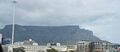 Table Mountain in Cape Town without its Cloud (SMH, August 2024)
 -
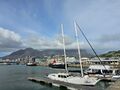 Table Mountain in Cape Town with its Cloud (SMH, August 2024)
 -
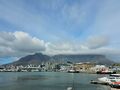 Table Mountain in Cape Town with its Cloud (SMH, August 2024)
 -
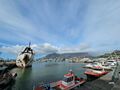 Table Mountain in Cape Town with its Cloud (SMH, August 2024)
 -
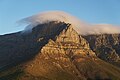 Table Mountain, Cape Town, South Africa (Bruno Wolff 2017, CC0)
 -
 View of Table Mountain from Orange Street, Cape Town, Western Cape, South Africa (CC By Dietmar Rabich).
 -
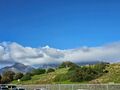 Table Mountain in Cape Town with its Cloud (SMH, August 2024)
 -
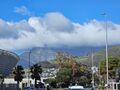 Table Mountain in Cape Town with its Cloud (SMH, August 2024)
 -
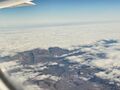 Cape Town mountains from above their clouds (SMH, August 2024); the layer is rather thin and attached to the mountains.


.jpg)
,_Table_Mountain_--_2024_--_3437.jpg)


Historical Images in Star Charts
-
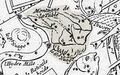 Lacaille's constellation Mensa in his French Planisphere (1756) (CC0)
 -
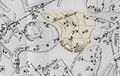 Mons Mensae in Lacaille's map Coelum australe stelliferum (1763): Zurich Library
 -
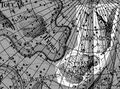 Constellation Mensa in Bode's Uranographia 1801 (CC0)


IAU WGSN Catalog of Star Names
By the occasion of the IAU GA in Cape Town 2024, it was proposed to name the (yet nameless) main star of the constellation Mensa with an Indigenous term for the mountain. Thus, it was proposed to use the term "Hoerikwaggo" from San language (Khoekhoe: Huriǂoaxa, lit. 'sea-emerging'). The term literally means "Sea Mountain" and is perhaps the earliest known (written) name for this mountain, published in 1779 already.
Sources:
- Robert Jacob Gordon, Travel Journals: Fourth journey (27 June 1779 to 13 January 1780), appendix to ms 107/3/1/1, fol. 67a, online
- John Barrows 1797; cited by Nienaber and Raper 1977: 560; again: Gabriel Stefanus Nienaber and P. E. Raper (1983, 213): "Hottentot (Khoekhoen) Place Names"
Astrophysics of Alpha Mensae (HIP 29271, HR 2261, HD 43834):
- observation: (a) in the TESS Continuous Viewing Zone, and (b) is one of the nearest, brightest stars subject to asteroseismologic analysis with TESS (Chontos+ 2021; SIMBAD)
- From asteroseismology, the age is fairly well-constrained age of 6 Gyr. It also has an M dwarf companion at 3".
- Alpha Men was also one of the 164 provisional target stars for the Habitable Worlds Observatory that Karl Stapelfeldt and Eric Mamajek (2023). They are mostly naked eye FGK-type dwarfs within about 20 parsecs, and Alpha Mensae is a G7V at 10 parsecs.
Weblinks
- Gordon, R.J. (1777-1786). Travel Journals (copies of manuscripts in the Rijks Museum, and transcriptions and page view)
- G.S. Nienaber & P.E. Raper, Toponymica Hottentotica (1977- 1980), vol. A2, p. 560 (vol A1, vol A2, vol. B)
- Ridpath, Ian, "Star Tales: online edition".
- Stapelfeldt, K. and Mamajek, E. (2023), Habitable Worlds Observatory
References
- References (general)







