Sextans: Difference between revisions
No edit summary |
No edit summary |
||
| (4 intermediate revisions by the same user not shown) | |||
| Line 1: | Line 1: | ||
Authors: {{PAGEAUTHORS}} | |||
---- | |||
[[File:Sextans IAU.svg|alt=star chart|thumb|Sextans star chart (IAU and Sky & Telescope magazine, Roger Sinnott & Rick Fienberg).]] | [[File:Sextans IAU.svg|alt=star chart|thumb|Sextans star chart (IAU and Sky & Telescope magazine, Roger Sinnott & Rick Fienberg).]] | ||
One of the [[:Category:88_IAU-Constellations|88 IAU constellations]]. The constellation was invented by Hevelius (1687). | One of the [[:Category:88_IAU-Constellations|88 IAU constellations]]. The constellation was invented by Hevelius (1687). | ||
| Line 5: | Line 7: | ||
[[File:Sex Hevelius.JPG|alt=screenshot(s) of text|thumb|Sextant described in Hevelius (1687).]] | [[File:Sex Hevelius.JPG|alt=screenshot(s) of text|thumb|Sextant described in Hevelius (1687).]] | ||
[[File:Sextant Hevelii-Prodromus-astronomiae-7.jpg|alt=star chart|thumb|Sextant depicted in Hevelius (1687).]] | [[File:Sextant Hevelii-Prodromus-astronomiae-7.jpg|alt=star chart|thumb|Sextant depicted in Hevelius (1687).]] | ||
=== Origin of Constellation === | |||
<ref>Hoffmann, Susanne M. Wie der Löwe an den Himmel kam. Franckh Kosmos Verlag, Stuttgart 2021</ref>The constellation Leo is located mainly north of the ecliptic. This has always been the case, even in ancient Sumer, Assyria, Babylonia, Egypt and Greece. The map based on the Almagest star catalogue is shown here: the bright stars of [[Leo]] and [[Virgo]] are all listed in the catalogue, but between them and [[Hydra]] there are only stars of magnitude 5 and fainter, nothing striking. So there is a region south of the ecliptic under [[Leo]] where the Moon sometimes stands, but where there are no bright stars whose occultation could be observed with the naked eye. This region remained nameless in ancient times. | |||
It was only with the new telescopic surveys of the sky that the need arose to group these faint stars into a constellation so that they could be clearly named. | |||
Johannes and Elizabetha Hevelius, a married couple and respected citizens of the city of Danzig (now Poland), ran a successful brewery and the husband was temporarily mayor of the city. In their spare time, they observed the starry sky and built world-famous large telescopes. The data from their celestial survey was published as a star catalogue in 1687. This was also where the constellation Sextans Uraniae was first established. In another book in which Hevelius describes his instruments, we can see from the illustration of himself next to the device that it is a rather large sextant. | |||
=== Transfer and Transformation of the Constellation === | === Transfer and Transformation of the Constellation === | ||
<gallery> | |||
File:Sextant Hevel detail.jpg|Sextans in Hevelius (1687) | |||
File:Sex Fortin1776.jpg|Sextans in Fortin (1776) | |||
File:Sex Fortin1795.jpg|Sextans in Fortin (1795) | |||
</gallery> | |||
== Mythology == | == Mythology == | ||
Latest revision as of 21:07, 26 February 2026
Authors: Susanne M Hoffmann

One of the 88 IAU constellations. The constellation was invented by Hevelius (1687).
Etymology and History


Origin of Constellation
[1]The constellation Leo is located mainly north of the ecliptic. This has always been the case, even in ancient Sumer, Assyria, Babylonia, Egypt and Greece. The map based on the Almagest star catalogue is shown here: the bright stars of Leo and Virgo are all listed in the catalogue, but between them and Hydra there are only stars of magnitude 5 and fainter, nothing striking. So there is a region south of the ecliptic under Leo where the Moon sometimes stands, but where there are no bright stars whose occultation could be observed with the naked eye. This region remained nameless in ancient times.
It was only with the new telescopic surveys of the sky that the need arose to group these faint stars into a constellation so that they could be clearly named.
Johannes and Elizabetha Hevelius, a married couple and respected citizens of the city of Danzig (now Poland), ran a successful brewery and the husband was temporarily mayor of the city. In their spare time, they observed the starry sky and built world-famous large telescopes. The data from their celestial survey was published as a star catalogue in 1687. This was also where the constellation Sextans Uraniae was first established. In another book in which Hevelius describes his instruments, we can see from the illustration of himself next to the device that it is a rather large sextant.
Transfer and Transformation of the Constellation
-
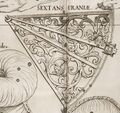 Sextans in Hevelius (1687)
 -
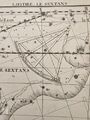 Sextans in Fortin (1776)
 -
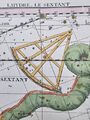 Sextans in Fortin (1795)


Mythology
Weblinks
References
- ↑ Hoffmann, Susanne M. Wie der Löwe an den Himmel kam. Franckh Kosmos Verlag, Stuttgart 2021





