Kemenu: Difference between revisions
No edit summary |
|||
| Line 5: | Line 5: | ||
[[File:Example.jpg|thumb|Image that shows the earliest map or drawing]] | [[File:Example.jpg|thumb|Image that shows the earliest map or drawing]] | ||
[[File:Example.jpg|thumb|Image that shows the cultural object (e.g. in archaeological museum)]] | [[File:Example.jpg|thumb|Image that shows the cultural object (e.g. in archaeological museum)]] | ||
Kemenu (... | Kemenu (... 𓈖...𓅓 𓅱), Crew, is an Egyptian constellation of three stars ρ Sgr - 44 Sgr, <s>used in Ramesside Star Clocks (RSC)</s>. | ||
==Concordance, Etymology, History== | ==Concordance, Etymology, History== | ||
=== Origin of Constellation === | === Origin of Constellation === | ||
Juan, what is the origin here - is that in the RSC??? | |||
=== Transfer and Transformation of the Constellation === | === Transfer and Transformation of the Constellation === | ||
| Line 33: | Line 23: | ||
== Religion/ Tales/ Mythology == | == Religion/ Tales/ Mythology == | ||
mnemonic tales and cultural significance | mnemonic tales and cultural significance | ||
== IAU WGSN star name discussion == | |||
The name was proposed to WGSN in 2025. As Kemenu means something as "crew", we are not sure if it would be appropriate for a single star. Juan Belmonte suggests to look for any pair of closing stars or a star which is multiple (not to the naked eye) in the area east of Kaus Australis, as in that case, it may suit. Therefore, we pick HIP 89637 is 6.03 mag in V. | |||
== Weblinks == | == Weblinks == | ||
Latest revision as of 18:14, 5 July 2026
Authors: Susanne M Hoffmann

Kemenu (... 𓈖...𓅓 𓅱), Crew, is an Egyptian constellation of three stars ρ Sgr - 44 Sgr, used in Ramesside Star Clocks (RSC).
Concordance, Etymology, History
Origin of Constellation
Juan, what is the origin here - is that in the RSC???
Transfer and Transformation of the Constellation
There is no identification of this constellation in Neugebauer and Parker, or in Leitz (1995), as their works focused on the so-called decan-constellation (further south).
-
 Tombs of Ramses V and VI (Diego Delso).
 -
 Schema of a Ramesside Star Clock (Fonctionnement d'une horloge ramesside.) from Karl Richard Lepsius - Denkmäler aus Ägypten und Äthiopien: Nach den Zeichnungen der von Seiner Majestät dem Könige von Preussen Friedrich Wilhelm IV nach diesen Ländern gesendeten und in den Jahren 1842-1845 ausgeführten wissenschaftlichen Expedition.
 -
 Explanation of Ramesside Star Clock by Frank Monnier
 -
 Tomb of Sethy I - front (CC BY Leon Petrosyan)
 -
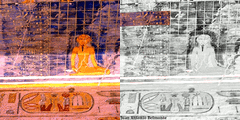 Tomb of Ramses IX with a RSC, detail photograph by J. Belmonte.


Religion/ Tales/ Mythology
mnemonic tales and cultural significance
IAU WGSN star name discussion
The name was proposed to WGSN in 2025. As Kemenu means something as "crew", we are not sure if it would be appropriate for a single star. Juan Belmonte suggests to look for any pair of closing stars or a star which is multiple (not to the naked eye) in the area east of Kaus Australis, as in that case, it may suit. Therefore, we pick HIP 89637 is 6.03 mag in V.
Weblinks
References
- References (general)