Al-Miġzal: Difference between revisions
Added image of a Bedouin spinning a spindle. |
|||
| (9 intermediate revisions by 2 users not shown) | |||
| Line 3: | Line 3: | ||
Authors: {{PAGEAUTHORS}} | Authors: {{PAGEAUTHORS}} | ||
---- | ---- | ||
[[File:Almighzal.png|thumb|Star chart of the Arabian asterism ''al-Miġzal'' (المِغْزَل). (CC BY Khalid AlAjaji 2026).]] | |||
'''al-Miġzal''' (Arabic: المِغْزَل), “the wool spindle” is an Arabic name for the stars forming a cross shape in Cygnus. | '''al-Miġzal''' (Arabic: المِغْزَل), “the wool spindle” is an Arabic name for the stars forming a cross shape in Cygnus. | ||
==Provenance, Etymology, History== | ==Provenance, Etymology, History== | ||
The name al-Miġzal is used regionally in central Saudi Arabia. | The name al-Miġzal is used regionally in central Saudi Arabia. | ||
[[File:Al-Miġzal.png|thumb|Al-Miġzal asterism in Cygnus. Photo by Khalid al-Ajaji taken on October 2016, the time of the identification of the name and its stars. (CC BY Khalid AlAjaji 2026).]] | |||
<gallery widths="240" heights="360" perrow="1"> | |||
File:Service-pnp-matpc-03700-03790v.jpg|Bedouin shepherdess spinning. Source: Library of Congress, Prints and Photographs Division. Digital ID: matpc 03790 https://hdl.loc.gov/loc.pnp/matpc.03790 [https://www.loc.gov/resource/matpc.03790/ Original image on loc.gov] | |||
</gallery> | |||
===Etymology=== | ===Etymology=== | ||
| Line 16: | Line 18: | ||
===Sources and Identification=== | ===Sources and Identification=== | ||
The name comes from local oral tradition, recorded by Khalid al-Ajaji in October 2016 during a star-gazing session in the dunes of Ṯuwayrāt in the al-Zulfī region, northwest of Riyadh, Saudi Arabia. | The name comes from local oral tradition, recorded by Khalid al-Ajaji in October 2016 during a star-gazing session in the dunes of Ṯuwayrāt in the [[wikipedia:Al-Zulfi|al-Zulfī]] region, northwest of Riyadh, Saudi Arabia. The identification was made directly at the time, when the informant pointed to the cross-shaped stars of Cygnus, visible from shortly after sunset until after midnight. | ||
The identification was made directly at the time, when the informant pointed to the cross-shaped stars of Cygnus, visible from shortly after sunset until after midnight. | |||
The research is documented and published in Stellarium software,<ref>Zotti, G., Hoffmann, S. M., Wolf, A., Chéreau, F., & Chéreau, G. (2021). The Simulated Sky: Stellarium for Cultural Astronomy Research. Journal of Skyscape Archaeology, 6(2), 221–258. DOI: 10.1558/jsa.17822</ref> available as a public dataset in the Stellarium GitHub Repository<ref>Stellarium Repo https://zenodo.org/records/20835040<nowiki/>Stellarium's official Zenodo Digital Object Identifier (DOI) 10.5281/zenodo.20835040</ref> and the description by Khalid AlAjaji is also published in paper form in the conference proceedings Hoffmann and Wolfschmidt (eds. 2022)<ref>Khalid AlAjaji (2022). Stellarium Sky Culture "Arabian Peninsula", in Hoffmann, S. and Wolfschmidt, G. (eds.). Astronomy in Culture - Cultures of Astronomy, Featuring the Proceedings of a splinter meeting in the German Astronomical Society. tredition, Ahrensburg.</ref>. In Stellarium it is written (by Khalid AlAjaji): <blockquote>'''The Wool Spindle:''' The cross-shaped arrangement of α Cyg (Deneb), ε Cyg (Gienah), γ Cyg (Sadr), δ Cyg, and β1+β2 Cyg (Albireo). This comes from oral tradition in Zulfi, central Saudi Arabia [#1]<ref>Reference [#1] in this case is "Oral Tradition" documented by the author of this sky culture, Khalid AlAjaji. </ref>. </blockquote> | |||
==== Stars Identification ==== | ==== Stars Identification ==== | ||
| Line 26: | Line 29: | ||
==IAU Working Group Star Names== | ==IAU Working Group Star Names== | ||
In | In 2026, the name al-Miġzal (or any spelling variant) was suggested as a star name in the area that is covered by the historical asterism. It is suggested to be used for η Cyg. | ||
WGSN decided in ... 202x to name ... ... | WGSN decided in ... 202x to name ... ... | ||
| Line 34: | Line 37: | ||
== Weblinks == | == Weblinks == | ||
* | * Stellarium https://stellarium.org/ | ||
== Reference == | == Reference == | ||
[[Category:Africa]][[Category:North Africa]] | [[Category:Africa]][[Category:North Africa]] | ||
[[Category:Eurasia]][[Category:Asian]][[Category:West Asian]] | [[Category:Eurasia]][[Category:Asian]][[Category:West Asian]] | ||
Latest revision as of 10:37, 16 July 2026
Authors: Khalid Al-Ajaji, Susanne M Hoffmann

al-Miġzal (Arabic: المِغْزَل), “the wool spindle” is an Arabic name for the stars forming a cross shape in Cygnus.
Provenance, Etymology, History
The name al-Miġzal is used regionally in central Saudi Arabia.

-
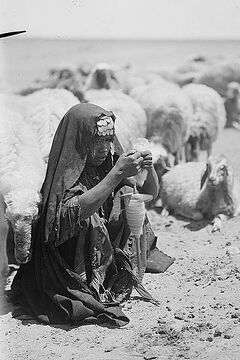 Bedouin shepherdess spinning. Source: Library of Congress, Prints and Photographs Division. Digital ID: matpc 03790 https://hdl.loc.gov/loc.pnp/matpc.03790 Original image on loc.gov

Etymology
al-Miġzal (Arabic: المِغْزَل)is derived from the Arabic root (غزل), referring to a wool spindle, and ultimately from the verb “أُغْزِلَ,” meaning “to be twisted and rotated”.
Sources and Identification
The name comes from local oral tradition, recorded by Khalid al-Ajaji in October 2016 during a star-gazing session in the dunes of Ṯuwayrāt in the al-Zulfī region, northwest of Riyadh, Saudi Arabia. The identification was made directly at the time, when the informant pointed to the cross-shaped stars of Cygnus, visible from shortly after sunset until after midnight.
The research is documented and published in Stellarium software,[1] available as a public dataset in the Stellarium GitHub Repository[2] and the description by Khalid AlAjaji is also published in paper form in the conference proceedings Hoffmann and Wolfschmidt (eds. 2022)[3]. In Stellarium it is written (by Khalid AlAjaji):
The Wool Spindle: The cross-shaped arrangement of α Cyg (Deneb), ε Cyg (Gienah), γ Cyg (Sadr), δ Cyg, and β1+β2 Cyg (Albireo). This comes from oral tradition in Zulfi, central Saudi Arabia [#1][4].
Stars Identification
The asterism of al-Miġzal is formed by the stars α, γ, β Cyg and ε, γ, δ Cyg.
The identification is considered secure, as the narrator of the name personally indicated these stars when describing al-Miġzal.
IAU Working Group Star Names
In 2026, the name al-Miġzal (or any spelling variant) was suggested as a star name in the area that is covered by the historical asterism. It is suggested to be used for η Cyg.
WGSN decided in ... 202x to name ... ...
This star is <a red giant or whatelse> ... here astrophysical data will be added (by Eric, most likely) after the decision.
Weblinks
- Stellarium https://stellarium.org/
Reference
- ↑ Zotti, G., Hoffmann, S. M., Wolf, A., Chéreau, F., & Chéreau, G. (2021). The Simulated Sky: Stellarium for Cultural Astronomy Research. Journal of Skyscape Archaeology, 6(2), 221–258. DOI: 10.1558/jsa.17822
- ↑ Stellarium Repo https://zenodo.org/records/20835040Stellarium's official Zenodo Digital Object Identifier (DOI) 10.5281/zenodo.20835040
- ↑ Khalid AlAjaji (2022). Stellarium Sky Culture "Arabian Peninsula", in Hoffmann, S. and Wolfschmidt, G. (eds.). Astronomy in Culture - Cultures of Astronomy, Featuring the Proceedings of a splinter meeting in the German Astronomical Society. tredition, Ahrensburg.
- ↑ Reference [#1] in this case is "Oral Tradition" documented by the author of this sky culture, Khalid AlAjaji.