IR.BI4.IL: Difference between revisions
Created page with "<sup>mul</sup>IR.BI4.IL is an ancient Mesopotamian asterism. ==Dictionary== === Kurtik with Hilder, Hoffmann, Horowitz, Kim === [G. 88, 230], the name of Saturn and Libra. {| class="wikitable" |+ !Sources !Identifications |- |'''Lexic. texts.''' (1) Series Ḫg. B VI: <sup>mul</sup>gi.gi = mul kit-tu<sub>2</sub> u me-šar = <sup>d</sup>sag.uš <sup>d</sup>utu "Star gi.gi = Star of truth and justice = Saturn, Shamash" [MSL XI, 40:39], later parallel: <sup>mul</sup>gi.gi..." |
No edit summary |
||
| (20 intermediate revisions by 4 users not shown) | |||
| Line 1: | Line 1: | ||
< | {{DISPLAYTITLE:IR.BI<sub>4</sub>.IL}} | ||
Authors: {{PAGEAUTHORS}} | |||
---- | |||
<sup>mul</sup>IR.BI<sub>4</sub>.IL (𒀯𒅕𒁁𒅋) is an ancient Mesopotamian asterism, referring to the planet Mars. | |||
{ | |||
[I don't think that this is a name, and if so, it has to be read differently. The line is crossed by a break which makes reading difficult. there has to be a verb before ANŠE.KUR.RA. MUL at the beginning may be subject, so "If a star ...", and the following signs the verb. Or we have an unread star name, followed by an unread verb. The commenting in the second part of the line refers to Mars, so its name may be hidden in the signs of the beginning, but they are not related to ''Ṣal-bat-a-nu.'' There is a transliteration in eBL under K.2329 which doubts the reading of ACh. The photo in CDLI is the same as in eBL.] | |||
==Concordance, Etymology, History<ref>[[Mesopotamian (All Terms)|Planetarium Babylonicum 2.0]], All Skies Encyclopaedia.</ref>== | |||
[G. 201]; apparently one of the epithets of Mars; only in prediction: DIŠ <sup>mul</sup>IR.BI<sub>4</sub>.IL<sup>(?)</sup> ANŠE.KUR.RA.MEŠ UŠ<sub>2</sub>.MEŠ <sup>d</sup>''Ṣal-bat-a-nu u''<sub>2</sub>-''tan-na''-[''at''] "When Irbil<sup>?</sup> (observed): horses die; (this happens when) the brilliance of Mars wanes" [ACh Ištar, 30:44]. Could this be a reference to Mars being Ishtar of the Assyrian city Irbil = Erbella - if yes why Mars and not Venus? '''<nowiki>[[need to collate?? - check in cdli for tablet??? ??]]</nowiki>''' | |||
{{Template:Mars}} | |||
== Historical Dictionaries == | == Historical Dictionaries == | ||
{| class="wikitable" | {| class="wikitable" | ||
|- | |- | ||
! scope="col" style="width: 60%;" | Kurtik (2022) | ! scope="col" style="width: 60%;" | Kurtik (2022, i14) | ||
! scope="col" style="width: 40%;" | Gössmann (1950) | ! scope="col" style="width: 40%;" | Gössmann (1950) | ||
|- | |- | ||
| [G. | | [G. 201]; по-видимому, один из эпитетов Марса; только в предсказании: DIŠ <sup>mul</sup>IR.BI<sub>4</sub>.IL<sup>(?)</sup> ANŠE.KUR.RA.MEŠ UŠ<sub>2</sub>.MEŠ <sup>d</sup>Ṣal-bat-a-nu u<sub>2</sub>-tan-na-[at] «Когда Ирбил<sup>?</sup> (наблюдается): лошади умирают; (это происходит, когда) блеск Марса ослабевает» [ACh Ištar, 30:44]. | ||
( | |||
| Example | | Example | ||
|} | |} | ||
| Line 56: | Line 26: | ||
[[Category:Mesopotamian]] | [[Category:Mesopotamian]] | ||
[[Category:Sumerian]] | [[Category:Sumerian]] | ||
[[Category:West Asian]] | [[Category:West Asian]] [[Category:Asian]] | ||
[[Category:Eurasia]] | [[Category:Eurasia]] | ||
[[Category:Cuneiform]] | [[Category:Cuneiform]] | ||
[[Category:Solar System]] | |||
[[Category:Planet]] | |||
[[Category:Mars]] | |||
[[Category:4workWayne]] | |||
Latest revision as of 15:31, 17 July 2026
Authors: Gennady E. Kurtik, Euin Choung Kim, David Hilder, Hermann Hunger, Susanne M Hoffmann, Wayne Horowitz, Youla Azkarrula
mulIR.BI4.IL (𒀯𒅕𒁁𒅋) is an ancient Mesopotamian asterism, referring to the planet Mars.
[I don't think that this is a name, and if so, it has to be read differently. The line is crossed by a break which makes reading difficult. there has to be a verb before ANŠE.KUR.RA. MUL at the beginning may be subject, so "If a star ...", and the following signs the verb. Or we have an unread star name, followed by an unread verb. The commenting in the second part of the line refers to Mars, so its name may be hidden in the signs of the beginning, but they are not related to Ṣal-bat-a-nu. There is a transliteration in eBL under K.2329 which doubts the reading of ACh. The photo in CDLI is the same as in eBL.]
Concordance, Etymology, History[1]
[G. 201]; apparently one of the epithets of Mars; only in prediction: DIŠ mulIR.BI4.IL(?) ANŠE.KUR.RA.MEŠ UŠ2.MEŠ dṢal-bat-a-nu u2-tan-na-[at] "When Irbil? (observed): horses die; (this happens when) the brilliance of Mars wanes" [ACh Ištar, 30:44]. Could this be a reference to Mars being Ishtar of the Assyrian city Irbil = Erbella - if yes why Mars and not Venus? [[need to collate?? - check in cdli for tablet??? ??]]
Images of Mars
-
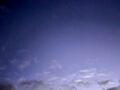 Close Conjunction of Jupiter (brighter) and Mars (reddish) under Orion (upper right), seen from Cape Town (SMH 2024)
 -
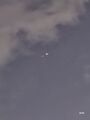 Closest Conjunction of Jupiter and Mars in 2024 (Cape Town, SMH).
 -
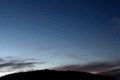 Jupiter, Mars and Pleiades at Dawn (SMH 2024).
 -
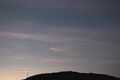 Jupiter, Mars, Pleiaden in a slightly cloudy morning twilight (SMH 2024).
 -
 Mars in the constellation Gemini, The Twins (SMH January 2025).
 -
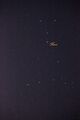 Mars in the constellation Gemini, The Twins (SMH February 2025).
 -
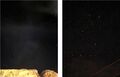 Mars extremly close to epsilon Geminorum (14 April 2023), seen from Petra, Jordan (SMH).
 -
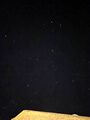 One day after the close conjunction of Mars with epsilon Geminorum; seen from Petra, Jordan (SMH 2023). The planet then had a visible separation from the star.
 -
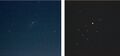 Mars in the Open Star Cluster Praesepe (M44) in Cancer (2023)
 -
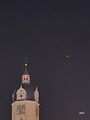 Mars next to a tower in Central Europe: its reddish colour is extraordinarily obvious (SMH 2025).
 -
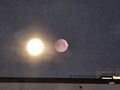 Mars two moon widths next to the Moon, photograph at full moon taken through a window in order to produce a dimmer image of the full moon next to Mars: the planet is at the right edge of the Moon. (SMH January 2025).


Historical Dictionaries
| Kurtik (2022, i14) | Gössmann (1950) |
|---|---|
| [G. 201]; по-видимому, один из эпитетов Марса; только в предсказании: DIŠ mulIR.BI4.IL(?) ANŠE.KUR.RA.MEŠ UŠ2.MEŠ dṢal-bat-a-nu u2-tan-na-[at] «Когда Ирбил? (наблюдается): лошади умирают; (это происходит, когда) блеск Марса ослабевает» [ACh Ištar, 30:44]. | Example |
References
- ↑ Planetarium Babylonicum 2.0, All Skies Encyclopaedia.