Eridanus: Difference between revisions
IanRidpath (talk | contribs) →Weblinks: Added Warburg link |
|||
| (19 intermediate revisions by 4 users not shown) | |||
| Line 2: | Line 2: | ||
---- | ---- | ||
[[File:Eridanus IAU.svg|alt=star chart|thumb|Eri star chart (IAU and Sky & Telescope magazine, Roger Sinnott & Rick Fienberg).]] | [[File:Eridanus IAU.svg|alt=star chart|thumb|Eri star chart (IAU and Sky & Telescope magazine, Roger Sinnott & Rick Fienberg).]] | ||
{{Infobox constellation | |||
| name = Ποταμός (Potamos) | |||
| native = Ποταμός | |||
| translation = River | |||
| pronounce = Potamos | |||
| IPA = | |||
| culture = Greek (Almagest) | |||
| RA = 41.27582834 to 77.28660023 | |||
| dec = -40.30467764 to -3.254659811 | |||
| areatotal = 950.68 | |||
| numbermainstars = 158 | |||
| numberbfstars = 129 | |||
| numberstarsplanets = | |||
| numberbrightstars = 2 | |||
| numbernearbystars = | |||
| brighteststarname = [[Cursa]] | |||
| starmagnitude = 2.79 | |||
| neareststarname = | |||
| stardistance = | |||
| numbermessierobjects = | |||
| meteorshowers = | |||
| bordering = Eri, For | |||
| notes = | |||
| cat = Almagest constellation | |||
}} | |||
[[File:Hugo-de-Groot-Syntagma-Arateorum MG 0631.tif|thumb|Hugo de Groot Syntagma Arateorum MG 0631]] | [[File:Hugo-de-Groot-Syntagma-Arateorum MG 0631.tif|thumb|Hugo de Groot Syntagma Arateorum MG 0631]] | ||
One of the [[:Category:88_IAU-Constellations|88 IAU constellations]]. In ancient Greece, the constellation simply had been named ‘The River’ with various interpretations. In Mediaeval times, e.g. in the Leiden Aratea, it is even depicted as a river god instead of a stream of water. The modern IAU-adoption renders the term as "Eridanus". | One of the [[:Category:88_IAU-Constellations|88 IAU constellations]]. In ancient Greece, the constellation simply had been named ‘The River’ with various interpretations. In Mediaeval times, e.g. in the Leiden Aratea, it is even depicted as a river god instead of a stream of water. The modern IAU-adoption renders the term as "Eridanus". | ||
| Line 23: | Line 48: | ||
===== Aratos ===== | ===== Aratos ===== | ||
Kidd (1997)<ref>Aratus, Phainomena, Engl. translation by Kidd, Douglas, Cambridge Classical Texts and Commentaries, 34, Cambridge Univ. Press 1997</ref> | |||
[359] For under the gods’ feet that too moves as a separate group, [360] a remnant of Eridanus, river of much weeping. It extends below the left foot of Orion. The tail-chains, by which the extremities of the Fishes are held, both come together as they descend from the tail-parts, and behind the Monster’s back-fin move jointly [365] as they converge, and terminate in a single star that lies close to the top of the Monster’s spine. | |||
[585] These nights are named after his late setting. So these constellations set, while opposite them no meagre one, but brilliant with his belt and two shoulders, Orion, trusting in the might of his sword, extends along the other horizon, bringing with him all of the River. | |||
[635] The windings of the River will plunge into the fair stream of ocean as soon as the Scorpion arrives, which also puts great Orion to flight at its coming. | |||
[726] At that time no part of the Monster is any longer crossing either horizon: you can now see it complete. Now too a sailor on a clear night at sea can observe the first bend of the River emerging from the sea, [730] as he waits for Orion himself, to see if a sign will at some point predict for him the length of either the night or the voyage; for everywhere the gods give these many predictions to men. | |||
===== Eratosthenes ===== | ===== Eratosthenes ===== | ||
Pamias and Zucker (2013,<ref>Pamìas, Jordi und Zucker, Arnaud (2013). Ératosthènes de Cyrène: Catastérrismes, Belles Lettres, Paris</ref> 110-111)<blockquote>'''Var. 1 (Περὶ τοῦ Ποταμοῦ)''': It rises at the left foot of Orion. Aratus calls it Eridanus, though he gives no reason for this identification; others say it is more accurate to call it the Nile, as it is the only river that rises in the south. It is lined along its entire length by a great many stars. </blockquote><blockquote>Below it lies the star called “Canopus”, which is near the rudder of Argo. Below this star, no other stars are visible. The River has three stars on the first bend, three on the second, and seven stretching from the third bend to the end, which is said to constitute the mouths of the Nile. Thirteen in all.</blockquote><blockquote>'''Var. 2 (Ποταμοῦ)''': It rises at the left foot of Orion. Aratus calls it Eridanus, though he gives no reason for this identification; others say that the most plausible interpretation is to see it as the Nile, for it is the only river that rises in the south. It is studded with a great many stars all along its course. Below it lies the star called “Canopus”, which is near the rudders of Argo. Below this star no other star is visible; this is why it is called “Perigean” (Near the Earth).</blockquote><blockquote>The River has three stars on the first bend, three on the second, and seven stretching from the third bend to the end, which is said to constitute the mouths of the Nile. Thirteen in all.</blockquote> | |||
'''Eratosthenes's star catalogue''' can be reconstructed from the list of stars he mentions in the last section of each of the constelllation descriptions. Hoffmann (2017)<ref name=":02">Hoffmann, S. M., <nowiki><i>Hipparchs Himmelsglobus</i></nowiki>. Springer Wiesbaden/ New York, 2017. doi:10.1007/978-3-658-18683-8.</ref> made such a catalogue and used it for computational comparison with Hipparchus's, Ptolemy's and Babylonian data; it is based on the edition and translation by Pamias and Geus (2007)<ref>Eratosthenes: Sternsagen, übersetzt von Pamìas, Jordi und Geus, Klaus, Verlag Utopica, Oberhaid 2007</ref> and presented here in English translation. | |||
{|class="wikitable" | |||
|+ | |||
!erat.Cat.ID | |||
!constStarID | |||
!starName | |||
!ident.Bayer | |||
!ident.HIP | |||
!certainty | |||
|- | |||
| 593 | |||
| 1 | |||
| three stars on the first bend | |||
| gamma Eri | |||
| 18543 | |||
| 1 | |||
|- | |||
| 594 | |||
| 2 | |||
| three stars on the first bend | |||
| delta Eri | |||
| 17378 | |||
| 1 | |||
|- | |||
| 595 | |||
| 3 | |||
| three stars on the first bend | |||
| eps Eri | |||
| 16537 | |||
| 1 | |||
|- | |||
| 596 | |||
| 4 | |||
| three on the second [bend] | |||
| tau4 Eri | |||
| 15474 | |||
| 1 | |||
|- | |||
| 597 | |||
| 5 | |||
| three on the second [bend] | |||
| tau5 Eri | |||
| 16611 | |||
| 1 | |||
|- | |||
| 598 | |||
| 6 | |||
| three on the second [bend] | |||
| tau6 Eri | |||
| 17651 | |||
| 1 | |||
|- | |||
| 599 | |||
| 7 | |||
| seven on the third [bend] up to the endpoints that are considered the mouth of the Nile | |||
| ups1 Eri | |||
| 21248 | |||
| 1 | |||
|- | |||
| 600 | |||
| 8 | |||
| seven on the third [bend] up to the endpoints that are considered the mouth of the Nile | |||
| ups2 Eri | |||
| 21393 | |||
| 1 | |||
|- | |||
| 601 | |||
| 9 | |||
| seven on the third [bend] up to the endpoints that are considered the mouth of the Nile | |||
| ups4 Eri | |||
| 20042 | |||
| 1 | |||
|- | |||
| 602 | |||
| 10 | |||
| seven on the third [bend] up to the endpoints that are considered the mouth of the Nile | |||
| ups3 Eri | |||
| 20535 | |||
| 1 | |||
|- | |||
| 603 | |||
| 11 | |||
| seven on the third [bend] up to the endpoints that are considered the mouth of the Nile | |||
| g Eri | |||
| 17874 | |||
| 1 | |||
|- | |||
| 604 | |||
| 12 | |||
| seven on the third [bend] up to the endpoints that are considered the mouth of the Nile | |||
| theta1 Eri | |||
| 13847 | |||
| 1 | |||
|- | |||
| 605 | |||
| 13 | |||
| seven on the third [bend] up to the endpoints that are considered the mouth of the Nile | |||
| e Eri | |||
| 17351 | |||
| 1 | |||
|} | |||
===== Hipparchus ===== | ===== Hipparchus ===== | ||
====== Rising (Lib II Cap V §10) ====== | ====== Rising (Lib II Cap V §10) ====== | ||
<blockquote>The Rising of | <blockquote>The Rising of Eridanus ... </blockquote> | ||
{| class="wikitable" | {| class="wikitable" | ||
! | ! | ||
| Line 55: | Line 192: | ||
|star | |star | ||
|in the quadrilateral which is located in the boow and next to the Sea Monster the front and northernmost (rho Cet) | |in the quadrilateral which is located in the boow and next to the Sea Monster the front and northernmost (rho Cet) | ||
|The brightest, front and southernmost of all | |The brightest, front and southernmost of all (θ Eri) | ||
| | | | ||
| | | | ||
| Line 88: | Line 225: | ||
|- | |- | ||
|star | |star | ||
|the front one and brightest of all ( | |the front one and brightest of all (θ Eri) | ||
|the first one which stands next to the foot of Orion | |the first one which stands next to the foot of Orion (λ Eri) | ||
| | | | ||
| | | | ||
| Line 96: | Line 233: | ||
| colspan="4" |4 7/10 hours = 282 min = 70 1/2° | | colspan="4" |4 7/10 hours = 282 min = 70 1/2° | ||
|} | |} | ||
{| class="wikitable" | ====== Hipparchus's "lost" star Catalogue ====== | ||
! | |||
! | The star catalogue of Hipparchus is not preserved. Yet, several scholars have reconstructed it in the past century: Vogt (1925)<ref>Vogt, H., “Versuch einer Wiederherstellung von Hipparchs Fixsternver zeichnis”, <nowiki><i>Astronomische Nachrichten</i></nowiki>, vol. 224, no. 2, Wiley, p. 17, 1925. doi:10.1002/asna.19252240202.</ref>, Grasshoff (1990)<ref>Graßhoff, G., <nowiki><i>The History of Ptolemy's Star Catalogue</i></nowiki>, Springer, New York, 1990 </ref>, Hoffmann (2017)<ref>Hoffmann, S. M., <nowiki><i>Hipparchs Himmelsglobus</i></nowiki>. Springer Wiesbaden/ New York, 2017. doi:10.1007/978-3-658-18683-8.</ref> and Glover (2026)<ref>Glover, E. (2026). ''The Astronomy of Hipparchus'', Cambridge University Press</ref>. Grasshoff's catalogue and computations are not published digitally, Hoffmann published three versions of the Manitius+Hoffmann<ref>Hipparchus's Lost Star Catalogue (1/2 reconstructed) (Hoffmann, 2017) in VizieR</ref> star lists in the CDS [https://vizier.unistra.fr/ VizieR] "catalog of catalogs", and Glover printed the star lists constellationwise in his book. | ||
! | {|class="wikitable" | ||
! | |+ Hipparchus's star in Aquarius (Glover 2026) | ||
!ident. | |||
! | !hipp.Cat.ID | ||
!constStarID | |||
!starName | |||
!ident.Bayer | |||
!ident.HIP | |||
!concordance | |||
|- | |||
|262 | |||
|1 | |||
| | |||
|α Dra | |||
|68756 | |||
|CPAE | |||
|- | |||
|263 | |||
|2 | |||
| | |||
|β Dra | |||
|85760 | |||
|CPAE | |||
|- | |||
|264 | |||
|3 | |||
| | |||
|γ Dra | |||
|87833 | |||
|CPAE | |||
|- | |||
|265 | |||
|4 | |||
| | |||
|δ Dra | |||
|94376 | |||
|CPAE | |||
|- | |||
|266 | |||
|5 | |||
| | |||
|ε Dra | |||
|97433 | |||
|CPAE | |||
|- | |||
|267 | |||
|6 | |||
| | |||
|ι Dra | |||
|75458 | |||
|CPAE | |||
|- | |||
|268 | |||
|7 | |||
| | |||
|κ Dra | |||
|61281 | |||
|CPAE | |||
|- | |||
|269 | |||
|8 | |||
| | |||
|λ Dra | |||
|56211 | |||
|CPAE | |||
|- | |||
|270 | |||
|9 | |||
| | |||
|μ Dra | |||
|83608 | |||
|CPAE | |||
|- | |||
|271 | |||
|10 | |||
| | |||
|ν Dra (ν2) | |||
|85829 | |||
|CPAE | |||
|- | |||
|272 | |||
|11 | |||
| | |||
|ξ Dra | |||
|87585 | |||
|CPAE | |||
|- | |||
|273 | |||
|12 | |||
| | |||
|χ Dra | |||
|89937 | |||
|CPAE | |||
|- | |- | ||
| | |274 | ||
| | |13 | ||
| | | | ||
| | |HIP 84950 | ||
| | |84950 | ||
|CPAE | |||
| | |||
|} | |} | ||
===== Hyginus, Astronomica ===== | ===== Hyginus, Astronomica ===== | ||
| Line 144: | Line 365: | ||
|2 | |2 | ||
|ὁ τούτου βορειότερος ἐν ἐπικαμπίῳ πρὸς τῷ ἀντικυημίῳ τοῦ Ὡρίωνος | |ὁ τούτου βορειότερος ἐν ἐπικαμπίῳ πρὸς τῷ ἀντικυημίῳ τοῦ Ὡρίωνος | ||
|The one north of | |The one north of this, in the curve near the shin of Orion | ||
|ß Eri | |ß Eri | ||
|- | |- | ||
|3 | |3 | ||
|τῶν μετὰ τοῦτον ἐφεξῆς β’ ὁ ἐπόμενος | |τῶν μετὰ τοῦτον ἐφεξῆς β’ ὁ ἐπόμενος | ||
| | |The rearmost of thc 2 stars next in order after this | ||
|psi Eri | |psi Eri | ||
|- | |- | ||
|4 | |4 | ||
|ὁ προηγούμενος αὐτῶν | |ὁ προηγούμενος αὐτῶν | ||
|The more advanced of | |The more advanced of them | ||
|ome Eri | |ome Eri | ||
|- | |- | ||
|5 | |5 | ||
|πάλιη τῶν ἐφεξῆς Β’ ὁ ἐπόμευος | |πάλιη τῶν ἐφεξῆς Β’ ὁ ἐπόμευος | ||
|The | |The rearmost of the next 2 in order again | ||
|mu Eri | |mu Eri | ||
|- | |- | ||
| Line 175: | Line 396: | ||
|ὁ μέσος αὐτῶν | |ὁ μέσος αὐτῶν | ||
|The middle one of these | |The middle one of these | ||
| | |omi<sup>2</sup> Eri | ||
|- | |- | ||
|9 | |9 | ||
|ὁ προηγούμενος τῶν τριῶν | |ὁ προηγούμενος τῶν τριῶν | ||
|The most advanced of the three | |The most advanced of the three | ||
| | |omi<sup>1</sup> Eri | ||
|- | |- | ||
|10 | |10 | ||
|τῶν ἐν τῇ ἐξῆς διαστάσει δ ὁ ἑπόμενος | |τῶν ἐν τῇ ἐξῆς διαστάσει δ ὁ ἑπόμενος | ||
|The | |The rearmost of the four stars in the next interval | ||
|gam Eri | |gam Eri | ||
|- | |- | ||
| Line 204: | Line 425: | ||
|14 | |14 | ||
|ὁμοίως τῶν ἐν τῇ ἐφεξῆς διαστάσει δ ὁ ἑπόμενος | |ὁμοίως τῶν ἐν τῇ ἐφεξῆς διαστάσει δ ὁ ἑπόμενος | ||
|The | |The rearmost of the 4 stars in the next interval again | ||
|zet Eri | |zet Eri | ||
|- | |- | ||
| Line 210: | Line 431: | ||
|ὁ τούτου προηγούμενος | |ὁ τούτου προηγούμενος | ||
|The one in advance of this | |The one in advance of this | ||
| | |rho<sup>3</sup> + rho<sup>2</sup> Eri | ||
|- | |- | ||
|16 | |16 | ||
| Line 224: | Line 445: | ||
|18 | |18 | ||
|ὁ ἐν τῇ ἐπιστροφῇ τοῦ ποταμοῦ α’ ἀπτόμενος τοῦ στήθους τοῦ Κήτους | |ὁ ἐν τῇ ἐπιστροφῇ τοῦ ποταμοῦ α’ ἀπτόμενος τοῦ στήθους τοῦ Κήτους | ||
|The first star | |The first star in the bend of the river, which [star] touches the chest of Cetus | ||
| | |tau<sup>1</sup> Eri | ||
|- | |- | ||
|19 | |19 | ||
|ὁ τούτῳ ἐπόμενος | |ὁ τούτῳ ἐπόμενος | ||
|The one to the rear of this | |The one to the rear of this | ||
| | |tau<sup>2</sup> Eri | ||
|- | |- | ||
|20 | |20 | ||
|τῶν ἐφεξῆς τριῶν ὁ προηγούμενος | |τῶν ἐφεξῆς τριῶν ὁ προηγούμενος | ||
|The most advanced of the next [group | |The most advanced of the next [group of] three | ||
| | |tau<sup>3</sup> Eri | ||
|- | |- | ||
|21 | |21 | ||
|ὁ μέσος αὐτῶν | |ὁ μέσος αὐτῶν | ||
|The | |The middle one of these | ||
| | |tau<sup>4</sup> Eri | ||
|- | |- | ||
|22 | |22 | ||
|ὁ ἐπόμευος τῶν τριῶν | |ὁ ἐπόμευος τῶν τριῶν | ||
|The rearmost of the three | |The rearmost of the three | ||
| | |tau<sup>5</sup> Eri | ||
|- | |- | ||
|23 | |23 | ||
|τῶν ἐξῆς ὡς ἐν τραπεξίῳ ὁ τῆς προηγουμένης πλευρᾶς ὁ βόρειος. | |τῶν ἐξῆς ὡς ἐν τραπεξίῳ ὁ τῆς προηγουμένης πλευρᾶς ὁ βόρειος. | ||
|The next four stars, nearly | |The next four stars, nearly forming a trapezium: the northern one on the advance side | ||
| | |tau<sup>6</sup> Eri | ||
|- | |- | ||
|24 | |24 | ||
|ὁ νοτιώτερος τῆς προηγουμένης πλευρᾶς | |ὁ νοτιώτερος τῆς προηγουμένης πλευρᾶς | ||
|The next four stars, nearly | |The next four stars, nearly forming a trapezium: the southernmost on the advance side | ||
| | |tau<sup>7</sup> Eri | ||
|- | |- | ||
|25 | |25 | ||
|τῆς ἐπομένης πλευρᾶς ὁ προηγούμενος | |τῆς ἐπομένης πλευρᾶς ὁ προηγούμενος | ||
|The next four stars, nearly | |The next four stars, nearly forming a trapezium: the more advanced one on the rear side | ||
| | |tau<sup>8</sup> Eri | ||
|- | |- | ||
|26 | |26 | ||
|ὁ ἑπόμενος αὐτῆς καὶ λοιπὸς τῶν δ | |ὁ ἑπόμενος αὐτῆς καὶ λοιπὸς τῶν δ | ||
|The next four stars, nearly | |The next four stars, nearly forming a trapezium: the last of the 4, the rear one on that side | ||
| | |tau<sup>9</sup> Eri | ||
|- | |- | ||
|27 | |27 | ||
|ὁ τῶν διεστώτων πρὸς ἀνατολὴν β συνεχῶν ὁ βόρειος | |ὁ τῶν διεστώτων πρὸς ἀνατολὴν β συνεχῶν ὁ βόρειος | ||
|The northernmost of the 2 | |The northernmost of the 2 stars close together at some distance to the east | ||
| | |ups<sup>1</sup> Eri | ||
|- | |- | ||
|28 | |28 | ||
|ὁ ποτιώτερος αὐτῶν | |ὁ ποτιώτερος αὐτῶν | ||
|The southernmost of them | |The southernmost of them | ||
| | |ups<sup>2</sup> Eri | ||
|- | |- | ||
|29 | |29 | ||
|τῶν ἐφεξῆς μετὰ τὴν καμπὴν β ὁ ἑπόμενος | |τῶν ἐφεξῆς μετὰ τὴν καμπὴν β ὁ ἑπόμενος | ||
|The rearmost of the next 2 stars after the bend | |The rearmost of the next 2 stars after the bend | ||
| | |ups<sup>3</sup> Eri | ||
|- | |- | ||
|30 | |30 | ||
|ὁ προηγούμενος αὐτῶν | |ὁ προηγούμενος αὐτῶν | ||
|The more advanced of them | |The more advanced of them | ||
| | |ups<sup>4</sup> Eri | ||
|- | |- | ||
|31 | |31 | ||
|τῶν ἐν τῇ ἐξῆς διαστάσει γ’ ὁ ἐπόμευος | |τῶν ἐν τῇ ἐξῆς διαστάσει γ’ ὁ ἐπόμευος | ||
|The rearmost of thc 3 stars in | |The rearmost of thc 3 stars in the next interval | ||
|g Eri | |g Eri | ||
|- | |- | ||
| Line 314: | Line 535: | ||
| | | | ||
|ἀστέρες λδ, ὥν α μεγέθους ἂ, γ’ ἔ, δ’ ἧς, εἱ β. | |ἀστέρες λδ, ὥν α μεγέθους ἂ, γ’ ἔ, δ’ ἧς, εἱ β. | ||
|{34 stars, 1 of the | |{34 stars, 1 of the first magnitude, 5 of the third, 26 of the fourth, 2 of the fifth} | ||
| | | | ||
|} | |} | ||
| Line 353: | Line 574: | ||
|- | |- | ||
|5 | |5 | ||
|υ 4 Eridani | |υ<sup>4</sup> Eridani | ||
|HIP 20042 | |HIP 20042 | ||
|Constellation lines | |Constellation lines | ||
| Line 359: | Line 580: | ||
|- | |- | ||
|6 | |6 | ||
|τ 4 Eridani | |τ<sup>4</sup> Eridani | ||
|HIP 15474 | |HIP 15474 | ||
|Constellation lines | |Constellation lines | ||
| Line 419: | Line 640: | ||
|- | |- | ||
|16 | |16 | ||
|τ 3 Eridani | |τ<sup>3</sup> Eridani | ||
|HIP 14146 | |HIP 14146 | ||
|Constellation lines | |Constellation lines | ||
| Line 431: | Line 652: | ||
|- | |- | ||
|18 | |18 | ||
|τ 6 Eridani | |τ<sup>6</sup> Eridani | ||
|HIP 17651 | |HIP 17651 | ||
|Constellation lines | |Constellation lines | ||
| Line 437: | Line 658: | ||
|- | |- | ||
|19 | |19 | ||
|τ 5 Eridani | |τ<sup>5</sup> Eridani | ||
|HIP 16611 | |HIP 16611 | ||
|Constellation lines | |Constellation lines | ||
| Line 479: | Line 700: | ||
|- | |- | ||
|26 | |26 | ||
|τ 1 Eridani | |τ<sup>1</sup> Eridani | ||
|HIP 12843 | |HIP 12843 | ||
|Constellation lines (Vertex) | |Constellation lines (Vertex) | ||
| Line 485: | Line 706: | ||
|- | |- | ||
|27 | |27 | ||
|υ 1 Eridani | |υ<sup>1</sup> Eridani | ||
|HIP 21248 | |HIP 21248 | ||
|Constellation lines | |Constellation lines | ||
| Line 497: | Line 718: | ||
|- | |- | ||
|29 | |29 | ||
|τ 8 Eridani | |τ<sup>8</sup> Eridani | ||
|HIP 18216 | |HIP 18216 | ||
|Constellation lines | |Constellation lines | ||
| Line 503: | Line 724: | ||
|- | |- | ||
|30 | |30 | ||
|τ 9 Eridani | |τ<sup>9</sup> Eridani | ||
|HIP 18673 | |HIP 18673 | ||
|Constellation lines | |Constellation lines | ||
| Line 593: | Line 814: | ||
|- | |- | ||
|45 | |45 | ||
|τ 7 Eridani | |τ<sup>7</sup> Eridani | ||
|HIP 17717 | |HIP 17717 | ||
|Constellation lines | |Constellation lines | ||
| Line 599: | Line 820: | ||
|- | |- | ||
|46 | |46 | ||
|ρ 3 Eridani | |ρ<sup>3</sup> Eridani | ||
|HIP 14293 | |HIP 14293 | ||
|Constellation lines (Vertex) | |Constellation lines (Vertex) | ||
| Line 605: | Line 826: | ||
|- | |- | ||
|47 | |47 | ||
|ρ 2 Eridani | |ρ<sup>2</sup> Eridani | ||
|HIP 14168 | |HIP 14168 | ||
|Constellation lines (Vertex) | |Constellation lines (Vertex) | ||
| Line 761: | Line 982: | ||
|- | |- | ||
|73 | |73 | ||
|χ 2 Fornacis | |χ<sup>2</sup> Fornacis | ||
|HIP 16112 | |HIP 16112 | ||
|Inside the hull | |Inside the hull | ||
| Line 989: | Line 1,210: | ||
|- | |- | ||
|111 | |111 | ||
|γ 1 Fornacis | |γ<sup>1</sup> Fornacis | ||
|HIP 13197 | |HIP 13197 | ||
|Inside the hull | |Inside the hull | ||
| Line 1,193: | Line 1,414: | ||
|- | |- | ||
|145 | |145 | ||
|χ 1 Fornacis | |χ<sup>1</sup> Fornacis | ||
|HIP 15987 | |HIP 15987 | ||
|Inside the hull | |Inside the hull | ||
| Line 1,283: | Line 1,504: | ||
File:Eridanus uranometria.jpg|Eri (Uranometria 1603) | File:Eridanus uranometria.jpg|Eri (Uranometria 1603) | ||
File:Eridanus Hevelius.jpg|Eri (Hevelius 1690) | File:Eridanus Hevelius.jpg|Eri (Hevelius 1690) | ||
File:Eridanus | File:H.A. Rey's stick figure stellarium-034.png|(1952) H.A. Rey's stick figure of Eridanus | ||
File:O. Hlad's stick figure stellarium-034.png|(1988) O. Hlad's stick figure of Eridanus | |||
</gallery> | </gallery> | ||
==Mythology== | ==Mythology== | ||
| Line 1,296: | Line 1,517: | ||
==Weblinks== | ==Weblinks== | ||
* [https://iconographic.warburg.sas.ac.uk/category/vpc-taxonomy-017079 Warburg Institute Iconographic Database – Eridanus] | * [https://iconographic.warburg.sas.ac.uk/category/vpc-taxonomy-017079 Warburg Institute Iconographic Database – Eridanus] | ||
* Ian Ridpath's ''Star Tales'' [http://www.ianridpath.com/startales/equuleus.html – Eridanus] | |||
==References== | ==References== | ||
Latest revision as of 15:04, 26 August 2026
Authors: Susanne M Hoffmann, Youla Azkarrula, Doris Vickers, IanRidpath

| Asterism Info | |
| Native | Ποταμός |
|---|---|
| Romanisation | Potamos |
| Translation | River |
| Position (2000) | |
| Right ascension | 41.27582834 to 77.28660023 |
| Declination | -40.30467764 to -3.254659811 |
| Area | 950.68 sq. deg. |
| Stars | |
| Bright stars | 158 |
| Bayer/Flamsteed stars | 129 |
| Stars brighter than 3.00m | 2 |
| Brightest star | Cursa (2.79m) |
| Taxonomy | |
| category of asterism | Almagest constellation |
| IAU- constellations | Eri, For |

One of the 88 IAU constellations. In ancient Greece, the constellation simply had been named ‘The River’ with various interpretations. In Mediaeval times, e.g. in the Leiden Aratea, it is even depicted as a river god instead of a stream of water. The modern IAU-adoption renders the term as "Eridanus".
Etymology and History


[1]In Greek, the constellation simply had been named ‘The River’ and is interpreted by authors as representing various real or mythological bodies of water. Aratus says it is the river Eridanus, but Eratosthenes also quotes others who believe it must be the Nile. Even in ancient times, some authors considered ‘Eridanus’ to be the name of a mythological river, while others considered it to be the name of the River Po in northern Italy.
Eridanus is a chain of stars next to Orion's foot. Like most stars in this chain, the star next to Orion's foot is not particularly bright (λ Eridani has a magnitude of 4.25). Since the southernmost star in the chain is brighter, many astronomers considered it to be the source of the celestial river. Eratosthenes notes that next to or below the river is the star ‘Kanobos’, Latinised as Canopus, which is the southernmost of all stars and is therefore also called the Earth-near (Perigeios). Canopus does not belong to the river, but it marks its southern end. At that time, it was probably located near ϑ Eridani. At least, that is the southernmost star listed by Ptolemy in his star catalogue.
For Ptolemy, the star next to Orion's foot is the beginning of the river and the southernmost star is the last in the chain. It may be that this list only indicates that Ptolemy systematically proceeded from north to south in his ‘inventory’ of the stars. In any case, he does not name any of the stars as the source or mouth of the river. It therefore remains unclear whether the river flows from north to south or from south to north, and the river therefore remains nameless. Eratosthenes, on the other hand, claims that the river flows from south to north, thus supporting the assertion that it must be the Nile, because this does not apply to any other river. He therefore does not need a mythological explanation, but sees the celestial river as a counterpart to geography.
In the 16th century, Dutch navigators extended this chain of stars, which originally only reached as far as ϑ Eridani, southwards for navigation purposes: on the star charts of Plancius (1598) and Bayer (1603), a line winds its way from the southernmost point of Eridanus to the south celestial pole. This asterism of a winding line was divided into two constellations: the extended Eridanus to the bright star that today bears the Arabic name ‘Achernar’ (end of the river) and the small water snake Hydrus, which was redesigned again in the 18th century.
Origin of Constellation
Babylonian
Greco-Roman
Aratos
Kidd (1997)[2]
[359] For under the gods’ feet that too moves as a separate group, [360] a remnant of Eridanus, river of much weeping. It extends below the left foot of Orion. The tail-chains, by which the extremities of the Fishes are held, both come together as they descend from the tail-parts, and behind the Monster’s back-fin move jointly [365] as they converge, and terminate in a single star that lies close to the top of the Monster’s spine.
[585] These nights are named after his late setting. So these constellations set, while opposite them no meagre one, but brilliant with his belt and two shoulders, Orion, trusting in the might of his sword, extends along the other horizon, bringing with him all of the River.
[635] The windings of the River will plunge into the fair stream of ocean as soon as the Scorpion arrives, which also puts great Orion to flight at its coming.
[726] At that time no part of the Monster is any longer crossing either horizon: you can now see it complete. Now too a sailor on a clear night at sea can observe the first bend of the River emerging from the sea, [730] as he waits for Orion himself, to see if a sign will at some point predict for him the length of either the night or the voyage; for everywhere the gods give these many predictions to men.
Eratosthenes
Pamias and Zucker (2013,[3] 110-111)
Var. 1 (Περὶ τοῦ Ποταμοῦ): It rises at the left foot of Orion. Aratus calls it Eridanus, though he gives no reason for this identification; others say it is more accurate to call it the Nile, as it is the only river that rises in the south. It is lined along its entire length by a great many stars.
Below it lies the star called “Canopus”, which is near the rudder of Argo. Below this star, no other stars are visible. The River has three stars on the first bend, three on the second, and seven stretching from the third bend to the end, which is said to constitute the mouths of the Nile. Thirteen in all.
Var. 2 (Ποταμοῦ): It rises at the left foot of Orion. Aratus calls it Eridanus, though he gives no reason for this identification; others say that the most plausible interpretation is to see it as the Nile, for it is the only river that rises in the south. It is studded with a great many stars all along its course. Below it lies the star called “Canopus”, which is near the rudders of Argo. Below this star no other star is visible; this is why it is called “Perigean” (Near the Earth).
The River has three stars on the first bend, three on the second, and seven stretching from the third bend to the end, which is said to constitute the mouths of the Nile. Thirteen in all.
Eratosthenes's star catalogue can be reconstructed from the list of stars he mentions in the last section of each of the constelllation descriptions. Hoffmann (2017)[4] made such a catalogue and used it for computational comparison with Hipparchus's, Ptolemy's and Babylonian data; it is based on the edition and translation by Pamias and Geus (2007)[5] and presented here in English translation.
| erat.Cat.ID | constStarID | starName | ident.Bayer | ident.HIP | certainty |
|---|---|---|---|---|---|
| 593 | 1 | three stars on the first bend | gamma Eri | 18543 | 1 |
| 594 | 2 | three stars on the first bend | delta Eri | 17378 | 1 |
| 595 | 3 | three stars on the first bend | eps Eri | 16537 | 1 |
| 596 | 4 | three on the second [bend] | tau4 Eri | 15474 | 1 |
| 597 | 5 | three on the second [bend] | tau5 Eri | 16611 | 1 |
| 598 | 6 | three on the second [bend] | tau6 Eri | 17651 | 1 |
| 599 | 7 | seven on the third [bend] up to the endpoints that are considered the mouth of the Nile | ups1 Eri | 21248 | 1 |
| 600 | 8 | seven on the third [bend] up to the endpoints that are considered the mouth of the Nile | ups2 Eri | 21393 | 1 |
| 601 | 9 | seven on the third [bend] up to the endpoints that are considered the mouth of the Nile | ups4 Eri | 20042 | 1 |
| 602 | 10 | seven on the third [bend] up to the endpoints that are considered the mouth of the Nile | ups3 Eri | 20535 | 1 |
| 603 | 11 | seven on the third [bend] up to the endpoints that are considered the mouth of the Nile | g Eri | 17874 | 1 |
| 604 | 12 | seven on the third [bend] up to the endpoints that are considered the mouth of the Nile | theta1 Eri | 13847 | 1 |
| 605 | 13 | seven on the third [bend] up to the endpoints that are considered the mouth of the Nile | e Eri | 17351 | 1 |
Hipparchus
Rising (Lib II Cap V §10)
The Rising of Eridanus ...
| east | south | |||
|---|---|---|---|---|
| lam1 | lam2 | lam1 | lam2 | |
| Tau 13 | Cnc 10 | Cap 27 | Psc 22 | |
| star | in the quadrilateral which is located in the boow and next to the Sea Monster the front and northernmost (rho Cet) | The brightest, front and southernmost of all (θ Eri) | ||
| duration | 3 3/5 hours = 216 min = 54 degree | |||
Setting (Lib III Cap II §10)
| west | south | |||
|---|---|---|---|---|
| lam1 | lam2 | lam1 | lam2 | |
| Psc 7° | Tau 4 1/2° | Gem 4 | Leo 9 1/2 | |
| star | the front one and brightest of all (θ Eri) | the first one which stands next to the foot of Orion (λ Eri) | ||
| duration | 4 7/10 hours = 282 min = 70 1/2° | |||
Hipparchus's "lost" star Catalogue
The star catalogue of Hipparchus is not preserved. Yet, several scholars have reconstructed it in the past century: Vogt (1925)[6], Grasshoff (1990)[7], Hoffmann (2017)[8] and Glover (2026)[9]. Grasshoff's catalogue and computations are not published digitally, Hoffmann published three versions of the Manitius+Hoffmann[10] star lists in the CDS VizieR "catalog of catalogs", and Glover printed the star lists constellationwise in his book.
| hipp.Cat.ID | constStarID | starName | ident.Bayer | ident.HIP | concordance |
|---|---|---|---|---|---|
| 262 | 1 | α Dra | 68756 | CPAE | |
| 263 | 2 | β Dra | 85760 | CPAE | |
| 264 | 3 | γ Dra | 87833 | CPAE | |
| 265 | 4 | δ Dra | 94376 | CPAE | |
| 266 | 5 | ε Dra | 97433 | CPAE | |
| 267 | 6 | ι Dra | 75458 | CPAE | |
| 268 | 7 | κ Dra | 61281 | CPAE | |
| 269 | 8 | λ Dra | 56211 | CPAE | |
| 270 | 9 | μ Dra | 83608 | CPAE | |
| 271 | 10 | ν Dra (ν2) | 85829 | CPAE | |
| 272 | 11 | ξ Dra | 87585 | CPAE | |
| 273 | 12 | χ Dra | 89937 | CPAE | |
| 274 | 13 | HIP 84950 | 84950 | CPAE |
Hyginus, Astronomica
Some call this the Nile, though many call it Ocean. Those who advocate the Nile point out that it is correctly so called on account of the great length and usefulness of that River, and especially because below the sign is a certain star, shining more brightly than the rest, called Canopus. Canopus is an island washed by the river Nile. (Mary Ward 1960)
Geminos
Almagest Ποταμός
| id | Greek
(Heiberg 1898) |
English
(Toomer 1984) |
ident. |
|---|---|---|---|
| Ποταμοῦ ἀστερισμός | |||
| 1 | ὁ μετὰ τὸν ἐν τῷ ἀκρόποδι τοῦ δρίωνος ἐπὶ τῆς ἀρχῆς τοῦ ποταμοῦ | The star after the one in the foot of Orion, at the beginning of the river | lam Eri |
| 2 | ὁ τούτου βορειότερος ἐν ἐπικαμπίῳ πρὸς τῷ ἀντικυημίῳ τοῦ Ὡρίωνος | The one north of this, in the curve near the shin of Orion | ß Eri |
| 3 | τῶν μετὰ τοῦτον ἐφεξῆς β’ ὁ ἐπόμενος | The rearmost of thc 2 stars next in order after this | psi Eri |
| 4 | ὁ προηγούμενος αὐτῶν | The more advanced of them | ome Eri |
| 5 | πάλιη τῶν ἐφεξῆς Β’ ὁ ἐπόμευος | The rearmost of the next 2 in order again | mu Eri |
| 6 | ὁ προηγούμενος αὐτῶν | The more advanced of them | nu Eri |
| 7 | τῶν μετὰ τοῦτον γ’ ὁ ἐπόμευος | The rearmost of the 3 stars after this | xi Eri |
| 8 | ὁ μέσος αὐτῶν | The middle one of these | omi2 Eri |
| 9 | ὁ προηγούμενος τῶν τριῶν | The most advanced of the three | omi1 Eri |
| 10 | τῶν ἐν τῇ ἐξῆς διαστάσει δ ὁ ἑπόμενος | The rearmost of the four stars in the next interval | gam Eri |
| 11 | ὁ τούτου προηγούμενος | The one in advance of this | pi Eri |
| 12 | ὁ ἔτι τούτου προηγούμενος | The one in advance again of this | del Eri |
| 13 | ὁ τῶν ὁ προηγούμενος | The most advanced of the 4 | eps Eri |
| 14 | ὁμοίως τῶν ἐν τῇ ἐφεξῆς διαστάσει δ ὁ ἑπόμενος | The rearmost of the 4 stars in the next interval again | zet Eri |
| 15 | ὁ τούτου προηγούμενος | The one in advance of this | rho3 + rho2 Eri |
| 16 | ὁ ἔτι τούτου προηγούμενος | The one in advance again of this | eta Eri |
| 17 | ὁ τῶν ὁ προηγούμενος | The most advanced of the 4 | HR 859 |
| 18 | ὁ ἐν τῇ ἐπιστροφῇ τοῦ ποταμοῦ α’ ἀπτόμενος τοῦ στήθους τοῦ Κήτους | The first star in the bend of the river, which [star] touches the chest of Cetus | tau1 Eri |
| 19 | ὁ τούτῳ ἐπόμενος | The one to the rear of this | tau2 Eri |
| 20 | τῶν ἐφεξῆς τριῶν ὁ προηγούμενος | The most advanced of the next [group of] three | tau3 Eri |
| 21 | ὁ μέσος αὐτῶν | The middle one of these | tau4 Eri |
| 22 | ὁ ἐπόμευος τῶν τριῶν | The rearmost of the three | tau5 Eri |
| 23 | τῶν ἐξῆς ὡς ἐν τραπεξίῳ ὁ τῆς προηγουμένης πλευρᾶς ὁ βόρειος. | The next four stars, nearly forming a trapezium: the northern one on the advance side | tau6 Eri |
| 24 | ὁ νοτιώτερος τῆς προηγουμένης πλευρᾶς | The next four stars, nearly forming a trapezium: the southernmost on the advance side | tau7 Eri |
| 25 | τῆς ἐπομένης πλευρᾶς ὁ προηγούμενος | The next four stars, nearly forming a trapezium: the more advanced one on the rear side | tau8 Eri |
| 26 | ὁ ἑπόμενος αὐτῆς καὶ λοιπὸς τῶν δ | The next four stars, nearly forming a trapezium: the last of the 4, the rear one on that side | tau9 Eri |
| 27 | ὁ τῶν διεστώτων πρὸς ἀνατολὴν β συνεχῶν ὁ βόρειος | The northernmost of the 2 stars close together at some distance to the east | ups1 Eri |
| 28 | ὁ ποτιώτερος αὐτῶν | The southernmost of them | ups2 Eri |
| 29 | τῶν ἐφεξῆς μετὰ τὴν καμπὴν β ὁ ἑπόμενος | The rearmost of the next 2 stars after the bend | ups3 Eri |
| 30 | ὁ προηγούμενος αὐτῶν | The more advanced of them | ups4 Eri |
| 31 | τῶν ἐν τῇ ἐξῆς διαστάσει γ’ ὁ ἐπόμευος | The rearmost of thc 3 stars in the next interval | g Eri |
| 32 | ὁ μέσος αὐτῶν | The middle one | f Eri |
| 33 | ὁ προηγούμενος τῶν τριῶν | The most advanced of the three | h Eri |
| 34 | ὁ ἔσχατος τοῦ Ποταμοῦ λαμπρός | The last star of the river, the bright one | tet Eri |
| ἀστέρες λδ, ὥν α μεγέθους ἂ, γ’ ἔ, δ’ ἧς, εἱ β. | {34 stars, 1 of the first magnitude, 5 of the third, 26 of the fourth, 2 of the fifth} |

Stars within the Constellation Area
| id | Label | IAU design. | description | Vmag |
|---|---|---|---|---|
| 1 | Cursa | HIP 23875 | Constellation lines (Vertex) | 2.79 |
| 2 | Zaurak | HIP 18543 | Constellation lines | 2.94 |
| 3 | Acamar | HIP 13847 | Constellation lines (Vertex) | 3.18 |
| 4 | Rana | HIP 17378 | Constellation lines | 3.54 |
| 5 | υ4 Eridani | HIP 20042 | Constellation lines | 3.56 |
| 6 | τ4 Eridani | HIP 15474 | Constellation lines | 3.7 |
| 7 | Ran | HIP 16537 | Constellation lines | 3.73 |
| 8 | Theemin | HIP 21393 | Constellation lines (Vertex) | 3.82 |
| 9 | Azha | HIP 13701 | Constellation lines (Vertex) | 3.87 |
| 10 | Sceptrum | HIP 21594 | Inside the hull | 3.87 |
| 11 | ν Eridani | HIP 21444 | Constellation lines (Vertex) | 3.928 |
| 12 | Beemim | HIP 20535 | Constellation lines (Vertex) | 3.96 |
| 13 | Dalim | HIP 14879 | Inside the hull | 3.98 |
| 14 | μ Eridani | HIP 22109 | Constellation lines (Vertex) | 4 |
| 15 | Beid | HIP 19587 | Constellation lines | 4.026 |
| 16 | τ3 Eridani | HIP 14146 | Constellation lines | 4.09 |
| 17 | - | HIP 17874 | Constellation lines | 4.17 |
| 18 | τ6 Eridani | HIP 17651 | Constellation lines | 4.2 |
| 19 | τ5 Eridani | HIP 16611 | Constellation lines | 4.25 |
| 20 | λ Eridani | HIP 23972 | Constellation lines (Vertex) | 4.27 |
| 21 | f Eri | HIP 17797 | Constellation lines (Vertex) | 4.27 |
| 22 | 54 Eri | HIP 21763 | Inside the hull | 4.3 |
| 23 | ω Eridani | HIP 22701 | Constellation lines | 4.4 |
| 24 | π Eridani | HIP 17593 | Constellation lines | 4.42 |
| 25 | Keid | HIP 19849 | Constellation lines | 4.43 |
| 26 | τ1 Eridani | HIP 12843 | Constellation lines (Vertex) | 4.46 |
| 27 | υ1 Eridani | HIP 21248 | Constellation lines | 4.51 |
| 28 | - | HIP 17351 | Constellation lines | 4.583 |
| 29 | τ8 Eridani | HIP 18216 | Constellation lines | 4.623 |
| 30 | τ9 Eridani | HIP 18673 | Constellation lines | 4.66 |
| 31 | Angetenar | HIP 13288 | Constellation lines | 4.77 |
| 32 | 64 Eri | HIP 23231 | Inside the hull | 4.77 |
| 33 | Zibal | HIP 15197 | Constellation lines | 4.8 |
| 34 | ψ Eridani | HIP 23364 | Constellation lines | 4.81 |
| 35 | 15 Eri | HIP 15382 | Inside the hull | 4.875 |
| 36 | 39 Eri | HIP 19777 | Inside the hull | 4.9 |
| 37 | δ Fornacis | HIP 17304 | Inside the hull | 4.973 |
| 38 | - | HIP 21644 | Inside the hull | 5.002 |
| 39 | 60 Eri | HIP 22479 | Inside the hull | 5.028 |
| 40 | - | HIP 18213 | Inside the hull | 5.092 |
| 41 | ξ Eridani | HIP 20507 | Constellation lines (Vertex) | 5.165 |
| 42 | 47 Eri | HIP 21296 | Inside the hull | 5.188 |
| 43 | 242 G. Eri | HIP 21297 | Inside the hull | 5.229 |
| 44 | 20 Eri | HIP 16803 | Inside the hull | 5.23 |
| 45 | τ7 Eridani | HIP 17717 | Constellation lines | 5.235 |
| 46 | ρ3 Eridani | HIP 14293 | Constellation lines (Vertex) | 5.3 |
| 47 | ρ2 Eridani | HIP 14168 | Constellation lines (Vertex) | 5.336 |
| 48 | 212 G. Eri | HIP 20264 | Inside the hull | 5.38 |
| 49 | 63 Eri | HIP 23221 | Inside the hull | 5.39 |
| 50 | DU Eri | HIP 20922 | Inside the hull | 5.41 |
| 51 | GU Eri | HIP 19398 | Inside the hull | 5.435 |
| 52 | 37 Eri | HIP 19483 | Inside the hull | 5.442 |
| 53 | 4 Eri | HIP 13782 | Inside the hull | 5.45 |
| 54 | 257 G. Eri | HIP 21685 | Inside the hull | 5.463 |
| 55 | 30 Eri | HIP 18141 | Inside the hull | 5.475 |
| 56 | 62 Eri | HIP 22958 | Inside the hull | 5.482 |
| 57 | 83 G. Eri | HIP 15643 | Inside the hull | 5.496 |
| 58 | 58 Eri | HIP 22263 | Inside the hull | 5.5 |
| 59 | 264 G. Eri | HIP 22028 | Inside the hull | 5.522 |
| 60 | ρ Fornacis | HIP 17738 | Inside the hull | 5.54 |
| 61 | 258 G. Eri | HIP 21743 | Inside the hull | 5.563 |
| 62 | 94 G. Eri | HIP 16263 | Inside the hull | 5.576 |
| 63 | 106 G. Eri | HIP 16780 | Inside the hull | 5.58 |
| 64 | 160 G. Eri | HIP 18647 | Inside the hull | 5.589 |
| 65 | 174 G. Eri | HIP 19095 | Inside the hull | 5.59 |
| 66 | 122 G. Eri | HIP 17395 | Inside the hull | 5.61 |
| 67 | 169 G. Eri | HIP 19011 | Inside the hull | 5.611 |
| 68 | AI For | HIP 15479 | Inside the hull | 5.622 |
| 69 | ζ Fornacis | HIP 13942 | Inside the hull | 5.686 |
| 70 | 278 G. Eri | HIP 22860 | Inside the hull | 5.688 |
| 71 | 184 G. Eri | HIP 19511 | Inside the hull | 5.689 |
| 72 | 267 G. Eri | HIP 22086 | Inside the hull | 5.692 |
| 73 | χ2 Fornacis | HIP 16112 | Inside the hull | 5.702 |
| 74 | R Eri | HIP 22881 | Inside the hull | 5.715 |
| 75 | 46 Eri | HIP 21278 | Inside the hull | 5.72 |
| 76 | 91 G. Eri | HIP 16142 | Inside the hull | 5.73 |
| 77 | 59 Eri | HIP 22325 | Inside the hull | 5.755 |
| 78 | - | HIP 22336 | Inside the hull | 5.77 |
| 79 | 291 G. Eri | HIP 23916 | Inside the hull | 5.78 |
| 80 | 216 G. Eri | HIP 20465 | Inside the hull | 5.796 |
| 81 | GW Eri | HIP 19571 | Inside the hull | 5.8 |
| 82 | 132 G. Eri | HIP 17798 | Inside the hull | 5.801 |
| 83 | 6 Eri | HIP 13835 | Inside the hull | 5.809 |
| 84 | 56 Eri | HIP 22024 | Inside the hull | 5.81 |
| 85 | 159 G. Eri | HIP 18606 | Inside the hull | 5.833 |
| 86 | 53 G. Eri | HIP 14110 | Inside the hull | 5.837 |
| 87 | EM Eri | HIP 20271 | Inside the hull | 5.838 |
| 88 | - | HR 997 | Inside the hull | 5.84 |
| 89 | 109 G. Eri | HIP 16989 | Inside the hull | 5.849 |
| 90 | ϵ Fornacis | HIP 14086 | Inside the hull | 5.85 |
| 91 | σ Fornacis | HIP 17618 | Inside the hull | 5.904 |
| 92 | 163 G. Eri | HIP 18723 | Inside the hull | 5.919 |
| 93 | - | HIP 15357 | Inside the hull | 5.93 |
| 94 | 35 G. Eri | HIP 13479 | Inside the hull | 5.931 |
| 95 | 202 G. Eri | HIP 19996 | Inside the hull | 5.932 |
| 96 | - | HIP 16029 | Inside the hull | 5.933 |
| 97 | 227 G. Eri | HIP 20892 | Inside the hull | 5.933 |
| 98 | 93 G. Eri | HIP 16266 | Inside the hull | 5.988 |
| 99 | DO Eri | HIP 18339 | Inside the hull | 6 |
| 100 | τ Fornacis | HIP 17007 | Inside the hull | 6.01 |
| 101 | - | HIP 13402 | Inside the hull | 6.05 |
| 102 | GZ Eri | HIP 20075 | Inside the hull | 6.052 |
| 103 | 236 G. Eri | HIP 21239 | Inside the hull | 6.052 |
| 104 | 205 G. Eri | HIP 20106 | Inside the hull | 6.06 |
| 105 | 240 G. Eri | HIP 21298 | Inside the hull | 6.063 |
| 106 | 171 G. Eri | HIP 19037 | Inside the hull | 6.111 |
| 107 | 247 G. Eri | HIP 21363 | Inside the hull | 6.111 |
| 108 | - | HIP 13907 | Inside the hull | 6.131 |
| 109 | 281 G. Eri | HIP 23060 | Inside the hull | 6.139 |
| 110 | 14 Eri | HIP 15244 | Inside the hull | 6.143 |
| 111 | γ1 Fornacis | HIP 13197 | Inside the hull | 6.146 |
| 112 | 45 G. Eri | HIP 13883 | Inside the hull | 6.15 |
| 113 | EK Eri | HIP 20263 | Inside the hull | 6.154 |
| 114 | - | HIP 15024 | Inside the hull | 6.162 |
| 115 | - | HIP 14551 | Inside the hull | 6.17 |
| 116 | DL Eri | HIP 18455 | Inside the hull | 6.177 |
| 117 | 113 G. Eri | HIP 17057 | Inside the hull | 6.182 |
| 118 | 133 G. Eri | HIP 17734 | Inside the hull | 6.19 |
| 119 | - | HIP 16628 | Inside the hull | 6.2 |
| 120 | - | HIP 23311 | Inside the hull | 6.21 |
| 121 | 147 G. Eri | HIP 18173 | Inside the hull | 6.216 |
| 122 | 229 G. Eri | HIP 20997 | Inside the hull | 6.219 |
| 123 | 86 G. Eri | HIP 15776 | Inside the hull | 6.23 |
| 124 | 104 G. Eri | HIP 16677 | Inside the hull | 6.239 |
| 125 | - | HIP 15125 | Inside the hull | 6.24 |
| 126 | 67 G. Eri | HIP 14814 | Inside the hull | 6.243 |
| 127 | 232 G. Eri | HIP 21110 | Inside the hull | 6.25 |
| 128 | 272 G. Eri | HIP 22439 | Inside the hull | 6.26 |
| 129 | 172 G. Eri | HIP 19121 | Inside the hull | 6.261 |
| 130 | - | HIP 13768 | Inside the hull | 6.281 |
| 131 | - | HIP 14972 | Inside the hull | 6.283 |
| 132 | - | HIP 13947 | Inside the hull | 6.302 |
| 133 | 59 G. Eri | HIP 14355 | Inside the hull | 6.31 |
| 134 | 173 G. Eri | HIP 19111 | Inside the hull | 6.334 |
| 135 | 248 G. Eri | HIP 21428 | Inside the hull | 6.34 |
| 136 | 114 G. Eri | HIP 17136 | Inside the hull | 6.343 |
| 137 | - | HIP 15700 | Inside the hull | 6.353 |
| 138 | 66 G. Eri | HIP 14797 | Inside the hull | 6.36 |
| 139 | 168 G. Eri | HIP 18990 | Inside the hull | 6.364 |
| 140 | - | HIP 21377 | Inside the hull | 6.37 |
| 141 | - | HIP 16449 | Inside the hull | 6.372 |
| 142 | 65 G. Eri | HIP 14757 | Inside the hull | 6.377 |
| 143 | - | HIP 18428 | Inside the hull | 6.38 |
| 144 | 246 G. Eri | HIP 21324 | Inside the hull | 6.38 |
| 145 | χ1 Fornacis | HIP 15987 | Inside the hull | 6.385 |
| 146 | 189 G. Eri | HIP 19601 | Inside the hull | 6.4 |
| 147 | - | HIP 15585 | Inside the hull | 6.404 |
| 148 | - | HIP 13789 | Inside the hull | 6.411 |
| 149 | 213 G. Eri | HIP 20360 | Inside the hull | 6.429 |
| 150 | - | HIP 16672 | Inside the hull | 6.43 |
| 151 | 188 G. Eri | HIP 19509 | Inside the hull | 6.44 |
| 152 | 186 G. Eri | HIP 19590 | Inside the hull | 6.44 |
| 153 | 166 G. Eri | HIP 18926 | Inside the hull | 6.45 |
| 154 | - | HIP 16697 | Inside the hull | 6.48 |
| 155 | 117 G. Eri | HIP 17214 | Inside the hull | 6.485 |
| 156 | - | HIP 15816 | Inside the hull | 6.499 |
| 157 | - | HIP 13843 | Inside the hull | 6.5 |
| 158 | - | HR 1359 | Inside the hull | 6.5 |
Transfer and Transformation of the Constellation
-
 Eridanus in Leiden Aratea (Hugo de Groot 1600)
 -
 Eri (Mercator 1551)
 -
 Eri (Uranometria 1603)
 -
 Eri (Hevelius 1690)
 -
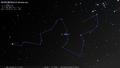 (1952) H.A. Rey's stick figure of Eridanus
 -
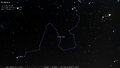 (1988) O. Hlad's stick figure of Eridanus


Mythology
Greek[1]
Ancient Greek mythology tells the story of Phaeton and the river Eridanus is often associated with this constellation. Phaeton, the radiant one, is the mortal son of the sun god Helios, who begged to be allowed to drive his sun chariot. Despite all his father's warnings, he insisted and had an accident on the way because the heavenly horses were too strong and stormy for him. When he fell from the sky, he plunged into the river Eridanus.
According to Herodotus and the geographer Strabo, Eridanus is a mythological river with no real counterpart. It is located ‘at the end of the world’. At least a century after Herodotus, it was discovered that the Earth is a sphere and therefore cannot have an edge. By Strabo's time, this had long been the accepted doctrine. Therefore, the idea of the ‘edge’ or ‘end’ of the world is probably an association with death and the eternity that follows – a popular motif for the starry sky.
Weblinks
- Warburg Institute Iconographic Database – Eridanus
- Ian Ridpath's Star Tales – Eridanus
References
- ↑ 1.0 1.1 Hoffmann, Susanne M. Wie der Löwe an den Himmel kam. Franckh Kosmos Verlag, Stuttgart 2021
- ↑ Aratus, Phainomena, Engl. translation by Kidd, Douglas, Cambridge Classical Texts and Commentaries, 34, Cambridge Univ. Press 1997
- ↑ Pamìas, Jordi und Zucker, Arnaud (2013). Ératosthènes de Cyrène: Catastérrismes, Belles Lettres, Paris
- ↑ Hoffmann, S. M., <i>Hipparchs Himmelsglobus</i>. Springer Wiesbaden/ New York, 2017. doi:10.1007/978-3-658-18683-8.
- ↑ Eratosthenes: Sternsagen, übersetzt von Pamìas, Jordi und Geus, Klaus, Verlag Utopica, Oberhaid 2007
- ↑ Vogt, H., “Versuch einer Wiederherstellung von Hipparchs Fixsternver zeichnis”, <i>Astronomische Nachrichten</i>, vol. 224, no. 2, Wiley, p. 17, 1925. doi:10.1002/asna.19252240202.
- ↑ Graßhoff, G., <i>The History of Ptolemy's Star Catalogue</i>, Springer, New York, 1990
- ↑ Hoffmann, S. M., <i>Hipparchs Himmelsglobus</i>. Springer Wiesbaden/ New York, 2017. doi:10.1007/978-3-658-18683-8.
- ↑ Glover, E. (2026). The Astronomy of Hipparchus, Cambridge University Press
- ↑ Hipparchus's Lost Star Catalogue (1/2 reconstructed) (Hoffmann, 2017) in VizieR