Nekhet: Difference between revisions
No edit summary |
|||
| (20 intermediate revisions by 3 users not shown) | |||
| Line 1: | Line 1: | ||
Authors: {{PAGEAUTHORS}} | Authors: {{PAGEAUTHORS}} | ||
---- | ---- | ||
[[File:Peg2Aql-2hi Zodiaque de Dendéra - Musée du Louvre Antiquités Egyptiennes D 38 ; E 13482.gif|thumb|Detail from the circular zodiac of Dendera between the Pegasus Square ("Peg") and a Duck depicted in Aquila ("Aql") with some figures drawn, including an animal cadava resembling the Mesopotamian constellation of The Corpse, instead of one big Giant, this image is not clearly traditionally Egyptian (photo: Musée du Louvre, GIF SMH).]] | [[File:Peg2Aql-2hi Zodiaque de Dendéra - Musée du Louvre Antiquités Egyptiennes D 38 ; E 13482.gif|thumb|Detail from the circular zodiac of Dendera between the Pegasus Square ("Peg") and a Duck depicted in Aquila ("Aql") with some figures drawn, including an animal cadava resembling the Mesopotamian constellation of The Corpse, instead of one big Giant, this image is not clearly traditionally Egyptian (photo: Musée du Louvre, GIF SMH).]] | ||
Nekhet, ''nḫt'', The Giant, is an Egyptian constellation, preserved in the 2nd millennium BCE. Based on Ramesside Star Clocks,<ref>Neugebauer, O. and Parker, R. A., 1969. ''Egyptian Astronomical Texts'', vol. III. Providence: Brown University.</ref><ref>Leitz, Ch., 1995. Altägyptische Sternuhren. OLA, 62. Leuven: Peeters.</ref> it is known that it covers 5 RA-hours.<ref name=":1">Petrie W.M.F. (1940). Wisdom of the Egyptians. London.</ref> | |||
==Concordance, Etymology, History== | ==Concordance, Etymology, History== | ||
[[File:Nekhet.png|thumb|Nekhet in hieroglyphs.]] | |||
'''Variants''' | '''Variants''' | ||
| Line 13: | Line 13: | ||
=== Sources === | === Sources === | ||
[[File:EarliestRepo_RSC_Lepsius1842-45.jpg|thumb|Earliest reproduction of a Ramesside Star Clock as one of the Egyptian astronomical ceilings in Neues Museum Berlin by Lepsius (1850); Staatliche Museen zu Berlin – Ägyptisches Museum und Papyrussammlung.]] | |||
==== Ramesside Star Clocks (RSC) ==== | |||
[[File:RamesssideStarClocks-schemaBelmonte2003.jpeg|thumb|Ramessside Star Clocks schematically, fig. 1 in Belmonte (2003)<ref name=":0" />]] | |||
[[File:Stars in Nekhet Belmonte2003-tab2 RSC.png|thumb|Stars in the Egyptian constellation The Giant, Nekhet, mentioned in the RSCs (CC BY Belmonte 2003<ref name=":0">Belmonte, J. A., 2003. The Ramesside star clocks and the ancient Egyptian constellations. In M. Blomberg, P. E. Blomberg and G. Henriksson (Eds.), ''Calendars, Symbols, and Orientations: Legacies of Astronomy in Culture'' (pp. 57–65). ''Uppsala Astronomical Observatory report'', 59. Uppsala Ocarina Books.</ref>, tab. 2).]] | [[File:Stars in Nekhet Belmonte2003-tab2 RSC.png|thumb|Stars in the Egyptian constellation The Giant, Nekhet, mentioned in the RSCs (CC BY Belmonte 2003<ref name=":0">Belmonte, J. A., 2003. The Ramesside star clocks and the ancient Egyptian constellations. In M. Blomberg, P. E. Blomberg and G. Henriksson (Eds.), ''Calendars, Symbols, and Orientations: Legacies of Astronomy in Culture'' (pp. 57–65). ''Uppsala Astronomical Observatory report'', 59. Uppsala Ocarina Books.</ref>, tab. 2).]] | ||
Ramesside Star Clocks (RSC) are ceiling paintings in some tombs in the Valley of Kings, Egypt, from the Ramesside Period.<ref>Marshall Clagett (1989). Ancient Egyptian Science: Calendars, clocks, and astronomy. American Philosophical Society.</ref> They are not actually used star clocks but information on stars in transit (probably through the meridian) provided in tabular layout. | The constellation is mentioned in the Ramesside Star Clocks (RSC) and identified by right ascension. Ramesside Star Clocks (RSC) are ceiling paintings in some tombs in the Valley of Kings, Egypt, from the Ramesside Period.<ref>Marshall Clagett (1989). Ancient Egyptian Science: Calendars, clocks, and astronomy. American Philosophical Society.</ref> They are not actually used star clocks but information on stars in transit (probably through the meridian) provided in tabular layout. It was assumed that they depict a practice in ancient Egypt to measure time by the, most likely, meridian or close to meridian transit of stars. These hour stars were single stars in a few cases or belong to constellations, some of them very large, of Egyptian sky maps. | ||
There are 16 stars related to Nekht named in the Ramesside Star Clocks (RSC)<ref name=":0" />. | There has been two dedicated approaches including an attempt to identify these hour stars: Leitz (1995)<ref name=":02">Leitz, Ch., 1995. Altägyptische Sternuhren. OLA, 62. Leuven: Peeters.</ref> and Belmonte (2003)<ref name=":12">Belmonte, J. A., 2003. The Ramesside star clocks and the ancient Egyptian constellations. In M. Blomberg, P. E. Blomberg and G. Henriksson (Eds.), ''Calendars, Symbols, and Orientations: Legacies of Astronomy in Culture'' (pp. 57–65). ''Uppsala Astronomical Observatory report'', 59. Uppsala Ocarina Books.</ref>. Pioneers Neugebauer and Parker (1969)<ref>Neugebauer, O. and Parker, R. A., 1969. ''Egyptian Astronomical Texts'', vol. III. Providence: Brown University.</ref> thought this was a worthless exercise. | ||
Leitz (1995)<ref name=":02" /> followed N&P hypothesis of stars transiting close to the southern horizon and reached a solution which for Belmonte (2003) was not satisfactory for various reasons. These are amply discussed in Lull and Belmonte (2006 & 2009)<ref name=":2">Belmonte, J.A. andd Lull, J., 2023. Astronomy in ancient Egypt: a cultural perspective. Cham: Springer.</ref>. This new hypothesis suggests that several RSC constellations were located in the northern skies such as the Giant (Nekht), the She-Hippo (Reret), the Mooring Post (Menyt) and the Bird (Apdu), among others of lesser entity (see also Davies, 1985<ref>Davis, V. L., 1985. Identifying Ancient Egyptian Constellations. ''Journal of the History of Astronomy'', ''16'', 102–104.</ref>). | |||
==== Dendera ==== | |||
<gallery> | |||
File:Nekhet2 circdendera.png|Nekhet on the circular Zodiac of Dendera (CC BY [https://collections.louvre.fr/en/ark:/53355/cl010028871 Musée du Louvre, Département des Antiquités égyptiennes]) | |||
File:Nekhet2 black inv.jpg|Constellation Nekhet, The Giant, on the circular Zodiac of Dendera, Egypt (drawing by SMH for Stellarium 2026). | |||
</gallery> | |||
=== Individual Stars / Body Parts === | |||
[[File:Nekhet RSC Belmonte+Lull2023 stellarium.jpg|thumb|Nekhet in the Ramesside Star Clocks (Belmonte and Lull 2023, drawing & mapping by SMH 2026).]] | |||
Belmonte and Lull (2023)<ref name=":22">Belmonte, J.A. andd Lull, J., 2023. Astronomy in ancient Egypt: a cultural perspective. Cham: Springer.</ref> suggest the identification of Nekhet with an area "From Aquila to the Square of Pegasus". There are 16 stars related to Nekht named in the Ramesside Star Clocks (RSC)<ref name=":0" />. | |||
{| class="wikitable" | {| class="wikitable" | ||
|+ | |+ | ||
!Star / Asterism Name | ! colspan="2" |Star / Asterism Name | ||
(transliteration) | (transliteration) | ||
!Translation | !Translation | ||
| Line 26: | Line 42: | ||
!ident. (Belmonte 2003) | !ident. (Belmonte 2003) | ||
|- | |- | ||
|tpy' ṥwty nt nḫt | |||
| | | | ||
|Predeccesor of the giant’s 2 feathers | |Predeccesor of the giant’s 2 feathers | ||
| Line 32: | Line 49: | ||
|[[Altair]] (17.1) | |[[Altair]] (17.1) | ||
|- | |- | ||
|ṥwty nt nḫt<sub>4</sub> | |||
| | | | ||
|The 2 feathers of the giant | |The 2 feathers of the giant | ||
| Line 38: | Line 56: | ||
|[[Sualocin]] -alf Del- (18.1) | |[[Sualocin]] -alf Del- (18.1) | ||
|- | |- | ||
| | |||
| | | | ||
|Head of mace (or Crown) of giant | |Head of mace (or Crown) of giant | ||
| Line 44: | Line 63: | ||
|[[Sadalsuud]] (18.5) | |[[Sadalsuud]] (18.5) | ||
|- | |- | ||
| | |||
| | | | ||
|Mace (or Crown) of the giant | |Mace (or Crown) of the giant | ||
| Line 50: | Line 70: | ||
|Area of [[Aquarius]] ? | |Area of [[Aquarius]] ? | ||
|- | |- | ||
| | |tp nḫt<sub>4</sub> | ||
|Tepennekhet | |||
|Head of the giant | |Head of the giant | ||
| | | | ||
| Line 56: | Line 77: | ||
|Area of [[Equuleus]] | |Area of [[Equuleus]] | ||
|- | |- | ||
| | |||
| | | | ||
|Nape of his neck | |Nape of his neck | ||
| Line 62: | Line 84: | ||
|[[Enif]] -alf Peg- (18.8) | |[[Enif]] -alf Peg- (18.8) | ||
|- | |- | ||
| | |||
| | | | ||
|Neck of the giant | |Neck of the giant | ||
| Line 68: | Line 91: | ||
|[[Enif]] -alf Peg- (18.8) | |[[Enif]] -alf Peg- (18.8) | ||
|- | |- | ||
| | |||
| | | | ||
|His breast | |His breast | ||
| Line 74: | Line 98: | ||
|tet Peg (19.2) or iot Peg (19.5) | |tet Peg (19.2) or iot Peg (19.5) | ||
|- | |- | ||
| | |||
| | | | ||
|Hip of the giant | |Hip of the giant | ||
| Line 80: | Line 105: | ||
|[[Markab]] -alf Peg- (20.2) | |[[Markab]] -alf Peg- (20.2) | ||
|- | |- | ||
| | |||
| | | | ||
|His shank | |His shank | ||
| Line 86: | Line 112: | ||
|[[Scheat]] -bet Peg- (20.3) | |[[Scheat]] -bet Peg- (20.3) | ||
|- | |- | ||
| | |||
| | | | ||
|Knee of the giant | |Knee of the giant | ||
| Line 92: | Line 119: | ||
|Area of the Square of [[Pegasus]] | |Area of the Square of [[Pegasus]] | ||
|- | |- | ||
| | |||
| | | | ||
|His foot | |His foot | ||
| Line 98: | Line 126: | ||
|alf And (21.3) | |alf And (21.3) | ||
|- | |- | ||
| | |||
| | | | ||
|Pedestal | |Pedestal | ||
| Line 104: | Line 133: | ||
|alf And & gam Peg (21.3) | |alf And & gam Peg (21.3) | ||
|- | |- | ||
| | |||
| | | | ||
|The one coming after his pedestal | |The one coming after his pedestal | ||
| Line 110: | Line 140: | ||
|del And (21.8) | |del And (21.8) | ||
|- | |- | ||
| | |||
| | | | ||
|star of the back of the pedestal | |star of the back of the pedestal | ||
| Line 116: | Line 147: | ||
|Area of [[Andromeda]] | |Area of [[Andromeda]] | ||
|} | |} | ||
[[File:Fig 4 45 Petrie1940 sky.jpg|thumb|Star map of the Egyptian Sky for the Ramesside Star Clocks. Petrie W.M.F. (1940)<ref name=":1" />. Wisdom of the Egyptians. London, fig. 4.45.]] | |||
[[File:Egypt Nekhet stellarium-RSC.jpg|thumb|Egyptian constellation Nekhet, The Giant, identified with Ramesside Star Clocks, mapped to Stellarium (CC BY Petrie 1940, SMH 2026). For this screenshot the time and date settings are Alexandria -1180. ]] | |||
=== Identification(s) === | === Previous Identification(s) === | ||
* "From Aquila to the Pegasus Square. Including his Feathers, Mace (or Crown) and Pedestal" (Belmonte 2003)<ref name=":0" /> | * "From Aquila to the Pegasus Square. Including his Feathers, Mace (or Crown) and Pedestal" (Belmonte 2003)<ref name=":0" /> | ||
| Line 127: | Line 160: | ||
==IAU Working Group on Star Names== | ==IAU Working Group on Star Names== | ||
The name "Nekhet" suggested to be considered by the IAU WGSN in 2023. Nekht extends for five hours of RA (from the RSCs) and it does not make justice to call a single petty star with the name of such a huge constellation. | The name "Nekhet" suggested to be considered by the IAU WGSN in 2023. Nekht extends for five hours of RA (from the RSCs) and it does not make justice to call a single petty star with the name of such a huge constellation. WGSN could call any star in the area Sebannekhet (Seba en Nekhet), meaning "Star of the Giant", i.e. this is a star of Nekht but without further details. | ||
The WGSN chose | The WGSN chose to adopt the name [[Tepennekhet]] in the IAU-CSN, as the name appears in the RSCs. | ||
== Weblinks == | == Weblinks == | ||
| Line 142: | Line 175: | ||
[[Category:Asterism]] | [[Category:Asterism]] | ||
[[Category:Constellation]] | [[Category:Constellation]] | ||
[[Category:Africa]] | [[Category:Africa]] [[Category:North Africa]] | ||
[[Category:Egyptian]] | [[Category:Egyptian]] | ||
[[Category:Peg]][[Category:Aql]] | [[Category:Peg]][[Category:Aql]] | ||
[[Category:Sge]][[Category:Del]] | [[Category:Sge]][[Category:Del]] | ||
Latest revision as of 12:53, 14 October 2026
Authors: Susanne M Hoffmann, Juan Antonio Belmonte Avilés, Youla Azkarrula

Nekhet, nḫt, The Giant, is an Egyptian constellation, preserved in the 2nd millennium BCE. Based on Ramesside Star Clocks,[1][2] it is known that it covers 5 RA-hours.[3]
Concordance, Etymology, History

Variants
- nḫt
- Nekhet
- Nekht
Sources

Ramesside Star Clocks (RSC)


The constellation is mentioned in the Ramesside Star Clocks (RSC) and identified by right ascension. Ramesside Star Clocks (RSC) are ceiling paintings in some tombs in the Valley of Kings, Egypt, from the Ramesside Period.[5] They are not actually used star clocks but information on stars in transit (probably through the meridian) provided in tabular layout. It was assumed that they depict a practice in ancient Egypt to measure time by the, most likely, meridian or close to meridian transit of stars. These hour stars were single stars in a few cases or belong to constellations, some of them very large, of Egyptian sky maps.
There has been two dedicated approaches including an attempt to identify these hour stars: Leitz (1995)[6] and Belmonte (2003)[7]. Pioneers Neugebauer and Parker (1969)[8] thought this was a worthless exercise.
Leitz (1995)[6] followed N&P hypothesis of stars transiting close to the southern horizon and reached a solution which for Belmonte (2003) was not satisfactory for various reasons. These are amply discussed in Lull and Belmonte (2006 & 2009)[9]. This new hypothesis suggests that several RSC constellations were located in the northern skies such as the Giant (Nekht), the She-Hippo (Reret), the Mooring Post (Menyt) and the Bird (Apdu), among others of lesser entity (see also Davies, 1985[10]).
Dendera
-
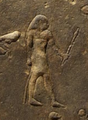 Nekhet on the circular Zodiac of Dendera (CC BY Musée du Louvre, Département des Antiquités égyptiennes)
 -
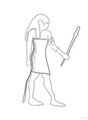 Constellation Nekhet, The Giant, on the circular Zodiac of Dendera, Egypt (drawing by SMH for Stellarium 2026).


Individual Stars / Body Parts

Belmonte and Lull (2023)[11] suggest the identification of Nekhet with an area "From Aquila to the Square of Pegasus". There are 16 stars related to Nekht named in the Ramesside Star Clocks (RSC)[4].
| Star / Asterism Name
(transliteration) |
Translation | RA (degr) | RA (h) | ident. (Belmonte 2003) | |
|---|---|---|---|---|---|
| tpy' ṥwty nt nḫt | Predeccesor of the giant’s 2 feathers | 260 | 17.3 | Altair (17.1) | |
| ṥwty nt nḫt4 | The 2 feathers of the giant | 273 | 18.4 | Sualocin -alf Del- (18.1) | |
| Head of mace (or Crown) of giant | Sadalsuud (18.5) | ||||
| Mace (or Crown) of the giant | Area of Aquarius ? | ||||
| tp nḫt4 | Tepennekhet | Head of the giant | Area of Equuleus | ||
| Nape of his neck | 280 | 18.7 | Enif -alf Peg- (18.8) | ||
| Neck of the giant | 280 | 18.7 | Enif -alf Peg- (18.8) | ||
| His breast | 290 | 19.3 | tet Peg (19.2) or iot Peg (19.5) | ||
| Hip of the giant | 300 | 20.0 | Markab -alf Peg- (20.2) | ||
| His shank | 304 | 20.2 | Scheat -bet Peg- (20.3) | ||
| Knee of the giant | 309 | 20.6 | Area of the Square of Pegasus | ||
| His foot | 317 | 21.1 | alf And (21.3) | ||
| Pedestal | 317 | 21.1 | alf And & gam Peg (21.3) | ||
| The one coming after his pedestal | 327 | 21.8 | del And (21.8) | ||
| star of the back of the pedestal | Area of Andromeda | ||||


Previous Identification(s)
- "From Aquila to the Pegasus Square. Including his Feathers, Mace (or Crown) and Pedestal" (Belmonte 2003)[4]
- "From Aquila to the Square of Pegasus" (Belmonte & Lull 2023)[12]
- Petrie's drawing also extends across this area
- The circular zodiac in Dendera the image is drawn above the "Duck" in Aquila. An accurate identification is not possible but it matches the suggestions above.
Mythology
IAU Working Group on Star Names
The name "Nekhet" suggested to be considered by the IAU WGSN in 2023. Nekht extends for five hours of RA (from the RSCs) and it does not make justice to call a single petty star with the name of such a huge constellation. WGSN could call any star in the area Sebannekhet (Seba en Nekhet), meaning "Star of the Giant", i.e. this is a star of Nekht but without further details.
The WGSN chose to adopt the name Tepennekhet in the IAU-CSN, as the name appears in the RSCs.
Weblinks
Reference
- References (general)
- References (early modern)
- Ian Ridpath's website (Star Tales )
- ↑ Neugebauer, O. and Parker, R. A., 1969. Egyptian Astronomical Texts, vol. III. Providence: Brown University.
- ↑ Leitz, Ch., 1995. Altägyptische Sternuhren. OLA, 62. Leuven: Peeters.
- ↑ 3.0 3.1 Petrie W.M.F. (1940). Wisdom of the Egyptians. London.
- ↑ 4.0 4.1 4.2 4.3 Belmonte, J. A., 2003. The Ramesside star clocks and the ancient Egyptian constellations. In M. Blomberg, P. E. Blomberg and G. Henriksson (Eds.), Calendars, Symbols, and Orientations: Legacies of Astronomy in Culture (pp. 57–65). Uppsala Astronomical Observatory report, 59. Uppsala Ocarina Books.
- ↑ Marshall Clagett (1989). Ancient Egyptian Science: Calendars, clocks, and astronomy. American Philosophical Society.
- ↑ 6.0 6.1 Leitz, Ch., 1995. Altägyptische Sternuhren. OLA, 62. Leuven: Peeters.
- ↑ Belmonte, J. A., 2003. The Ramesside star clocks and the ancient Egyptian constellations. In M. Blomberg, P. E. Blomberg and G. Henriksson (Eds.), Calendars, Symbols, and Orientations: Legacies of Astronomy in Culture (pp. 57–65). Uppsala Astronomical Observatory report, 59. Uppsala Ocarina Books.
- ↑ Neugebauer, O. and Parker, R. A., 1969. Egyptian Astronomical Texts, vol. III. Providence: Brown University.
- ↑ Belmonte, J.A. andd Lull, J., 2023. Astronomy in ancient Egypt: a cultural perspective. Cham: Springer.
- ↑ Davis, V. L., 1985. Identifying Ancient Egyptian Constellations. Journal of the History of Astronomy, 16, 102–104.
- ↑ Belmonte, J.A. andd Lull, J., 2023. Astronomy in ancient Egypt: a cultural perspective. Cham: Springer.
- ↑ Belmonte, J.A. andd Lull, J., 2023. Astronomy in ancient Egypt: a cultural perspective. Cham: Springer.





