Psalterium Georgianum: Difference between revisions
No edit summary |
|||
| (10 intermediate revisions by 3 users not shown) | |||
| Line 2: | Line 2: | ||
Authors: {{PAGEAUTHORS}} | Authors: {{PAGEAUTHORS}} | ||
---- | ---- | ||
[[File:PsalteriumGeorgium_MaxHell.png|thumb|The original (first) drawing of Psalterium | [[File:PsalteriumGeorgium_MaxHell.png|thumb|The original (first) drawing of Psalterium Georgianum in Hell (1789).]] | ||
Psalterium Georgianum, George's Harp, is an early modern constellation introduced by Maximilian Hell in 1789. | Psalterium Georgianum, George's Psaltery or Harp, is an early modern constellation introduced by Maximilian Hell in 1789. | ||
==Concordance, Etymology, History== | ==Concordance, Etymology, History== | ||
| Line 9: | Line 9: | ||
* Psalterium Georgianum | * Psalterium Georgianum | ||
* | * Psalterium Georgii | ||
* Harpa Georgii | * [[Harpa]] Georgii | ||
=== Origin of Constellation === | === Origin of Constellation === | ||
Ian Ridpath:<ref>Ian Ridpath, Star Tales, [http://www.ianridpath.com/startales/harpa.html Online Edition]</ref><blockquote>Maximilian Hell (1720–92), the Hungarian-born director of the Vienna observatory, introduced this constellation in 1789 under the name Psalterium Georgianum, i.e. George’s Psaltery, a psaltery being an ancient form of harp. It was intended to honour King George III of England, patron of William Herschel who had discovered the planet Uranus in 1781. Hell depicted the harp dangling from a ribbon beneath the hooves of Taurus on a chart in Monumenta, Aere Perenniora, Inter Astra Ponenda, a special publication issued to announce this constellation and two others he invented that commemorated William Herschel’s telescopes | Ian Ridpath:<ref>Ian Ridpath, Star Tales, [http://www.ianridpath.com/startales/harpa.html Online Edition]</ref><blockquote>Maximilian Hell (1720–92), the Hungarian-born director of the Vienna observatory, introduced this constellation in 1789 under the name Psalterium Georgianum, i.e. George’s Psaltery, a psaltery being an ancient form of harp with ten strings, also known as a salterion decacordum. It was intended to honour King George III of England, patron of William Herschel who had discovered the planet Uranus in 1781. Hell depicted the harp dangling from a ribbon beneath the hooves of Taurus on a chart in Monumenta, Aere Perenniora, Inter Astra Ponenda, a special publication issued to announce this constellation and two others he invented that commemorated William Herschel’s telescopes (see Sources below). | ||
Johann Bode adopted Hell’s new constellation on his ''Uranographia'' atlas of 1801 but simplified its name to Harpa Georgii. Bode depicted it as a more modern form of harp, dispensed with the suspending ribbon, and angled the harp to fit better between the surrounding constellations (''below''). This was the representation that became best-known, before it faded from the sky over the following decades. </blockquote> | |||
==== Source ==== | ==== Source ==== | ||
In 1789, Hell wrote a treatise in which he introduced three new constellations in the sky in honor of Herschel. It first appeared in Latin as ''Monumenta, Aere Perenniora, Inter Astra Ponenda''. | |||
The three constellations that Hell sought to introduce to the heavens are '''Tubus Herschelii Major''' (Herschel’s large telescope, held in Castor's left hand), '''Tubus Herschelii Minor''' (Herschel’s small telescope, through which Taurus the Bull gazes), and '''Psalterium Georgianum''' (George’s Harp, located beneath the legs of Taurus and in front of the mouth of the sea monster Cetus), two in honour of Herschel, and one in honor of King George III. The positions of these constellations are depicted on a total of four star charts. The fourth chart, which provides a general overview of the celestial region, displays not only the constellations but also the position of the planet Uranus, which was discovered by Herschel in 1781. | |||
In the preface, Maximilan Hell explains the introduction of the constellation:<blockquote>''Constellationem hanc formo in Tabula mea III. quae Flamsteedio est 12ma, et in Atlante minore Domini Fortin 24ta, quae eadem comparet in Tabula mea II, et Flamstedii 2da, atque Domini Fortin 14ta; itemque in Tabula mea IV, infra Taurum Zodiacalem, et inter Orionem, atque Cetum, supra Eridanum, e fixis viginti et una, nondum in ullam Constellationem ordinatis, sub figura quidem Psalterii Davidici, decem chordarum, sed nomine, Psalterii Georgiani, insignitam, quod instrumentum Musicum decem chordarum (tanquam Symbolum Decalogi Mosaici) quoniam ab hebraeo Populo ad solas decantandas laudes divinas in Templo Hierosolymitano olim adhibitum sit, mihi (et fortassis etiam Reipublicae astronomicae) maxime congruum videtur, ad Pietatem singularem Christianum Georgii III, qua inter ceteras Virtutes, et dotes Regias maxime eminet, (hoc potissimum Seculo pseudo-philosophico) Symbolice declarandam, et ad Posterorum Astronomorum memoriam perennem, sub hoc Religionis, et Pietatis Symbolo in Coelo adservandam, celebrandamque aptissimum.'' | |||
''Psalterium hoc Georgianum, ut in Tabula mea II, III, et IV exhibetur, componitur e stellis fixis Catalogi Flamsteediani, viginti et una, quarum quatuor sunt quartae magnitudinis, novem quintae, et octo sextae classis.'' | |||
''Figura autem Psalterii ea est, quae respondet descriptionibus S. Hieronymi, S. Augustini, D. Schilte, et aliorum in Kircheri Musurgia relatis: nam ea, quam Kircherus in sua Musurgia Tomi I. Libro II de Musica Hebraeorum exhibet, et quam desumpsisse se asserit ex antiquo Codice Vaticano, quaeque etiam in Opere Encyclopedico: Recueil des Planches par ordre de Materires Tomo IIItio Pl. XIV ex Kirchero deprompt proponitur, descriptionibus S. Hieronymi, et S. Augustini minime congruit: Figura Kircheri similitudinem habet Clypei quadrati, decem chordis instructi: Dominus Schilte autem illud rectius exhibet sub figura Trapezii, et nomine hebraeo Nevel, aut Nablon indicatum, quae vox significat: irganum laudatorium: inde cantus laudatorius vocatur Psalmus, quia ad pulsum Psalterii laudes divinae, et sacrae cantabantur olim ab Hebraeis.'' | |||
''Est ergo Psalterium, Graecis ψαλτήριον, Hebraeis Nablon, instrumentum musicum, decem chordarum, ut in Psalmis dicitur Ps. XXXII, vers. 2. In Psalterio, decem chordarum psalite illi, quod S. Hieronymus ita describit: "Psalterium proprie genus organi musici, melius sonans, quam Cythara, similitudinem habet Cytharae, sed non est Cythara: inter Psalterium, et Cytharam hoc interest, quod Cythara deorsum percutitur, Psalterium vero sursum, quod verbo vulgari Polyphthongum dicitur, et alio loco ait "Cythara doersum habet Cavamen, et sex chordas, Psalterium sursum habet Cavamen, et decem chordas."'' | |||
''S. Augustinus autem hoc instrumentum ita declrat: "Psalterium est organum, quod quidem manibus portatur percutientis, et choras distinctas habet, sed illum locum, unde Sonum recipium chordae, illud concavum lignum, quod pendet, et tactum resonat, quia accipit aerem, Psalterium superiore parte habet, Cythara autem hoc genus ligni Cavum, et resonans in inferiore parte habet: itaque in Psalterio chordae sonum desuper accipiunt, in Cythara autem ex inferiore parte."'' | |||
Juxta has descriptiones, PSALTERIUM GEORGIANUM (tanquam congruum Religionis, et Pietatis Georgii III Symbolum) inter Constellationes a me efformatum est. Et quoniam, juxta S. Augustinum, Psalterium hoc manibus portabatur percutientis, quod fieri nequit, nisi illud, opefaseiae cujuspiam, suspensum gestaretur, ob eam rationem fascia haec (non solius superiore mei PSALTERII GEORGIANI applicata, et stellis decem ornata cernitur. | |||
I am designing this constellation in my '''Plate III''', which corresponds to the 12th in Flamsteed’s and the 24th in Mr. Fortin’s celestial atlas; this constellation is also found on my '''Plate II''', and on the 2nd in Flamsteed’s, as well as on the 14th in Mr. Fortin’s star charts, and in my '''Map IV''', located below the zodiacal Taurus, between Orion and the Whale [Cetus], above the river Eridanus, marked by twenty-one fixed stars not yet organized into any constellation, under the figure of the ten-stringed '''Psaltery of David''', but with the name of the '''Georgian Psaltery'''. Since this musical instrument of ten strings (as a symbol of the Mosaic Decalogue) was once used by the Hebrew people solely for chanting divine praises in the Temple of Jerusalem, it seems to me (and perhaps also to the astronomical republic) most fitting for symbolically declaring the singular Christian piety of '''George III,''' which shines most brightly among his other virtues and royal gifts (especially in this pseudo-philosophical century), and most appropriate for preserving and celebrating his memory for future astronomers under this symbol of religion and piety in the heavens. | |||
This Georgian Psaltery, as it is depicted in my '''Plates II, III, and IV''', comprises '''21 stars''' from Flamsteed’s star catalog, of which four are of the fourth magnitude, nine of the fifth, and eight of the sixth magnitude. | |||
The shape of this Psaltery is exactly that which Saint Augustine and Jerome, as well as Schilte and others cited in Kircher’s ''Musurgia'', have described. For the figure which Kircher himself illustrated in his ''Musurgia'' (Book 2, Volume 1) in his description of the music of the Hebrews, which he claims to have drawn from an old Vatican codex, and which was also taken from Kircher for the French ''Encyclopédie'' (''Recueil des planches'', Vol. III, Plate XIV), does not correspond to the descriptions of Saint Jerome and Augustine. Kircher’s figure bears much resemblance to a square shield strung with ten strings; however, Mr. Schilte represents it more correctly in the shape of a '''trapezium''', with the designation ''Nebel'' or ''Nablum'', which is a Hebrew word signifying an instrument of songs of praise. Therefore, the song of praise is called a "Psalm", because the Hebrews once sang their hymns of praise during divine service while striking the psaltery. | |||
The '''Psaltery,''' psaltērion in Greek, Nablum in Hebrew, is a musical instrument of ten strings, as stated in the Psalms (Psalm 32, verse 2): Sing to him upon the psaltery of ten strings. > Saint Jerome describes it thus: 'The psaltery is properly a type of musical organ [instrument], sounding better than the cithara [lyre]. It bears a resemblance to the cithara, but it is not a cithara. The difference between the psaltery and the cithara is this: the cithara is struck from below, whereas the psaltery is struck from above, which in common parlance is called a polyphthongum [many-toned].' And in another place he says: 'The cithara has its hollow [soundbox] at the bottom and has six strings; the psaltery has its hollow at the top and has ten strings. | |||
Saint Augustine, however, explains this instrument thus: 'The psaltery is an instrument which is carried by the hands of the player and has distinct strings; but that place from which the strings receive their sound, that hollow wood which hangs and resonates when touched because it captures the air, the psaltery has in its '''upper part'''. The cithara, however, has this kind of hollow, resonant wood in its '''lower part'''. Therefore, in the psaltery, the strings receive their sound from above, but in the cithara, from the lower part. | |||
According to these descriptions, the '''GEORGIAN PSALTERY''' (as a fitting symbol of the Religion and Piety of George III) has been formed by me among the constellations. And since, according to Saint Augustine, this psaltery was carried in the hands of the player, which could not be done unless it were carried suspended by the help of some strap, for that reason, this '''strap''' (or band) is seen applied to the upper part of my GEORGIAN PSALTERY, adorned with ten stars. | |||
(Translation: Doris Vickers)</blockquote> | |||
==== Identifications ==== | ==== Identifications ==== | ||
The exact area covered by this image differs between the historical atlases, but it in the area where Taurus, Cetus and Eridanus meet. | The exact area covered by this image differs between the historical atlases, but it in the area where Taurus, Cetus and Eridanus meet. | ||
=== Transfer and Transformation of the Constellation === | === Transfer and Transformation of the Constellation === | ||
| Line 24: | Line 54: | ||
File:Harpa Georgii.JPG|Harpa Georgii in the Uranographia of Johann Bode (1801). | File:Harpa Georgii.JPG|Harpa Georgii in the Uranographia of Johann Bode (1801). | ||
File:Sidney Hall - Urania's Mirror - Psalterium Georgii, Fluvius Eridanus, Cetus, Officina Sculptoris, Fornax Chemica, and Machina Electrica.jpg|Sidney Hall (1825), plate 28 in ''Urania's Mirror'' | File:Sidney Hall - Urania's Mirror - Psalterium Georgii, Fluvius Eridanus, Cetus, Officina Sculptoris, Fornax Chemica, and Machina Electrica.jpg|Sidney Hall (1825), plate 28 in ''Urania's Mirror'' | ||
File:Psalterium Georgii.jpg|Alexander Jamieson (1822). Orion, | File:Psalterium Georgii.jpg|Alexander Jamieson (1822). Orion, Psalterium Georgii, Sceptrum Brandenburgium, Lepus and Columba Noachi | ||
File:Psalterium Georgianum Constellation Position.jpg|Psalterium Georgianum Constellation Position on a modern map | File:Psalterium Georgianum Constellation Position.jpg|Psalterium Georgianum Constellation Position on a modern map | ||
</gallery> | </gallery> | ||
| Line 41: | Line 71: | ||
[[Category:European]] [[Category:Asterism]] [[Category:Constellation]] | [[Category:European]] [[Category:Asterism]] [[Category:Constellation]] | ||
[[Category:Tau]] | [[Category:Tau]][[Category:Cet]][[Category:Eri]] | ||
Latest revision as of 10:22, 18 May 2026
Authors: Doris Vickers, Susanne M Hoffmann, IanRidpath

Psalterium Georgianum, George's Psaltery or Harp, is an early modern constellation introduced by Maximilian Hell in 1789.
Concordance, Etymology, History
Variants
- Psalterium Georgianum
- Psalterium Georgii
- Harpa Georgii
Origin of Constellation
Ian Ridpath:[1]
Maximilian Hell (1720–92), the Hungarian-born director of the Vienna observatory, introduced this constellation in 1789 under the name Psalterium Georgianum, i.e. George’s Psaltery, a psaltery being an ancient form of harp with ten strings, also known as a salterion decacordum. It was intended to honour King George III of England, patron of William Herschel who had discovered the planet Uranus in 1781. Hell depicted the harp dangling from a ribbon beneath the hooves of Taurus on a chart in Monumenta, Aere Perenniora, Inter Astra Ponenda, a special publication issued to announce this constellation and two others he invented that commemorated William Herschel’s telescopes (see Sources below). Johann Bode adopted Hell’s new constellation on his Uranographia atlas of 1801 but simplified its name to Harpa Georgii. Bode depicted it as a more modern form of harp, dispensed with the suspending ribbon, and angled the harp to fit better between the surrounding constellations (below). This was the representation that became best-known, before it faded from the sky over the following decades.
Source
In 1789, Hell wrote a treatise in which he introduced three new constellations in the sky in honor of Herschel. It first appeared in Latin as Monumenta, Aere Perenniora, Inter Astra Ponenda.
The three constellations that Hell sought to introduce to the heavens are Tubus Herschelii Major (Herschel’s large telescope, held in Castor's left hand), Tubus Herschelii Minor (Herschel’s small telescope, through which Taurus the Bull gazes), and Psalterium Georgianum (George’s Harp, located beneath the legs of Taurus and in front of the mouth of the sea monster Cetus), two in honour of Herschel, and one in honor of King George III. The positions of these constellations are depicted on a total of four star charts. The fourth chart, which provides a general overview of the celestial region, displays not only the constellations but also the position of the planet Uranus, which was discovered by Herschel in 1781.
In the preface, Maximilan Hell explains the introduction of the constellation:
Constellationem hanc formo in Tabula mea III. quae Flamsteedio est 12ma, et in Atlante minore Domini Fortin 24ta, quae eadem comparet in Tabula mea II, et Flamstedii 2da, atque Domini Fortin 14ta; itemque in Tabula mea IV, infra Taurum Zodiacalem, et inter Orionem, atque Cetum, supra Eridanum, e fixis viginti et una, nondum in ullam Constellationem ordinatis, sub figura quidem Psalterii Davidici, decem chordarum, sed nomine, Psalterii Georgiani, insignitam, quod instrumentum Musicum decem chordarum (tanquam Symbolum Decalogi Mosaici) quoniam ab hebraeo Populo ad solas decantandas laudes divinas in Templo Hierosolymitano olim adhibitum sit, mihi (et fortassis etiam Reipublicae astronomicae) maxime congruum videtur, ad Pietatem singularem Christianum Georgii III, qua inter ceteras Virtutes, et dotes Regias maxime eminet, (hoc potissimum Seculo pseudo-philosophico) Symbolice declarandam, et ad Posterorum Astronomorum memoriam perennem, sub hoc Religionis, et Pietatis Symbolo in Coelo adservandam, celebrandamque aptissimum.
Psalterium hoc Georgianum, ut in Tabula mea II, III, et IV exhibetur, componitur e stellis fixis Catalogi Flamsteediani, viginti et una, quarum quatuor sunt quartae magnitudinis, novem quintae, et octo sextae classis.
Figura autem Psalterii ea est, quae respondet descriptionibus S. Hieronymi, S. Augustini, D. Schilte, et aliorum in Kircheri Musurgia relatis: nam ea, quam Kircherus in sua Musurgia Tomi I. Libro II de Musica Hebraeorum exhibet, et quam desumpsisse se asserit ex antiquo Codice Vaticano, quaeque etiam in Opere Encyclopedico: Recueil des Planches par ordre de Materires Tomo IIItio Pl. XIV ex Kirchero deprompt proponitur, descriptionibus S. Hieronymi, et S. Augustini minime congruit: Figura Kircheri similitudinem habet Clypei quadrati, decem chordis instructi: Dominus Schilte autem illud rectius exhibet sub figura Trapezii, et nomine hebraeo Nevel, aut Nablon indicatum, quae vox significat: irganum laudatorium: inde cantus laudatorius vocatur Psalmus, quia ad pulsum Psalterii laudes divinae, et sacrae cantabantur olim ab Hebraeis.
Est ergo Psalterium, Graecis ψαλτήριον, Hebraeis Nablon, instrumentum musicum, decem chordarum, ut in Psalmis dicitur Ps. XXXII, vers. 2. In Psalterio, decem chordarum psalite illi, quod S. Hieronymus ita describit: "Psalterium proprie genus organi musici, melius sonans, quam Cythara, similitudinem habet Cytharae, sed non est Cythara: inter Psalterium, et Cytharam hoc interest, quod Cythara deorsum percutitur, Psalterium vero sursum, quod verbo vulgari Polyphthongum dicitur, et alio loco ait "Cythara doersum habet Cavamen, et sex chordas, Psalterium sursum habet Cavamen, et decem chordas."
S. Augustinus autem hoc instrumentum ita declrat: "Psalterium est organum, quod quidem manibus portatur percutientis, et choras distinctas habet, sed illum locum, unde Sonum recipium chordae, illud concavum lignum, quod pendet, et tactum resonat, quia accipit aerem, Psalterium superiore parte habet, Cythara autem hoc genus ligni Cavum, et resonans in inferiore parte habet: itaque in Psalterio chordae sonum desuper accipiunt, in Cythara autem ex inferiore parte."
Juxta has descriptiones, PSALTERIUM GEORGIANUM (tanquam congruum Religionis, et Pietatis Georgii III Symbolum) inter Constellationes a me efformatum est. Et quoniam, juxta S. Augustinum, Psalterium hoc manibus portabatur percutientis, quod fieri nequit, nisi illud, opefaseiae cujuspiam, suspensum gestaretur, ob eam rationem fascia haec (non solius superiore mei PSALTERII GEORGIANI applicata, et stellis decem ornata cernitur.
I am designing this constellation in my Plate III, which corresponds to the 12th in Flamsteed’s and the 24th in Mr. Fortin’s celestial atlas; this constellation is also found on my Plate II, and on the 2nd in Flamsteed’s, as well as on the 14th in Mr. Fortin’s star charts, and in my Map IV, located below the zodiacal Taurus, between Orion and the Whale [Cetus], above the river Eridanus, marked by twenty-one fixed stars not yet organized into any constellation, under the figure of the ten-stringed Psaltery of David, but with the name of the Georgian Psaltery. Since this musical instrument of ten strings (as a symbol of the Mosaic Decalogue) was once used by the Hebrew people solely for chanting divine praises in the Temple of Jerusalem, it seems to me (and perhaps also to the astronomical republic) most fitting for symbolically declaring the singular Christian piety of George III, which shines most brightly among his other virtues and royal gifts (especially in this pseudo-philosophical century), and most appropriate for preserving and celebrating his memory for future astronomers under this symbol of religion and piety in the heavens.
This Georgian Psaltery, as it is depicted in my Plates II, III, and IV, comprises 21 stars from Flamsteed’s star catalog, of which four are of the fourth magnitude, nine of the fifth, and eight of the sixth magnitude.
The shape of this Psaltery is exactly that which Saint Augustine and Jerome, as well as Schilte and others cited in Kircher’s Musurgia, have described. For the figure which Kircher himself illustrated in his Musurgia (Book 2, Volume 1) in his description of the music of the Hebrews, which he claims to have drawn from an old Vatican codex, and which was also taken from Kircher for the French Encyclopédie (Recueil des planches, Vol. III, Plate XIV), does not correspond to the descriptions of Saint Jerome and Augustine. Kircher’s figure bears much resemblance to a square shield strung with ten strings; however, Mr. Schilte represents it more correctly in the shape of a trapezium, with the designation Nebel or Nablum, which is a Hebrew word signifying an instrument of songs of praise. Therefore, the song of praise is called a "Psalm", because the Hebrews once sang their hymns of praise during divine service while striking the psaltery.
The Psaltery, psaltērion in Greek, Nablum in Hebrew, is a musical instrument of ten strings, as stated in the Psalms (Psalm 32, verse 2): Sing to him upon the psaltery of ten strings. > Saint Jerome describes it thus: 'The psaltery is properly a type of musical organ [instrument], sounding better than the cithara [lyre]. It bears a resemblance to the cithara, but it is not a cithara. The difference between the psaltery and the cithara is this: the cithara is struck from below, whereas the psaltery is struck from above, which in common parlance is called a polyphthongum [many-toned].' And in another place he says: 'The cithara has its hollow [soundbox] at the bottom and has six strings; the psaltery has its hollow at the top and has ten strings.
Saint Augustine, however, explains this instrument thus: 'The psaltery is an instrument which is carried by the hands of the player and has distinct strings; but that place from which the strings receive their sound, that hollow wood which hangs and resonates when touched because it captures the air, the psaltery has in its upper part. The cithara, however, has this kind of hollow, resonant wood in its lower part. Therefore, in the psaltery, the strings receive their sound from above, but in the cithara, from the lower part.
According to these descriptions, the GEORGIAN PSALTERY (as a fitting symbol of the Religion and Piety of George III) has been formed by me among the constellations. And since, according to Saint Augustine, this psaltery was carried in the hands of the player, which could not be done unless it were carried suspended by the help of some strap, for that reason, this strap (or band) is seen applied to the upper part of my GEORGIAN PSALTERY, adorned with ten stars.
(Translation: Doris Vickers)
Identifications
The exact area covered by this image differs between the historical atlases, but it in the area where Taurus, Cetus and Eridanus meet.
Transfer and Transformation of the Constellation
Here we give a list of all sources where the name is attested.
-
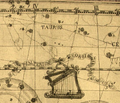 Hell (1789).
 -
 Harpa Georgii in the Uranographia of Johann Bode (1801).
 -
 Sidney Hall (1825), plate 28 in Urania's Mirror
 -
 Alexander Jamieson (1822). Orion, Psalterium Georgii, Sceptrum Brandenburgium, Lepus and Columba Noachi
 -
 Psalterium Georgianum Constellation Position on a modern map


Mythology
mnemonic tales and cultural significance
Weblinks
References
- References (general)
- ↑ Ian Ridpath, Star Tales, Online Edition