Anunitu: Difference between revisions
JanSafford (talk | contribs) Mul.Apin |
No edit summary |
||
| (19 intermediate revisions by 4 users not shown) | |||
| Line 2: | Line 2: | ||
Authors: {{PAGEAUTHORS}} | Authors: {{PAGEAUTHORS}} | ||
---- | ---- | ||
[[File:Psc-And- | [[File:Psc-And-Aqr_grp-GIF_engl.gif|alt=Andromeda, Pisces and adjacent constellation in their transformation.|right|366x366px]] | ||
{{Infobox constellation | |||
| name = 𒀀𒉡𒉌𒌓 | |||
| native = 𒀀𒉡𒉌𒌓 | |||
| translation = Anunitu (goddess) | |||
| pronounce = Anunitu | |||
| IPA = /anuni:tu/ | |||
| culture = Babylonia | |||
| RA = 9.22021384 to 19.86664022 | |||
| dec = 24.26717855 to 41.07891089 | |||
| areatotal = 111.88 | |||
| numbermainstars = 22 | |||
| numberbfstars = 18 | |||
| numberstarsplanets = | |||
| numberbrightstars = 1 | |||
| numbernearbystars = | |||
| brighteststarname = Mirach | |||
| starmagnitude = 2.05 | |||
| neareststarname = | |||
| stardistance = | |||
| numbermessierobjects = | |||
| meteorshowers = | |||
| bordering = And, Psc | |||
| notes = | |||
| cat = constellation | |||
}} | |||
''Anunītu'' (𒀭𒀀𒉡𒉌𒌓) is an asterism in human form bearing the name of the goddess Anunitu, this being an aspect or by-name for Inanna = Ištar. The stars comprising this asterism are now considered the head and breast of [[Andromeda]] and the northernmost part of [[Pisces]]. Together, astral ''Anunītu'' and <sup>mul</sup>[[SIM.MAḪ]], a huge 'Swallow,' were transformed into the images of Andromeda and Pisces with the step in between of fish and a (small) swallow connected with a ribbon, as known in Mesopotamian uranology, normal star text and seals in Uruk. The multi-step transformation is visualised in the animated GIF. | |||
== Concordance, Etymology, History<ref>[[Mesopotamian (All Terms)|Planetarium Babylonicum 2.0]], All Skies Encyclopaedia.</ref> == | |||
* <sup>mul / d</sup>''An(n)unītu(m)'' (436), | |||
<sup>mul / d</sup>''An(n)unītu(m)'' (436), = "''Anunītu''" ( | * = "''Anunītu''" (goddess): a constellation corresponding to the eastern fish in [[Pisces]] (Pisces) [Gössmann 27]. | ||
Goddess:<ref>Hoffmann, S. M. and Krebernik, M. (2023). What do deities tell us about the celestial positioning system, in: R. Rollinger, I. Madreiter, M. Lang, C. Pappi (eds.). The Intellectual Heritage of the Ancient Near East, Papers held at the 64th Rencontre Assyriologique International and 12th Melammu Symposium July 16-20 2018, Innsbruck. Austrian Academy of Sciences Press, 539-579</ref> <blockquote>Anunītu(m). By-name of the goddess Ištar, originally a local hypostasis of particular importance to the dynasty of Akkad. The association with ‘fish’ (cf. SpTU III 114A v 46, <sup>mul</sup>''Nu-nu'' ‘fish’ = <sup>d</sup>''A-nu-ni-tú/ti'') seems to be based on the partial homophony with Akk. ''nūnu'' ‘fish’, cf. the association of ''Anunītu(m)'' with the ‘Tigris-star’ in Hg: <sup>mul.íd</sup>Idigna = <sup>d</sup>''A-nu-ni-tu''<sub>4</sub> (MSL 11, 40: 229). <sup>mu''l''</sup>''A-nu-ni-tu''<sub>4</sub> (AN 3r).</blockquote>Introduced in MUL.APIN I i 42 (Hunger & Steele 2019): | Goddess:<ref>Hoffmann, S. M. and Krebernik, M. (2023). What do deities tell us about the celestial positioning system, in: R. Rollinger, I. Madreiter, M. Lang, C. Pappi (eds.). The Intellectual Heritage of the Ancient Near East, Papers held at the 64th Rencontre Assyriologique International and 12th Melammu Symposium July 16-20 2018, Innsbruck. Austrian Academy of Sciences Press, 539-579</ref> <blockquote>Anunītu(m). By-name of the goddess Ištar, originally a local hypostasis of particular importance to the dynasty of Akkad. The association with ‘fish’ (cf. SpTU III 114A v 46, <sup>mul</sup>''Nu-nu'' ‘fish’ = <sup>d</sup>''A-nu-ni-tú/ti'') seems to be based on the partial homophony with Akk. ''nūnu'' ‘fish’, cf. the association of ''Anunītu(m)'' with the ‘Tigris-star’ in Hg: <sup>mul.íd</sup>Idigna = <sup>d</sup>''A-nu-ni-tu''<sub>4</sub> (MSL 11, 40: 229). <sup>mu''l''</sup>''A-nu-ni-tu''<sub>4</sub> (AN 3r).</blockquote>Introduced in MUL.APIN I i 42 (Hunger & Steele 2019): | ||
* Transliteration: DIŠ MUL ''ša'' EGIR <sup>mul</sup>AŠ.IKU GUB''-zu'' <sup>mul</sup>''A-nu-ni-tu''<sub>4</sub> | * Transliteration: DIŠ MUL ''ša'' EGIR <sup>mul</sup>AŠ.IKU GUB''-zu'' <sup>mul</sup>''A-nu-ni-tu''<sub>4</sub> | ||
| Line 22: | Line 49: | ||
| | | | ||
|- | |- | ||
|'''Three Stars Each ( | |'''"Three Stars Each" (Astrolabes Group)''' | ||
See Horowitz 2014, 105-106 (= Enlil 2): | |||
* | * MUL ''ša''<sub>2</sub> IGI-''it'' <sup>d</sup>''En-lil''<sub>2</sub> ''ina'' ZI IM.[ULU.lu GUB] / MUL BI <sup>d</sup>''A-nu-ni''-[''tum''] | ||
* "The star that [stands] in front of Enlil (= <sup>mul</sup>apin "Plow") at the rising of the [south] wind, / this star is Anunitu" (KAV 218 Section II iii 4-5). | |||
* | Month-Star Lists: (Horowitz 2014: 195, Anu II), BM 34713 (LBAT 1499, Anu 3); BM 82923 | ||
* | |||
** a) Month Simanu, stars of Enlil, see (Kurtik s22) [[SIPA.ZI.AN.NA]]; | * <sup>mul</sup>''a-nu-ni-tu'']''m'' // 45 // <sup>d</sup>INNIN ''be-let mat nu-kur''<sub>2</sub>-''tim'' <sup>d</sup>''I''<sub>2</sub>-''gi''<sub>3</sub>-''gi''<sub>3</sub> | ||
** b) Month Araḫsamnu, stars of Anu, see (Kurtik u19) [[UR.GI7|UR.GI<sub>7</sub>]] [LBAT, 1499: 3, 8]. | * "[Anunit]u // 45 // Ištar, mistress of the hostile country, Igigi" [Horowitz 2014: 140-141,Walker and Hunger 1977, 30:6]. | ||
* The stars of Ea, Anu and Enlil. | |||
** a) A list of 12 stars of Anu (no. 3): [<sup>mul</sup>''A-nu'']-''ni-tu''<sub>4</sub> [CT 33, 9 r. 9; Horowitz 1998, 176]. | Rising and Setting Stars (Horowitz 2014: 161-162): Rising in Month II, Setting in Month VIII. | ||
** b) A list of 12 stars of Enlil (no. 2): <sup>mul</sup>''A-nu-ni-tu''<sub>4</sub> [TCL 6, 13; Rochberg-Halton 1987b, 212]. | |||
CT 39, Nv. 10, and parallels: | |||
Nv. 10 rev. 29': | |||
* <sup>mul</sup>''A-nu-ni-tu''<sub>4</sub> for Month II (Simanu), Fincke 2025, 68 [see previously Horowitz 2014: 216, Donbaz and Koch 1995: 65-66] | |||
Parallels: Fincke 2025 70: 11', 72: 4'. | |||
** | |||
** <s>(3) List (rise-set=6months): rise–Month Ayyaru, set– Month Araḫsamnu [KAV 218, C 15, 28 '''??where is C 15, 28 in Horowitz 2014???'''; Horowitz 2014, 39 col. iii 4-5, 40-41 '''??cannot find 40-41 in Horowitz 2014, 39??''']; see (Kurtik m35) [[MUL.MUL]].</s> | |||
* <s>BM 82923. Month Ayyaru, stars of Enlil: [</s> | |||
** <s>a) Month Simanu, stars of Enlil, see (Kurtik s22) [[SIPA.ZI.AN.NA]];</s> | |||
** <s>b) Month Araḫsamnu, stars of Anu, see (Kurtik u19) [[UR.GI7|UR.GI<sub>7</sub>]] [LBAT, 1499: 3, 8].</s> | |||
* <s>The stars of Ea, Anu and Enlil.</s> | |||
** <s>a) A list of 12 stars of Anu (no. 3): [<sup>mul</sup>''A-nu'']-''ni-tu''<sub>4</sub> [CT 33, 9 r. 9; Horowitz 1998, 176].</s> | |||
** <s>b) A list of 12 stars of Enlil (no. 2): <sup>mul</sup>''A-nu-ni-tu''<sub>4</sub> [TCL 6, 13; Rochberg-Halton 1987b, 212].</s> | |||
| | | | ||
|- | |- | ||
|'''EAE'''. | |'''EAE'''. | ||
See [Rochberg | See [Rochberg-Halton 1988, 219 BM 38164:4; Verderame 2002, 246; SpTU III, 101:35]. | ||
| | | | ||
|- | |- | ||
| Line 49: | Line 92: | ||
| | | | ||
|- | |- | ||
|'''LBAT 1502''' | |'''<s>LBAT 1502</s>''' | ||
* [<sup>múl</sup>''A-nu-ni-t'']''u''<sub>4</sub> is the star of Antašurra, see (Kurtik m14) [[Maš-a-ti|''maš-a-ti'']]. | * <s>[<sup>múl</sup>''A-nu-ni-t'']''u''<sub>4</sub> is the star of Antašurra, see (Kurtik m14) [[Maš-a-ti|''maš-a-ti'']].</s> | ||
| | | | ||
|- | |- | ||
|'''MUL.APIN.''' | |'''MUL.APIN.''' | ||
* (1) The stars of Anu (no. 3): MUL ''ša''<sub>2</sub> EGIR <sup>mul</sup>AŠ.IKU GUB-''zu'' ''A-nu-ni-tu''<sub>4</sub> "The star which stands behind the Field: Anunītu" (I i 42); parallel in MLC 1866 i 6 [Beaulieu et al. 2018, 35]. | * (1) The stars of Anu (no. 3): | ||
* (2) Dates of heliacal rising: ina <sup>iti</sup>ZIZ<sub>2</sub> UD 25 KAM <sup>mul</sup>''A-nu-ni-tu''<sub>4</sub> IGI.LA<sub>2</sub> "On the 25th of Šabaṭu, Anunītu becomes visible" (I iii 11). | ** MUL ''ša''<sub>2</sub> EGIR <sup>mul</sup>AŠ.IKU GUB-''zu'' ''A-nu-ni-tu''<sub>4</sub> | ||
* (3) Simultaneous daily risings and settings: <sup>mul</sup>NIN.MAḪ KUR-''ma'' <sup>mul</sup>''A-nu-ni-tu''<sub>4</sub> ŠU<sub>2</sub>-''bi'' "Ninmaḫ rises and Anunītu sets" (I iii 22). | ** "The star which stands behind the Field: Anunītu" (I i 42); parallel in MLC 1866 i 6 [Beaulieu et al. 2018, 35]. | ||
* (4) Stars "in the path of the moon": <sup>mul</sup>''A-nu-ni-tu''<sub>4</sub> | * (2) Dates of heliacal rising: | ||
** "the Tails of the Swallow, Anunitu, and the Hired Man."(I iv 37), see (Kurtik s20) ''[[Sîn]]'' [Hunger and Steele (2019) | ** ''ina'' <sup>iti</sup>ZIZ<sub>2</sub> UD 25 KAM <sup>mul</sup>''A-nu-ni-tu''<sub>4</sub> IGI.LA<sub>2</sub> | ||
** "On the 25th of Šabaṭu, Anunītu becomes visible" (I iii 11). | |||
* (3) Simultaneous daily risings and settings: | |||
** <sup>mul</sup>NIN.MAḪ KUR-''ma'' <sup>mul</sup>''A-nu-ni-tu''<sub>4</sub> ŠU<sub>2</sub>-''bi'' | |||
** "Ninmaḫ rises and Anunītu sets" (I iii 22). | |||
* (4) Stars "in the path of the moon": | |||
** KUN<sup>me</sup> <sup>mul</sup>SIM.MAḪ, <sup>mul</sup>''A-nu-ni-tu''<sub>4,</sub> <sup>mul</sup> <sup>lú</sup>ḪUN.GA<sub>2</sub> | |||
** "the Tails of the Swallow, Anunitu, and the Hired Man."(I iv 37), see (Kurtik s20) ''[[Sîn]]'' [Hunger and Steele (2019) 30, 46, 49, 69]. | |||
Text BM 77054. See (Kurtik u31) [[UZ3|UZ<sub>3</sub>]]. | Text BM 77054. See (Kurtik u31) [[UZ3|UZ<sub>3</sub>]]. | ||
|[[File:Anunitu stellarium.jpg|thumb|Anunitu painted for Stellarium by Jessica Gullberg (CC BY).]] | |[[File:Anunitu stellarium.jpg|thumb|Anunitu painted for Stellarium by Jessica Gullberg (CC BY).]] | ||
| Line 67: | Line 117: | ||
|- | |- | ||
|'''"The Great Star List".''' | |'''"The Great Star List".''' | ||
* (1) <sup>mul</sup>''a-nu-ni-tum'' = <sup>d</sup>ištar min(= ''bēlet'' | * (1) <sup>mul</sup>''a-nu-ni-tum'' = <sup>d</sup>ištar min(= ''bēlet'' KUR.KUR) "Anunītum = Ištar, ruler of countries"; | ||
* (2) <sup>mul íd</sup>idigna = <sup>d</sup>''a-nu-ni-tum'' "Tigris River = Anunītum"; | * (2) <sup>mul íd</sup>idigna = <sup>d</sup>''a-nu-ni-tum'' "Tigris River = Anunītum"; | ||
* (3) <sup>mul</sup>tul-''tum'' = <sup>d</sup>''a-nu-ni-tum'' "Worm = Anunītum", the next line probably contains a commentary: ku<sub>6</sub> | * (3) <sup>mul</sup>tul-''tum'' = <sup>d</sup>''a-nu-ni-tum'' "Worm = Anunītum", the next line probably contains a commentary: ku<sub>6</sub><sup>meš</sup> ''tu-la-a-tum'' ''u'' mušen<sup>meš</sup> ''ḫu-u''<sub>8</sub>-''u''<sub>2</sub> "Fishes–worms, and birds..." whose meaning is unclear, cf. [CAD Ḫ, 212b, N/2, 337b]; | ||
* (4) the 12 stars of Akkad [Mesop.Astrol., App. B:31, 146, 165, 208]; see also [Weidner 1959-60, 107ff]. | * (4) the 12 stars of Akkad [Mesop.Astrol., App. B:31, 146, 165, 208]; see also [Weidner 1959-60, 107ff]. | ||
| | | | ||
| Line 108: | Line 158: | ||
| | | | ||
|- | |- | ||
|'''MLC 1866''' See (Kurtik s19) [[SIM.MAḪ]]. | |<s>'''MLC 1866''' See (Kurtik s19) [[SIM.MAḪ]].</s> | ||
'''Uranologiesː''' | |||
MLC 1866 i 6-9: | |||
* MUL ''ša''<sub>2</sub> EGIR.MEŠ <sup>mul</sup>IKU GUB-''zu'' <sup>mul</sup>''A-nu-ni-tu''<sub>4</sub> ''na-a-ru'' / <sup>[mu]l</sup>''Si''<sub>2</sub>''-nu-nu-tu''<sub>4</sub> ''u''<sub>3</sub> <sup>mul</sup>''A-nu-ni-tu''<sub>4</sub> ''ina'' KUN.MEŠ-''šu''<sub>2</sub>-''nu it-gu-ru-u''<sub>2</sub>-''ma'' / ˹MUL˺.MEŠ <sup>íd</sup>IDIGNA ''u'' <sup>íd</sup>BURANUN<sup>ki</sup> ''ina ṣip-ri'' <sup>mul</sup>ZIB / ˹''ṣab-tu''<sub>4</sub>˺ <sup>mul</sup>SIM.MAḪ ''u'' GU<sub>2</sub>.LA<sub>2</sub> <sup>mul</sup>''A-nu-ni-tu''<sub>4</sub> ''man-za-za'' <sup>mul</sup>''dil-bat'' | |||
* The star that stands behind the Field is Anunitu, the river. / The [Swa]llow and Anunitu have their tails crossing each other, / the stars of the Tigris and Euphrates, by the crest of "The Tail" they are held together. The swallow and the elongated neck of Anunitu — the station of Venus" [Beaulieu et al. 2018, 35, 39]. | |||
| | | | ||
|- | |- | ||
| Line 266: | Line 323: | ||
[[File:Psc-And-Aqr grp-GIF engl.gif|alt=Andromeda, Pisces and adjacent constellation in their transformation.|thumb|Andromeda, Pisces and adjacent constellation in their transformation (animated GIF).]]Originally, "Anunītu" was a by-name of the goddess Ištar of particular importance to the Old Akkadian dynasty of the third millennium BCE. The name first appears as a name for a constellation in Astrolabe B ca. 1200 BCE (Horowitz 2014: 115) but is not in any way associated with fish. In contrast, the traditional Sumerian-Akkadian fish constellation is <sup>mul</sup>[[KU6|KU<sub>6</sub>]] = ''[[Nūnu]]'', ‘The Fish’ = [[Piscis Austrinus]], south of Aquarius and separated from this region by the Babylonian constellation of The Swallow. | [[File:Psc-And-Aqr grp-GIF engl.gif|alt=Andromeda, Pisces and adjacent constellation in their transformation.|thumb|Andromeda, Pisces and adjacent constellation in their transformation (animated GIF).]]Originally, "Anunītu" was a by-name of the goddess Ištar of particular importance to the Old Akkadian dynasty of the third millennium BCE. The name first appears as a name for a constellation in Astrolabe B ca. 1200 BCE (Horowitz 2014: 115) but is not in any way associated with fish. In contrast, the traditional Sumerian-Akkadian fish constellation is <sup>mul</sup>[[KU6|KU<sub>6</sub>]] = ''[[Nūnu]]'', ‘The Fish’ = [[Piscis Austrinus]], south of Aquarius and separated from this region by the Babylonian constellation of The Swallow. | ||
Later in the first millennium, the northern parts of the constellation ''Anunītu'' were changed into the Syrian image of the goddess Derketo (from Bambyke, depicted with accompanying fish), the goddess of Ashkelon (which was a syncretism of Babylonian Ištar and Egyptian Isis, depicted with fish-tail), and the chained maiden Andromeda honoured with a rock in Jaffa (Tel Aviv). The southern parts of the region of ''Anunītu'' and the constellation <sup>mul</sup>SIM.MAḪ = ''Šinūnūtu'' were transformed into the two fish of classical Pisces. An intermediate step between the original image of "a giant swallow and a goddess" and the later (Greco-Egyptian) "two fish connected with a ribbon", there was a Mesopotamian constellation called "Swallow-Fish". This connects most commonly Anunītu as a fish and <sup>mul</sup>SIM.MAḪ = ''Šinūnūtu'', ‘The Swallow,’ as a bird (see fig. 44-46 = Kurtik’s plates, p. 738-739). The outline of the two figures held together by a V-shaped ribbon with a star called <sup>mul</sup>ZIB at its tip. <sup>mul</sup>ZIB means ‘The | Later in the first millennium, the northern parts of the constellation ''Anunītu'' were changed into the Syrian image of the goddess Derketo (from Bambyke, depicted with accompanying fish), the goddess of Ashkelon (which was a syncretism of Babylonian Ištar and Egyptian Isis, depicted with fish-tail), and the chained maiden Andromeda honoured with a rock in Jaffa (Tel Aviv). The southern parts of the region of ''Anunītu'' and the constellation <sup>mul</sup>SIM.MAḪ = ''Šinūnūtu'' were transformed into the two fish of classical Pisces. An intermediate step between the original image of "a giant swallow and a goddess" and the later (Greco-Egyptian) "two fish connected with a ribbon", there was a Mesopotamian constellation called "Swallow-Fish". This connects most commonly Anunītu as a fish and <sup>mul</sup>SIM.MAḪ = ''Šinūnūtu'', ‘The Swallow,’ as a bird (see fig. 44-46 = Kurtik’s plates, p. 738-739). The outline of the two figures held together by a V-shaped ribbon with a star called <sup>mul</sup>ZIB at its tip. <sup>mul</sup>ZIB means ‘The Tail' and was later translated to Al-Risha, The Cord, in Arabic. The V-shaped cord apparently reminded Ancient Mesopotamians of the courses of the middle Tigris and Euphrates, which nearly touched in the vicinity of Babylon (Beaulieu et al. 2018: 44-45). | ||
[[File:RiversPlt labelled.jpg|alt=geo map|thumb|The two rivers of Mesopotamia with Babylon roughly at the closest encounter (equalling the knot of the cords in the sky).]] | [[File:RiversPlt labelled.jpg|alt=geo map|thumb|The two rivers of Mesopotamia with Babylon roughly at the closest encounter (equalling the knot of the cords in the sky).]] | ||
A related philological link between the two constellations and fish is that the Akkadian word for ‘fish,’ ''Nūnu'', forms part of both Akkadian constellation names, ''A'''nun'''ītu'' and ''Ši'''nūnū'''tu,'' making classical Pisces in Babylonian terms a super-constellation. | A related philological link between the two constellations and fish is that the Akkadian word for ‘fish,’ ''Nūnu'', forms part of both Akkadian constellation names, ''A'''nun'''ītu'' and ''Ši'''nūnū'''tu,'' making classical Pisces in Babylonian terms a super-constellation. | ||
| Line 283: | Line 340: | ||
==== Deity. ==== | ==== Deity. ==== | ||
Anunitu—goddess, probably of Western Semitic origin, had a warlike character. Her name, originally used as an epithet of Inanna, perhaps to be connected with Akkadian '''anantu'',' a poetic term for 'battle, strife,' with reference to Inanna's role as a goddess of war. She was considered as an independent goddess during the Ur III era and further towards the end of the first millennium BCE in Mesopotamia, where she retained her warlike characteristics. According to Nabonidus, she is "the mistress of battle, the one who carries a bow and a quiver" ( | Anunitu—goddess, probably of Western Semitic origin, had a warlike character. Her name, originally used as an epithet of Inanna, perhaps to be connected with Akkadian '''anantu'',' a poetic term for 'battle, strife,' with reference to Inanna's role as a goddess of war. She was considered as an independent goddess during the Ur III era and further towards the end of the first millennium BCE in Mesopotamia, where she retained her warlike characteristics. According to Nabonidus, she is "the mistress of battle, the one who carries a bow and a quiver" (GAŠAN ME<sub>3</sub> ''na-ša''<sub>2</sub>-''ta'' <sup>giš</sup>PAN ''u''<sub>3</sub> ''iš-pa-ti'') [Schaudig 2001, 424: III 23, 439]. On the early history of Anunitu see [Gelb 1987, 130-132; Roberts 1972, 147; Selz 2000, 34-35, note 81; Tallqvist 1938, 255]. | ||
===== Prayers and rituals. ===== | ===== Prayers and rituals. ===== | ||
| Line 415: | Line 472: | ||
* Hoffmann and Krebernik (2023) | * Hoffmann and Krebernik (2023) | ||
[[Category:Asterism]] | [[Category:Asterism]][[Category:Constellation]] | ||
[[Category:Constellation]] | [[Category:Eurasia]][[Category:West Asian]] [[Category:Asian]][[Category:Mesopotamian]] | ||
[[Category:West Asian]] | [[Category:Cuneiform]] [[Category:Akkadian]] | ||
[[Category:Mesopotamian]] | [[Category:Rubric]] [[Category:Lunar System]] [[Category:Zodiac]] | ||
[[Category:Cuneiform]] | |||
[[Category:And]][[Category:Psc]] | [[Category:And]][[Category:Psc]] | ||
Latest revision as of 19:46, 17 July 2026
Authors: Susanne M Hoffmann, Gennady E. Kurtik, Euin Choung Kim, David Hilder, Wayne Horowitz, Jan Safford, Hermann Hunger, Youla Azkarrula

| Asterism Info | |
| Native | 𒀀𒉡𒉌𒌓 |
|---|---|
| Romanisation | Anunitu |
| IPA | /anuni:tu/ |
| Translation | Anunitu (goddess) |
| Position (2000) | |
| Right ascension | 9.22021384 to 19.86664022 |
| Declination | 24.26717855 to 41.07891089 |
| Area | 111.88 sq. deg. |
| Stars | |
| Bright stars | 22 |
| Bayer/Flamsteed stars | 18 |
| Stars brighter than 3.00m | 1 |
| Brightest star | Mirach (2.05m) |
| Taxonomy | |
| category of asterism | constellation |
| IAU- constellations | And, Psc |
Anunītu (𒀭𒀀𒉡𒉌𒌓) is an asterism in human form bearing the name of the goddess Anunitu, this being an aspect or by-name for Inanna = Ištar. The stars comprising this asterism are now considered the head and breast of Andromeda and the northernmost part of Pisces. Together, astral Anunītu and mulSIM.MAḪ, a huge 'Swallow,' were transformed into the images of Andromeda and Pisces with the step in between of fish and a (small) swallow connected with a ribbon, as known in Mesopotamian uranology, normal star text and seals in Uruk. The multi-step transformation is visualised in the animated GIF.
Concordance, Etymology, History[1]
- mul / dAn(n)unītu(m) (436),
- = "Anunītu" (goddess): a constellation corresponding to the eastern fish in Pisces (Pisces) [Gössmann 27].
Goddess:[2]
Anunītu(m). By-name of the goddess Ištar, originally a local hypostasis of particular importance to the dynasty of Akkad. The association with ‘fish’ (cf. SpTU III 114A v 46, mulNu-nu ‘fish’ = dA-nu-ni-tú/ti) seems to be based on the partial homophony with Akk. nūnu ‘fish’, cf. the association of Anunītu(m) with the ‘Tigris-star’ in Hg: mul.ídIdigna = dA-nu-ni-tu4 (MSL 11, 40: 229). mulA-nu-ni-tu4 (AN 3r).
Introduced in MUL.APIN I i 42 (Hunger & Steele 2019):
- Transliteration: DIŠ MUL ša EGIR mulAŠ.IKU GUB-zu mulA-nu-ni-tu4
- Akkadian: kakkabu ša arki Ikî izzazzu Anunītu
- English: The asterism which stands behind the Field: Anunitu.
Sources and Identification(s)
| Sources | Identifications |
|---|---|
Lexical texts.
Variant MUL NU.NU without the divine determinative also in Fadhil and Hilgert 2007: 99, 29'. |
|
| "Three Stars Each" (Astrolabes Group)
See Horowitz 2014, 105-106 (= Enlil 2):
Month-Star Lists: (Horowitz 2014: 195, Anu II), BM 34713 (LBAT 1499, Anu 3); BM 82923
Rising and Setting Stars (Horowitz 2014: 161-162): Rising in Month II, Setting in Month VIII. CT 39, Nv. 10, and parallels: Nv. 10 rev. 29':
Parallels: Fincke 2025 70: 11', 72: 4'.
|
|
| EAE.
See [Rochberg-Halton 1988, 219 BM 38164:4; Verderame 2002, 246; SpTU III, 101:35]. |
|
| Šumma Sîn ina tāmartīšu.
See [Koch-Westenholz 1999, 161:120]. |
|
Text Nv. 10.
|
|
|
|
MUL.APIN.
Text BM 77054. See (Kurtik u31) UZ3 (𒍚, Akkadian Enzu). |
 |
| "Reports."
See [SAA 8, 355 r. 3, 357:5, 538:5]. |
|
"The Great Star List".
|
|
"Planisphere" K 8538.
|
|
Dalbanna-text.
|
|
List of stars VR 46, 1:34.
|
|
"Astronomical Diaries and Related Texts"
|
|
Uranologiesː MLC 1866 i 6-9:
|
|
Text W. 22281a.
"On the 15th of Du'uzu with the rise of the Sun, the Horn of the Stag, Anunitu and the middle of the Fish are in equilibrium; on the 15th of Ṭebetu in the evening with sunset the same thing takes place." [SpTU I, 95:7′-8′; ASM, 99; Steele (2017) 29f. = J. M. Steele, Rising Time Schemes in Babylonian Astronomy, Springer 2017]. |

Stars within the Constellation Area
| id | Label | IAU design. | description | Vmag |
|---|---|---|---|---|
| 1 | Mirach | HIP 5447 | Constellation lines (Vertex) | 2.05 |
| 2 | δ Andromedae | HIP 3092 | Constellation lines (Vertex) | 3.28 |
| 3 | μ Andromedae | HIP 4436 | Constellation lines | 3.87 |
| 4 | Shimu | HIP 3693 | Constellation lines (Vertex) | 4.06 |
| 5 | π Andromedae | HIP 2912 | Constellation lines (Vertex) | 4.36 |
| 6 | τ Piscium | HIP 5586 | Constellation lines | 4.511 |
| 7 | ν Andromedae | HIP 3881 | Constellation lines (Vertex) | 4.53 |
| 8 | υ Piscium | HIP 6193 | Constellation lines (Vertex) | 4.748 |
| 9 | 82 Psc | HIP 5544 | Inside the Hull | 5.152 |
| 10 | 32 And | HIP 3231 | Constellation lines (Vertex) | 5.33 |
| 11 | 68 Psc | HIP 4510 | Inside the Hull | 5.438 |
| 12 | σ Piscium | HIP 4889 | Inside the Hull | 5.5 |
| 13 | - | HIP 4552 | Inside the Hull | 5.98 |
| 14 | - | HIP 4185 | Inside the Hull | 6.057 |
| 15 | 67 Psc | HIP 4366 | Inside the Hull | 6.1 |
| 16 | - | HIP 5034 | Inside the Hull | 6.202 |
| 17 | - | HIP 5679 | Inside the Hull | 6.23 |
| 18 | 76 Psc | HIP 5175 | Inside the Hull | 6.26 |
| 19 | * 65 Psc B | HIP 3885 | Inside the Hull | 6.28 |
| 20 | * 65 Psc A | HIP 3885 | Inside the Hull | 6.29 |
| 21 | BD+26 128 | BD+26 128 | Inside the Hull | 6.3 |
| 22 | DT Psc | HIP 5772 | Inside the Hull | 6.347 |
Transformation of the constellation
Originally, "Anunītu" was a by-name of the goddess Ištar of particular importance to the Old Akkadian dynasty of the third millennium BCE. The name first appears as a name for a constellation in Astrolabe B ca. 1200 BCE (Horowitz 2014: 115) but is not in any way associated with fish. In contrast, the traditional Sumerian-Akkadian fish constellation is mulKU6 = Nūnu, ‘The Fish’ = Piscis Austrinus, south of Aquarius and separated from this region by the Babylonian constellation of The Swallow.
Later in the first millennium, the northern parts of the constellation Anunītu were changed into the Syrian image of the goddess Derketo (from Bambyke, depicted with accompanying fish), the goddess of Ashkelon (which was a syncretism of Babylonian Ištar and Egyptian Isis, depicted with fish-tail), and the chained maiden Andromeda honoured with a rock in Jaffa (Tel Aviv). The southern parts of the region of Anunītu and the constellation mulSIM.MAḪ = Šinūnūtu were transformed into the two fish of classical Pisces. An intermediate step between the original image of "a giant swallow and a goddess" and the later (Greco-Egyptian) "two fish connected with a ribbon", there was a Mesopotamian constellation called "Swallow-Fish". This connects most commonly Anunītu as a fish and mulSIM.MAḪ = Šinūnūtu, ‘The Swallow,’ as a bird (see fig. 44-46 = Kurtik’s plates, p. 738-739). The outline of the two figures held together by a V-shaped ribbon with a star called mulZIB at its tip. mulZIB means ‘The Tail' and was later translated to Al-Risha, The Cord, in Arabic. The V-shaped cord apparently reminded Ancient Mesopotamians of the courses of the middle Tigris and Euphrates, which nearly touched in the vicinity of Babylon (Beaulieu et al. 2018: 44-45).

A related philological link between the two constellations and fish is that the Akkadian word for ‘fish,’ Nūnu, forms part of both Akkadian constellation names, Anunītu and Šinūnūtu, making classical Pisces in Babylonian terms a super-constellation.
The lexical text Urra XXII 303: mul dNU-NU = dA-nu-ni-tum, makes use of a pseudo-Sumerian name for the constellation in the left Sumerian column that is meant to be understood as a loan-word from Akkadian Nūnu, so too Fadhil and Hilgert 2007: 99, 29' mulNU.NU = dA-nu-ni-tum.
There is yet no native Sumerian name for the group of stars that are later seen as the goddess Anunitu from at least the end of the second millennium onwards. One might guess that an original Sumerian name for an asterism in this area of the sky was forgotten when it became associated with the Akkadian goddess Anunitum, perhaps even as early as the Old Akkadian period when the goddess Anunitum first became important.
-
 Ištar holding her symbol. Terracotta relief, early 2nd millennium BC. From Ešnunna (figurine AO 12456, Louvre, dating between 2004 and 1595 BCE)
 -
 Ištar as naked beauty. Terracotta plaque, showing the goddess Ištar (Inanna), wearing the horned headdress and a necklace. 19th-17th century BCE. From Iraq. Pergamon Museum, Berlin, Germany (CC By Osama Shukir Muhammed Amin).
 -
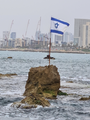 Andromeda's Rock in front of the skyline of modern Tel Aviv. (Susanne M Hoffmann, 2023)
 -
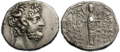 Coin from Ashkelon, reign of Demetrios III Eucairos (115-98 BCE; Greek Δημήτριος Θεός Φιλοπάτωρ Σωτήρ Dēmḗtrios Theós Philopátōr Sōtḗr) with the revers showcasing the goddess with a fish-tail.
 -
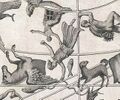 Andromeda on the marble globe of the Atlas Farnese (2nd c. CE) with one of the fish of Pisces next to her. Engraving of the Farnese globe by Louis-Philippe Boitard (fl. 1733–58).
 -
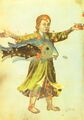 Andromeda in as-Sufi's illustrated book (10th century) depicted as Syrian Derketo with two fish as attribute


Addition (Kurtik and Horowitz)
Deity.
Anunitu—goddess, probably of Western Semitic origin, had a warlike character. Her name, originally used as an epithet of Inanna, perhaps to be connected with Akkadian 'anantu,' a poetic term for 'battle, strife,' with reference to Inanna's role as a goddess of war. She was considered as an independent goddess during the Ur III era and further towards the end of the first millennium BCE in Mesopotamia, where she retained her warlike characteristics. According to Nabonidus, she is "the mistress of battle, the one who carries a bow and a quiver" (GAŠAN ME3 na-ša2-ta gišPAN u3 iš-pa-ti) [Schaudig 2001, 424: III 23, 439]. On the early history of Anunitu see [Gelb 1987, 130-132; Roberts 1972, 147; Selz 2000, 34-35, note 81; Tallqvist 1938, 255].
Prayers and rituals.
- (1) The ritual of the "washing of the mouth" (mīs pî) or the "revival" of the statue-deity, see (Kurtik a48) AŠ.GAN2.
Exactly when Anunitu acquired astral significance is unknown. The earliest text in which Anunitu is mentioned as a constellation is Astrolabe B (Horowitz 2014, 115).
Symbol.
Anunitu as a deity originally had no attributes of water. However, in the astronomical texts she is closely connected with water. In the 1st millennium BCE her symbol in the sky was considered to be a fish. In the only lexical text where we meet the name Anunitu, it corresponds to mul.nu.nu "fish" in the column of Sumerian (?!) names. For Seleucid depictions of fish in various combinations and especially of the astral pair "fish (=Anunitu) and bird (= flying fish or Swallow)" on the seals from Uruk see [AUWE 19, 128-12]. [AUWE 19, 128-129, 156; Kurtik 2007, Figures 25-27, 44-46)]. See also the astrological prediction in which two fish are mentioned when describing Mercury's position in the constellation Tails, (Kurtik k27) KUNme(š), III 2.
Astrology.
(1) Eclipse of the Moon in Anunitu: [DIŠ 30 ina] KI mulA-nu-ni-tum a-d[ir EŠ.BAR ídIDIGNA u EŠ.BAR A.GA.DE3ki] "[If the Moon] is dark in the area of Anunitu: decision for the Tigris River and for Akkad" [Rochberg-Halton 1988, 219, BM 38164:4]; for a parallel see [Weidner 1963, 118, MNB 1849 Rs. 50; Steele 2015, 209; Kurtik 2010]; apodosis variant: ... EŠ.BAR ídIDIGNA u A-ga-de3ki u3 EŠ.BAR A.AB.BAki KUR.˹DILMUN˺ki "...: decision for the Tigris River and Akkad and decision for the sea country and Dilmun" [Verderame 2002, 54 Tablet IIa:7′].
(2) Venus and Anunitu: DIŠ mu[l t]ul!-tum gup-pu!-šat / ARḪUŠ u SILIM-mu ina KUR GAL2-ši / muldil-bat ina ŠA3 mulA-nu-ni-tum GUB-ma "If the Worm is extremely massive: / in the country there will be welfare and peace. / (This means:) Venus stands within Anunitu" [SAA 8, 357:3-5]; for parallels see [ibid. 538:3-5; BPO 2, III 10a, XV 25].
(3) Saturn stands within the Swallow or Anunitu; see (Kurtik k24) KU6, V 10.
See also (Kurtik k05) KA.MUŠ.I3.GU7.E, IV 1.
Historical Dictionaries
| Kurtik (2022, a42) | Gössmann (1950) in German |
|---|---|
| «Ануниту»; созвездие, соответствующее восточной рыбе в Рыбах (Pisces) [Gössmann 1950 27].
I. Источники. Лексич. тексты. Серия Urra XXII: mul dnu.nu = dA-nu-ni-ti/tu2 «Рыба = Ануниту» [SpTU III, 114A v 46; Bloch–Horowitz 2015, 109:303′]; cм. также E2.TUR3. «Астролябии». Astrolabe P. Месяц айяру, звезды Энлиля, 55 [Pinches 1900, 573]. Astrolabe B: (1) Cписок (12´3): mul ša2 igi-it dEn-lil2 ina zi im.[kur.ra] <gub-zu> / mul.bi dA-nu-ni-[tum] «Звезда, которая впереди Энлиля (= mulapin «Плуг») при восходе восточного ветра [стоит], / Звезда эта Ануниту» (B iii 4–5). (2) Список (3´12): itigu4 … mulA-nu-ni-tum šu-ut dEn-[lil2] «Месяц айяру: … Ануниту (на пути) Энлиля (восходит)» (C iii 2). (3) Список (восход–заход=6m): восход — айяру, заход — арахсамну [KAV 218, С 15, 28; Horowitz 2014, 39 col. iii 4–5, 40–41]; см. m35MUL.MUL. BM 82923. Месяц айяру, звезды Энлиля: [mula-nu-ni-tu]m // 45 // dINNIN be-let mat nu-kur2-tim dI2-gi3-gi3 «Ануниту // 45 // Иштар, госпожа враждебной страны, Игиги» [Walker–Hunger 1977, 30:6]. BM 34713. múlA-nu-ni-tu2 (дважды!): a) месяц симану, звезды Энлиля, см. s22SIPA.ZI.AN.NA; b) месяц арахсамну, звезды Ану, см. u19UR.GI7 [LBAT, 1499: 3, 8]. Звезды Эа, Ану и Энлиля. a) Список 12 звезд Ану (№ 3): [mulA-nu]-ni-tu4 [CT 33, 9 r. 9; Horowitz 1998, 176]. b) Список 12 звезд Энлиля (№ 2): mulA-nu-ni-tu4 [TCL 6, 13; Rochberg-Halton 1987b, 212]. EAE. Cм. [Rochberg and Halton 1988, 219, BM 38164:4; Verderame 2002, 246; SpTU III, 101:35]. Šumma Sîn ina tāmartīšu. См. [Koch-Westenholz 1999, 161:120]. MUL.APIN. (1) Звезды Ану (№ 3): MUL ša2 EGIR mulAŠ.IKU GUB-zu A-nu-ni-tu4 «Звезда, которая позади Поля стоит: Ануниту» (I i 42); параллель в MLC 1866 (i 6) [Beaulieu et al. 2018]. (2) Даты гелиакических восходов: ina itiZIZ2 UD 25 KAM mulA-nu-ni-tu4 IGI.LA2 «25-го шабату Ануниту становится видна» (I iii 11). (3) Одновременные суточные восходы и заходы: mulNIN.MAḪ KUR-ma mulA-nu-ni-tu4 ŠU2-bi «Нинмах восходит, Ануниту заходит» (I iii 22). (4) Звезды «на пути Луны»: mulA-nu-ni-tu4, после mulSIM.MAḪ, перед mul lúḪUN.GA2 (I iv 37), см. s20Sîn [Hunger and Steele (2019), 30, 46, 49, 69]. «Рапорты». См. [SAA 8, 355 r. 3, 357:5, 538:5]. Текст BM 77054. См. u31UZ3. «Большой список звезд». (1) mula-nu-ni-tum = dištar min(= bēlet kur.kur) «Анунитум = Иштар, владычица стран»; (2) mul ídidigna = da-nu-ni-tum «Река Тигр = Анунитум»; (3) multul-tum = da-nu-ni-tum «Червь = Анунитум», следующая строка, возможно, содержит комментарий: ku6.meš tu-la-a-tum u mušen.meš ḫu-u8-u2 «Рыбы — черви, птицы — …», смысл которого неясен, см. [CAD Ḫ, 212b, N/2, 337b]; (4) 12 звезд Аккада [Mesop.Astrol., App. B:31, 146, 165, 208]; см. также [Weidner 1959–60, 107ff]. «Планисфера» К 8538. В секторе 1 надпись по внешнему кругу: mulA-nu-n[i-tu4] [Koch 1989, 56]. Dalbanna-текст. §D. [mul] ˹gub3˺ [ḫe]-pi2 eš-šu2 mul dil.bat ša2 a-nu-ni-t[i [mul …-ḫu?-u2 ša2 z]ag AŠ.GAN2 ˹3 mul˺.meš ˹sag˺.d[u3] «Левая [звезда]. Новое [пов]реждение. Звезда с большим блеском Анунит[у (γ Peg) … пр]авая Поля (α Peg). 3 звезды. Треугольник.» [Walker 1995, 29; ASM, 105]; согласно [Koch 1995, 44, 57], [mul] ˹gub3˺ [ḫe]-pi2 eš-šu2 = [mul] ˹gub3˺ [ša2 zag AŠ-iku] «Левая звезда правой стороны Поля», [mul …-ḫu?-u2 ša2 z]ag AŠ-iku = [mul a-ḫu2-u2 ša2 z]ag AŠ-iku «боковая звезда с правой стороны Поля». §E. mul dil.bat ša2 ˹a˺-[nu-ni-ti] «Звезда с большим блеском Ану[ниту]» (γ Peg), см. k05KA.MUŠ.I3.KU2.E. §F. mul dil.bat ša2 a-nu-ni-t[i], mul dil.bat ša2 a-nu-ni-ti maḫ-r[u], см. sh02ŠAD. §J. m[ul dil.bat ša2] ˹a˺-nu-ni-ti, см. u06UD.KA.DU8.A. §K. [mu]l ka x x x […] x-ab-ri a-nu-ni-ti 3 mul.meš maš šar2 «mulKA[…], плавник Ануниту (υ Psc): 3 звезды, maš šar2» [Walker 1995, 31; ASM, 196]; согласно [Koch 1995, 45, 58], [mu]l ka x x x = [mu]lka l[u?.li]m? «Рот Оленя»(ε Cas), […] = [mul giš-ši lu.lim]? «[бедро Оленя]» (γ Cas), x-ab-ri a-nu-ni-ti = ˹mul˺ab-ri A-nu-ni-ti «Плавник Ануниту». §L. [mul …] x […] = [muldil.bat ša2 A-nu-ni-ti]? «[Звезда с большим блеском Ануниту]» (γ Peg) [Koch 1995, 45, 58]. §T. muldil.bat ša2 a-nu-ni-ti, см. k05KA.MUŠ.I3.KU2.E. §x. muldil.bat a-nu-ni-ti, см. u06UD.KA.DU8.A. Список звезд VR 46, 1:34. mulA-nu-ni-tu4 u mulŠi-nu-nu-tu4 = ídidigna u ídburanun «Ануниту и Ласточка = Тигр и Евфрат», см. также [HBA, 52; Wee 2016, 162:34]. Текст Nv. 10. mulA-nu-ni-tu4 — звезда AN.TA.GUB.BA в месяце симану, см. sh17ŠU.PA. LBAT 1502. [múlA-nu-ni-t]u4 — звезда Анташурра, см. m14maš-a-ti. «Дневники наблюдений». DUR ša2 A-nu-n[i-tu4] «Лента Ануниту» [Sachs and Hunger Diaries I, No.-567, Month XI: 20]. MLC 1866. См. s19SIM.MAḪ. Текст W. 22281a. ina itiŠU UD 15 KAM2 KI KUR ša2 dŠamaš(UTU) qaran(SI) mulLU.LIM mulA-nu-ni-tum u MURUB4 mulKU6 šit-qu-lu ina itiAB UD 15 KAM2 ina li-la-a-ti KI ŠU2 ša2 dŠamaš(UTU) ŠU.BI.AŠ.AM3 «15-го дуузу при восходе Солнца Рог Оленя, Ануниту и середина Рыбы в равновесии (=кульминируют). 15-го тебету вечером при заходе Солнца имеет место то же самое.» [SpTU I, 95:7′–8′; ASM, 99]. II. Божество. Ануниту ― богиня, вероятно, западно-семитского происхождения, имевшая воинственный характер. Ее имя, первоначально употреблявшееся как эпитет Инанны, означает букв. «Относящаяся к схватке». Почиталась в Месопотамии как самостоятельная богиня уже в эпоху III династии Ура и далее до конца I тыс. до н.э., сохраняла признаки воинственности. Согласно Набониду, она «госпожа битвы, та, кто несет лук и колчан» (gašan me3 na-ša2-ta gišpan u3 iš-pa-ti) [Schaudig 2001, 424: III 23, 439]. О ранней истории Ануниту см. [Gelb 1987, 130–132; Roberts 1972, 147; Selz 2000, 34–35, note 81; Tallqvist 1938, 255]. Молитвы и ритуалы. (1) Ритуал «омовения рта» (mīs pî) или «оживления» статуи-божества, см. a48AŠ.GAN2. Когда именно Ануниту приобрела астральное значение, неизвестно. Самые ранние тексты, в которых Ануниту упоминается как созвездие, это «Астролябии». III. Символ. Ануниту как божество первоначально не имела никаких водных признаков. Однако в астрономических текстах она тесно связана с водой. В I тыс. до н.э. ее символом на небе считалась рыба. В единственном лексическом тексте, где мы встречаем имя Ануниту, ей в соответствие в колонке шумерских(?!) названий поставлено mulnu.nu «Рыба». Изображения селевкидского времени на печатях из Урука рыбы в различных сочетаниях и в особенности астральной пары “рыба (=Ануниту) и птица (= летающая рыба или Ласточка)” см. [AUWE 19, 128–129, 156; Куртик 2007, рис. 25–27, 44–46). См. также астрологическое предсказание, в котором при описании положения Меркурия в созвездии Хвосты упомянуты две рыбы, k27KUNmeš, III 2. IV. Отождествление. = северо-восточная часть Рыб [Gössmann 1950 27]; = северо-восточная часть Рыб + средняя часть Андромеды [Waerden 1952–53, 219; 197, 72]; = восточная рыба в созвездии Pisces до ν Andromedae [Weidner 1957–59, 76, 78]; = восточная рыба в Pisces [BPO 2, 10; Mesop. Astrol., 207; Horowitz 2014, 245; ibid. 2018, 71]; = восточная рыба и часть ленты Рыб [Hunger and Steele (2019), 138; ASM, 270]; = τυφχψ64 Piscium + γ Pegasi [Koch 1989, 108–111]. V. Части созвездия и отдельные звезды. (1) MUL2 KUR ša2 DUR nu-nu «Звезда с большим блеском ленты Рыб» (= η Piscium) [Sachs and Hunger Diaries I, 17]; звезда входила в число «нормальных звезд», см. m39MUL2.ŠID.MEŠ. Возможно, здесь nu-nu «рыба» (единственное число) — символ созвездия Ануниту. (2) DUR ša2 A-nu-n[i-tu4] «Лента Ануниту», см. «Дневники». (3) Хвост Ануниту, см. MLC 1866. (4) ˹mul˺abri A-nu-ni-ti «Плавник Ануниту» (= υ Piscium), см. dbn-текст. (5) mul dil.bat ša2 A-nu-ni-ti «Блестящая звезда Ануниту» (γ Peg), см. dbn-текст. VI. Астрология. (1) Затмение Луны в Ануниту; [DIŠ 30 ina] KI mulA-nu-ni-tum a-d[ir EŠ.BAR ídIdigna u EŠ.BAR A.GA.DE3ki] «[Если Луна] затмилась в пределах Ануниту: решение для реки Тигр и для Аккада» [Rochberg and Halton 1988, 219, BM 38164:4]; параллель см. [Weidner 1963, 118, MNB 1849 Rs. 50; Steele 2015, 209; Куртик 2010]; вариант аподосиса: …EŠ.BAR ídIDIGNA u A-ga-de3ki u3 EŠ.BAR A.AB.BAki KUR.˹DILMUN˺ki «…: решение для реки Тигр и Аккада и решение для приморской страны и Дильмуна» [Verderame 2002, Table IIa:7′]. (2) Венера и Ануниту; DIŠ mu[l t]ul!-tum gup-pu!-šat / ARḪUŠ u SILIM-mu ina KUR GAL2-ši / muldil-bat ina ŠA3 mulA-nu-ni-tum GUB-ma «Если Червь очень массивный: / в стране будет благополучие и мир. / (Это означает:) Венера стоит внутри Ануниту» [SAA 8, 357:3–5]; параллели см. [ibid. 538:3–5; BPO 2, III 10a, XV 25]. (3) Сатурн стоит внутри Ласточки или Ануниту; см. k24KU6, V 10. См. также k05KA.MUŠ.I3.KU2.E, IV 1. |
I. Gewöhnliche Schreibung: A-nu-ni-tum (Panth. 91); Bedeutung "Himmelsbewohnerin" (asibat [samê], Hinke, A new boundary stone, 53). Sachlich ist nach K250 IV 4: ilA-nu-ni-tum = multul-tum, "Wurmstern", Weid. Hdb. S.13; Bab.VI S. 162.
Identifizierungen:
Ergebnis: mulAnunîtum ist die nordöstliche Fischellipse , mulSIM2.MAH die südwestliche.
II Astronomische Angaben:
III Astrologische Angaben Im astrologischen Sprachgebrauch stellt Anunîtum den himmlischen Tigris dar, wie Sinunutu den Eufrat: VR 46 Vs 34 (vgl. auch AL.LUL!). Ein diesbezügliches Omen bietet VACh 1. Sup. I 7: Wenn Anunîtum dunkel ist, so ist das ein Omen für den Tigris und für Akkad desgl. ein Omen..; vgl. AfOF 2 S.130; 14 S. 194102; Bab. VI S. 160. Des weiteren ist Anunîtum Deckname für folgende Planeten:
|
Transformation from Anunitu to Andromeda

Ištar is a Babylonian goddess of love (and war), so she has analogies in all other cultures. The Dea Syria was also a goddess of love. She was worshipped as Derketo or Goddess of Ashkelon in the area of present day Israel, and as Atargatis further north in Manbij (Bambyke) in present day Syria. The Goddess of Ashkelon is a syncretism of the Babylonian Ištar and the Egyptian Isis for the area of Ashkelon belonging occasionally to one or the other kingdom.
The ancient lore of Andromeda is said to originate from Jaffa (Joppa/ Yafo, modern day Tel Aviv) by the ancient historians (Strabo, Flavius Josephus), and the city of Ashkelon is only 40 km south along the Mediterranean coastline.
Derketo, the goddess of love from Ashkelon is depicted with fish around her or even with a fish-tail. This way, she is depicted on Greek coins. So, Derketo is half-fish.
The Babylonian name "Anunitu" is homophon with the Akkadian term "nūnu" for fish, so the name contains a reference to the fish-like goddess (who is known as a syncretism anyway).
-
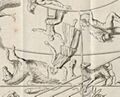 detail of the drawing of the Farnese Atlas (marble, 2nd century CE), showcasing Andromeda and adjacent figures
 -
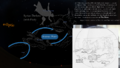 Andromeda and Cetus on the Farnese Globe - with highlighted lines by Susanne M Hoffmann (zodiac conference Berlin 2022).
 -
Latin copy of the Al-Sufi manuscript (so-called Sufi Latinus text). Andromeda is depicted with two fish, a remainder of the Derketo-tradition. This specific manuscript was produced in 1428 in northern Italy (Gotha, Forschungsbibliothek, MS. Memb. II 141).


Weblinks
Reference
- Kurtik's References
- Hoffmann and Krebernik (2023)
- ↑ Planetarium Babylonicum 2.0, All Skies Encyclopaedia.
- ↑ Hoffmann, S. M. and Krebernik, M. (2023). What do deities tell us about the celestial positioning system, in: R. Rollinger, I. Madreiter, M. Lang, C. Pappi (eds.). The Intellectual Heritage of the Ancient Near East, Papers held at the 64th Rencontre Assyriologique International and 12th Melammu Symposium July 16-20 2018, Innsbruck. Austrian Academy of Sciences Press, 539-579