GIGIR: Difference between revisions
No edit summary |
|||
| (11 intermediate revisions by 3 users not shown) | |||
| Line 1: | Line 1: | ||
Authors: {{PAGEAUTHORS}} | Authors: {{PAGEAUTHORS}} | ||
---- | ---- | ||
[[File:TauAll+ | [[File:TauAll+year2 stellarium vat7851.jpg|thumb|division of the Taurus sign in ancient Mesopotamia: above in the Astronomical Diaries (Hoffmann and Hunger 2024)<ref name=":0">Hoffmann, S. M. and Hunger, H. (2024). Terminology in Taurus, The Bull. Nouvelles Assyriologiques Brèves et Utilitaires, 4, 121</ref>, middle mapped to Stellarium, on VAT 7851<ref name=":7" /> (CC BY Susanne M Hoffmann, WGSN 2026). ]] | ||
<sup>mul giš</sup>GIGIR (𒀯𒄑𒇀) = <sup>(mul)</sup>''Narkabtu'' "The Chariot", is an ancient Mesopotamian asterism in [[Taurus]] [Gössmann 1950<ref name=":1">''Gössmann P.F''. Planetarium Babylonicum, Rom, 1950 (A. Deimel. Šumerisches Lexikon 4/2).</ref>, 89; BPO 2<ref name=":2">''Reiner E., Pingree D''. Enuma Anu Enlil, Tablets 50-51. Undena Publications, Malibu, 1981 (Babylonian Planetary Omens: Part Two).</ref>, 12; CAD<ref name=":3">''The Assyrian Dictionary of the Oriental Institute of the University of Chicago.'' Chicago - Glückstadt, 1956 -...</ref> N/1, 353ff.]; in astral-mythological contexts it is the chariot of the god [[EN.ME.ŠAR2.RA|EN.ME.ŠAR<sub>2</sub>.RA]]. The term was also used in the astronomical diaries and related texts before 300 BCE to designate the eastern half of the zodiac sign of Taurus [Steele 2018<ref>Steele, J. M. (2018), `The development of the Babylonian zodiac: Some preliminary observations', Mediterranean Archaeology and Archaeometry 18(4), 97--105.</ref>, Hoffmann and Hunger 2024<ref name=":0" />]. Note the double determinative, GIŠ for wooden objects and MUL for asterisms, indicating that the asterism is a stellar version of the wooden chariot. | <sup>mul giš</sup>GIGIR (𒀯𒄑𒇀) = <sup>(mul)</sup>''Narkabtu'' "The Chariot", is an ancient Mesopotamian asterism in [[Taurus]] [Gössmann 1950<ref name=":1">''Gössmann P.F''. Planetarium Babylonicum, Rom, 1950 (A. Deimel. Šumerisches Lexikon 4/2).</ref>, 89; BPO 2<ref name=":2">''Reiner E., Pingree D''. Enuma Anu Enlil, Tablets 50-51. Undena Publications, Malibu, 1981 (Babylonian Planetary Omens: Part Two).</ref>, 12; CAD<ref name=":3">''The Assyrian Dictionary of the Oriental Institute of the University of Chicago.'' Chicago - Glückstadt, 1956 -...</ref> N/1, 353ff.]; in astral-mythological contexts it is the chariot of the god [[EN.ME.ŠAR2.RA|EN.ME.ŠAR<sub>2</sub>.RA]]. The term was also used in the astronomical diaries and related texts before 300 BCE to designate the eastern half of the zodiac sign of Taurus [Steele 2018<ref>Steele, J. M. (2018), `The development of the Babylonian zodiac: Some preliminary observations', Mediterranean Archaeology and Archaeometry 18(4), 97--105.</ref>, Hoffmann and Hunger 2024<ref name=":0" />]. Note the double determinative, GIŠ for wooden objects and MUL for asterisms, indicating that the asterism is a stellar version of the wooden chariot. | ||
| Line 20: | Line 20: | ||
** ˹<sup>mul</sup>gigir˺ [MSL XI<ref name=":4" />, 134, col. ix 7], | ** ˹<sup>mul</sup>gigir˺ [MSL XI<ref name=":4" />, 134, col. ix 7], | ||
** <sup>mul giš</sup>gigir [MSL XI<ref name=":4" />, 143, col. x 18]. | ** <sup>mul giš</sup>gigir [MSL XI<ref name=":4" />, 143, col. x 18]. | ||
* (2) Urra XXII | * (2) Series Urra XXII: | ||
** Urra XXII: 290', <sup>mul giš</sup>gigir = <sup>d</sup>''En''-[''me-šar''<sub>2</sub>]-''ra'' [Bloch | ** Urra XXII: 290', <sup>mul giš</sup>gigir = <sup>d</sup>''En''-[''me-šar''<sub>2</sub>]-''ra'' [Bloch and Horowitz 2015<ref>Bloch Y. and W. Horowitz (2015): “Urra = hubullu XXII: The Standard Recension,” with Y. Bloch, Journal of Cuneiform Studies 67: 71-125.</ref>, 107:290ʹ]. | ||
** [''nar-kab-tu''] [Cavigneaux 1981<ref>''Cavigneaux A.'' Textes scolares du temple de Nabû ša Harê. Texts from Babylon I. Baghdad, 1981.</ref>, 105, 79.B.1/5 iv 13], | ** [''nar-kab-tu''] [Cavigneaux 1981<ref>''Cavigneaux A.'' Textes scolares du temple de Nabû ša Harê. Texts from Babylon I. Baghdad, 1981.</ref>, 105, 79.B.1/5 iv 13], | ||
* (3) Ea I 48a: | * (3) Ea I 48a: | ||
** <sup>gi-gir</sup> | ** <sup>gi-gir</sup>LAGAB×BAD ''ša''<sub>2</sub> <sup>mul</sup>LAGAB×BAD <sup>d</sup>''En-me-šar''<sub>2</sub>-''ra'' "the chariot (constellation) in regard to the Chariot-asterism, the god Enmešarra" [MSL XIV<ref>''Materials for the Sumerian Lexicon''. Vol. XIV. Ea A = ''nâqu'', Aa A = ''nâqu'' with their Forerunners and Related Texts. Ed. by M.Civil and W.G.Lambert. Roma, 1979.</ref>, 197; CAD<ref name=":3" /> N/1, 353b]. See also (Kurtik sh16) [[ŠU.GI]]. | ||
| | | | ||
|- | |- | ||
| '''"Enki and the World Order."''' | | '''"Enki and the World Order."''' | ||
See (Kurtik a48) AŠ.GAN<sub>2</sub> = [[IKU|<sup>mul</sup>IKU]] (<sup>mul giš</sup>gigir as a star name in Sumerian literature). | See (Kurtik a48) AŠ.GAN<sub>2</sub> = [[IKU|<sup>mul</sup>IKU]] (<sup>mul giš</sup>gigir as a star name in Sumerian literature). | ||
| | | | ||
|- | |- | ||
|'''"Prayers to the Gods of the Night."''' | |'''"Prayers to the Gods of the Night."''' | ||
| Line 36: | Line 36: | ||
|- | |- | ||
|'''MUL.APIN.''' | |'''MUL.APIN.''' | ||
Astrological | Astrological predictionsː | ||
| | |||
* If U.RI.RI approaches the Chariot: horses will die. | |||
see (Kurtik u02) [[U.RI.RI]] [MUL.APIN<ref>Hunger, H. and Steele, J. M. (2019). The Babylonian Astronomical Compendium MUL.APIN, Routledge, NY</ref> II iii 23]. | |||
|The translation of U.RI.RI is uncertain (could be Mercury or a comet). If it is a planet, the identification of GIGIR with an asterism in Taurus is likely. | |||
|- | |- | ||
|'''"Letters"''' | |'''"Letters"''' | ||
| Line 43: | Line 47: | ||
* ''šap-la'' <sup>mul giš</sup>GIGIR ''ina'' KASKAL ''šu-ut'' <sup>d</sup>EN.LIL<sub>2</sub> ''iz-za-az'' | * ''šap-la'' <sup>mul giš</sup>GIGIR ''ina'' KASKAL ''šu-ut'' <sup>d</sup>EN.LIL<sub>2</sub> ''iz-za-az'' | ||
* "below the Chariot in the | * "it stands below the Chariot in the path (of the stars) of Enlil " [SAA 10<ref>''A. Sachs, T. Pinches, J. Strassmaier,'' Late Babylonian Astronomical and Related Texts, London, 1955.</ref>, 363 r. 9-10, 11; LAS 2<ref name=":5">''Parpola S.'' Letters from Assyrian Scholars. Pt. II.: Commentary and appendices. Verlag Butzon & Bercker, Kevelaer, 1983.</ref> 289-291]. | ||
| | | | ||
|- | |- | ||
|''' | |'''Astronomical Diaries and Related Texts.''' | ||
* (1) The constellation was used to record the positions of the planets, e.g.: | * (1) The constellation was used to record the positions of the planets, e.g.: | ||
** AN ''ina'' GIGIR "Mars in the Chariot" [ | ** AN ''ina'' GIGIR "Mars in the Chariot" [ADRT I, No.-380 rev. 1′], | ||
** MUL<sub>2</sub>.BABBAR ''ina'' GIGIR "Jupiter in the Chariot" [ | ** MUL<sub>2</sub>.BABBAR ''ina'' GIGIR "Jupiter in the Chariot" [ADRT I<ref name=":6">''Ch. Virolleaud'', L'astrologie chaldéenne S(in); Shamasz; Isht(ar); Adad; S/Supp. = Supplément; SS / 2.Supp. = Second Supplément (Paris 1905 - 1912)</ref>, No.-372 D obv. 3′], | ||
** GU<sub>4</sub>.UD ''ar''<sub>2</sub> GIGIR ŠU<sub>2</sub>, AN ''ina'' G[IGIR SU<sub>2</sub>...] "Last appearance of Mercury behind the Chariot, [last appearance of] Mars in the Chariot..." [ | ** GU<sub>4</sub>.UD ''ar''<sub>2</sub> GIGIR ŠU<sub>2</sub>, AN ''ina'' G[IGIR SU<sub>2</sub>...] "Last appearance of Mercury behind the Chariot, [last appearance of] Mars in the Chariot..." [ADRT I<ref name=":6" />, No.-366 Col. i 19′], | ||
** MUL<sub>2</sub>.BABBAR ''ina'' GIGIR ŠU<sub>2</sub> " | ** MUL<sub>2</sub>.BABBAR ''ina'' GIGIR ŠU<sub>2</sub> "last appearance of Jupiter in the Chariot" [ADRT I<ref name=":6" />, No.-324 A obv.12], | ||
** GENNA ''ina'' GIGIR SU<sub>2</sub> " | ** GENNA ''ina'' GIGIR SU<sub>2</sub> "last appearance of Saturn in the Chariot" [ADRT I<ref name=":6" />, No.-266 A obv. 6′], etc. | ||
* (2) There are two "normal stars" in the constellation. | * (2) There are two "normal stars" in the constellation. | ||
** (a) | ** (a) ''šur'' GIGIR ''ša''<sub>2</sub> SI "The northern reins of the Chariot" (β Tauri). | ||
** (b) | ** (b) ''šur'' GIGIR ''ša''<sub>2</sub> ULU<sub>3</sub> "the southern reins of the Chariot" (ζ Tauri). | ||
|[[File:GIGIR-GUAN div-350BCE Screenshot.png|thumb|It is uncertain where exactly the Chariot constellation was seen but from the ADRT, the division of the second sign is proven as shown here: the orange (left) part is the Chariot (CC BY Susanne M Hoffmann).]] | |[[File:GIGIR-GUAN div-350BCE Screenshot.png|thumb|It is uncertain where exactly the Chariot constellation was seen, but from the ADRT, the division of the second sign is proven as shown here: the orange (left) part is the Chariot (CC BY Susanne M Hoffmann, based on Hoffmann and Hunger 2024<ref name=":0" />).]] | ||
|- | |- | ||
|'''Microzodiac''' | |'''Microzodiac''' | ||
VAT 7851 shows a drawn figure of seven asterisks from which the middle | VAT 7851 shows a drawn figure of seven asterisks from which the bottom middle one features some additional rays and the two left ones are a bit more distant from the cluster of the rest. The group is labelled "[[MUL.MUL]]" which is usually the term for the [[Pleiades]] star cluster, but at that (late) time was used in the ADRT for the 30°-section of the Taurus sign. Hence, it is possible that this figure on the clay tablet actually features the Wagon (GIGIR) imagined in the Hyades plus Beta and Zeta Tauri (spanning almost the entire sign). | ||
|[[File:GIGIR taurus.jpg|thumb|The figure on the top left of VAT 7851 could perhaps represent GIGIR, see Hoffmann (2025)<ref>Hoffmann, S.M. (2025). Image Analysis of VAT 7851, Archiv für Orientforschung (AfO) 56, 45-53</ref>.]] | |[[File:GIGIR taurus.jpg|thumb|The figure on the top left of [[Taurus#/media/File:Fig1 taurus tablet 150dpi sciLogs.jpg|VAT 7851]] could perhaps represent GIGIR, see Hoffmann (2025)<ref name=":7">Hoffmann, S.M. (2025). Image Analysis of VAT 7851, Archiv für Orientforschung (AfO) 56, 45-53</ref>.]] | ||
|} | |} | ||
See also: <sup>mul giš</sup>GIGIR ''='' <sup>d</sup>[[Dilbat|Dili-bat]] (Venus) [SpTU I<ref>''Špätbabylonische Texte aus Uruk.'' Teil I / Bearb. von H.Hunger. Berlin, 1976.</ref>, 27 r. 24; 28:9ʹ] | See also: <sup>mul giš</sup>GIGIR ''='' <sup>d</sup>[[Dilbat|Dili-bat]] (Venus) [SpTU I<ref>''Špätbabylonische Texte aus Uruk.'' Teil I / Bearb. von H.Hunger. Berlin, 1976.</ref>, 27 r. 24; 28:9ʹ] | ||
===Additional=== | ===Additional=== | ||
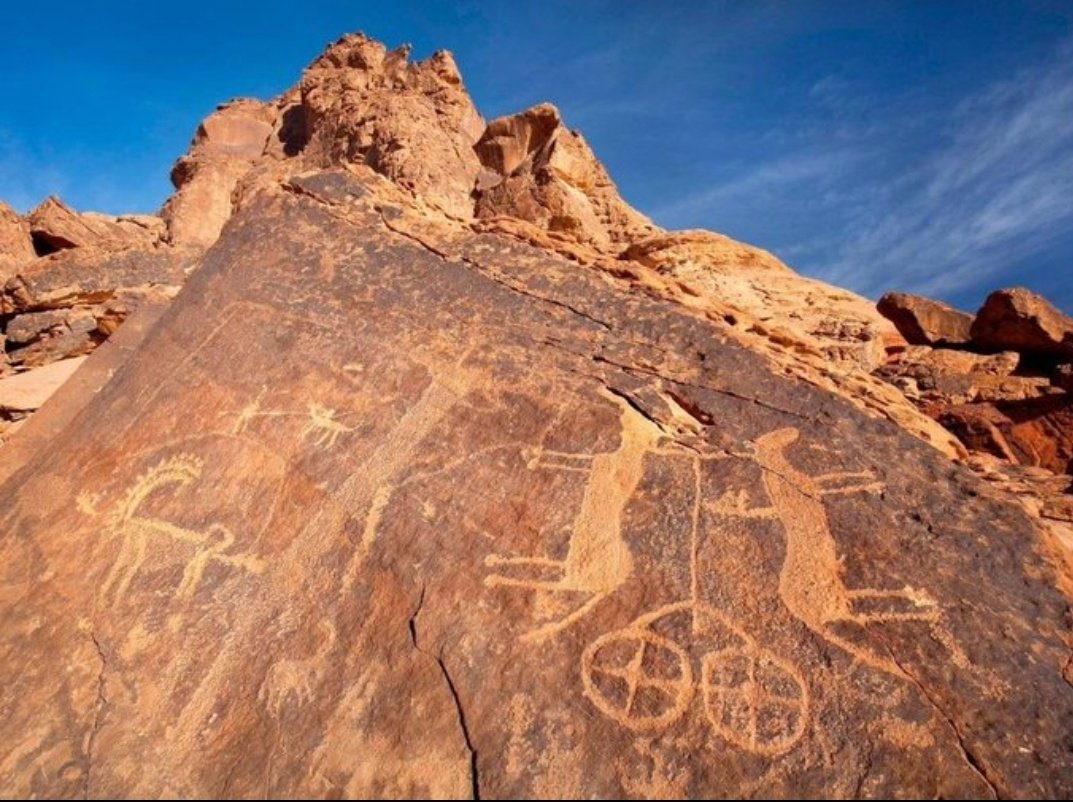
[[File:Chariot SaudiRockArt.jpg|thumb|Chariotː rock art in Saudi Arabia ([https://pbs.twimg.com/media/GbSOxkIXIAAjyUP.jpg see here])]] | |||
==== Deity. ==== | ==== Deity. ==== | ||
Enmešarra, see (Kurtik e11) [[EN.ME.ŠAR2.RA|<sup>d</sup>EN.ME.ŠAR<sub>2</sub>.RA]]. | |||
==== Symbol. ==== | ==== Symbol. ==== | ||
Chariot with the body of | Chariot with the body of Enmešarra (?), see (Kurtik e11) [[EN.ME.ŠAR2.RA|<sup>d</sup>EN.ME.ŠAR<sub>2</sub>.RA]]. | ||
==== Previous Identification(s). ==== | ==== Previous Identification(s). ==== | ||
= β + ζ Tauri [Gössmann 1950<ref name=":1" />, 89, I]; = τὸ ἅρμα "Chariot," mentioned in the "Barbarian sphere" of the Greek astrologer | = β + ζ Tauri [Gössmann 1950<ref name=":1" />, 89, I]; = τὸ ἅρμα "Chariot," mentioned in the "Barbarian sphere" of the Greek astrologer Teukros ("Babylonian") (1st century AD?) [ibid.<ref name=":1" />; Boll 1903<ref>''Boll F.'' Sphaera. Leipzig 1903.</ref>, 108ff.; Bezold-Kopff-Boll 1913<ref>''Bezold C., Kopff A., Boll F.'' Zenit- und Aequatorialgestirne am babylonischen Fixsternhimmel // Sitzungsberichte der Heidelberger Akademie der Wissenschaften, Philos.-hist. Kl., 11. Abhandlung. Heidelberg, 1913.</ref>, 15:62]. | ||
= Hyades [Weidner 1957-59<ref>''Weidner E.'' mul gir<sub>2</sub>.tab = ''zuqaqîpi'' // AfO. 1957-1958. Bd. 18. S. 393-394].</ref>, 73a]. | = Hyades [Weidner 1957-59<ref>''Weidner E.'' mul gir<sub>2</sub>.tab = ''zuqaqîpi'' // AfO. 1957-1958. Bd. 18. S. 393-394].</ref>, 73a]. | ||
| Line 81: | Line 86: | ||
= ζ, ο+ Persei, possibly with some stars in northern Taurus [BPO 2<ref name=":2" />, 11-12]. | = ζ, ο+ Persei, possibly with some stars in northern Taurus [BPO 2<ref name=":2" />, 11-12]. | ||
= north of Taurus [Hunger | = north of Taurus [Hunger and Pingree 1999, 271]. | ||
==== Parts of the constellation and individual stars. ==== | ==== Parts of the constellation and individual stars. ==== | ||
(1) | (1) ''šur'' GIGIR ''ša''<sub>2</sub> SI "The northern reins of the Chariot" (β Tauri). | ||
(2) | (2) ''šur'' GIGIR ''ša''<sub>2</sub> ULU<sub>3</sub> "the southern reins of the Chariot" (ζ Tauri). | ||
Stars (1) and (2) were among the "normal stars", see (Kurtik m39) [[MUL2.ŠID.MEŠ|MUL<sub>2</sub>.ŠID.MEŠ]]. | Stars (1) and (2) were among the "normal stars", see (Kurtik m39) [[MUL2.ŠID.MEŠ|MUL<sub>2</sub>.ŠID.MEŠ]]. | ||
| Line 156: | Line 161: | ||
*[[References (Babylonian)|Kurtik's references]] | *[[References (Babylonian)|Kurtik's references]] | ||
[[Category: | |||
[[Category:Constellation]] | [[Category:Asterism]] [[Category:Constellation]] | ||
[[Category:Sumerian]] | [[Category:Sumerian]][[Category:Mesopotamian]][[Category:West Asian]] [[Category:Asian]][[Category:Eurasia]] | ||
[[Category:West Asian]] | [[Category:Rubric]] [[Category:Lunar System]] [[Category:Zodiac]] | ||
[[Category: | |||
[[Category:Cuneiform]] | [[Category:Cuneiform]] | ||
[[Category:Tau]] | [[Category:Tau]] | ||
[[Category:Hyades]] | [[Category:Hyades]] | ||
Latest revision as of 10:31, 10 June 2026
Authors: Gennady E. Kurtik, Euin Choung Kim, David Hilder, Susanne M Hoffmann, Wayne Horowitz, Jan Safford, Hermann Hunger, Youla Azkarrula

mul gišGIGIR (𒀯𒄑𒇀) = (mul)Narkabtu "The Chariot", is an ancient Mesopotamian asterism in Taurus [Gössmann 1950[3], 89; BPO 2[4], 12; CAD[5] N/1, 353ff.]; in astral-mythological contexts it is the chariot of the god EN.ME.ŠAR2.RA. The term was also used in the astronomical diaries and related texts before 300 BCE to designate the eastern half of the zodiac sign of Taurus [Steele 2018[6], Hoffmann and Hunger 2024[1]]. Note the double determinative, GIŠ for wooden objects and MUL for asterisms, indicating that the asterism is a stellar version of the wooden chariot.
Concordance, Etymology, History[7]
Variant readings:
- mulLAGABxBAD, the compound elements for the sign GIGIR.
- = narkabtu; the syllabic entry is found mostly in lexical texts.
| Sources | Identifications |
|---|---|
Lexical texts.
|
|
| "Enki and the World Order."
See (Kurtik a48) AŠ.GAN2 = mulIKU (mul gišgigir as a star name in Sumerian literature). |
|
"Prayers to the Gods of the Night."
|
|
| MUL.APIN.
Astrological predictionsː
|
The translation of U.RI.RI is uncertain (could be Mercury or a comet). If it is a planet, the identification of GIGIR with an asterism in Taurus is likely. |
| "Letters"
Report on the observation of Jupiter: |
|
Astronomical Diaries and Related Texts.
|
 |
| Microzodiac
VAT 7851 shows a drawn figure of seven asterisks from which the bottom middle one features some additional rays and the two left ones are a bit more distant from the cluster of the rest. The group is labelled "MUL.MUL" which is usually the term for the Pleiades star cluster, but at that (late) time was used in the ADRT for the 30°-section of the Taurus sign. Hence, it is possible that this figure on the clay tablet actually features the Wagon (GIGIR) imagined in the Hyades plus Beta and Zeta Tauri (spanning almost the entire sign). |
 |
See also: mul gišGIGIR = dDili-bat (Venus) [SpTU I[17], 27 r. 24; 28:9ʹ]
Additional

Deity.
Enmešarra, see (Kurtik e11) dEN.ME.ŠAR2.RA.
Symbol.
Chariot with the body of Enmešarra (?), see (Kurtik e11) dEN.ME.ŠAR2.RA.
Previous Identification(s).
= β + ζ Tauri [Gössmann 1950[3], 89, I]; = τὸ ἅρμα "Chariot," mentioned in the "Barbarian sphere" of the Greek astrologer Teukros ("Babylonian") (1st century AD?) [ibid.[3]; Boll 1903[18], 108ff.; Bezold-Kopff-Boll 1913[19], 15:62].
= Hyades [Weidner 1957-59[20], 73a].
= β + ζ Tauri [LAS 2[15], 291].
= ζ, ο+ Persei, possibly with some stars in northern Taurus [BPO 2[4], 11-12].
= north of Taurus [Hunger and Pingree 1999, 271].
Parts of the constellation and individual stars.
(1) šur GIGIR ša2 SI "The northern reins of the Chariot" (β Tauri).
(2) šur GIGIR ša2 ULU3 "the southern reins of the Chariot" (ζ Tauri).
Stars (1) and (2) were among the "normal stars", see (Kurtik m39) MUL2.ŠID.MEŠ.
Astrology.
(1) The Moon "rides" on the Chariot; see (Kurtik sh16) ŠU.GI, VI 12.
In astrological texts the asterism is mentioned more often as dEn-me-šar2-ra (cf. e11).
Historical Dictionaries
| Kurtik (2022, g15) | Gössmann (1950) |
|---|---|
| вар. чтения: mulLAGAB´BAD; = narkabtu «Колесница»; созвездие, включавшее звезды северной части Тельца (Taurus) и южной части Персея (Perseus) [Gössmann 1950, 89; BPO 2, 12; CAD N/1, 353ff.].
I. Источники. Лексич. тексты. (1) Шумерские одноязычные списки звезд: mul gišgigir [MSL XI, 108:398], ˹mulgigir˺ [MSL XI, 134, col. ix 7], mul gišgigir [MSL XI, 143, col. x 18]. (2) Серия Urra XXII: [nar-kab-tu] [Cavigneaux 1981, 105, 79.B.1/5 iv 13], mul gišgigir = dEn-[me-šar2]-ra [Bloch–Horowitz 2015, 107:290ʹ]. (3) Ea I 48a: gi-girLAGAB´BAD ša2 mulLAGAB´BAD dEn-me-šar2-ra «Колесница (созвездия) “Колесница Энмешарры”» [MSL XIV, 197; CAD N/1, 353b]. См. также sh16ŠU.GI. «Энки и устройство мира». См. a48AŠ.GAN2. «Молитвы ночным богам». Новоассирийская молитва: в списке астральных богов mul gišGIGIR [Oppenheim 1959, 283:16]. MUL.APIN. Астрологические предсказания, см. u02U.RI.RI [MA, 110]. «Письма» Сообщение о наблюдении Юпитера: šap-la mul gišGIGIR ina KASKAL šu-ut dEN.LIL2 iz-za-az «ниже Колесницы на пути (звезд) Энлиля он стоит» [SAA 10, 363 r. 9–10, 11; LAS 2 289–291]. «Дневники наблюдений». (1) Созвездие использовалось для фиксации положений планет, например: AN ina GIGIR «Марс в Колеснице» [AD I, No.-380 rev. 1′], MUL2.BABBAR ina GIGIR «Юпитер в Колеснице» [AD I, No.-372 D obv. 3′], GU4.UD ar2 GIGIR ŠU2, AN ina G[IGIR SU2…] «Последнее появление Меркурия позади Колесницы, [последнее появление] Марса в Ко[леснице…]» [AD I, No.-366 Col. i 19′], MUL2.BABBAR ina GIGIR ŠU2 «Последнее появление Юпитера в Колеснице» [AD I, No.-324 A obv.12], GENNA ina GIGIR SU2 «Последнее появление Сатурна в Колеснице» [AD I, No.-266 A obv. 6′] и др. (2) В созвездии две «нормальных звезды» (см. ниже). См. также: mul gišGIGIR = dDili-pat2 [SpTU I, 27 r. 24; 28:9ʹ]. II. Божество. Энмешарра, см. e11dEN.ME.ŠAR2.RA. III. Символ. Колесница c телом Энмешарры (?), см. e11dEN.ME.ŠAR2.RA. IV. Отождествление. = β + ζ Tauri [Gössmann 1950, 89, I]; = τὸ ἅρμα «Колесница», упоминается в «Варварской сфере» греческого астролога Тевкра («Вавилонянина») (I в.н.э.?) [ibid.; Boll 1903, 108ff.; Bezold–Kopff–Boll 1913, 15:62]. = Hyades [Weidner 1957–59, 73a]. = β + ζ Tauri [LAS 2, 291]. = ζ, ο+ Persei, возможно, с некоторыми звездами на севере Тельца [BPO 2, 11–12]. = северная часть Тельца [Hunger-Pingree 1999, 271]. V. Части созвездия и отдельные звезды. (1) ŠUR GIGIR ša2 SI «Северная вожжа Колесницы» (β Tauri). (2) ŠUR GIGIR ša2 ULU2 «Южная вожжа Колесницы» (ζ Tauri). Звезды (1) и (2) входили в число «нормальных звезд», см. m39MUL2.ŠID.MEŠ. VI. Астрология. (1) Луна “едет” на Колеснице; см. sh16ŠU.GI, VI 12. В астрологических текстах созвездие упоминается чаще как dEn-me-šar2-ra (см. e11). |
Example |
| Kurtik (2022, n07) | |
(mul)Narkabtu |
|
| аккадская параллель к mul gišGIGIR «Колесница»; cозвездие в северной части Тельца (Taurus) и южной части Персея (Perseus); силлабическая запись встречается в основном в лексических текстах. См. g15GIGIR и e11dEN.ME.ŠAR2.RA. |
References
- ↑ 1.0 1.1 1.2 Hoffmann, S. M. and Hunger, H. (2024). Terminology in Taurus, The Bull. Nouvelles Assyriologiques Brèves et Utilitaires, 4, 121
- ↑ 2.0 2.1 Hoffmann, S.M. (2025). Image Analysis of VAT 7851, Archiv für Orientforschung (AfO) 56, 45-53
- ↑ 3.0 3.1 3.2 Gössmann P.F. Planetarium Babylonicum, Rom, 1950 (A. Deimel. Šumerisches Lexikon 4/2).
- ↑ 4.0 4.1 Reiner E., Pingree D. Enuma Anu Enlil, Tablets 50-51. Undena Publications, Malibu, 1981 (Babylonian Planetary Omens: Part Two).
- ↑ 5.0 5.1 The Assyrian Dictionary of the Oriental Institute of the University of Chicago. Chicago - Glückstadt, 1956 -...
- ↑ Steele, J. M. (2018), `The development of the Babylonian zodiac: Some preliminary observations', Mediterranean Archaeology and Archaeometry 18(4), 97--105.
- ↑ Planetarium Babylonicum 2.0, All Skies Encyclopaedia.
- ↑ 8.0 8.1 8.2 Materials for the Sumerian Lexicon. Vol. XI. The Series HAR-ra = hubullu. Tablets XX-XXIV. Ed. by E.Reiner with the coll. of M.Civil. Roma, 1974.
- ↑ Bloch Y. and W. Horowitz (2015): “Urra = hubullu XXII: The Standard Recension,” with Y. Bloch, Journal of Cuneiform Studies 67: 71-125.
- ↑ Cavigneaux A. Textes scolares du temple de Nabû ša Harê. Texts from Babylon I. Baghdad, 1981.
- ↑ Materials for the Sumerian Lexicon. Vol. XIV. Ea A = nâqu, Aa A = nâqu with their Forerunners and Related Texts. Ed. by M.Civil and W.G.Lambert. Roma, 1979.
- ↑ Oppenheim A.L. A New Prayer to the “Gods of the Night” // Analecta biblica. 1959. Vol. 12. P. 282-301.
- ↑ Hunger, H. and Steele, J. M. (2019). The Babylonian Astronomical Compendium MUL.APIN, Routledge, NY
- ↑ A. Sachs, T. Pinches, J. Strassmaier, Late Babylonian Astronomical and Related Texts, London, 1955.
- ↑ 15.0 15.1 Parpola S. Letters from Assyrian Scholars. Pt. II.: Commentary and appendices. Verlag Butzon & Bercker, Kevelaer, 1983.
- ↑ 16.0 16.1 16.2 16.3 Ch. Virolleaud, L'astrologie chaldéenne S(in); Shamasz; Isht(ar); Adad; S/Supp. = Supplément; SS / 2.Supp. = Second Supplément (Paris 1905 - 1912)
- ↑ Špätbabylonische Texte aus Uruk. Teil I / Bearb. von H.Hunger. Berlin, 1976.
- ↑ Boll F. Sphaera. Leipzig 1903.
- ↑ Bezold C., Kopff A., Boll F. Zenit- und Aequatorialgestirne am babylonischen Fixsternhimmel // Sitzungsberichte der Heidelberger Akademie der Wissenschaften, Philos.-hist. Kl., 11. Abhandlung. Heidelberg, 1913.
- ↑ Weidner E. mul gir2.tab = zuqaqîpi // AfO. 1957-1958. Bd. 18. S. 393-394].