Hyades: Difference between revisions
IanRidpath (talk | contribs) →Weblinks: Added link |
|||
| (6 intermediate revisions by 3 users not shown) | |||
| Line 1: | Line 1: | ||
Authors: {{PAGEAUTHORS}} | |||
---- | |||
[[File:Pleiades and Hyades in Stellarium.jpg|thumb|Pleiades and Hyades in Stellarium (date -300 but this view is independent of the historical epoch on human scales).]] | [[File:Pleiades and Hyades in Stellarium.jpg|thumb|Pleiades and Hyades in Stellarium (date -300 but this view is independent of the historical epoch on human scales).]] | ||
[[File:Plej+hyad smh2025 4gif.gif|thumb|Hyades and Pleiades as observed in central Europe (photo and animation SMH)]] | [[File:Plej+hyad smh2025 4gif.gif|thumb|Hyades and Pleiades as observed in central Europe (photo and animation SMH)]] | ||
| Line 17: | Line 20: | ||
[[File:Hyaden+plejaden_smh2025_isle.JPG|thumb|Hyades (photograph) and The Jaw of the Bull from a claytablet (CC BY SMH 2024).]] | [[File:Hyaden+plejaden_smh2025_isle.JPG|thumb|Hyades (photograph) and The Jaw of the Bull from a claytablet (CC BY SMH 2024).]] | ||
The V-shaped Hyades appear more scattered in the sky; in Mesopotamia they were regarded as [[AGA A-nim]], the Crown of the sky god Anu, or the ‘Jaw of The Bull’ ([[Is le10|''is-lê'']]) and are interpreted in Greek as its face. The bright star [[Aldebaran]], which physically does not belong to the star cluster but is (coincidentally) seen standing in the foreground in the same direction in the sky, had no proper name - neither in Mesopotamia nor in mathematical Greek astronomy. Only in his astrological work Tetrabiblos does Ptolemy give a name for the star: the torch. The modern name, Aldebaran, is Arabic and alludes to its position in the sky. The Pleiades rise first, followed by Aldebaran and the Hyades. Ad-Dabaran means ‘the following one’. | The V-shaped Hyades appear more scattered in the sky; in Mesopotamia they were regarded as [[AGA A-nim]], the Crown of the sky god Anu, or the ‘Jaw of The Bull’ ([[Is le10|''is-lê'']]) and are interpreted in Greek as its face. The bright star [[Aldebaran]], which physically does not belong to the star cluster but is (coincidentally) seen standing in the foreground in the same direction in the sky, had no proper name - neither in Mesopotamia nor in mathematical Greek astronomy. Only in his astrological work Tetrabiblos does Ptolemy give a name for the star: the torch. The modern name, Aldebaran, is Arabic and alludes to its position in the sky. The Pleiades rise first, followed by Aldebaran and the Hyades. Ad-Dabaran means ‘the following one’. | ||
===Transfer and Transformation of the Constellation=== | ===Transfer and Transformation of the Constellation=== | ||
The | The star cluster seems to be also part of Late Babylonian constellation of The Chariot, GIGIR.<ref name=":0" /> In Indian astral science, the star cluster is referred to as ''Rohiṅī śakaṭa'' - the cart of ''Rohiṅī.'' It is unknown whether these two carts, the Babylonian and the Indian, share the same root.<gallery> | ||
File:Hyaden+plejaden_smh2025_isle.JPG|Akkadian "Jaw of the Bull" | |||
File:GIGIR taurus.jpg|Babylonian GIGIR, The Chariot, star cluster | |||
</gallery> | |||
==Mythology== | ==Mythology== | ||
| Line 48: | Line 44: | ||
==Weblinks== | ==Weblinks== | ||
* [https://iconographic.warburg.sas.ac.uk/category/vpc-taxonomy-017719 Warburg Institute Iconographic Database – Hyades] | |||
* Ian Ridpath's ''Star Tales'' [http://www.ianridpath.com/startales/taurus.html#hyades – The Hyades] | |||
==References== | ==References== | ||
| Line 56: | Line 53: | ||
*[[References (Medieval and Early Modern)|References (medieval)]] | *[[References (Medieval and Early Modern)|References (medieval)]] | ||
[[Category:Eurasia]] [[Category:Asterism]] [[Category:Almagest]] [[Category:European]] [[Category:Mesopotamian]] [[Category:West Asian]] [[Category:Modern]] | [[Category:Eurasia]] [[Category:Asterism]] [[Category:Almagest]] [[Category:European]] [[Category:Mesopotamian]] [[Category:West Asian]] [[Category:Asian]] [[Category:Modern]] | ||
[[Category:Star Cluster]] | [[Category:Star Cluster]] | ||
[[Category:Tau]] | [[Category:Tau]] | ||
[[Category:Hyades]] | [[Category:Hyades]] | ||
<references /> | <references /> | ||
Latest revision as of 20:57, 22 July 2026
Authors: Susanne M Hoffmann, Ian Ridpath, Youla Azkarrula


The Hyades (Ὑας, Ὑαδες) are a significant pattern of stars in the sky that has been recognized as an asterism or constellation by almost all cultures. They form part of the modern constellation of Taurus.
Etymology and History
Name Variants:
- Suculae (Latin)
- Rainy Ones (hyô, hyetos)
- Regengestirn (German)
- ‘jaws of Taurus’ (is-lê)
- AGA A-nim, the Crown of the sky god Anu
- Rohiṅī śakaṭa - the cart of Rohiṅī (Sanskrit)
Origin of Constellation


The V-shaped Hyades appear more scattered in the sky; in Mesopotamia they were regarded as AGA A-nim, the Crown of the sky god Anu, or the ‘Jaw of The Bull’ (is-lê) and are interpreted in Greek as its face. The bright star Aldebaran, which physically does not belong to the star cluster but is (coincidentally) seen standing in the foreground in the same direction in the sky, had no proper name - neither in Mesopotamia nor in mathematical Greek astronomy. Only in his astrological work Tetrabiblos does Ptolemy give a name for the star: the torch. The modern name, Aldebaran, is Arabic and alludes to its position in the sky. The Pleiades rise first, followed by Aldebaran and the Hyades. Ad-Dabaran means ‘the following one’.
Transfer and Transformation of the Constellation
The star cluster seems to be also part of Late Babylonian constellation of The Chariot, GIGIR.[1] In Indian astral science, the star cluster is referred to as Rohiṅī śakaṭa - the cart of Rohiṅī. It is unknown whether these two carts, the Babylonian and the Indian, share the same root.
-
 Akkadian "Jaw of the Bull"
 -
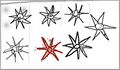 Babylonian GIGIR, The Chariot, star cluster

Mythology
In Greek mythology, both the names of the sisters and their parents vary.[2]
| parents | sisters |
|---|---|
|
|
Weblinks
- Warburg Institute Iconographic Database – Hyades
- Ian Ridpath's Star Tales – The Hyades
References
- ↑ 1.0 1.1 Hoffmann, S.M. (2025). Image Analysis of VAT 7851, Archiv für Orientforschung (AfO) 56, 45-53
- ↑ Hyades in THEOI online





