Niandao: Difference between revisions
Boshunyang (talk | contribs) |
infobox |
||
| (10 intermediate revisions by 3 users not shown) | |||
| Line 3: | Line 3: | ||
---- | ---- | ||
[[File:Zhinü (right), Jiantai (lower) and Niandao (upper left).png|alt=Zhinü (right), Jiantai (lower) and Niandao (upper left)|thumb|''Zhinü'' (right), ''Jiantai'' (lower) and '''''Niandao''''' (upper left)]] | [[File:Zhinü (right), Jiantai (lower) and Niandao (upper left).png|alt=Zhinü (right), Jiantai (lower) and Niandao (upper left)|thumb|''Zhinü'' (right), ''Jiantai'' (lower) and '''''Niandao''''' (upper left)]] | ||
Niǎn Dào (Imperial Passageway, 辇道), a Chinese constellation consists of 5 stars, belongs to the Ox (Niu, 牛) Lunar Mansion | {{Infobox constellation | ||
| name = Niandao | |||
| native = 辇道 | |||
| translation = Imperial Passageway | |||
| pronounce = | |||
| IPA = [njɛn.taʊ] | |||
| culture = IAU | |||
| RA = 283.8337597 | |||
| dec = 43.94608958 | |||
| areatotal = 0 | |||
| numbermainstars = 1 | |||
| numberbfstars = 1 | |||
| numberstarsplanets = | |||
| numberbrightstars = 0 | |||
| numbernearbystars = | |||
| brighteststarname = Niandao | |||
| starmagnitude = 4 | |||
| neareststarname = | |||
| stardistance = | |||
| numbermessierobjects = | |||
| meteorshowers = | |||
| bordering = Lyr | |||
| notes = | |||
| cat = IAU-Star Name | |||
}} | |||
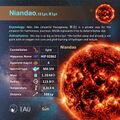
[[File:Niando profileCard SadeghFaghanpour-IAU-WGSN.jpg|thumb|Niandao profile card (CC BY M.Sadegh Faghanpour for IAU WGSN).]] | |||
Niǎn Dào (Imperial Passageway, 辇道), a Chinese constellation consists of 5 stars, belongs to the Ox (Niu, 牛) Lunar Mansion from the Gan school, and corresponds to parts of the modern constellations [[Lyra]] and [[Cygnus]]. Niandao is the road for the imperial chariot, symbolizing the emperor's path for going on excursions and private journeys. | |||
== Concordance, Etymology, History == | == Concordance, Etymology, History == | ||
Niandao is the way along which the emperor "roams freely and travels privately", governing leisurely and harmonious journeys. | ''Niandao'' is the way along which the emperor "roams freely and travels privately", governing leisurely and harmonious journeys. | ||
''Dongjin Ji'' (东晋纪) says:<blockquote>Niandao governs the concubines' chambers and the spring‑autumn palaces.</blockquote>''Chunqiu Wei'' (春秋纬) calls it the "Concubines' Palace" or the "Palace of Excursions", symbolizing a place where the ruler and ministers flourish in virtue. | ''Dongjin Ji'' (东晋纪) says:<blockquote>Niandao governs the concubines' chambers and the spring‑autumn palaces.</blockquote>''Chunqiu Wei'' (春秋纬) calls it the "Concubines' Palace" or the "Palace of Excursions", symbolizing a place where the ruler and ministers flourish in virtue. | ||
The Book of Jin: Astronomical Treatise states: <blockquote>It is the path for the king to take his pleasure and roam; the Han dynasty's Niandao connecting the Northern and Southern Palaces is its earthly image.</blockquote>In Luoyang of the Eastern Han dynasty, a covered passageway (an aerial double corridor) was built to link the Northern and Southern Palaces, imitating the celestial Niandao constellation. Thus the Niandao | The Book of Jin: Astronomical Treatise states: <blockquote>It is the path for the king to take his pleasure and roam; the Han dynasty's ''Niandao'' connecting the Northern and Southern Palaces is its earthly image.</blockquote> | ||
[[File:Nova1408 report.jpg|thumb|Historical Report on the Nova 1408 in Niandao.]] | |||
In Luoyang of the Eastern Han dynasty, a covered passageway (an aerial double corridor) was built to link the Northern and Southern Palaces, imitating the celestial Niandao constellation. Thus the ''Niandao'' not only represents the physical imperial road but also touches upon the emperor's consorts and recreational life. Its changes can be used to divine whether the emperor's private travels are excessive and whether the state is peaceful. | |||
In the year of 1408, the Chinese astronomers observed a new star in the southeastern region of Niandao, the record in the “''Memorial of Congratulations on the Auspicious Star'' 贺瑞星表" in ''Hu wenmugong quanji'' 胡文穆公全集 is the only one that demonstrates a strong proof of it being a nova or superova.<ref>Boshun Yang, Nikolaus Vogt, Susanne M Hoffmann. Was there a (Super)nova in 1408?. ''The Astronomical Journal'', Volume 170, Issue 1, id.17, 10 pp.</ref> | In the year of 1408, the Chinese astronomers observed a new star in the southeastern region of ''Niandao'', the record in the “''Memorial of Congratulations on the Auspicious Star'' 贺瑞星表" in ''Hu wenmugong quanji'' 胡文穆公全集 is the only one that demonstrates a strong proof of it being a nova or superova.<ref name=":2">Boshun Yang, Nikolaus Vogt, Susanne M Hoffmann. Was there a (Super)nova in 1408?. ''The Astronomical Journal'', Volume 170, Issue 1, id.17, 10 pp.</ref><ref>see [[Suggested Stellar Transients|All Skies Encyclopaedia: Stellar Transients]]</ref> | ||
[[File:The location of 1408 (super)Nova is located near "Niandao".jpeg|thumb|'''The location of 1408 (super)Nova is located near ''Niandao''''']] | [[File:The location of 1408 (super)Nova is located near "Niandao".jpeg|thumb|'''The location of 1408 (super)Nova is located near ''Niandao'''''<ref name=":2" />]] | ||
<blockquote>The Qintianjian reported: In the sixth year of the Yongle era, on the sixth day (1408.10.24) of the tenth month at early dusk, a star was observed in the southern region of the Niandao in the middle of the sky, appearing as large as a Zhan (cup), with pure yellow color, smooth and bright. The star remained stationary and calm over 10 days of measurement and observation.</blockquote> | <blockquote>The Qintianjian reported: In the sixth year of the Yongle era, on the sixth day (1408.10.24) of the tenth month at early dusk, a star was observed in the southern region of the ''Niandao'' in the middle of the sky, appearing as large as a ''Zhan'' (cup), with pure yellow color, smooth and bright. The star remained stationary and calm over 10 days of measurement and observation.</blockquote> | ||
=== Identification of stars === | === Identification of stars === | ||
| Line 97: | Line 125: | ||
== IAU Working Group on Star Names == | == IAU Working Group on Star Names == | ||
In | [[File:Niando stickfigure SadeghFaghanpour-IAU-WGSN.jpg|thumb|WGSN]] | ||
In 2026, the name of the historical constellation "Niandao" was suggested to be used for 13 Lyr in this constellation. This star has been used as the determinative star of ''Niandao'' for more than 2,000 years, and ''Niandao'' is important for it was used to record a historical (super)Nova in 1408. This is the only reliable record for this event in the whole world. | |||
Decision: ... | Decision: The IAU adopted the name Niandao for 13 Lyr on 18 June 2026.<gallery> | ||
File:Niando profileCard SadeghFaghanpour-IAU-WGSN.jpg|WGSN | |||
File:Niando stickfigure SadeghFaghanpour-IAU-WGSN.jpg|WGSN | |||
</gallery> | |||
==References == | ==References == | ||
| Line 106: | Line 138: | ||
[[Category:Asterism ]] | [[Category:Asterism ]] | ||
[[Category:Constellation ]] | [[Category:Constellation]] | ||
[[Category:Eurasia]] | [[Category:Eurasia]] | ||
[[Category:Asian]] | [[Category:Asian]] | ||
| Line 113: | Line 145: | ||
[[Category:Cyg]] | [[Category:Cyg]] | ||
[[Category:Lyr]] | [[Category:Lyr]] | ||
[[Category:IAU-Star Name]] [[Category:Star Name]] | |||
Latest revision as of 01:51, 17 August 2026
Authors: Lyu Haocheng, Boshun YANG, Susanne M Hoffmann, Youla Azkarrula
,_Jiantai_(lower)_and_Niandao_(upper_left).png)
| Asterism Info | |
| Native | 辇道 |
|---|---|
| IPA | [njɛn.taʊ] |
| Translation | Imperial Passageway |
| Position (2000) | |
| Right ascension | 283.8337597 |
| Declination | 43.94608958 |
| Area | 0 sq. deg. |
| Stars | |
| Bright stars | 1 |
| Bayer/Flamsteed stars | 1 |
| Stars brighter than 3.00m | 0 |
| Brightest star | Niandao (4m) |
| Taxonomy | |
| category of asterism | IAU-Star Name |
| IAU- constellations | Lyr |

Niǎn Dào (Imperial Passageway, 辇道), a Chinese constellation consists of 5 stars, belongs to the Ox (Niu, 牛) Lunar Mansion from the Gan school, and corresponds to parts of the modern constellations Lyra and Cygnus. Niandao is the road for the imperial chariot, symbolizing the emperor's path for going on excursions and private journeys.
Concordance, Etymology, History
Niandao is the way along which the emperor "roams freely and travels privately", governing leisurely and harmonious journeys.
Dongjin Ji (东晋纪) says:
Niandao governs the concubines' chambers and the spring‑autumn palaces.
Chunqiu Wei (春秋纬) calls it the "Concubines' Palace" or the "Palace of Excursions", symbolizing a place where the ruler and ministers flourish in virtue. The Book of Jin: Astronomical Treatise states:
It is the path for the king to take his pleasure and roam; the Han dynasty's Niandao connecting the Northern and Southern Palaces is its earthly image.

In Luoyang of the Eastern Han dynasty, a covered passageway (an aerial double corridor) was built to link the Northern and Southern Palaces, imitating the celestial Niandao constellation. Thus the Niandao not only represents the physical imperial road but also touches upon the emperor's consorts and recreational life. Its changes can be used to divine whether the emperor's private travels are excessive and whether the state is peaceful.
In the year of 1408, the Chinese astronomers observed a new star in the southeastern region of Niandao, the record in the “Memorial of Congratulations on the Auspicious Star 贺瑞星表" in Hu wenmugong quanji 胡文穆公全集 is the only one that demonstrates a strong proof of it being a nova or superova.[1][2]
Nova_is_located_near_%22Niandao%22.jpeg)
The Qintianjian reported: In the sixth year of the Yongle era, on the sixth day (1408.10.24) of the tenth month at early dusk, a star was observed in the southern region of the Niandao in the middle of the sky, appearing as large as a Zhan (cup), with pure yellow color, smooth and bright. The star remained stationary and calm over 10 days of measurement and observation.
Identification of stars
| Star Names or Orders(Traditional/Qing) | Ho PENG YOKE[3][comment 1] | Yi Shitong[4]
Based on catalogue in 18th century |
Pan Nai[5]
based on Xinyixiangfayao Star Map |
Pan Nai[6]
based on catalogues in Yuan dynasty |
SUN X. & J. Kistemaker[7]
Han Dynasty |
Boshun Yang[8]
before Tang dynasty |
|---|---|---|---|---|---|---|
| 1st (determinative) | V545 Lyr ? | 13 Lyr | 13 Lyr | 13 Lyr | 13 Lyr | 13 Lyr |
| 2nd | θ Lyr | η Lyr [comment 2] | η Lyr | η Lyr | η Lyr | η Lyr |
| 3rd | 4 Cyg | θ Lyr | θ Lyr | θ Lyr | θ Lyr | θ Lyr |
| 4th | χ Cyg | 4 Cyg | 4 Cyg | 4 Cyg | 4 Cyg | 4 Cyg |
| 5th | ? | 17 Cyg | 8 Cyg | 8 Cyg | 8 Cyg | 8 Cyg |
- ↑ The star chart in the original material is not standard and only displays four stars. The modern star names given here are for reference only.
- ↑ In the original 18th century star catalog, the star (Niandao II) was actually 19 Lyr, not η Lyr. Due to a transcription error in the Flamsteed's catalog, the declination value was copied incorrectly by 10 degrees. The star catalog in Yixiang Kaocheng used incorrect coordinates, with 19 Lyr mistakenly corresponding to Niandao II. Later scholars often used incorrect coordinates to identify the star as η Lyr, but based on the original data, η Lyr should actually be Niandao Added II.
Maps (Gallery)
| historical map | modern identification
(Yang 2023) |
same in Stellarium 24.4 |
|---|---|---|
 |
.png) |
|
  |
.png) | |
.png) |
.png) |
 |
IAU Working Group on Star Names

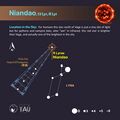
In 2026, the name of the historical constellation "Niandao" was suggested to be used for 13 Lyr in this constellation. This star has been used as the determinative star of Niandao for more than 2,000 years, and Niandao is important for it was used to record a historical (super)Nova in 1408. This is the only reliable record for this event in the whole world.
Decision: The IAU adopted the name Niandao for 13 Lyr on 18 June 2026.
-
 WGSN
WGSN -
 WGSN
WGSN
References
- ↑ 1.0 1.1 Boshun Yang, Nikolaus Vogt, Susanne M Hoffmann. Was there a (Super)nova in 1408?. The Astronomical Journal, Volume 170, Issue 1, id.17, 10 pp.
- ↑ see All Skies Encyclopaedia: Stellar Transients
- ↑ P.-Y. Ho, “Ancient And Mediaeval Observations of Comets and Novae in Chinese Sources,” Vistas in Astronomy, 5(1962), 127-225.
- ↑ Yi Shitong伊世同. Zhongxi Duizhao Hengxing Tubiao中西对照恒星图表1950. Beijing: Science Press.1981: 56.
- ↑ Pan Nai潘鼐. Zhongguo Hengxing Guance shi中国恒星观测史[M]. Shanghai: Xuelin Pree. 1989. p226.
- ↑ Pan Nai潘鼐. Zhongguo Hengxing Guance shi中国恒星观测史[M]. Shanghai: Xuelin Pree. 2009. p443.
- ↑ Sun Xiaochun. & Kistemaker J. The Chinese sky during the Han. Leiden: Brill. 1997, Pp241-6.
- ↑ B.-S. Yang杨伯顺, Zhongguo Chuantong Hengxing Guance Jingdu ji Xingguan Yanbian Yanjiu 中国传统恒星观测精度及星官演变研究 (A Research on the Accuracy of Chinese Traditional Star Observation and the Evolution of Constellations), PhD thesis, (Hefei: University of Science and Technology of China, 2023). 261.





