User:KhalidAlAjaji/sandbox: Difference between revisions
m removed {{Distinguish|الخباء الشآمي}} template |
mNo edit summary |
||
| (8 intermediate revisions by the same user not shown) | |||
| Line 1: | Line 1: | ||
{{DISPLAYTITLE: ''al-Khibā' al- | {{DISPLAYTITLE: ''al-Khibā' al-Shaāmī'', ''al-Ḫibāʾ al-Šaāmī'' (الْخِبَاء الشَّآمِي)}} | ||
Authors: {{PAGEAUTHORS}} | Authors: {{PAGEAUTHORS}} | ||
---- | ---- | ||
''This page is about Alkhiba as an asterism in the northern sky, corresponding to the so‑called Northern Tent (الخباء الشآمي). For the similarly named asterism in Corvus, see [[ | ''This page is about Alkhiba as an asterism in the northern sky, corresponding to the so‑called Northern Tent (الخباء الشآمي). For the similarly named asterism in Corvus, see [[Alkhiba alyamani]] (Southern Tent). For a star with a similar name meaning, see [[Alchiba]] (the Tent).'' | ||
'''Terminology''' | '''Terminology''' | ||
The name appeared in historical resources as Alkhiba (Arabic: الخباء, the Tent) without any specifier, but to avoid confusion with the Corvus asterism also known as ''[[Alkhiba]]'' and the star α Crv named ''[[Alchiba]]'', this encyclopedia refers to the Hercules asterism as “Northern Tent” (Arabic: الخباء الشآمي, al‑Ḫibāʾ ash‑Šāmī), while reserving “Southern Tent” (الخباء اليماني) for the Corvus asterism following the name reported by Ibn Qutayba ([[User:KhalidAlAjaji/sandbox#Ibn Qutayba (d. 276 H / 889)|See below]]). | |||
'''Headword (Arabic):''' الْخِبَاء الشَّآمِي | '''Headword (Arabic):''' الْخِبَاء الشَّآمِي | ||
'''Transliteration:''' ''al-Ḫibāʾ'' | '''Transliteration:''' ''al-Ḫibāʾ al-Šaāmī'' | ||
'''English:''' ''al-Khibā' al- | '''English:''' ''al-Khibā' al-Shaāmī'' | ||
'''IPA:''' /al.xɪ. | '''IPA:''' /al.xɪ.baːʔuʃ.ʃʔaː.miː/ | ||
'''Alkhiba''' (Arabic: الخباء, "the small tent") is an area or an asterism of four stars forming a quadrilateral shape in the northern sky. The name is reported by astronomers, ''anwāʾ'', and lexicon authors of the 9th and 10th century. | '''Alkhiba''' (Arabic: الخباء, "the small tent") is an area or an asterism of four stars forming a quadrilateral shape in the northern sky. The name is reported by astronomers, ''anwāʾ'', and lexicon authors of the 9th and 10th century. | ||
| Line 33: | Line 33: | ||
===== Concordance ===== | ===== Concordance ===== | ||
''Alkhiba'' is an asterism of the quadrilateral ζ, ε, π, η Her corresponding exactly to the stars of the Hercules Keystone | ''Alkhiba'' is an asterism of the quadrilateral ζ, ε, π, η Her corresponding exactly to the stars of the Hercules Keystone. | ||
===== History ===== | ===== History ===== | ||
| Line 40: | Line 40: | ||
To understand how the Arabs imagined ''al-Ḫibāʾ'', we can look at two well defined ''Ḫibāʾ'' asterisms at our disposal. The first is ''al-Ḫibāʾ al-Yamānī'' (Arabic: الخباء اليماني, "the Southern Tent"), which corresponds to an asterism of four quadrilateral stars γ, ε, β, δ in Corvus. | To understand how the Arabs imagined ''al-Ḫibāʾ'', we can look at two well defined ''Ḫibāʾ'' asterisms at our disposal. The first is ''al-Ḫibāʾ al-Yamānī'' (Arabic: الخباء اليماني, "the Southern Tent"), which corresponds to an asterism of four quadrilateral stars γ, ε, β, δ in Corvus. | ||
<gallery widths="360" heights="360"> | <gallery widths="360" heights="360"> | ||
File:Southern Tent.jpg|Southern Tent (الخباء اليماني), alḪibāʾ alYamānī in Corvus. | File:Southern Tent.jpg|Southern Tent (الخباء اليماني), alḪibāʾ alYamānī in Corvus. Image produced by Stellarium. (CC BY Khalid AlAjaji 2026). | ||
File:Khiba ai generated.png|Arabian Khiba tent. image inspired by [https://tile.loc.gov/storage-services/service/pnp/matpc/01100/01108v.jpg a century old photo in Matson collection in Library of Congress]. | File:Khiba ai generated.png|Arabian Khiba tent. image inspired by [https://tile.loc.gov/storage-services/service/pnp/matpc/01100/01108v.jpg a century old photo in Matson collection in Library of Congress]. (CC BY Khalid AlAjaji 2026). | ||
</gallery> | </gallery> | ||
The other is ''Saʿd al-Aḫbiya'' (سعد الأَخْبِيَة), an asterism of four stars in Aquarius: three form a triangle, which is ''al-Ḫibāʾ'' (the tent), and the fourth star inside the triangle is ''Saʿd'' (a man inside the tent). This description is given by Ibn Qutayba, al-Marzūqī, and al-Ṣūfī. Al-Ṣūfī said:<ref> | The other is ''Saʿd al-Aḫbiya'' (سعد الأَخْبِيَة), an asterism of four stars in Aquarius: three form a triangle, which is ''al-Ḫibāʾ'' (the tent), and the fourth star inside the triangle is ''Saʿd'' (a man inside the tent). This description is given by Ibn Qutayba, al-Marzūqī, and al-Ṣūfī. Al-Ṣūfī said:<ref>[https://drive.google.com/drive/folders/1s6JXzftwjMQ5rgZoGE3718EtBLBZtjzr <span dir="rtl">كتاب الكواكب لأبي الحسين عبد الرحمن بن عمر الرازي المعروف بالصوفي (291-376)، تحقيق خالد بن عبد الله العجاجي، ص 619.</span><br>] | ||
[https://drive.google.com/drive/folders/1s6JXzftwjMQ5rgZoGE3718EtBLBZtjzr Book of the stars by al-Ṣūfī (died 986): Critical edition with commentary by Khalid al-Ajaji, digital edition, 2021, pg 619.] | |||
</blockquote> | |||
</ref> | </ref> | ||
| Line 51: | Line 51: | ||
<blockquote>''Saʿd al-Aḫbiya'' ("Saad of the Tents"), the twenty-fifth of the lunar stations, was given this name because it consists of four stars: three form a triangle, and one lies at the center of that triangle — the eleventh star of Aquarius. They considered the central one ''Saʿd'', and the three surrounding it like the tent that shelters Saʿd.</blockquote> | <blockquote>''Saʿd al-Aḫbiya'' ("Saad of the Tents"), the twenty-fifth of the lunar stations, was given this name because it consists of four stars: three form a triangle, and one lies at the center of that triangle — the eleventh star of Aquarius. They considered the central one ''Saʿd'', and the three surrounding it like the tent that shelters Saʿd.</blockquote> | ||
<gallery widths="360" heights="360"> | <gallery widths="360" heights="360"> | ||
File:Saad alakhbiya.jpg|Saʿd al-AḪbiya, in Aquarius. | File:Saad alakhbiya.jpg|Saʿd al-AḪbiya, in Aquarius. Image produced by Stellarium. (CC BY Khalid AlAjaji 2026). | ||
File:Khiba-triangular ai generated.png|Arabian Khiba tent supported by one pole. image inspired by [https://www.loc.gov/resource/matpc.04679/ a century old photo in Matson collection in Library of Congress] | File:Khiba-triangular ai generated.png|Arabian Khiba tent supported by one pole. image inspired by [https://www.loc.gov/resource/matpc.04679/ a century old photo in Matson collection in Library of Congress]. (CC BY Khalid AlAjaji 2026). | ||
</gallery> | </gallery> | ||
====== Ibn Qutayba (d. 276 H / 889) ====== | ====== Ibn Qutayba (d. 276 H / 889) ====== | ||
The complete text describing the Northern Tent (''al-Ḫibāʾ ash-Šāmī'') reads:<ref>أبو محمد عبد الله بن مسلم ابن قتيبة الدينوري (توفي 276 هـ)، كتاب الأنواء في مواسم العرب، دائرة المعارف العثمانية، حيدر أباد، الهند، 1375 | The complete text describing the Northern Tent (''al-Ḫibāʾ ash-Šāmī'') reads:<ref><span dir="rtl">أبو محمد عبد الله بن مسلم ابن قتيبة الدينوري (توفي 276 هـ)، كتاب الأنواء في مواسم العرب، دائرة المعارف العثمانية، حيدر أباد، الهند، 1375 هـ، ص 67.</span><br /> | ||
Ibn Qutayba al-Dīnawarī, Abū Muḥammad ʿAbdallah b. Muslim. 1956. ''Kitāb al-anwāʾ (fī mawāsim al-ʿArab)''. Hyderabad: Maṭbaʿat Majlis Dāʾirat al-Maʿārif al-ʿUthmāniyya.</ref> | Ibn Qutayba al-Dīnawarī, Abū Muḥammad ʿAbdallah b. Muslim. 1956. ''Kitāb al-anwāʾ (fī mawāsim al-ʿArab)''. Hyderabad: Maṭbaʿat Majlis Dāʾirat al-Maʿārif al-ʿUthmāniyya, pg 67.</ref> | ||
;Original Arabic | ;Original Arabic | ||
| Line 73: | Line 73: | ||
It appears that ''al-Ḫibāʾ'' (الخِبَاءُ), as described by Ibn Qutayba, denotes a quadrilateral configuration of four stars, reflecting the form of the southern tent (''al-Ḫibāʾ al-Yamānīyah'', الخِبَاءِ اليَمَانِيَّةِ). Two such arrangements meet this criterion: one located beneath ''al-Ḥawḍ'' at its rising, and another beneath ''al-Ḥawḍ'' at its setting. The first consists of the four stars of the Big Dipper, which may be discounted since these are well known stars, and Ibn Qutayba would likely have acknowledged this alternate designation. The other candidate is the quadrilateral formed by 15 Lyn, δ Aur, and α, β Cam. | It appears that ''al-Ḫibāʾ'' (الخِبَاءُ), as described by Ibn Qutayba, denotes a quadrilateral configuration of four stars, reflecting the form of the southern tent (''al-Ḫibāʾ al-Yamānīyah'', الخِبَاءِ اليَمَانِيَّةِ). Two such arrangements meet this criterion: one located beneath ''al-Ḥawḍ'' at its rising, and another beneath ''al-Ḥawḍ'' at its setting. The first consists of the four stars of the Big Dipper, which may be discounted since these are well known stars, and Ibn Qutayba would likely have acknowledged this alternate designation. The other candidate is the quadrilateral formed by 15 Lyn, δ Aur, and α, β Cam. | ||
<gallery widths="360" heights="360"> | <gallery widths="360" heights="360"> | ||
File:Northern Khiba ibn Qutayba.jpg|Al-Ḫibāʾ as described by ibn Qutayba. | File:Northern Khiba ibn Qutayba.jpg|Al-Ḫibāʾ as described by ibn Qutayba. Image produced by Stellarium. (CC BY Khalid AlAjaji 2026). | ||
</gallery> | </gallery> | ||
====== Al-Ṣūfī (d. 376 H / 986) ====== | ====== Al-Ṣūfī (d. 376 H / 986) ====== | ||
The complete text describing the Northern Tent (''al-Ḫibāʾ ash-Šāmī'') reads:<ref>[https://drive.google.com/drive/folders/1s6JXzftwjMQ5rgZoGE3718EtBLBZtjzr Book of the stars by al-Ṣūfī (died 986): Critical edition with commentary by Khalid al-Ajaji, digital edition, 2021 | The complete text describing the Northern Tent (''al-Ḫibāʾ ash-Šāmī'') reads:<ref>[https://drive.google.com/drive/folders/1s6JXzftwjMQ5rgZoGE3718EtBLBZtjzr <span dir="rtl">كتاب الكواكب لأبي الحسين عبد الرحمن بن عمر الرازي المعروف بالصوفي (291-376)، تحقيق خالد بن عبد الله العجاجي، ص 247.</span><br>] | ||
[https://drive.google.com/drive/folders/1s6JXzftwjMQ5rgZoGE3718EtBLBZtjzr Book of the stars by al-Ṣūfī (died 986): Critical edition with commentary by Khalid al-Ajaji, digital edition, 2021, pg 247.]</ref> | |||
</ref> | |||
;Original Arabic | ;Original Arabic | ||
| Line 94: | Line 92: | ||
It is evident from the description that ''al-Ḫibāʾ'' (الخِبَاء) refers to a region of the sky encompassing numerous stars, including the two on the head of Auriga, δ and ξ Aur. Restricting the definition to only a specific number of stars does not align with the account given by al-Ṣūfī. | It is evident from the description that ''al-Ḫibāʾ'' (الخِبَاء) refers to a region of the sky encompassing numerous stars, including the two on the head of Auriga, δ and ξ Aur. Restricting the definition to only a specific number of stars does not align with the account given by al-Ṣūfī. | ||
<gallery widths="360" heights="360"> | <gallery widths="360" heights="360"> | ||
File:Northern Khiba al-sufi.jpg|Al-Ḫibāʾ region as described by al-Ṣūfī. | File:Northern Khiba al-sufi.jpg|Al-Ḫibāʾ region as described by al-Ṣūfī. Image produced by Stellarium. (CC BY Khalid AlAjaji 2026). | ||
</gallery> | </gallery> | ||
====== Al-Marzūqī (d. 421 H / 1030) ====== | ====== Al-Marzūqī (d. 421 H / 1030) ====== | ||
The complete text describing the Northern Tent (''al-Ḫibāʾ ash-Šāmī'') on the authority of Ibn al-Aʿrabī (d. 230 H / 845) reads:<ref>Al-Marzūqī, Abū ʿAli Aḥmad b. Muḥammad b. al-Ḥassan (died 1030), Al-Azminah wa al-amkinah (Times and Places), Edition by Dr. Mohammad Nayef al-Dulaymi, (Arabic print of the original book in 2002, World of Books, Beirut, Lebanon) | The complete text describing the Northern Tent (''al-Ḫibāʾ ash-Šāmī'') on the authority of Ibn al-Aʿrabī (d. 230 H / 845) reads:<ref><span dir="rtl">الإمام أبو علي أحمد بن محمد بن الحسن المرزوقي (توفي سنة 421 هـ)، الأزمنة والأمكنة، تحقيق د. محمد نايف الدليمي، عالم الكتب، بيروت، لبنان، 1422 هـ، الجزء الثاني، ص 345.</span><br> | ||
Al-Marzūqī, Abū ʿAli Aḥmad b. Muḥammad b. al-Ḥassan (died 1030), Al-Azminah wa al-amkinah (Times and Places), Edition by Dr. Mohammad Nayef al-Dulaymi, (Arabic print of the original book in 2002, World of Books, Beirut, Lebanon), vol 2, pg 345. | |||
</ref> | </ref> | ||
| Line 115: | Line 112: | ||
Al-Marzūqī places ''al-Ḫibāʾ'' in spatial relation below ''al-Ḍibāʿ''. From the text we can easily find a quadrilateral shape with relatively bright stars as described in the region of the constellation Hercules. The location of this tent fits nicely with the nearby shepherd with his goats and two dogs in the middle of a desert pasture. Notably, his description is clearer than those of Ibn Qutayba and al-Ṣūfī and corresponds well with the arrangement of stars in the night sky. According to his narrative, ''al-Ḫibāʾ'' refers to the four stars ζ, ε, π, η Her. | Al-Marzūqī places ''al-Ḫibāʾ'' in spatial relation below ''al-Ḍibāʿ''. From the text we can easily find a quadrilateral shape with relatively bright stars as described in the region of the constellation Hercules. The location of this tent fits nicely with the nearby shepherd with his goats and two dogs in the middle of a desert pasture. Notably, his description is clearer than those of Ibn Qutayba and al-Ṣūfī and corresponds well with the arrangement of stars in the night sky. According to his narrative, ''al-Ḫibāʾ'' refers to the four stars ζ, ε, π, η Her. | ||
<gallery widths="360" heights="360"> | <gallery widths="360" heights="360"> | ||
File:Northern Khiba al-Marzuqi.jpg|Al-Ḫibāʾ as described by al-Marzūqī. | File:Northern Khiba al-Marzuqi.jpg|Al-Ḫibāʾ as described by al-Marzūqī. Image produced by Stellarium. (CC BY Khalid AlAjaji 2026). | ||
File:01S alKhibaAlshami.png|Star chart of the Arabian asterism al-Khiba al-shami (الخباء الشآمي) as described by al-Marzūqī in the area of Hercules constellation. (CC BY Khalid AlAjaji 2026). | |||
</gallery> | </gallery> | ||
==== Summary of stars identification ==== | |||
===== Summary of stars identification ===== | |||
{| class="wikitable" | {| class="wikitable" | ||
|+ | |+ | ||
|- | |- | ||
! | ! Source!! Identification !! Comment | ||
|- | |- | ||
| Ibn Qutayba || The quadrilateral formed by 15 Lyn, δ Aur, and α, β Cam || This is the closest match of the description, but the asterism stars are not prominent. | | Ibn Qutayba || The quadrilateral formed by 15 Lyn, δ Aur, and α, β Cam || This is the closest match of the description, but with some uncertainty as the asterism stars are not prominent. | ||
|- | |- | ||
| Al-Ṣūfī || A region of the sky surrounded by Auriga, along with the head of the Great Bear, Polaris, and Cassiopeia, including the two stars δ and ξ Aur. || A region with no bright stars, | | Al-Ṣūfī || A region of the sky surrounded by Auriga, along with the head of the Great Bear, Polaris, and Cassiopeia, including the two stars δ and ξ Aur. || A region with no bright stars, but no prominent asterism or group of stars resembling a tent could be identified. | ||
|- | |- | ||
| Al-Marzūqī || ζ, ε, π, η Her || Definitive identification from a clear description | | Al-Marzūqī || ζ, ε, π, η Her || Definitive identification from a clear description | ||
|} | |} | ||
==== | ===== Recommended identification ===== | ||
Based on the concordance of star positions and the historical descriptions, al-Marzūqī account is adopted for '''al-Ḫibāʾ in Hercules (Northern Tent)''' as the preferred identification. | Based on the concordance of star positions and the historical descriptions, al-Marzūqī account is adopted for '''al-Ḫibāʾ in Hercules (Northern Tent)''' as the preferred identification. A''l-Ḫibāʾ ash-Šāmī'' denotes the quadrilateral ζ, ε, π, η Her, corresponding to the Hercules Keystone. | ||
==== Roland Laffitte ==== | ==== Roland Laffitte ==== | ||
Latest revision as of 16:34, 1 June 2026
Authors: Khalid Al-Ajaji
This page is about Alkhiba as an asterism in the northern sky, corresponding to the so‑called Northern Tent (الخباء الشآمي). For the similarly named asterism in Corvus, see Alkhiba alyamani (Southern Tent). For a star with a similar name meaning, see Alchiba (the Tent).
Terminology
The name appeared in historical resources as Alkhiba (Arabic: الخباء, the Tent) without any specifier, but to avoid confusion with the Corvus asterism also known as Alkhiba and the star α Crv named Alchiba, this encyclopedia refers to the Hercules asterism as “Northern Tent” (Arabic: الخباء الشآمي, al‑Ḫibāʾ ash‑Šāmī), while reserving “Southern Tent” (الخباء اليماني) for the Corvus asterism following the name reported by Ibn Qutayba (See below).
Headword (Arabic): الْخِبَاء الشَّآمِي
Transliteration: al-Ḫibāʾ al-Šaāmī
English: al-Khibā' al-Shaāmī
IPA: /al.xɪ.baːʔuʃ.ʃʔaː.miː/
Alkhiba (Arabic: الخباء, "the small tent") is an area or an asterism of four stars forming a quadrilateral shape in the northern sky. The name is reported by astronomers, anwāʾ, and lexicon authors of the 9th and 10th century.
Modern Authors
Danielle Adams
Khalid AlAjaji
Etymology
Alkhiba (Arabic: الخباء, from the Arabic root خبي) denotes a small tent. Lisān al-ʿArab defines al-Ḫibāʾ as:[1]
الخِباءُ مِنَ الأَبنية: وَاحِدُ الأَخْبية، وَهُوَ مَا كَانَ مِنْ وَبَر أَو صُوفٍ وَلَا يَكُونُ مِنْ شَعَر، وَهُوَ عَلَى عَمُودَيْنِ أَو ثَلَاثَةٍ، وَمَا فوقَ ذَلِكَ فَهُوَ بَيْت.
Al-Ḫibāʾ (الخِبَاء) is a tent made of camel wool or sheep’s wool, never of goat hair. It usually stands on two or three poles; anything larger than that is called a bayt (large tent).
Concordance
Alkhiba is an asterism of the quadrilateral ζ, ε, π, η Her corresponding exactly to the stars of the Hercules Keystone.
History
Three primary sources discuss the Arabic Northern Tent (الخِبَاء الشآمي, al-Ḫibāʾ ash-Šāmī): Ibn Qutayba, al-Marzūqī, and al-Ṣūfī. Their accounts differ, and to elucidate the significance of al-Ḫibāʾ, one must compare it to other distinctly named stellar configurations that bear analogous nomenclature.
To understand how the Arabs imagined al-Ḫibāʾ, we can look at two well defined Ḫibāʾ asterisms at our disposal. The first is al-Ḫibāʾ al-Yamānī (Arabic: الخباء اليماني, "the Southern Tent"), which corresponds to an asterism of four quadrilateral stars γ, ε, β, δ in Corvus.
-
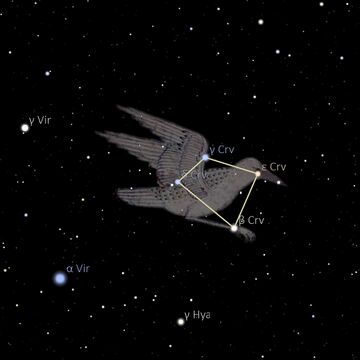 Southern Tent (الخباء اليماني), alḪibāʾ alYamānī in Corvus. Image produced by Stellarium. (CC BY Khalid AlAjaji 2026).
 -
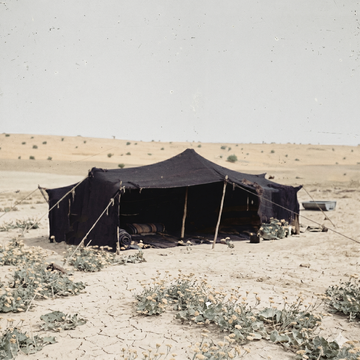 Arabian Khiba tent. image inspired by a century old photo in Matson collection in Library of Congress. (CC BY Khalid AlAjaji 2026).


The other is Saʿd al-Aḫbiya (سعد الأَخْبِيَة), an asterism of four stars in Aquarius: three form a triangle, which is al-Ḫibāʾ (the tent), and the fourth star inside the triangle is Saʿd (a man inside the tent). This description is given by Ibn Qutayba, al-Marzūqī, and al-Ṣūfī. Al-Ṣūfī said:[2]
سَعْدَ الأَخْبِيَةِ، وهو المنزل الخامس والعشرون من منازل القمر، سُمِّيَ بهذا الاسم لأنه من أربعة كواكب: ثلاثة منها على مثلث، وواحد في وسط المثلث وهو الحادي عشر، فجعلوا هذا الواحد سعدًا والثلاثة له بمنزلة الخباء.
Saʿd al-Aḫbiya ("Saad of the Tents"), the twenty-fifth of the lunar stations, was given this name because it consists of four stars: three form a triangle, and one lies at the center of that triangle — the eleventh star of Aquarius. They considered the central one Saʿd, and the three surrounding it like the tent that shelters Saʿd.
-
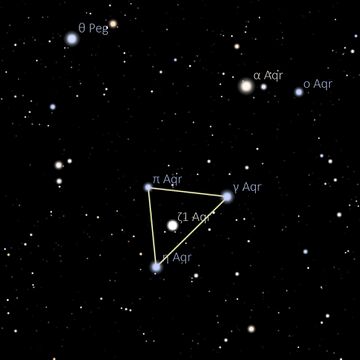 Saʿd al-AḪbiya, in Aquarius. Image produced by Stellarium. (CC BY Khalid AlAjaji 2026).
 -
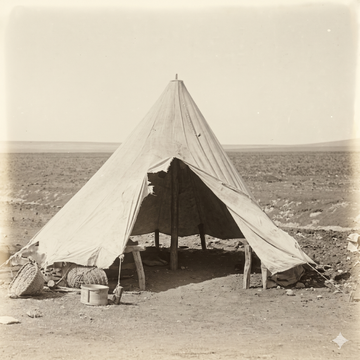 Arabian Khiba tent supported by one pole. image inspired by a century old photo in Matson collection in Library of Congress. (CC BY Khalid AlAjaji 2026).


Ibn Qutayba (d. 276 H / 889)
The complete text describing the Northern Tent (al-Ḫibāʾ ash-Šāmī) reads:[3]
- Original Arabic
وأولاد الظباء كواكب صغار، فيما بين الظباء والنفزات، وعن يمين نفزات الظباء كواكب مستديرة غير متقارنة، تسمّى: الحوض. والخباء أسفل من الحوض، كواكب في مثل هيئة الخباء اليمانية.
- English translation
The fawns, awlād al-Ẓibāʾ (أَوْلادُ الظِّبَاءِ), are small stars located between al-Ẓibāʾ (الظِّبَاءِ) and the Gazelle Leaps (النَّفَزَاتِ). To the right of the Gazelle Leaps (نَفَزَاتِ الظِّبَاءِ), there are round, non-aligned stars called al-Ḥawḍ (الحَوْضَ, "the Pool"). Below al-Ḥawḍ lies al-Ḫibāʾ (الخِبَاءُ, "the Tent"), a group of stars shaped like the southern tent (الخِبَاءِ اليَمَانِيَّةِ).
- Stars identification
It appears that al-Ḫibāʾ (الخِبَاءُ), as described by Ibn Qutayba, denotes a quadrilateral configuration of four stars, reflecting the form of the southern tent (al-Ḫibāʾ al-Yamānīyah, الخِبَاءِ اليَمَانِيَّةِ). Two such arrangements meet this criterion: one located beneath al-Ḥawḍ at its rising, and another beneath al-Ḥawḍ at its setting. The first consists of the four stars of the Big Dipper, which may be discounted since these are well known stars, and Ibn Qutayba would likely have acknowledged this alternate designation. The other candidate is the quadrilateral formed by 15 Lyn, δ Aur, and α, β Cam.
-
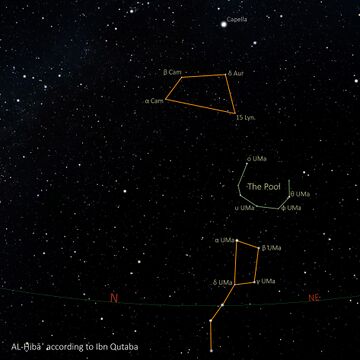 Al-Ḫibāʾ as described by ibn Qutayba. Image produced by Stellarium. (CC BY Khalid AlAjaji 2026).

Al-Ṣūfī (d. 376 H / 986)
The complete text describing the Northern Tent (al-Ḫibāʾ ash-Šāmī) reads:[4]
- Original Arabic
وفي القطعة من السماء التي حواليها هذه الصورة ورأس الدب الأكبر والجَدْيُ وكوكبة ذات الكرسي، وهي رقعة من السماء شبه مفازة ليس فيها كوكب نيِّر ولا شيء من الكواكب المرصودة إلا الاثنين اللذين على الرأس من هذه الصورة، وفيها من الكواكب ما لا يمكن إحصاؤه لكثرته وكثافة جمعه، وفي الوسط منها، كواكب من القدر الخامس والسادس، تُسَمِّيها العرب: الخِبَاءَ؛ لأنّها على صورة الخباء، والاثنان اللذان على الرأس من هذه الصورة داخلان في جملة الخباء.
- English translation
In the region of the sky surrounded by this constellation (referring to the constellation of Auriga), along with the head of the Great Bear, Polaris, and the constellation Cassiopeia, there is an area with no bright star, nor any reported by Ptolemy except for the two at the head of Auriga. This area contains countless stars, densely packed together. In its center are stars of fifth and sixth magnitude, which the Arabs call al-Ḫibāʾ (الخِبَاءُ, "the Tent") because they resemble the shape of a tent. The two stars at the head of this constellation are considered part of al-Ḫibāʾ.
- Stars identification
It is evident from the description that al-Ḫibāʾ (الخِبَاء) refers to a region of the sky encompassing numerous stars, including the two on the head of Auriga, δ and ξ Aur. Restricting the definition to only a specific number of stars does not align with the account given by al-Ṣūfī.
-
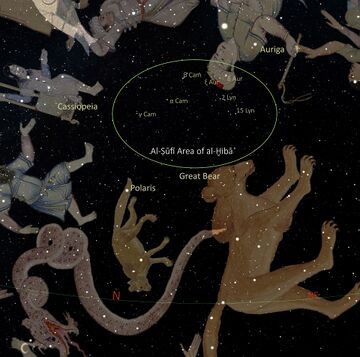 Al-Ḫibāʾ region as described by al-Ṣūfī. Image produced by Stellarium. (CC BY Khalid AlAjaji 2026).

Al-Marzūqī (d. 421 H / 1030)
The complete text describing the Northern Tent (al-Ḫibāʾ ash-Šāmī) on the authority of Ibn al-Aʿrabī (d. 230 H / 845) reads:[5]
- Original Arabic
وقال [ابن الأعرابي]: أسفل من بَنَاتِ نَعْشٍ كواكب كثيرة مختلطة يقال لها: الضِّبَاعُ. وأَوْلَادُ الضِّبَاعِ كواكب صغار، عن يمين الضِّبَاعِ، بينها وبين بَنَاتِ نَعْشٍ. قال: والخِبَاءُ كواكب في مثل هيئة الخِبَاءِ، أسفل من أَوْلَادِ الضِّبَاعِ.
- English translation
[Ibn al-Aʿrabī] said: Below Banāt Naʿsh (بَنَاتِ نَعْش) are numerous, scattered stars called al-Ḍibāʿ (الضِّبَاعُ, "the hyenas"). Awlād al-Ḍibāʿ (أَوْلَادُ الضِّبَاعِ, "the young hyenas") are small stars located to the right of al-Ḍibāʿ, between them and Banāt Naʿsh. He also said: al-Ḫibāʾ (الخِبَاءُ) is a group of stars resembling the shape of a tent, situated below Awlād al-Ḍibāʿ (أَوْلَادُ الضِّبَاعِ, "the young hyenas").
- Stars identification
Al-Marzūqī places al-Ḫibāʾ in spatial relation below al-Ḍibāʿ. From the text we can easily find a quadrilateral shape with relatively bright stars as described in the region of the constellation Hercules. The location of this tent fits nicely with the nearby shepherd with his goats and two dogs in the middle of a desert pasture. Notably, his description is clearer than those of Ibn Qutayba and al-Ṣūfī and corresponds well with the arrangement of stars in the night sky. According to his narrative, al-Ḫibāʾ refers to the four stars ζ, ε, π, η Her.
-
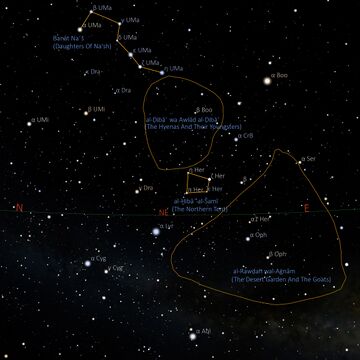 Al-Ḫibāʾ as described by al-Marzūqī. Image produced by Stellarium. (CC BY Khalid AlAjaji 2026).
 -
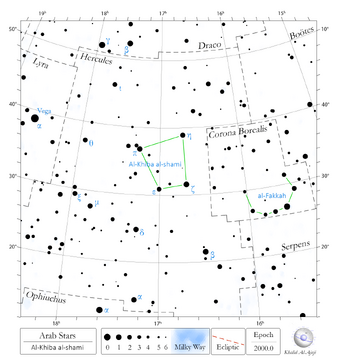 Star chart of the Arabian asterism al-Khiba al-shami (الخباء الشآمي) as described by al-Marzūqī in the area of Hercules constellation. (CC BY Khalid AlAjaji 2026).


Summary of stars identification
| Source | Identification | Comment |
|---|---|---|
| Ibn Qutayba | The quadrilateral formed by 15 Lyn, δ Aur, and α, β Cam | This is the closest match of the description, but with some uncertainty as the asterism stars are not prominent. |
| Al-Ṣūfī | A region of the sky surrounded by Auriga, along with the head of the Great Bear, Polaris, and Cassiopeia, including the two stars δ and ξ Aur. | A region with no bright stars, but no prominent asterism or group of stars resembling a tent could be identified. |
| Al-Marzūqī | ζ, ε, π, η Her | Definitive identification from a clear description |
Recommended identification
Based on the concordance of star positions and the historical descriptions, al-Marzūqī account is adopted for al-Ḫibāʾ in Hercules (Northern Tent) as the preferred identification. Al-Ḫibāʾ ash-Šāmī denotes the quadrilateral ζ, ε, π, η Her, corresponding to the Hercules Keystone.
Roland Laffitte
Weblinks
Reference
- ↑ Lisān al-ʿarab, لسان العرب، باب الواو والياء المعتل فصل الخاء المعجمة
- ↑ كتاب الكواكب لأبي الحسين عبد الرحمن بن عمر الرازي المعروف بالصوفي (291-376)، تحقيق خالد بن عبد الله العجاجي، ص 619.
Book of the stars by al-Ṣūfī (died 986): Critical edition with commentary by Khalid al-Ajaji, digital edition, 2021, pg 619. - ↑ أبو محمد عبد الله بن مسلم ابن قتيبة الدينوري (توفي 276 هـ)، كتاب الأنواء في مواسم العرب، دائرة المعارف العثمانية، حيدر أباد، الهند، 1375 هـ، ص 67.
Ibn Qutayba al-Dīnawarī, Abū Muḥammad ʿAbdallah b. Muslim. 1956. Kitāb al-anwāʾ (fī mawāsim al-ʿArab). Hyderabad: Maṭbaʿat Majlis Dāʾirat al-Maʿārif al-ʿUthmāniyya, pg 67. - ↑ كتاب الكواكب لأبي الحسين عبد الرحمن بن عمر الرازي المعروف بالصوفي (291-376)، تحقيق خالد بن عبد الله العجاجي، ص 247.
Book of the stars by al-Ṣūfī (died 986): Critical edition with commentary by Khalid al-Ajaji, digital edition, 2021, pg 247. - ↑ الإمام أبو علي أحمد بن محمد بن الحسن المرزوقي (توفي سنة 421 هـ)، الأزمنة والأمكنة، تحقيق د. محمد نايف الدليمي، عالم الكتب، بيروت، لبنان، 1422 هـ، الجزء الثاني، ص 345.
Al-Marzūqī, Abū ʿAli Aḥmad b. Muḥammad b. al-Ḥassan (died 1030), Al-Azminah wa al-amkinah (Times and Places), Edition by Dr. Mohammad Nayef al-Dulaymi, (Arabic print of the original book in 2002, World of Books, Beirut, Lebanon), vol 2, pg 345.