Kautoki: Difference between revisions
infobox |
|||
| (15 intermediate revisions by 4 users not shown) | |||
| Line 3: | Line 3: | ||
---- | ---- | ||
[[File:Karte von Mikronesien.png|thumb|Map of Micronesia with the island of Kapingamarangi labelled.]] | [[File:Karte von Mikronesien.png|thumb|Map of Micronesia with the island of Kapingamarangi labelled.]] | ||
{{Infobox constellation | |||
| name = Kautoki | |||
| native = kau and toki | |||
| translation = hand of the adze | |||
| pronounce = | |||
| IPA = | |||
| culture = IAU | |||
| RA = 281.1931545 | |||
| dec = 37.60512165 | |||
| areatotal = 0 | |||
| numbermainstars = 1 | |||
| numberbfstars = 1 | |||
| numberstarsplanets = | |||
| numberbrightstars = 0 | |||
| numbernearbystars = | |||
| brighteststarname = Kautoki | |||
| starmagnitude = 4.36 | |||
| neareststarname = | |||
| stardistance = | |||
| numbermessierobjects = | |||
| meteorshowers = | |||
| bordering = Lyr | |||
| notes = | |||
| cat = IAU-Star Name | |||
}} | |||
[[File:Kautoki profileCard SadeghFaghanpour-IAU-WGSN.jpg|thumb|Kautoki profile card (CC BY M.Sadegh Faghanpour).]] | |||
An asterism representing an adze handle known in the Polynesian outlier island of Kapingamarangi. It is formed of [[Vega]] (α Lyr), δ, ε, and ζ Lyr (Johnson, Mahelona and Ruggles 2026:<ref>Johnson, Rubellite K, John K. Mahelona and Clive Ruggles (2026). ''Nā Inoa Hōkū: Hawaiian and Pacific Star'' ''Name''s (3rd edition). Honolulu: University of Hawai‘i Press.</ref> 298). | An asterism representing an adze handle known in the Polynesian outlier island of Kapingamarangi. It is formed of [[Vega]] (α Lyr), δ, ε, and ζ Lyr (Johnson, Mahelona and Ruggles 2026:<ref>Johnson, Rubellite K, John K. Mahelona and Clive Ruggles (2026). ''Nā Inoa Hōkū: Hawaiian and Pacific Star'' ''Name''s (3rd edition). Honolulu: University of Hawai‘i Press.</ref> 298). | ||
[[File:Toki (adze), Canterbury Museum, 2016-01-27.jpg|thumb|Toki (adze) in the Canterbury Museum (CC0)]] | |||
Since 2026, Kautoki is also a modern star name for ζ<sup>1</sup> Lyr; the companion ζ<sup>2</sup> Lyr is named [[Urquchillay]]. | |||
==Concordance, Etymology, History== | ==Concordance, Etymology, History== | ||
[[File:Kautoki stellarium hi.png|thumb|the asterism of Kautoki sketched above a Stellarium map]] | [[File:Kautoki stellarium hi.png|thumb|the asterism of Kautoki sketched above a Stellarium map]] | ||
[[File:Fighting Adze Toki, Greenstone blade and carved handle Wellcome M0016042.jpg|thumb|Fighting Adze Toki, Greenstone blade and carved handle. Maori, New Zeland. In the exhibition of The Medicine of Aboriginal Peoples in the British Commonwealth.]] | |||
'''Variants''' | '''Variants''' | ||
| Line 14: | Line 43: | ||
The American anthropologist Kenneth Emory conducted an expedition to Kapingamarangi in 1947, during which he recorded 28 star names confirmed to him by, and identified with the help of, the informant “King David” (Emory 1965:<ref name=":0">Emory, Kenneth P. (1965). ''Kapingamarangi: Social and Religious Life of a Polynesian Atoll''. Honolulu: Bernice P. Bishop Museum (Bulletin 228).</ref> 341–343). Amongst these is ''Kautoki'' (#14). | The American anthropologist Kenneth Emory conducted an expedition to Kapingamarangi in 1947, during which he recorded 28 star names confirmed to him by, and identified with the help of, the informant “King David” (Emory 1965:<ref name=":0">Emory, Kenneth P. (1965). ''Kapingamarangi: Social and Religious Life of a Polynesian Atoll''. Honolulu: Bernice P. Bishop Museum (Bulletin 228).</ref> 341–343). Amongst these is ''Kautoki'' (#14). | ||
According to Emory, the name means handle (''kau'') of the adze (''toki''), and is formed of α, δ, ε, and ζ Lyr. However, he then states that Vega (α | According to Emory, the name means handle (''kau'') of the adze (''toki''), and is formed of α, δ, ε, and ζ Lyr. However, he then states that Vega (α Lyr) is the head of the adze, δ Lyr and ζ Lyr the handle, and ε Lyr the point of the blade. He adds that it (i.e., the asterism) is also called ''Me-mua'', meaning the “thing in front”, a synonym for adze. | ||
The asterism had been identified earlier (in 1910) by the German ethnographer Anneliese Eilers (1934:<ref>Eilers, Anneliese (1934). ''Inseln um Ponape''. In series Georg Thilenius (ed.), ''Ergebnisse der Südsee–Expedition'' ''1908–10'', sect. II, pt. B, vol. 8 (#23 of 30 vols., 1917–38). Hamburg: L. Friederichsen.</ref> 143 #15), who named it ''Gautogi'' but mistakenly identified it as Polaris. Emory (1910) mentions in the first paragraph on p. 341 that it was [Paul] Hambruch who did the fieldwork on Kapingamarangi in 1910, not Eilers herself. | The asterism had been identified earlier (in 1910) by the German ethnographer Anneliese Eilers (1934:<ref>Eilers, Anneliese (1934). ''Inseln um Ponape''. In series Georg Thilenius (ed.), ''Ergebnisse der Südsee–Expedition'' ''1908–10'', sect. II, pt. B, vol. 8 (#23 of 30 vols., 1917–38). Hamburg: L. Friederichsen.</ref> 143 #15), who named it ''Gautogi'' but mistakenly identified it as Polaris. Emory (1910) mentions in the first paragraph on p. 341 that it was [Paul] Hambruch who did the fieldwork on Kapingamarangi in 1910, not Eilers herself. | ||
| Line 21: | Line 50: | ||
[[File:Emory 1965 p. 343 Kautoki hi.jpg|thumb|Kautoki described in Emory (1965, 343). ]] | [[File:Emory 1965 p. 343 Kautoki hi.jpg|thumb|Kautoki described in Emory (1965, 343). ]] | ||
Kautoki is a weather sign asterism: it was believed to be the "maker of wind". | Kautoki is a weather sign asterism: it was believed to be the "maker of wind". | ||
[[File:Emory 1965 p. 342 hi.jpg|thumb|List of asterism names in Emory (1965, 342), Kautoki highlighted.]] | |||
Emory (1965,<ref name=":0" /> 341): <blockquote>Hambruch, in 1910, learned the names of 26 star or constellations (Eilers, 1934, p. 142 ) . His informant drew a rectangular horizon in the and, setting 26 little stones around it (7 along each side) , and gave each stone a name representing a star or constellation. Evidently this is a method for enumerating the tar used al o in the Carolines (Eilers, 1934, p. 142 ). The informant then made an attempt to show the position of these stars in the sky, by rearranging the stones. </blockquote><blockquote>The following 11 star and constellation names and their locations are known generally at present: Matariki , Unu, Taranga, Romoi, Harapori, Meremere, '''Kautoki''' , Mairap(a), Ti Kumat(e) , Pukute(a), and Ti Hetu-naniu. King David, however, knew 28 names and the locations of nearly all. He knew all the name in Hambruch's Iist except two ( No. 12, "ta moro," which I believe is the name me muri of King David, and No. 16, "go ixolii"). He was able to point out to me a ll tho e fo r which he knew the location and which were in the night sky during September, and I identified most of these from star charts I had with me. | |||
Emory (1965,<ref name=":0" /> 341-342): <blockquote>Hambruch, in 1910, learned the names of 26 star or constellations (Eilers, 1934, p. 142 ) . His informant drew a rectangular horizon in the and, setting 26 little stones around it (7 along each side) , and gave each stone a name representing a star or constellation. Evidently this is a method for enumerating the tar used al o in the Carolines (Eilers, 1934, p. 142 ). The informant then made an attempt to show the position of these stars in the sky, by rearranging the stones. </blockquote><blockquote>The following 11 star and constellation names and their locations are known generally at present: Matariki , Unu, Taranga, Romoi, Harapori, Meremere, '''Kautoki''' , Mairap(a), Ti Kumat(e) , Pukute(a), and Ti Hetu-naniu. King David, however, knew 28 names and the locations of nearly all. He knew all the name in Hambruch's Iist except two ( No. 12, "ta moro," which I believe is the name me muri of King David, and No. 16, "go ixolii"). He was able to point out to me a ll tho e fo r which he knew the location and which were in the night sky during September, and I identified most of these from star charts I had with me. | |||
... | ... | ||
14. Kautoki (No. 15).Vega and also Epsilon, Zeta, and Delta in Lyra. Kautoki means adz (toki) handle (kau). The point of the | 14. '''Kautoki''' (No. 15).Vega and also Epsilon, Zeta, and Delta in Lyra. Kautoki means adz (toki) handle (kau). The point of the blade is Epsilon; the handle is formed by Zeta and Delta. It is also called Me-mua, meaning "thing in front," a synonym for adz. (...) | ||
...</blockquote>Emory gives no drawings. | ...</blockquote>Emory gives no drawings. | ||
[[File:Eilers 1934 p142 drawings.jpg|thumb|drawings in the sand for star positions according to Eilers (1934 p142)]] | |||
The text also mentions a "drawing in the sand" which appears to be some form of star compass, which was then adjusted to show the positions of the stars in the sky. Eilers does show these at the bottom of p. 142. However, the star positions in the left-hand diagram don't seem to be in any meaningful order, even accounting for the fact that the cardinal directions might have been recored wrongly. | |||
=== Transfer and Transformation of the Constellation === | === Transfer and Transformation of the Constellation === | ||
nothing known | |||
== Mythology == | == Mythology == | ||
| Line 36: | Line 70: | ||
== IAU Working Group on Star Names == | == IAU Working Group on Star Names == | ||
The name | The IAU WGSN adopted the name '''Kautoki''' for the star [https://simbad.cds.unistra.fr/simbad/sim-id?Ident=%25402900021&Name=*%20zet01%20Lyr ζ<sup>1</sup> Lyr (6 Lyr, HR 7056, HD 173648, HIP 91971, WDS J18448+3736A)] on 18 June 2026. The star is a single-lined spectroscopic binary (catalogued as [http://vizier.cds.unistra.fr/viz-bin/VizieR-6?-out.form=%2bH%2bm&-source=B/sb9&-corr=FK=Seq&-out.max=9999&Seq===1079 SBC9 1079]) with orbital period 4.3 days ([https://ui.adsabs.harvard.edu/abs/1985ApJS...59..229A/abstract Abt & Levy 1985]), so technically the name is adopted for the bright primary star. The star is a chemically peculiar hot star with a complicated spectral type assigned of kA3hA5mF2(IV) by [https://ui.adsabs.harvard.edu/abs/1989ApJS...70..623G/abstract Gray & Garrison (1989)], implying the star has hydrogen Balmer absorption lines consistent with an A5-type star, but weaker Ca absorption lines consistent with A3, but other metal lines which are stronger and consistent with F2. | ||
Kautoki (ζ<sup>1</sup> Lyr) in a wide multiple system (WDS J18448+3736, STFA 38) with the neighboring star Urquchillay (ζ<sup>2</sup> Lyr), with separation of 44 arcseconds. The astrometric data from Gaia DR3 shows that their parallaxes and proper motions are nearly identical, implying that the triple system is approximately 48 parsecs away.<gallery> | |||
File:Kautoki profileCard SadeghFaghanpour-IAU-WGSN.jpg|Kautoki profile card (CC BY M.Sadegh Faghanpour). | |||
File:Kautoki stickfigure2 SadeghFaghanpour-IAU-WGSN.jpg|Kautoki stick figure (CC BY M.Sadegh Faghanpour). | |||
</gallery> | |||
== Weblinks == | == Weblinks == | ||
| Line 43: | Line 82: | ||
== References == | == References == | ||
[[Category:Oceania]] [[Category:Asterism]] [[Category:Constellation]] [[Category: | [[Category:Oceania]] [[Category:Micronesia]] [[Category:Federation States of Micronesia]] [[Category:Kapingamarangi]] [[Category:Asterism]] | ||
[[Category:Constellation]][[Category:IAU-Star Name]] [[Category:Star Name]] [[Category:Lyr]] | |||
Latest revision as of 07:33, 13 August 2026
Authors: Susanne M Hoffmann, Clive Ruggles, Eric Mamajek, Youla Azkarrula, IanRidpath

| Asterism Info | |
| Native | kau and toki |
|---|---|
| Translation | hand of the adze |
| Position (2000) | |
| Right ascension | 281.1931545 |
| Declination | 37.60512165 |
| Area | 0 sq. deg. |
| Stars | |
| Bright stars | 1 |
| Bayer/Flamsteed stars | 1 |
| Stars brighter than 3.00m | 0 |
| Brightest star | Kautoki (4.36m) |
| Taxonomy | |
| category of asterism | IAU-Star Name |
| IAU- constellations | Lyr |

An asterism representing an adze handle known in the Polynesian outlier island of Kapingamarangi. It is formed of Vega (α Lyr), δ, ε, and ζ Lyr (Johnson, Mahelona and Ruggles 2026:[1] 298).
,_Canterbury_Museum,_2016-01-27.jpg)
Since 2026, Kautoki is also a modern star name for ζ1 Lyr; the companion ζ2 Lyr is named Urquchillay.
Concordance, Etymology, History


Variants
- Kautoki
- Gautogi
The American anthropologist Kenneth Emory conducted an expedition to Kapingamarangi in 1947, during which he recorded 28 star names confirmed to him by, and identified with the help of, the informant “King David” (Emory 1965:[2] 341–343). Amongst these is Kautoki (#14).
According to Emory, the name means handle (kau) of the adze (toki), and is formed of α, δ, ε, and ζ Lyr. However, he then states that Vega (α Lyr) is the head of the adze, δ Lyr and ζ Lyr the handle, and ε Lyr the point of the blade. He adds that it (i.e., the asterism) is also called Me-mua, meaning the “thing in front”, a synonym for adze.
The asterism had been identified earlier (in 1910) by the German ethnographer Anneliese Eilers (1934:[3] 143 #15), who named it Gautogi but mistakenly identified it as Polaris. Emory (1910) mentions in the first paragraph on p. 341 that it was [Paul] Hambruch who did the fieldwork on Kapingamarangi in 1910, not Eilers herself.
Origin of Constellation

Kautoki is a weather sign asterism: it was believed to be the "maker of wind".

Emory (1965,[2] 341-342):
Hambruch, in 1910, learned the names of 26 star or constellations (Eilers, 1934, p. 142 ) . His informant drew a rectangular horizon in the and, setting 26 little stones around it (7 along each side) , and gave each stone a name representing a star or constellation. Evidently this is a method for enumerating the tar used al o in the Carolines (Eilers, 1934, p. 142 ). The informant then made an attempt to show the position of these stars in the sky, by rearranging the stones.
The following 11 star and constellation names and their locations are known generally at present: Matariki , Unu, Taranga, Romoi, Harapori, Meremere, Kautoki , Mairap(a), Ti Kumat(e) , Pukute(a), and Ti Hetu-naniu. King David, however, knew 28 names and the locations of nearly all. He knew all the name in Hambruch's Iist except two ( No. 12, "ta moro," which I believe is the name me muri of King David, and No. 16, "go ixolii"). He was able to point out to me a ll tho e fo r which he knew the location and which were in the night sky during September, and I identified most of these from star charts I had with me.
...
14. Kautoki (No. 15).Vega and also Epsilon, Zeta, and Delta in Lyra. Kautoki means adz (toki) handle (kau). The point of the blade is Epsilon; the handle is formed by Zeta and Delta. It is also called Me-mua, meaning "thing in front," a synonym for adz. (...)
...
Emory gives no drawings.

The text also mentions a "drawing in the sand" which appears to be some form of star compass, which was then adjusted to show the positions of the stars in the sky. Eilers does show these at the bottom of p. 142. However, the star positions in the left-hand diagram don't seem to be in any meaningful order, even accounting for the fact that the cardinal directions might have been recored wrongly.
Transfer and Transformation of the Constellation
nothing known
Mythology
Emory gives little contextual information about the mythological context, although he does mention (1965:[2] 343) that Kautoki is believed to be the “maker of wind”.
IAU Working Group on Star Names
The IAU WGSN adopted the name Kautoki for the star ζ1 Lyr (6 Lyr, HR 7056, HD 173648, HIP 91971, WDS J18448+3736A) on 18 June 2026. The star is a single-lined spectroscopic binary (catalogued as SBC9 1079) with orbital period 4.3 days (Abt & Levy 1985), so technically the name is adopted for the bright primary star. The star is a chemically peculiar hot star with a complicated spectral type assigned of kA3hA5mF2(IV) by Gray & Garrison (1989), implying the star has hydrogen Balmer absorption lines consistent with an A5-type star, but weaker Ca absorption lines consistent with A3, but other metal lines which are stronger and consistent with F2.
Kautoki (ζ1 Lyr) in a wide multiple system (WDS J18448+3736, STFA 38) with the neighboring star Urquchillay (ζ2 Lyr), with separation of 44 arcseconds. The astrometric data from Gaia DR3 shows that their parallaxes and proper motions are nearly identical, implying that the triple system is approximately 48 parsecs away.
-
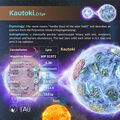 Kautoki profile card (CC BY M.Sadegh Faghanpour).
 -
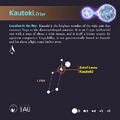 Kautoki stick figure (CC BY M.Sadegh Faghanpour).

Weblinks
References
- ↑ Johnson, Rubellite K, John K. Mahelona and Clive Ruggles (2026). Nā Inoa Hōkū: Hawaiian and Pacific Star Names (3rd edition). Honolulu: University of Hawai‘i Press.
- ↑ 2.0 2.1 2.2 Emory, Kenneth P. (1965). Kapingamarangi: Social and Religious Life of a Polynesian Atoll. Honolulu: Bernice P. Bishop Museum (Bulletin 228).
- ↑ Eilers, Anneliese (1934). Inseln um Ponape. In series Georg Thilenius (ed.), Ergebnisse der Südsee–Expedition 1908–10, sect. II, pt. B, vol. 8 (#23 of 30 vols., 1917–38). Hamburg: L. Friederichsen.