User:KhalidAlAjaji/الخباء اليماني: Difference between revisions
mNo edit summary |
fixed typing and consistency of using romanization |
||
| Line 15: | Line 15: | ||
== Names == | == Names == | ||
The asterism is referred to in historical sources as '' | The asterism is referred to in historical sources as ''al-Khibāʾ'' (Arabic: الخباء, “the Tent”) without a specifier, and as '''“Southern Tent”''' (Arabic: الخباء اليماني, ''al-Khibāʾ al-yamānī''). To avoid confusion with the asterism in Hercules also known as al-Khibāʾ and with the star α Crv named '''[[Alchiba]]''', this article uses the form '''“Southern Tent”''' (Arabic: الخباء اليماني, ''al-Khibāʾ al-yamānī''), following Ibn Qutayba. | ||
The asterism is also called '''عجز الأسد''' (romanized: ''ʿajz al-asad'', “the Lion’s Hindquarters”), '''عرش السماك''' (romanized: ''ʿarsh al‑Simāk'', literally “the Throne of al‑Simāk”; al‑Simāk is a proper name connected with being high or elevated) in works by Ibn Qutayba, al-Marzūqī, and al-Ṣūfī, while the form '''الأجمال'''/'''الأحمال؟''' (romanized: ''al-Ajmāl/al-Ahmāl'', “the camels/the loads on camels”) is reported only by al‑Ṣūfī. | |||
=== Modern Authors === | === Modern Authors === | ||
| Line 27: | Line 27: | ||
===== Etymology ===== | ===== Etymology ===== | ||
''al-Khibāʾ'' (Arabic: الخباء, from the Arabic root خبي) denotes a small tent. | ''al-Khibāʾ'' (Arabic: الخباء, from the Arabic root خبي) denotes a small tent. | ||
Lisān al-ʿArab defines ''al- | Lisān al-ʿArab defines ''al-Khibāʾ'' as:<ref>Lisān al-ʿarab, لسان العرب، باب الواو والياء المعتل فصل الخاء المعجمة</ref> | ||
<blockquote><p dir="rtl">الخِباءُ مِنَ الأَبنية: وَاحِدُ الأَخْبية، وَهُوَ مَا كَانَ مِنْ وَبَر أَو صُوفٍ وَلَا يَكُونُ مِنْ شَعَر، وَهُوَ عَلَى عَمُودَيْنِ أَو ثَلَاثَةٍ، وَمَا فوقَ ذَلِكَ فَهُوَ بَيْت.</p></blockquote> | <blockquote><p dir="rtl">الخِباءُ مِنَ الأَبنية: وَاحِدُ الأَخْبية، وَهُوَ مَا كَانَ مِنْ وَبَر أَو صُوفٍ وَلَا يَكُونُ مِنْ شَعَر، وَهُوَ عَلَى عَمُودَيْنِ أَو ثَلَاثَةٍ، وَمَا فوقَ ذَلِكَ فَهُوَ بَيْت.</p></blockquote> | ||
<blockquote>''Al- | <blockquote>''Al-Khibāʾ'' (الخِبَاء) is a tent made of camel wool or sheep’s wool, never of goat hair. It usually stands on two or three poles; anything larger than that is called a ''bayt'' (large tent).</blockquote> | ||
===== Concordance ===== | ===== Concordance ===== | ||
''al-Khibāʾ al-yamānī'' is an asterism of the quadrilateral γ, ε, β, δ Crv in the constellation Corvus. | ''al-Khibāʾ al-yamānī'' is an asterism of the quadrilateral γ, ε, β, δ Crv in the constellation Corvus, corresponding to the 2<sup>nd</sup>, 4<sup>th</sup>, 5<sup>th</sup>, and 7<sup>th</sup> stars of the 7 star Ptolemaic Corvus. | ||
===== History ===== | ===== History ===== | ||
Three primary sources discuss the Arabic Southern Tent (الخِبَاء اليماني, ''al-Khibāʾ al-yamānī''): Ibn Qutayba, al-Marzūqī, and al-Ṣūfī. Their accounts | Three primary sources discuss the Arabic Southern Tent (الخِبَاء اليماني, ''al-Khibāʾ al-yamānī''): Ibn Qutayba, al-Marzūqī, and al-Ṣūfī. Their accounts in agreement and support each other to give a star identification with great confidence and to understand how the Arabs imagined ''al-Khibāʾ'' as a sky figure. | ||
<gallery widths="360" heights="360"> | <gallery widths="360" heights="360"> | ||
File:Southern Tent.jpg|Southern Tent (الخباء اليماني), | File:Southern Tent.jpg|Southern Tent (الخباء اليماني), al-Khibāʾ al-yamānī in Corvus. Image produced by Stellarium. (CC BY Khalid AlAjaji 2026). | ||
File:Khiba ai generated.png|Arabian | File:Khiba ai generated.png|Arabian Khibāʾtent. image inspired by [https://tile.loc.gov/storage-services/service/pnp/matpc/01100/01108v.jpg a century old photo in Matson collection in Library of Congress]. (CC BY Khalid AlAjaji 2026). | ||
</gallery> | </gallery> | ||
Revision as of 03:21, 2 June 2026
Authors: Khalid Al-Ajaji
This article is about the asterism Alkhiba in the constellation Corvus. For the similarly named asterism in the northern sky, see Alkhiba alshamai (Northern Tent). For the star with a similar name, see Alchiba (the Tent).
Alkhiba (Arabic: الخباء, “the small tent”; also transliterated as al‑Ḫibāʾ and referred to as الْخِبَاء اليماني “Southern Tent”) is an asterism of four stars forming a quadrilateral in the constellation Corvus.
Headword
Arabic: الْخِبَاء اليماني Transliteration: al‑Ḫibāʾ al‑yamānī Romanization: al-Khibāʾ al-yamānī IPA: /ʔal.xɪ.baːʔu l.ja.maːniː/
Names
The asterism is referred to in historical sources as al-Khibāʾ (Arabic: الخباء, “the Tent”) without a specifier, and as “Southern Tent” (Arabic: الخباء اليماني, al-Khibāʾ al-yamānī). To avoid confusion with the asterism in Hercules also known as al-Khibāʾ and with the star α Crv named Alchiba, this article uses the form “Southern Tent” (Arabic: الخباء اليماني, al-Khibāʾ al-yamānī), following Ibn Qutayba.
The asterism is also called عجز الأسد (romanized: ʿajz al-asad, “the Lion’s Hindquarters”), عرش السماك (romanized: ʿarsh al‑Simāk, literally “the Throne of al‑Simāk”; al‑Simāk is a proper name connected with being high or elevated) in works by Ibn Qutayba, al-Marzūqī, and al-Ṣūfī, while the form الأجمال/الأحمال؟ (romanized: al-Ajmāl/al-Ahmāl, “the camels/the loads on camels”) is reported only by al‑Ṣūfī.
Modern Authors
Danielle Adams
Khalid AlAjaji
Etymology
al-Khibāʾ (Arabic: الخباء, from the Arabic root خبي) denotes a small tent. Lisān al-ʿArab defines al-Khibāʾ as:[1]
الخِباءُ مِنَ الأَبنية: وَاحِدُ الأَخْبية، وَهُوَ مَا كَانَ مِنْ وَبَر أَو صُوفٍ وَلَا يَكُونُ مِنْ شَعَر، وَهُوَ عَلَى عَمُودَيْنِ أَو ثَلَاثَةٍ، وَمَا فوقَ ذَلِكَ فَهُوَ بَيْت.
Al-Khibāʾ (الخِبَاء) is a tent made of camel wool or sheep’s wool, never of goat hair. It usually stands on two or three poles; anything larger than that is called a bayt (large tent).
Concordance
al-Khibāʾ al-yamānī is an asterism of the quadrilateral γ, ε, β, δ Crv in the constellation Corvus, corresponding to the 2nd, 4th, 5th, and 7th stars of the 7 star Ptolemaic Corvus.
History
Three primary sources discuss the Arabic Southern Tent (الخِبَاء اليماني, al-Khibāʾ al-yamānī): Ibn Qutayba, al-Marzūqī, and al-Ṣūfī. Their accounts in agreement and support each other to give a star identification with great confidence and to understand how the Arabs imagined al-Khibāʾ as a sky figure.
-
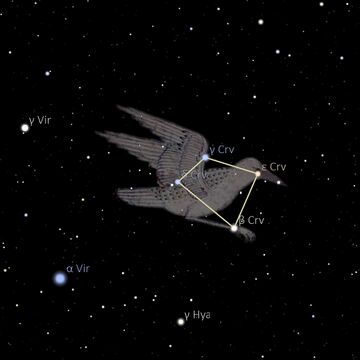 Southern Tent (الخباء اليماني), al-Khibāʾ al-yamānī in Corvus. Image produced by Stellarium. (CC BY Khalid AlAjaji 2026).
 -
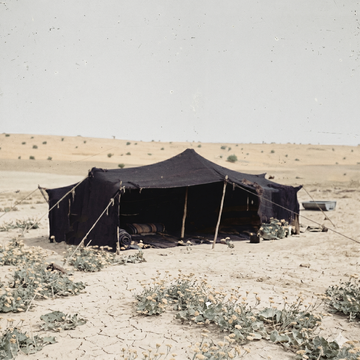 Arabian Khibāʾtent. image inspired by a century old photo in Matson collection in Library of Congress. (CC BY Khalid AlAjaji 2026).


Ibn Qutayba (d. 276 H / 889)
Ibn Qutayba named this asterism the Southern tent (Arabic: الخباء اليماني، al-Khibāʾ alyamānī) in his description of the Northern Tent. The complete text reads:[2]
- Original Arabic
وأولاد الظباء كواكب صغار، فيما بين الظباء والنفزات، وعن يمين نفزات الظباء كواكب مستديرة غير متقارنة، تسمّى: الحوض. والخباء أسفل من الحوض، كواكب في مثل هيئة الخباء اليمانية.
- English translation
The fawns, awlād al-Zibāʾ (أَوْلادُ الظِّبَاءِ), are small stars located between al-Zibāʾ (الظِّبَاءِ) and the Gazelle Leaps (النَّفَزَاتِ). To the right of the Gazelle Leaps (نَفَزَاتِ الظِّبَاءِ), there are round, non-aligned stars called al-Hawd (الحَوْضَ, "the Pool"). Below al-Hawd lies al-Khibāʾ (الخِبَاءُ, "the Tent"), a group of stars shaped like the Southern tent (الخِبَاءِ اليَمَانِيَّةِ).
Al-Ṣūfī (d. 376 H / 986)
The complete text describing the Northern Tent (al-Ḫibāʾ ash-Šāmī) reads:[3]
- Original Arabic
وفي القطعة من السماء التي حواليها هذه الصورة ورأس الدب الأكبر والجَدْيُ وكوكبة ذات الكرسي، وهي رقعة من السماء شبه مفازة ليس فيها كوكب نيِّر ولا شيء من الكواكب المرصودة إلا الاثنين اللذين على الرأس من هذه الصورة، وفيها من الكواكب ما لا يمكن إحصاؤه لكثرته وكثافة جمعه، وفي الوسط منها، كواكب من القدر الخامس والسادس، تُسَمِّيها العرب: الخِبَاءَ؛ لأنّها على صورة الخباء، والاثنان اللذان على الرأس من هذه الصورة داخلان في جملة الخباء.
- English translation
In the region of the sky surrounded by this constellation (referring to the constellation of Auriga), along with the head of the Great Bear, Polaris, and the constellation Cassiopeia, there is an area with no bright star, nor any reported by Ptolemy except for the two at the head of Auriga. This area contains countless stars, densely packed together. In its center are stars of fifth and sixth magnitude, which the Arabs call al-Ḫibāʾ (الخِبَاءُ, "the Tent") because they resemble the shape of a tent. The two stars at the head of this constellation are considered part of al-Ḫibāʾ.
Al-Marzūqī (d. 421 H / 1030)
The complete text describing the Northern Tent (al-Ḫibāʾ ash-Šāmī) on the authority of Ibn al-Aʿrabī (d. 230 H / 845) reads:[4]
- Original Arabic
وقال [ابن الأعرابي]: أسفل من بَنَاتِ نَعْشٍ كواكب كثيرة مختلطة يقال لها: الضِّبَاعُ. وأَوْلَادُ الضِّبَاعِ كواكب صغار، عن يمين الضِّبَاعِ، بينها وبين بَنَاتِ نَعْشٍ. قال: والخِبَاءُ كواكب في مثل هيئة الخِبَاءِ، أسفل من أَوْلَادِ الضِّبَاعِ.
- English translation
[Ibn al-Aʿrabī] said: Below Banāt Naʿsh (بَنَاتِ نَعْش) are numerous, scattered stars called al-Ḍibāʿ (الضِّبَاعُ, "the hyenas"). Awlād al-Ḍibāʿ (أَوْلَادُ الضِّبَاعِ, "the young hyenas") are small stars located to the right of al-Ḍibāʿ, between them and Banāt Naʿsh. He also said: al-Ḫibāʾ (الخِبَاءُ) is a group of stars resembling the shape of a tent, situated below Awlād al-Ḍibāʿ (أَوْلَادُ الضِّبَاعِ, "the young hyenas").
-
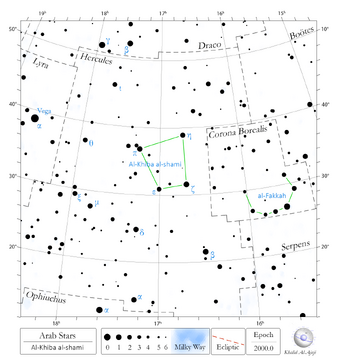 Star chart of the Arabian asterism al-Khiba al-shami (الخباء الشآمي) as described by al-Marzūqī in the area of Hercules constellation. (CC BY Khalid AlAjaji 2026).

Roland Laffitte
Weblinks
Reference
- ↑ Lisān al-ʿarab, لسان العرب، باب الواو والياء المعتل فصل الخاء المعجمة
- ↑ أبو محمد عبد الله بن مسلم ابن قتيبة الدينوري (توفي 276 هـ)، كتاب الأنواء في مواسم العرب، دائرة المعارف العثمانية، حيدر أباد، الهند، 1375 هـ، ص 67.
Ibn Qutayba al-Dīnawarī, Abū Muḥammad ʿAbdallah b. Muslim. 1956. Kitāb al-anwāʾ (fī mawāsim al-ʿArab). Hyderabad: Maṭbaʿat Majlis Dāʾirat al-Maʿārif al-ʿUthmāniyya, pg 67. - ↑ كتاب الكواكب لأبي الحسين عبد الرحمن بن عمر الرازي المعروف بالصوفي (291-376)، تحقيق خالد بن عبد الله العجاجي، ص 247.
Book of the stars by al-Ṣūfī (died 986): Critical edition with commentary by Khalid al-Ajaji, digital edition, 2021, pg 247. - ↑ الإمام أبو علي أحمد بن محمد بن الحسن المرزوقي (توفي سنة 421 هـ)، الأزمنة والأمكنة، تحقيق د. محمد نايف الدليمي، عالم الكتب، بيروت، لبنان، 1422 هـ، الجزء الثاني، ص 345.
Al-Marzūqī, Abū ʿAli Aḥmad b. Muḥammad b. al-Ḥassan (died 1030), Al-Azminah wa al-amkinah (Times and Places), Edition by Dr. Mohammad Nayef al-Dulaymi, (Arabic print of the original book in 2002, World of Books, Beirut, Lebanon), vol 2, pg 345.