Equuleus: Difference between revisions
| Line 20: | Line 20: | ||
The term "protomê" in principle can designate any forepart, e.g. a bust of a statue or a face of an animal. | The term "protomê" in principle can designate any forepart, e.g. a bust of a statue or a face of an animal. | ||
==== Ptolemy ==== | ==== Ptolemy' Almagest ==== | ||
{| class="wikitable" | {| class="wikitable" | ||
|+ | |+ | ||
| Line 102: | Line 102: | ||
|6.057 | |6.057 | ||
|} | |} | ||
=== Mediaeval, Renaissance and Early Modern Source === | |||
==== Alfonsine Tables (1483) ==== | |||
In 1483 the printer Erhard Ratdolt, working in Venice, published Tabulae Alphonsinae or the Alphonsine Tables, a compilation of astronomical data tabulating the positions and movements of the planets. | |||
==== Dürer (1515) ==== | |||
The pair of celestial maps created by Albrecht Dürer in 1515, one showing the Northern Hemisphere sky and the other the Southern Hemisphere sky, are generally regarded as the first printed star charts published in Europe. | |||
Schickard wrote it ... . | |||
==== Bayer and de Houtman (1603) ==== | |||
In his Uranometria, Bayer gives all the name alternatives mentioned above: | |||
==== Rudolphine Tables (1627) ==== | |||
[[File:Equ EquiSectio RudolphTab.png|thumb|Equ in Rudolphine Tables (Kepler 1627).]] | |||
TheTabulae Rudolphinae were ordered and dedicated to Emperor Rudolph II of the Holy Roman Empire. The main purpose was to allow the computation of the positions of the then known five classically known planets, but the tables also consist of a star catalogue. They were published by Johannes Kepler (1627), including earlier work and observational data by Tycho Brahe. The original Latin title is "Tabulæ Rudolphinæ, Quibus Astronomicæ Scientiæ, Temporum longinquitate collapsæ Restauratio continetur". | |||
An alternative name for Equuleus is given: '''Equi Sectio''', the Horse Part | |||
=== Transfer and Transformation of the Constellation === | === Transfer and Transformation of the Constellation === | ||
| Line 107: | Line 126: | ||
File:Pegasus et Equuleus - Mercator.jpeg|Equuleus (Mercator 1551) | File:Pegasus et Equuleus - Mercator.jpeg|Equuleus (Mercator 1551) | ||
File:Equuleus Uranometria.jpg|Equuleus, Johannes Bayer (1603), Uranometria. | File:Equuleus Uranometria.jpg|Equuleus, Johannes Bayer (1603), Uranometria. | ||
File:Equ EquiSectio RudolphTab.png|Equ in Rudolphine Tables (Kepler 1627). | |||
File:1776 - John Flamsteed - Pegase, Le Petit Cheval, Le Dauphin (Pegasus, Pisces and Equuleus).jpg|1776 (Jean Fortin) after John Flamsteed - Pegase, Le Petit Cheval, Le Dauphin (Pegasus, Delphinus and Equuleus). | File:1776 - John Flamsteed - Pegase, Le Petit Cheval, Le Dauphin (Pegasus, Pisces and Equuleus).jpg|1776 (Jean Fortin) after John Flamsteed - Pegase, Le Petit Cheval, Le Dauphin (Pegasus, Delphinus and Equuleus). | ||
File:1822 - Alexander Jamieson - Pegasus and Equuleus.jpg|Equuleus in Alexander Jamieson (1822). | File:1822 - Alexander Jamieson - Pegasus and Equuleus.jpg|Equuleus in Alexander Jamieson (1822). | ||
Revision as of 10:45, 20 June 2026
Authors: Susanne M Hoffmann, Eric Mamajek, Youla Azkarrula, Ian Ridpath

One of the 88 IAU constellations. It was invented in the first century BCE, called Protomê Hippou (Forepart of the Horse) by Geminos and Hippou Protomes in the Almagest (138 CE). Geminos attributes the constellation to Hipparchus but this cannot be confirmed by the surviving fragments and texts.
Etymology and History
[1]The small constellation is missing from the Farnese Globe, the Mainz Globe and the Kugel Globe, and it is not mentioned by Hipparchus, Eratosthenes and Aratos. Only Geminos (1st century BCE) mentions this constellation, and Ptolemy's Almagest finally establishes it.
The stars in the area of Equuleus are rather faint (brightest one has V~3.9 mag) and did not form a separate constellation. On the Farnese Globe, they are part of the dolphin's tail (Delphinus).
The Roman authors do not explain for what reason they invented it or where the inspiration for it came from. The mythographers point to Greek mythology as the starting point, according to which the neighbouring constellation (The Horse, now called Pegasus) gave birth to a young animal, a foal.
Ptolemy's constellation is supposed to depict a bust of a horse, i.e., by no means a complete horse.
The constellation is too small to be identified with any Babylonian constellation as the error bars in the Babylonian data are too large. The area might have been part of the constellation of The Corpse (Kurtik a06 AD6, pagru) or The Pig (Kurtik sh02 ŠAḪ). There is a Babylonian constellation The Horse, but it is likely to be seen in the northern parts of the sky (north of Deneb and the area of Equuleus).
Origin of Constellation
Geminos Protomê Hippou
The term "protomê" in principle can designate any forepart, e.g. a bust of a statue or a face of an animal.
Ptolemy' Almagest
| Ἵππου προτομῆς ἀστερισμóς. | Bust of Horse-Constellation | ||
|---|---|---|---|
| Greek | English | id. | |
| 1 | τῶv ἐv τῇ κεφαλῇ β ὁ προηγούμενος | The more advanced of the 2 stars in the head | α Equ |
| 2 | ὁ ἐπóμεvος αὐτῶν | The rearmost of them | β Equ |
| 3 | τῶv ἐv τῷ στόματι δύο ὁ προηγούμενος | The more advanced of the two stars in the mouth | γ Equ |
| 4 | ὁ ἑπóμεvος αὐτῶv | The rearmost of them | δ Equ |
| ἀστέρες δ ἀμανροί. | |||

Stars within the Constellation Area
| id | Label | IAU design. | description | Vmag |
|---|---|---|---|---|
| 1 | Kitalpha | HIP 104987 | Constellation lines (Vertex) | 3.933 |
| 2 | δ Equulei | HIP 104858 | Constellation lines (Vertex) | 4.49 |
| 3 | γ Equulei | HIP 104521 | Constellation lines (Vertex) | 4.68 |
| 4 | β Equulei | HIP 105570 | Constellation lines (Vertex) | 5.148 |
| 5 | 9 Equ | HIP 105413 | Inside the hull | 5.798 |
| 6 | 6 Equ | HIP 104538 | Inside the hull | 6.057 |
Mediaeval, Renaissance and Early Modern Source
Alfonsine Tables (1483)
In 1483 the printer Erhard Ratdolt, working in Venice, published Tabulae Alphonsinae or the Alphonsine Tables, a compilation of astronomical data tabulating the positions and movements of the planets.
Dürer (1515)
The pair of celestial maps created by Albrecht Dürer in 1515, one showing the Northern Hemisphere sky and the other the Southern Hemisphere sky, are generally regarded as the first printed star charts published in Europe.
Schickard wrote it ... .
Bayer and de Houtman (1603)
In his Uranometria, Bayer gives all the name alternatives mentioned above:
Rudolphine Tables (1627)

TheTabulae Rudolphinae were ordered and dedicated to Emperor Rudolph II of the Holy Roman Empire. The main purpose was to allow the computation of the positions of the then known five classically known planets, but the tables also consist of a star catalogue. They were published by Johannes Kepler (1627), including earlier work and observational data by Tycho Brahe. The original Latin title is "Tabulæ Rudolphinæ, Quibus Astronomicæ Scientiæ, Temporum longinquitate collapsæ Restauratio continetur".
An alternative name for Equuleus is given: Equi Sectio, the Horse Part
Transfer and Transformation of the Constellation
-
 Equuleus (Mercator 1551)
 -
 Equuleus, Johannes Bayer (1603), Uranometria.
 -
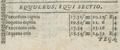 Equ in Rudolphine Tables (Kepler 1627).
 -
 1776 (Jean Fortin) after John Flamsteed - Pegase, Le Petit Cheval, Le Dauphin (Pegasus, Delphinus and Equuleus).
 -
 Equuleus in Alexander Jamieson (1822).
 -
 Equuleus in Sidney Hall's Urania's Mirror (1825).
 -
 Equuleus, Persian Manuscript 373, Wellcome Library London
 -
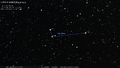 (1952) H.A. Rey's stick figure of Equuleus
 -
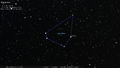 (1988) O. Hlad's stick figure of Equuleus


.jpg)

_-_original.jpg)


Greek Mythology
[1]The Greek myth revolves around Hippe, the daughter of the centaur Cheiron. When she got pregnant, she hid from her father. As he was looking for her, she was turned into a mare by the merciful gods. So she gave birth to a foal, which is depicted here.
IAU WGSN
The Greek name for the constellation in the Almagest, protome, means "the bust" and it designated the fore part of a horse (Alpha, Beta, Gamma, Delta Equulei). Alpha Equ already has an IAU name. Among the remaining ones, Delta Equ is the brightest.





