Tongling: Difference between revisions
Boshunyang (talk | contribs) Created page with " {{DISPLAYTITLE:Tongling (桐陵)}} thumb|Shaowei profile card (CC BY M. Sadegh Faghanpour for IAU WGSN). thumb|Shaowei stick figure (CC BY M. Sadegh Faghanpour for IAU WGSN). ''Shào Wèi'' (The Second Imperial Guard, 少衛) is the sixth star on the right wall of the ''Zǐ Gōng'' (''Purple Palace, 紫宮'') or ''Zǐwēi Yuán'' (''Purple Fo..." Tag: Disambiguation links |
Boshunyang (talk | contribs) No edit summary |
||
| Line 1: | Line 1: | ||
{{DISPLAYTITLE:Tongling (桐陵)}} | {{DISPLAYTITLE:Tongling (桐陵)}} | ||
Tóng Líng (Phoenix Tree Mound, 桐陵) is the sixth star on the right wall of the ''[[Zigong|Zǐ Gōng]]'' (''Purple Palace, 紫宮'') or Zǐwēi Yuán (Purple Enclosure), counting northward from the southern gate. It lies within the modern constellation ''[[Camelopardalis]]''. | |||
__FORCETOC__ | __FORCETOC__ | ||
== Etymology and History of the Name == | == Etymology and History of the Name == | ||
The '' | The name ''Tongling'' was current from the Han through the Tang dynasty but was later replaced by ''Shào Wèi'' (Junior Guard, 少衛) in the revised nomenclature of the ''Zigong''. As a result, the original designation fell gradually into obscurity. | ||
The term ''tong'' refers to the ''wutong'' tree (''Firmiana simplex''), which in Chinese mythology is the perch of the phoenix; ''líng'' denotes a “high mound” or “tumulus.” Thus, ''Tóng Líng'' may be interpreted as “Phoenix Tree Mound,” evoking a place of elevation and sanctity within the imperial celestial precinct. | |||
=== Constellation & Star Name === | |||
The ''Cheonsang Yeolcha Bunyajido'' (''Tianxiang Lieci Fenye zhi tu'', Diagram of the Astrological Field Allocations) preserves the most ancient configuration of Chinese asterisms, allowing ''Tongling'' to be securely identified with HIP 33694. The name is also explicitly labeled in another Tang-period star map, the ''Gezi Yuejin tu'' (Gridded Monthly Progress Diagram), confirming its position and continued recognition during that era. | |||
See [[Zigong]] for more identification. | |||
See [[Zigong]] for | |||
{| class="wikitable" | {| class="wikitable" | ||
|+ | |+ | ||
| Line 33: | Line 30: | ||
!Boshun Yang<ref name=":1" /> | !Boshun Yang<ref name=":1" /> | ||
Song Jingyou(1034) | Song Jingyou(1034) | ||
|- | |||
|Tongling (桐陵, 6th on the Right Wall ) | |||
| | |||
| | |||
| | |||
| | |||
| | |||
|HIP 33694 | |||
| | |||
|- | |- | ||
|Shaowei (少衛, 6th on the Right Wall ) | |Shaowei (少衛, 6th on the Right Wall ) | ||
| Line 40: | Line 46: | ||
|γ Cam | |γ Cam | ||
|BK Cam | |BK Cam | ||
| | | | ||
|HIP33694 | |HIP33694 | ||
|} | |} | ||
| Line 61: | Line 58: | ||
==IAU Working Group on Star Names== | ==IAU Working Group on Star Names== | ||
== References == | == References == | ||
[[References]] | [[References]] | ||
Revision as of 10:53, 2 January 2026
Tóng Líng (Phoenix Tree Mound, 桐陵) is the sixth star on the right wall of the Zǐ Gōng (Purple Palace, 紫宮) or Zǐwēi Yuán (Purple Enclosure), counting northward from the southern gate. It lies within the modern constellation Camelopardalis.
Etymology and History of the Name
The name Tongling was current from the Han through the Tang dynasty but was later replaced by Shào Wèi (Junior Guard, 少衛) in the revised nomenclature of the Zigong. As a result, the original designation fell gradually into obscurity.
The term tong refers to the wutong tree (Firmiana simplex), which in Chinese mythology is the perch of the phoenix; líng denotes a “high mound” or “tumulus.” Thus, Tóng Líng may be interpreted as “Phoenix Tree Mound,” evoking a place of elevation and sanctity within the imperial celestial precinct.
Constellation & Star Name
The Cheonsang Yeolcha Bunyajido (Tianxiang Lieci Fenye zhi tu, Diagram of the Astrological Field Allocations) preserves the most ancient configuration of Chinese asterisms, allowing Tongling to be securely identified with HIP 33694. The name is also explicitly labeled in another Tang-period star map, the Gezi Yuejin tu (Gridded Monthly Progress Diagram), confirming its position and continued recognition during that era.
See Zigong (紫宮) for more identification.
| Star Name | Ho PENG YOKE[1] | Yi Shitong[2]
Based on catalogue in 18th century |
Pan Nai[3]
based on Huangyou Star Catalogue |
Pan Nai[4]
based on catalogues in Yuan dynasty |
SUN X. & J. Kistemaker[5]
Han Dynasty |
Boshun Yang[6]
before Tang dynasty |
Boshun Yang[6]
Song Jingyou(1034) |
|---|---|---|---|---|---|---|---|
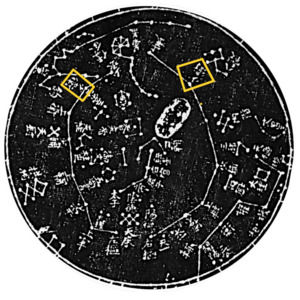
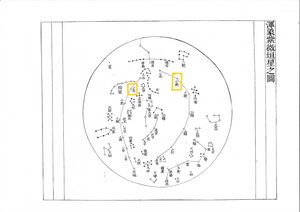
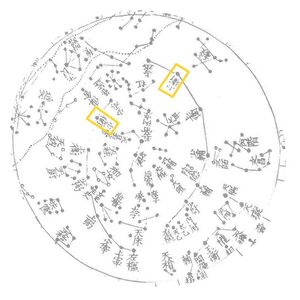
| Tongling (桐陵, 6th on the Right Wall ) | HIP 33694 | ||||||
| Shaowei (少衛, 6th on the Right Wall ) | α Cam | α Cam | BN Cam | γ Cam | BK Cam | HIP33694 |
Images
- Shaowei
-
 Shaowei on Suzhou Star Map
 -
 Shaowei on Xinyixinagfayao Star Map
 -
 Shaowei on 18th Century Yixiang kaocheng Star Map


IAU Working Group on Star Names
References
- ↑ P.-Y. Ho, “Ancient And Mediaeval Observations of Comets and Novae in Chinese Sources,” Vistas in Astronomy, 5 (1962), 127-225.
- ↑ Yi Shitong [伊世同]. Zhongxi Duizhao Hengxing Tubiao [中西对照恒星图表1950]. Beijing: Science Press. 1981: p. 56.
- ↑ Pan Nai [潘鼐]. Zhongguo Hengxing Guance shi [中国恒星观测史]. Shanghai: Xuelin Pree. 1989. p. 226.
- ↑ Pan Nai [潘鼐]. Zhongguo Hengxing Guance shi [中国恒星观测史]. Shanghai: Xuelin Pree. 2009. p. 443.
- ↑ Sun Xiaochun & Kistemaker J. The Chinese sky during the Han. Leiden: Brill. 1997, pp. 241-6.
- ↑ 6.0 6.1 B.-S. Yang [杨伯顺], Zhongguo Chuantong Hengxing Guance Jingdu ji Xingguan Yanbian Yanjiu [中国传统恒星观测精度及星官演变研究] (A Research on the Accuracy of Chinese Traditional Star Observation and the Evolution of Constellations), PhD thesis, (Hefei: University of Science and Technology of China, 2023). p.238.