Maenalus: Difference between revisions
Ericmamajek (talk | contribs) |
Ericmamajek (talk | contribs) update on discussion about the star |
||
| Line 34: | Line 34: | ||
==IAU Working Group on Star Names== | ==IAU Working Group on Star Names== | ||
The stars in the area of the extinct constellation Mons Maenalus are rather faint, with the brightest stars in the region outlined by Hevelius being 109 Vir (Vmag=3.72), 110 Vir (Vmag=4.40), 31 Boo (Vmag=4.86). | The stars in the area of the extinct constellation Mons Maenalus are rather faint, with the brightest stars in the region outlined by Hevelius being 109 Vir (Vmag=3.72), 110 Vir (Vmag=4.40), 31 Boo (Vmag=4.86). | ||
On April 15, 2026, the IAU Working Group Star Names adopted the name '''Maenalus''' for the star 109 Virginis (HR 5511, HD 130109, HIP 72220). The star has spectral type A0IVnn, with the "nn" implying very fast projected rotational velocity (Gray & Garrison 1987). The star is noteworthy as being one of the 6 stars classified A0V (at the time) by Johnson & Morgan (1953) which they used to define the zero point colors for the famous Johnson UBV photometric system (the averaged U-B and B-V colors of the 6 stars, which included Vega, were set to zero). | |||
== Weblinks == | == Weblinks == | ||
Revision as of 05:32, 17 April 2026
Authors: Susanne M Hoffmann, Eric Mamajek, Youla Azkarrula


Mons Maenalus is an early modern European constellation or asterism introduced by Hevelius. Its position was south of Boötes (several degrees south of Arcturus), but north of Virgo, and west of Serpens Caput. The term is Latin, and the constellation was not included among the 88 IAU constellations and is now obsolete.[1]
Concordance, Etymology, History

Spelling Variants
- Mons Maenalis
- Mons Menalis
Origin of the Constellation
Mons Maenalus was a subdivision of Boötes introduced by Hevelius.
Ian Ridpath writes:[1]
Representing a real mountain of Arcadia in the central Peloponnese, Mons Maenalus was a subdivision of Boötes introduced by Johannes Hevelius in his Firmamentum Sobiescianum star atlas published in 1690, where it was depicted with Boötes standing on its slopes. However, in his accompanying catalogue Hevelius listed its stars under Boötes, not as a separate constellation. The mountain appeared on many later maps made by other astronomers including Bode, below, but always as part of Boötes, and it never had an independent existence.
The ancient Greek name for the mountain was Μαίναλος or Μαίναλον, with a modern Greek spelling of Μαίναλο (Romanized as Mainalo).
Transformations & Variants
-
 Bootes - Prodromus astronomiae 1690
 -
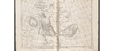 Mons Maenalus in Bode (1801).
 -
 Mons Maenalus in Bode (1801), coloured.
.jpg)


Mythology
Ian Ridpath's Star Tales:[1]
Mons Maenalus took its name from a character in Greek mythology. Maenalus was said by some mythologists to have been the eldest son of Lycaon, king of Arcadia; this would have made Maenalus brother of Callisto and hence uncle of her son Arcas, whom the constellation Boötes represents. Others, though, say he was actually the son of Arcas and hence the grandson of Callisto. Either way, Maenalus gave his name to the mountain in Arcadia and to the city of Maenalon which he founded. Its modern name is Mainalo.
Mons Maenalus was sacred to the god Pan who frequented it. Ovid in his Metamorphoses said that Mons Maenalus bristled with the lairs of wild beasts and was a favourite hunting ground of Diana and her entourage, including Callisto. In saying this, Ovid clearly rejected the story that Maenalus was Callisto’s grandson, as the mountain would not yet have got its name.
IAU Working Group on Star Names
The stars in the area of the extinct constellation Mons Maenalus are rather faint, with the brightest stars in the region outlined by Hevelius being 109 Vir (Vmag=3.72), 110 Vir (Vmag=4.40), 31 Boo (Vmag=4.86).
On April 15, 2026, the IAU Working Group Star Names adopted the name Maenalus for the star 109 Virginis (HR 5511, HD 130109, HIP 72220). The star has spectral type A0IVnn, with the "nn" implying very fast projected rotational velocity (Gray & Garrison 1987). The star is noteworthy as being one of the 6 stars classified A0V (at the time) by Johnson & Morgan (1953) which they used to define the zero point colors for the famous Johnson UBV photometric system (the averaged U-B and B-V colors of the 6 stars, which included Vega, were set to zero).
Weblinks
- Hevelius' Atlas (1690) in Biblioteka Narodowa, polona.pl
Reference
- ↑ 1.0 1.1 1.2 Ian Ridpath, Star Tales, Online Edition





