User:KhalidAlAjaji/al-Ḫibāʾ al-šaāmī: Difference between revisions
mNo edit summary |
m Adde image |
||
| Line 137: | Line 137: | ||
It is a notable coincidence that the al-Ḫibāʾ al-yamānī (γ, ε, β, δ Crv) lies near a circular group of stars—the circular stars of al-Maʿlaf (θ, ε, δ, γ, ζ, η Crt); that the al-Ḫibāʾ described by al-Marzūqī lies near the circular stars of al-Fakkah (Corona Borealis); and that the al-Ḫibāʾ mentioned by Ibn Qutayba lies near the circular stars of al-Ḥawḍ (υ, φ, θ, e, f UMa). | It is a notable coincidence that the al-Ḫibāʾ al-yamānī (γ, ε, β, δ Crv) lies near a circular group of stars—the circular stars of al-Maʿlaf (θ, ε, δ, γ, ζ, η Crt); that the al-Ḫibāʾ described by al-Marzūqī lies near the circular stars of al-Fakkah (Corona Borealis); and that the al-Ḫibāʾ mentioned by Ibn Qutayba lies near the circular stars of al-Ḥawḍ (υ, φ, θ, e, f UMa). | ||
<gallery> | <gallery widths="360" heights="360"> | ||
File:AlKhiba alyamani plus crater.png|Al-Ḫibāʾ al-yamānī near the the circular star pattern of al-Maʿlaf (Crater). | |||
</gallery> | </gallery> | ||
Revision as of 16:53, 12 June 2026
Authors: Khalid Al-Ajaji


al-Ḫibāʾ (Arabic: الخباء), “the small tent” is an Arabic name for a region or an asterism of four stars in the northern sky forming a quadrilateral shape.
Provenance, Etymology, History
Variants The name appeared in historical resources as al-Ḫibāʾ (Arabic: الخباء, the Tent) without any specifier, but to avoid confusion with the Corvus asterism also known as al‑Ḫibāʾ and the star α Crv named Alchiba, this encyclopedia refers to the Hercules asterism as al-Ḫibāʾ al-al-šaāmī (Arabic: الخباء الشآمي, “Northern Tent” ), while reserving al-Ḫibāʾ al-yamānī (Arabic: الخباء اليماني, “Southern Tent”) for the Corvus asterism as specified by Ibn Qutayba and al-Ṣūfī (See al-Ḫibāʾ al-yamānī).
Etymology
al‑Ḫibāʾ (Arabic: الخباء), from the Arabic root خ ب ي) denotes a small tent.
Lisān al-ʿArab defines al-Ḫibāʾ as:[1]
الخِباءُ مِنَ الأَبنية: وَاحِدُ الأَخْبية، وَهُوَ مَا كَانَ مِنْ وَبَر أَو صُوفٍ وَلَا يَكُونُ مِنْ شَعَر، وَهُوَ عَلَى عَمُودَيْنِ أَو ثَلَاثَةٍ، وَمَا فوقَ ذَلِكَ فَهُوَ بَيْت.
al‑Ḫibāʾ (الخِبَاء) is a tent made of camel wool or sheep’s wool, never of goat hair. It usually stands on two or three poles; anything larger than that is called a bayt (large tent).
Sources and Identification
Three primary sources discuss the Arabic al-Ḫibā' al-šaāmī (الخِبَاء الشآمي, "Northern Tent"): Ibn Qutayba, al-Marzūqī, and al-Ṣūfī. Their accounts differ, and to elucidate the significance of al-Ḫibā', one must compare it to other distinctly named stellar configurations that bear analogous nomenclature.
To understand how the Arabs imagined al-Ḫibā', we can look at two well defined Ḫibā' asterisms at our disposal. The first is al-Ḫibā' al-Yamānī (Arabic: الخباء اليماني, "the Southern Tent"), which corresponds to an asterism of four quadrilateral stars γ, ε, β, δ in Corvus.
-
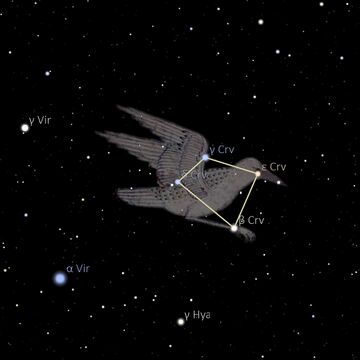 Southern Tent (الخباء اليماني), al-Ḫibā' al-Yamānī in Corvus. Image produced by Stellarium. (CC BY Khalid AlAjaji 2026).
 -
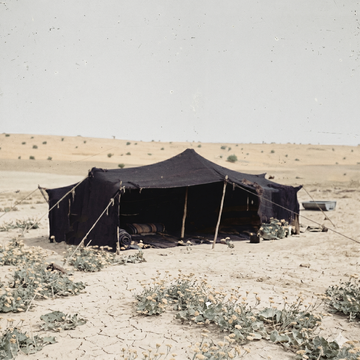 Arabian Ḫibā' tent. image inspired by a century old photo in Matson collection in Library of Congress. (CC BY Khalid AlAjaji 2026).

The other is Saʿd al-AḪbiya (Arabic: سعد الأَخْبِيَة, "Auspice of Small Tents"), an asterism of four stars in Aquarius: three form a triangle, which is al-Ḫibā' (the tent), and the fourth star inside the triangle is Saʿd (a man inside the tent). This description is given by Ibn Qutayba, al-Marzūqī, and al-Ṣūfī. Al-Ṣūfī said (description of Aquarius)[2]:
سَعْدَ الأَخْبِيَةِ، وهو المنزل الخامس والعشرون من منازل القمر، سُمِّيَ بهذا الاسم لأنه من أربعة كواكب: ثلاثة منها على مثلث، وواحد في وسط المثلث وهو الحادي عشر، فجعلوا هذا الواحد سعدًا والثلاثة له بمنزلة الخباء.
Saʿd al-AḪbiya ("Saʿd of the Tents"), the twenty-fifth of the lunar stations, was given this name because it consists of four stars: three form a triangle, and one lies at the center of that triangle — the eleventh star of Aquarius. They considered the central one Saʿd, and the three surrounding it like the tent that shelters Saʿd.
-
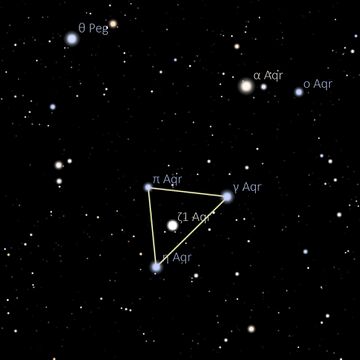 Saʿd al-AḪbiya, in Aquarius. Image produced by Stellarium. (CC BY Khalid AlAjaji 2026).
 -
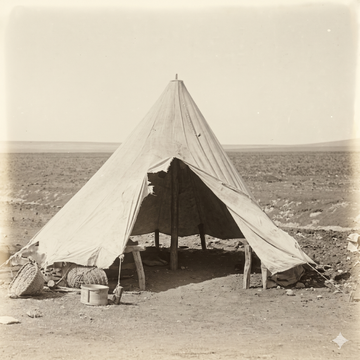 Arabian Ḫibā' tent supported by one pole. image inspired by a century old photo in Matson collection in Library of Congress. (CC BY Khalid AlAjaji 2026).


| Sources | Identification(s) |
|---|---|
| Ibn Qutayba (d. 276 H / 889)
Original Arabic (p. 67)[3] وأولاد الظباء كواكب صغار، فيما بين الظباء والنفزات، وعن يمين نفزات الظباء كواكب مستديرة غير متقارنة، تسمّى: الحوض. والخباء أسفل من الحوض، كواكب في مثل هيئة الخباء اليمانية. English translation The fawns, awlād al-Zibāʾ (أَوْلادُ الظِّبَاءِ), are small stars located between al-Zibāʾ (الظِّبَاءِ) and the Gazelle Leaps (النَّفَزَاتِ). To the right of the Gazelle Leaps (نَفَزَاتِ الظِّبَاءِ), there are round, non-aligned stars called al-Hawd (الحَوْضَ, "the Pool"). Below al-Hawd lies al-Ḫibāʾ (الخِبَاءُ, "the Tent"), a group of stars shaped like the Southern tent (الخِبَاءِ اليَمَانِيَّةِ, al-Ḫibāʾ alyamāniyah).
It appears that al-Ḫibāʾ (الخِبَاءُ), as described by Ibn Qutayba, denotes a quadrilateral configuration of four stars, reflecting the form of the southern tent (al-Ḫibā' al-Yamāniyah, الخِبَاءِ اليَمَانِيَّةِ). Two such arrangements meet this criterion: one located beneath al-Ḥawḍ at its rising, and another beneath al-Ḥawḍ at its setting. The first consists of the four stars of the Big Dipper, which may be discounted since these are well known stars, and Ibn Qutayba would likely have acknowledged this alternate designation. The other candidate is the quadrilateral formed by 15 Lyn, δ Aur, and α, β Cam. |
 |
| Al-Ṣūfī (d. 376 H / 986)[2]
Original Arabic (description of Auriga) Original Arabic وفي القطعة من السماء التي حواليها هذه الصورة ورأس الدب الأكبر والجَدْيُ وكوكبة ذات الكرسي، وهي رقعة من السماء شبه مفازة ليس فيها كوكب نيِّر ولا شيء من الكواكب المرصودة إلا الاثنين اللذين على الرأس من هذه الصورة، وفيها من الكواكب ما لا يمكن إحصاؤه لكثرته وكثافة جمعه، وفي الوسط منها، كواكب من القدر الخامس والسادس، تُسَمِّيها العرب: الخِبَاءَ؛ لأنّها على صورة الخباء، والاثنان اللذان على الرأس من هذه الصورة داخلان في جملة الخباء.
In the region of the sky surrounded by this constellation (referring to the constellation of Auriga), along with the head of the Great Bear, Polaris, and the constellation Cassiopeia, there is an area with no bright star, nor any reported by Ptolemy except for the two at the head of Auriga. This area contains countless stars, densely packed together. In its center are stars of fifth and sixth magnitude, which the Arabs call al-Ḫibāʾ (الخِبَاءُ, "the Tent") because they resemble the shape of a tent. The two stars at the head of this constellation are considered part of al-Ḫibāʾ.
It is evident from the description that al-Ḫibāʾ (الخِبَاء) refers to a region of the sky encompassing numerous stars, including the two on the head of Auriga, δ and ξ Aur. Restricting the definition to only a specific number of stars does not align with the account given by al-Ṣūfī. |
 |
| Al-Marzūqī (d. 421 H / 1030) (vol 2, p. 345)[4]
The complete text describing the Northern Tent (al-Khibā' al-Shaāmī) on the authority of Ibn al-Aʿrabī (d. 230 H / 845) reads:
وقال [ابن الأعرابي]: أسفل من بَنَاتِ نَعْشٍ كواكب كثيرة مختلطة يقال لها: الضِّبَاعُ. وأَوْلَادُ الضِّبَاعِ كواكب صغار، عن يمين الضِّبَاعِ، بينها وبين بَنَاتِ نَعْشٍ. قال: والخِبَاءُ كواكب في مثل هيئة الخِبَاءِ، أسفل من أَوْلَادِ الضِّبَاعِ.
[Ibn al-Aʿrabī] said: Below Banāt Naʿsh (بَنَاتِ نَعْش) are numerous, scattered stars called al-Ḍibāʿ (الضِّبَاعُ, "the hyenas"). Awlād al-Ḍibāʿ (أَوْلَادُ الضِّبَاعِ, "the young hyenas") are small stars located to the right of al-Ḍibāʿ, between them and Banāt Naʿsh. He also said: al-Ḫibāʾ (الخِبَاءُ) is a group of stars resembling the shape of a tent, situated below Awlād al-Ḍibāʿ (أَوْلَادُ الضِّبَاعِ, "the young hyenas").
Al-Marzūqī places al-Ḫibāʾ in spatial relation below al-Ḍibāʿ. From the text we can easily find a quadrilateral shape with relatively bright stars as described in the region of the constellation Hercules. The location of this tent fits nicely with the nearby shepherd with his goats and two dogs in the middle of a desert pasture. Notably, his description is clearer than those of Ibn Qutayba and al-Ṣūfī and corresponds well with the arrangement of stars in the night sky. According to his narrative, al-Ḫibāʾ refers to the four stars ζ, ε, π, η Her. |
 |
Stars Identification
| Source | Identification | Comment |
|---|---|---|
| Ibn Qutayba | The quadrilateral formed by 15 Lyn, δ Aur, and α, β Cam | This is the closest match of the description, but with some uncertainty as the asterism stars are not prominent. |
| Al-Ṣūfī | A region of the sky surrounded by Auriga, along with the head of the Great Bear, Polaris, and Cassiopeia, including the two stars δ and ξ Aur. | A region with no bright stars, but no prominent asterism or group of stars resembling a tent could be identified. |
| Al-Marzūqī | ζ, ε, π, η Her | Definitive identification from a clear description |
Discussion
Ibn Qutayba says:
“Al-Khibāʾ is below (Arabic: asfal) al-Ḥawḍ; stars arranged in a formation resembling the Southern tent.”
There are no prominent stars in the vicinity of al-Ḥawḍ (υ, φ, θ, e, f UMa) that match the form of the Southern tent (γ, ε, β, δ Crv), except for the stars of the Square of Banāt Naʿsh (α, β, γ, δ UMa). These stars, however, are extremely well known, and if they had been called al-Ḫibāʾ, Ibn Qutaybah would have mentioned that. Therefore, it is necessary to examine what Ibn Qutaybah meant by his expression “below/ Arabic: asfal.” He uses this description more than ten times, for example:
- al-Kaff al-Jadhmāʾ (λ, α, γ, δ, ξ², μ Cet), which is below al-Sharaṭayn (α, β Ari) (p. 32)
- “Kursī al-Jawzāʾ,” four stars forming an irregular quadrilateral (α, β, δ, γ Lep), below al-Jawzāʾ (p. 48)
- “al-Qubbah” (Corona Australis), which is below the Šawlat al-ʿaqrab (λ Sco) (p. 73)
All these examples consistently indicate that “below” means beneath at the rising of these stars. Accordingly, al-Ḫibāʾ is below al-Ḥawḍ, which is only satisfied by the Square of Banāt Naʿsh. As for the other stars that lie below al-Ḥawḍ at its culmination or setting, they are faint—below fourth magnitude—except for δ Aur.
As for al-Ṣūfī’s description of al-Ḫibāʾ, it is likely that he attempted to reconcile Ibn Qutaybah’s account with the actual appearance of the stars in the sky. Not finding a pattern similar to the Southern tent, he instead placed al-Ḫibāʾ as a region in the area of the constellations Camelopardalis and Lynx.
This suggests that Ibn Qutayba, followed by al-Ṣūfī, transmitted a text in which an error occurred, substituting the word “al-Ḍibāʿ” (the hyenas) with “al-Ẓibāʾ” (the gazelles). Perhaps the description originally referred to a circular group of stars—intended to denote al-Fakkah (Corona Borealis)—which Ibn Qutayba then interpreted as al-Ḥawḍ. This is supported by al-Marzūqī’s version, which aligns with the actual sky. He transmitted the statement of Ibn al-Aʿrābī, who died about half a century before Ibn Qutayba:
“Ibn al-Aʿrābī said: Below Banāt Naʿsh are many mingled stars called al-Ḍibāʿ. The ‘young of the hyenas’ are small stars to the right of al-Ḍibāʿ, between them and Banāt Naʿsh. He said: al-Ḫibāʾ consists of stars arranged in the form of a tent, below the ‘young of the hyenas.’”
The position of this al-Ḫibāʾ (ζ, ε, π, η Her) lies beneath the circular stars of al-Fakkah (Corona Borealis).
It is a notable coincidence that the al-Ḫibāʾ al-yamānī (γ, ε, β, δ Crv) lies near a circular group of stars—the circular stars of al-Maʿlaf (θ, ε, δ, γ, ζ, η Crt); that the al-Ḫibāʾ described by al-Marzūqī lies near the circular stars of al-Fakkah (Corona Borealis); and that the al-Ḫibāʾ mentioned by Ibn Qutayba lies near the circular stars of al-Ḥawḍ (υ, φ, θ, e, f UMa).
-
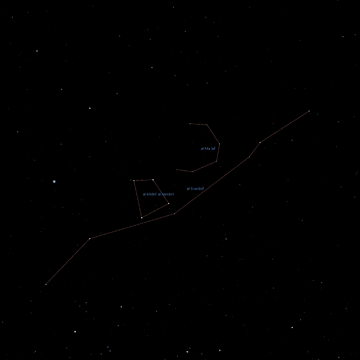 Al-Ḫibāʾ al-yamānī near the the circular star pattern of al-Maʿlaf (Crater).

Image Variants, Transfer and Transformation
-
 ancient manuscript 1
 -
Laffitte's mapping
-
something else ...

Verbal Discussion/ Conclusion
Ideler
Ideler identified al-Ḫibāʾ as the stars λ, μ, σ Aurigae (p. 90)[5] based on al-Qazwīnī text (p. 383)[5].
- German text
Das Gestirn ممسك الأعنة, Mumsikh el-aïnna,
der Fuhrmann,
steht hinter Râs el-gûl (dem Medusenkopf), zwischen den Plejaden und dem grofsen Bären, und enthält vierzehn Sterne. Die Araber nennen die Sterne in der Mitte des Bildes (vermuthlich λ, μ,σ) الخبا, El-chibâ.
- English translation
The constellation ممسك الأعنة, Mumsikh el-aïnna,
the Charioteer,
lies behind Râs el-gûl (the Medusa's Head), between the Pleiades and the Great Bear, and contains fourteen stars. The Arabs call the stars in the center of the figure (presumably λ, μ, σ) الخبا, El-chibâ.
- Discussion of Ideler identification
Ideler based his identification on al-Qazwīnī text (p. 383)[5], which reads:
- Original Arabic
وفي وسط الصورة كواكب تسميها العرب الخبا
- English translation
and in the middle of the figure, there are stars, which Arabs call Al-Ḫibāʾ.
Al-Qazwīnī usually reproduces al-Ṣūfī’s wording as closely as possible, and that is clearly his intention here. However, in this passage he begins with “and in the middle of the figure, there are stars, which the Arabs call al-Ḫibāʾ,” whereas al-Ṣūfī had written “and in the middle of it, there are stars, which the Arabs call al-Ḫibāʾ.” Al-Qazwīnī’s substitution of “the figure” for “it” completely changes the sense: in al-Ṣūfī’s text, “it” refers not to the figure of Auriga but to a specific region of the sky bounded by Auriga, the head of Ursa Major, Polaris, and the constellation Cassiopeia, which he had just described in the preceding passage and which al-Qazwīnī omitted. Because of this change, Ideler was led to think that al-Ḫibāʾ lies in the middle of the figure of Auriga.
Al-Ṣūfī’s full text reads (paraphrased in English): in the region of the sky enclosed by this constellation (Auriga), the head of Ursa Major, Polaris, and the constellation Cassiopeia, there is a wide expanse like a desert, with no bright stars and none of Ptolemy’s catalogued stars except the two at the head of this constellation (δ and ξ Aur). Within it there are countless faint stars due to their great number and dense clustering, and in the middle of it there are stars of the fifth and sixth magnitudes that the Arabs call al-Ḫibāʾ (“the tent”), because they form the shape of a tent, with the two stars at the head of Auriga included among the stars of al-Ḫibāʾ.
Ideler’s identification of al-Ḫibāʾ in the middle of Auriga’s figure results from al-Qazwīnī’s wrong wording, whereas al-Ṣūfī’s text clearly points to a different area of the sky, mainly in present-day Camelopardalis and Lynx.
H. C. F. C. Schjellerup
In his translation of al-Ṣūfī book, Schjellerup commented on Ideler identificayion. He wrote footnote (1), (p.93)[6]:
- Original French
1) Kazvini, en faisant son extrait de Sufi, écrit par inattention في وسط الصورة au milieu de la figure, ce qui a trompé Ideler p. 90, où il identifie al-chibâ avec les trois étoiles: λ, μ et σ Aurigae. Selon l'explication que nous fournit le texte, on ne peut adopter l'opinion d'Ideler; al-chibâ sans doute se compose de det & Aurigae avec Fl. 9 et 10 Camelopardi et d'autres étoiles de la dernière constellation.
- English translation
1) Kazvini [al-Qazwīnī], in making his extract from Sufi, inadvertently wrote في وسط الصورة in the middle of the figure, which misled Ideler p. 90, where he identifies al-chibâ with the three stars: λ, μ and o Aurigae. According to the explanation provided by the text, Ideler's opinion cannot be adopted; al-chiba undoubtedly consists of δ and ξ Aurigae with Fl. 9 and 10 Camelopardi and other stars of the latter constellation.
Kunitzsch
Professor Kunitzsch discussed al-Ḫibāʾ (no. 130)[7], but didn't provide stars identification.
- Original German
130. al-ḫibā
“das Zelt”. Ibn Qutayba 67,3 (bei den unter Mondstation 14 mitbehandelten Sternen): wa-l-ḫibāʾ asfal min al-ḥawḍ kawākib fi miṯl hayʾat al-ḫibāʾ al-yamāniya “al-hibā': Sterne unterhalb von al-ḥawḍ [= thυφθef Ursae Maioris], in Form des Südlichen Zeltes [cf. den folgenden Artikel]”. Bei Marzūqī 2, 378, 19 lautet die Definition: wa-l-ḫibāʾ kawākib fi miṯl hayʾat al-ḫibāʾ asfal min awlād aḍ-ḍibāʿ “al-hibā' sind Sterne in Form eines Zeltes, unterhalb von awlād aḍ-ḍibā [nr. 20]”. Ṣūfī 91, 16-17 rechnet zu diesen al-Ḫibā genannten Sternen die schwachen von Ptolemäus nicht beschrieben Sterne des modernen Bildes Giraffe sowie auch den 1. und 2. des ptolemäischen Bildes Fuhrmann = δξ Aurigae.
- English translation
130. al-ḫibā
“the tent”. Ibn Qutayba 67.3 (among the stars discussed under Moon Station 14): wa-l-ḫibāʾ asfal min al-ḥawḍ kawākib fi miṯl hayʾat al-ḫibāʾ al-yamāniya “al-hibā': Stars below al-ḥawḍ [= thυφθef Ursae Majoris], in the form of the Southern Tent [cf. the following article]”. In Marzūqī 2, 378, 19 the definition reads: wa-l-ḫibāʾ kawākib fi miṯl hayʾat al-ḫibāʾ asfal min awlād aḍ-ḍibāʿ “al-hibā' are stars in the shape of a tent, below awlād aḍ-ḍibā [no. 20]”. Ṣūfī 91, 16-17 includes among these stars called al-Ḫibā the faint stars of the modern constellation Giraffe, which were not described by Ptolemy, as well as the 1st and 2nd stars of the Ptolemaic constellation Aurigae.
Khalid al-Ajaji
Looking at the three descriptions of al-Ḫibāʾ, it seems that Ibn Qutayba, followed by al-Ṣūfī, based their accounts on a text transmission in which an error occurred. Only al-Marzūqī gives a description that is consistent with the actual star arrangement in the sky. The location of this tent fits nicely with the nearby shepherd (α Oph) with his two dogs (α1 Her and β Oph) and goats in the middle of a desert pasture (parts of Hercules and Ophiuchus). This leads to the stars identification (ζ, ε, π, η Her) for al-Ḫibāʾ.
| Header text | Adams | AlAjaji | Laffitte |
|---|---|---|---|
| Example | Example | Example | Example |
| Star Name | beta | alpha | gamma |
| Example | Example | Example | Example |
.
IAU Working Group Star Names
In 202x, the name ... was suggest as a star name in the area that is covered by the historical asterism. It is suggested to be used for ...
WGSN decided in ... 202x to name ... ...
This star is <a red giant or whatelse> ... here astrophysical data will be added (by Eric, most likely) after the decision.
Weblinks
Bibliography
Lisān al-ʿarab[1], Kitāb al-Kawākib[2], Ibn Qutayba[3], Al-Marzūqī[4], Kunitzsch[7], Danielle Adams[8], Laffitte (2012[9], 2025[10]), Urjuzat al-Kawākib[11], Al-Ṯaqafī[12], Al-Farāhīdī[13], Al-Ṣūfī 1954[14] Ideler 1809[5], Schjellerup[6]
Reference
- ↑ 1.0 1.1 لسان العرب، ابن منظور (توفي 711 هـ)
Ibn Manẓūr (d. 711 H/~1312 AD), Lisān al-ʿarab - ↑ 2.0 2.1 2.2 كتاب الكواكب لأبي الحسين عبد الرحمن بن عمر الرازي المعروف بالصوفي (291-376)، تحقيق خالد بن عبد الله العجاجي.
Book of the stars by al-Ṣūfī (died 986): Critical edition with commentary by Khalid al-Ajaji, digital edition, 2021. - ↑ 3.0 3.1 أبو محمد عبد الله بن مسلم ابن قتيبة الدينوري المتوفى سنة 276هـ - 879م، كتاب الأنواء في مواسم العرب، دائرة المعارف العثمانية، حيدر أباد، الهند، 1375 هـ - 1956م.
Ibn Qutayba ad-Dīnawarī, abū Muḥammad ʿabd Allah b. Muslim. d. 276 A.H / 879 A.D., Kitābu'l-Anwāʾ (on Meteorology of the Arabs), Dairatu'l-Maʿarifi'l-Osmania, Hyderabad - India 1956 A.D./1375 A.H. - ↑ 4.0 4.1 الإمام أبو علي أحمد بن محمد بن الحسن المرزوقي (توفي سنة 421 هـ)، الأزمنة والأمكنة، تحقيق د. محمد نايف الدليمي، عالم الكتب، بيروت، لبنان، 1422 هـ.
Al-Marzūqī, Abū ʿAli Aḥmad b. Muḥammad b. al-Ḥassan (d. 1030), Al-Azminah wa al-Amkinah (Times and Places), Edition by Dr. Mohammad Nayef al-Dulaymi, (Arabic print of the original book in 2002, World of Books, Beirut, Lebanon). - ↑ 5.0 5.1 5.2 5.3 Ideler, Ludwig, Untersuchungen über den Ursprung und die Bedeutung der Sternnamen,Berlin 1809
- ↑ 6.0 6.1 Ṣūfī, ʻAbd al-Raḥmān ibn 'Umar, 903-986. Description Des étoiles Fixes. traduction littérale avec des notes par H. C. F. C Schjellerup. St. Pétersbourg: Commissionnaires de lÁcadémie Impériale des sciences, 1874.
- ↑ 7.0 7.1 Kunitzsch, Paul. 1961. Untersuchungen zur Sternnomenklatur der Araber. Wiesbaden: Otto Harrassowitz.
- ↑ Danielle Adams, Rain Stars Set, Lunar Stations Rise, 2018
- ↑ Roland Laffitte, Le ciel des Arabes, 2012
- ↑ Roland Laffitte, Nommer les étoile: 500 noms hérités des Arabes - Apport de l'uranographie arabe, Orient des Mots, 2025 (online)
- ↑ أرجوزة الكواكب لأبي علي الحسين بن عبد الرحمن بن عمر الرازي المعروف بابن الصوفي (ت بعد 400 ه، 1010م)، تحقيق خالد بن عبد الله العجاجي.
Poem of the stars by Ibn al-Ṣūfī (died after ~ 400H, 1010AD): Critical edition with commentary by Khalid al-Ajaji, digital edition, 2021. - ↑ عبد الله بن حسين بن عاصم الثقفي (توفي 403 هـ)، الأنواء والأزمنة، تحقيق: د. نوري حمودي القيسي، د. محمد نايف الدليمي، دار الجيل، بيروت، لبنان، 1416 هـ.
Al-Ṯaqafī, ʿabd Allah ibn Ḥusayn ibn ʿāṣim (d. 403 H/ ~1013 AD), Al-Anwaʾ wa al-Azmina, critical edition by Dr. Nūrī al-Qaysī and Dr. Moḥammad Nayef al-Dulaymī, Dar al-Jīl, Beirut, Lebanon, 1416 H/1996 AD. - ↑ أبو عبد الرحمن الخليل بن أحمد الفراهيدي (توفي 170 ه)، كتاب العين، 1400 – 1405 هـ.
Al-Farāhīdī, abū ʿAbd al-Raḥmān al-Ḫalīl b. Aḥmad (died ~ 786 AD), Kitab al-ʿayn, a lexicon titled: The book of ʿayn (Arabic letter العين), (Arabic print of the original book, 1980 – 1985). - ↑ أبو الحسين عبدالرحمن بن عمر الرازي المعروف بالصوفي (المتوفى سنة 376 هـ/986م)، كتاب صور الكواكب الثمانية والأربعين، الطبعة الأولى بمطبعة مجلس دائرة المعارف العثمانية، حيدر أباد الدكن، الهند، 1375 هـ - 1954 م.
Abūl-ḥusayn ʿabdur-Raḥmān aṣ-Ṣūfī. d. 376 A.H / 986 A.D., Ṣuwaru'l-Kawākib, The Dairatu'l-Maʿarifi'l-Osmania, Hyderabad - Deccan - India, 1373 A.H./1954 A.D.