<ref name="lisan"><span dir="rtl">لسان العرب، ابن منظور (توفي 711 هـ)</span><br>
Ibn Manẓūr (d. 711 H/~1312 AD), ''Lisān al-ʿarab''</ref>
<ref name="khalid2021sufi">[https://drive.google.com/drive/folders/1s6JXzftwjMQ5rgZoGE3718EtBLBZtjzr <span dir="rtl">كتاب الكواكب لأبي الحسين عبد الرحمن بن عمر الرازي المعروف بالصوفي (291-376)، تحقيق خالد بن عبد الله العجاجي.</span><br>]
[https://drive.google.com/drive/folders/1s6JXzftwjMQ5rgZoGE3718EtBLBZtjzr ''Book of the stars'' by al-Ṣūfī (died 986): Critical edition with commentary by Khalid al-Ajaji, digital edition, 2021.]</ref>
<ref name="qutayba"><span dir="rtl">أبو محمد عبد الله بن مسلم ابن قتيبة الدينوري المتوفى سنة 276هـ - 879م، كتاب الأنواء في مواسم العرب، دائرة المعارف العثمانية، حيدر أباد، الهند، 1375 هـ - 1956م.</span><br />
Ibn Qutayba ad-Dīnawarī, abū Muḥammad ʿabd Allah b. Muslim. d. 276 A.H / 879 A.D., ''Kitābu'l-Anwāʾ (on Meteorology of the Arabs)'', Dairatu'l-Maʿarifi'l-Osmania, Hyderabad - India 1956 A.D./1375 A.H.</ref>
<ref name="marzuqi"><span dir="rtl">الإمام أبو علي أحمد بن محمد بن الحسن المرزوقي (توفي سنة 421 هـ)، الأزمنة والأمكنة، تحقيق د. محمد نايف الدليمي، عالم الكتب، بيروت، لبنان، 1422 هـ.</span><br>
Al-Marzūqī, Abū ʿAli Aḥmad b. Muḥammad b. al-Ḥassan (d. 1030), ''Al-Azminah wa al-Amkinah'' (Times and Places), Edition by Dr. Mohammad Nayef al-Dulaymi, (Arabic print of the original book in 2002, World of Books, Beirut, Lebanon).</ref>
<ref name="Kunitzsch1961">Kunitzsch, Paul. 1961. ''Untersuchungen zur Sternnomenklatur der Araber.'' Wiesbaden: Otto Harrassowitz.</ref>
<ref name="Laffitte2012">Roland Laffitte, ''Le ciel des Arabes'', 2012</ref>
<ref name="Laffitte2025">Roland Laffitte, ''Nommer les étoile: 500 noms hérités des Arabes - Apport de l'uranographie arabe'', Orient des Mots, 2025 ([https://uranos.fr/500-noms-herites-des-arabes/ online])</ref>
<ref name="khalid2021urjuza">[https://drive.google.com/drive/folders/1s6JXzftwjMQ5rgZoGE3718EtBLBZtjzr?usp=sharing <span dir="rtl">أرجوزة الكواكب لأبي علي الحسين بن عبد الرحمن بن عمر الرازي المعروف بابن الصوفي (ت بعد 400 ه، 1010م)، تحقيق خالد بن عبد الله العجاجي.</span><br>]
[https://drive.google.com/drive/folders/1s6JXzftwjMQ5rgZoGE3718EtBLBZtjzr?usp=sharing ''Poem of the stars'' by Ibn al-Ṣūfī (died after ~ 400H, 1010AD): Critical edition with commentary by Khalid al-Ajaji, digital edition, 2021.]</ref>
<ref name="thaqafi"><span dir="rtl">عبد الله بن حسين بن عاصم الثقفي (توفي 403 هـ)، الأنواء والأزمنة، تحقيق: د. نوري حمودي القيسي، د. محمد نايف الدليمي، دار الجيل، بيروت، لبنان، 1416 هـ.</span><br>
Al-Ṯaqafī, ʿabd Allah ibn Ḥusayn ibn ʿāṣim (d. 403 H/ ~1013 AD), ''Al-Anwaʾ wa al-Azmina'', critical edition by Dr. Nūrī al-Qaysī and Dr. Moḥammad Nayef al-Dulaymī, Dar al-Jīl, Beirut, Lebanon, 1416 H/1996 AD.</ref>
<ref name="farahidi"><span dir="rtl">أبو عبد الرحمن الخليل بن أحمد الفراهيدي (توفي 170 ه)، كتاب العين، 1400 – 1405 هـ.</span><br>
Al-Farāhīdī, abū ʿAbd al-Raḥmān al-Ḫalīl b. Aḥmad (died ~ 786 AD), ''Kitab al-ʿayn'', a lexicon titled: The book of ʿayn (Arabic letter العين), (Arabic print of the original book, 1980 – 1985).</ref>
<ref name="sufi1954"><span dir="rtl">أبو الحسين عبدالرحمن بن عمر الرازي المعروف بالصوفي (المتوفى سنة 376 هـ/986م)، كتاب صور الكواكب الثمانية والأربعين، الطبعة الأولى بمطبعة مجلس دائرة المعارف العثمانية، حيدر أباد الدكن، الهند، 1375 هـ - 1954 م.</span><br />
Abūl-ḥusayn ʿabdur-Raḥmān aṣ-Ṣūfī. d. 376 A.H / 986 A.D., ''Ṣuwaru'l-Kawākib'', The Dairatu'l-Maʿarifi'l-Osmania, Hyderabad - Deccan - India, 1373 A.H./1954 A.D.</ref>
<ref name="ideler">Ideler, Ludwig, ''Untersuchungen über den Ursprung und die Bedeutung der Sternnamen'',Berlin 1809</ref>
<ref name="Schjellerup">Ṣūfī, ʻAbd al-Raḥmān ibn 'Umar, 903-986. ''Description Des étoiles Fixes''. traduction littérale avec des notes par H. C. F. C Schjellerup. St. Pétersbourg: Commissionnaires de lÁcadémie Impériale des sciences, 1874.</ref>
The name al-Miġzal is used regionally in central Saudi Arabia.
Al-Miġzal asterism in Cygnus. Photo by Khalid al-Ajaji taken on October 2016, the time of the identification of the name and its stars. (CC BY Khalid AlAjaji 2026).
al-Miġzal (Arabic: المِغْزَل)is derived from the Arabic root (غزل), referring to a wool spindle, and ultimately from the verb “أُغْزِلَ,” meaning “to be twisted and rotated”.
Sources and Identification
The name comes from local oral tradition, recorded by Khalid al-Ajaji in October 2016 during a star-gazing session in the dunes of Ṯuwayrāt in the al-Zulfī region, northwest of Riyadh, Saudi Arabia. The identification was made directly at the time, when the informant pointed to the cross-shaped stars of Cygnus, visible from shortly after sunset until after midnight.
The research is documented and published in Stellarium software,[1] available as a public dataset in the Stellarium GitHub Repository[2] and the description by Khalid AlAjaji is also published in paper form in the conference proceedings Hoffmann and Wolfschmidt (eds. 2022)[3]. In Stellarium it is written (by Khalid AlAjaji):
The Wool Spindle: The cross-shaped arrangement of α Cyg (Deneb), ε Cyg (Gienah), γ Cyg (Sadr), δ Cyg, and β1+β2 Cyg (Albireo). This comes from oral tradition in Zulfi, central Saudi Arabia [#1][4].
Stars Identification
The asterism of al-Miġzal is formed by the stars α, γ, β Cyg and ε, γ, δ Cyg.
The identification is considered secure, as the narrator of the name personally indicated these stars when describing al-Miġzal.
IAU Working Group Star Names
In 2026, the name al-Miġzal (or any spelling variant) was suggested as a star name in the area that is covered by the historical asterism. It is suggested to be used for ...
WGSN decided in ... 202x to name ... ...
This star is <a red giant or whatelse> ... here astrophysical data will be added (by Eric, most likely) after the decision.
↑Zotti, G., Hoffmann, S. M., Wolf, A., Chéreau, F., & Chéreau, G. (2021). The Simulated Sky: Stellarium for Cultural Astronomy Research. Journal of Skyscape Archaeology, 6(2), 221–258. DOI: 10.1558/jsa.17822
↑Khalid AlAjaji (2022). Stellarium Sky Culture "Arabian Peninsula", in Hoffmann, S. and Wolfschmidt, G. (eds.). Astronomy in Culture - Cultures of Astronomy, Featuring the Proceedings of a splinter meeting in the German Astronomical Society. tredition, Ahrensburg.
↑Reference [#1] in this case is "Oral Tradition" documented by the author of this sky culture, Khalid AlAjaji.


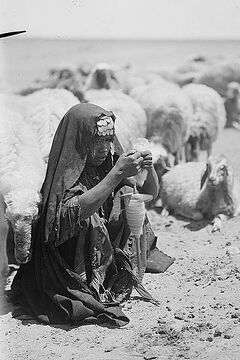 Bedouin shepherdess spinning. Source: Library of Congress, Prints and Photographs Division. Digital ID: matpc 03790 https://hdl.loc.gov/loc.pnp/matpc.03790 Original image on loc.gov