Gudja
Authors: IAU-WGSN Etymology Group, Susanne M Hoffmann, Youla Azkarrula


Gudja is a modern star name adopted by the International Astronomical Union in the IAU-Catalog of Star Names (IAU-CSN). Its origin is Aboriginal/ Wardaman. It is the name of HIP 77450 (κ Ser, HR 5879) in constellation Ser.
Etymology and History

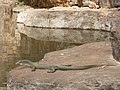
Gudja is the Wardaman name of κ Ser, from the Northern Territory, Australia. Gudja is a Water Goanna, related to birth and rebirth. It is part of the bright trio of stars in Serpens Caput, which also include Munin the Rock Cod (γ Ser) and the Mungamungga birthing place (β Ser), likened to a little hospital. Gudja is involved with the birthing process, which includes sacred ritual practices. The Spiritual Women at the birthing and blessing site in Serpens Caput are connected to the sacred areas of Crux and enacted at Munin Rock and Yinggalarri.
-
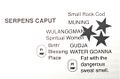 "Gudja" in a Wardaman star map (CC BY Cairns and Harney 2004).
 -

-

-


Dark Sparklers (2003:[1] 111):
In Serpens Caput nearby the Water Goanna, Gudja is already to do with birth and rebirth, as above. Gudja takes across the Spiritual Women's song related to the Warrbarri rock art site, a song to do with 'the little hospital for the birthing'. Willy Wagtail also is involved with this at Jirin-Jirin where the Water Goanna provides a very dangerous scent, so this story in land and sky is telling of dangerous things. A very special sweat smell is given to the women by Gudja, and the fatty base is worn by them. The sweat drips like fumes; and this human smell of fat, like the colour black, is very dangerous. The sacred context is the awesome reality of Birth, for the child is smothered in his special lineament at birth.
Mythology
IAU Working Group on Star Names
The name was adopted by the IAU WGSN on 2018/08/10.
Gudja is a red giant roughly 3x the mass of the Sun that has already left the main-sequence and blew up to a size of 71 solar radii. At its position only 18° north of the celestial equator with an apparent magnitude of 4.09, it is visible almost everywhere on Earth. It's rushing towards us at a speed 1000x of cars on highways.
Weblinks
- Website of the IAU WGSN: https://exopla.net/
Reference
- References (general)
- Cairns, H. and Harney, B.Y. (2003) Dark Sparklers - Yidumduma's Aboriginal Astronomy. H.C. Cairns, Merimbula, NSW. pp. 107-113.
- ↑ Cairns, H. and Harney, B.Y. (2003) Dark Sparklers - Yidumduma's Aboriginal Astronomy. H.C. Cairns, Merimbula, NSW