Purvaṣādha (पूर्व आषाढा)
Purva Ashadha
Authors: Susanne M Hoffmann, Youla Azkarrula


Purvaṣādha (पूर्व आषाढा) is an Indian name, used by the Indian Vedic tradition. Most of these names are roughly 3000 years old. They pre-date Hinduism but were taken over by it. Typically identified with δ and ε Sagittarii.
Etymology and History
Name Variants
- Purvaṣādha
- Purva Ashadha
- Jaladaivata,
- Jalarksha
- Apya,
- Toya,
Origin of Constellation
Ashadha means The Invincible and refers to two asterisms in Sagittarius. The First (Purva A.) is depicted as a group of two stars marking a horn or stinger. They are identified with δ and ε Sagittarii, the "arrow" of the Greek and Babylonian archer. The identification of δ is certain because of given coordinates in the 2nd millennium but instead of ε Sgr it could also be γ Sgr (at the tip of the arrow): the three stars form a racognizable pattern.
Stars within the Constellation Area
| id | Label | IAU design. | description | Vmag |
|---|---|---|---|---|
| 1 | Kaus Australis | HIP 90185 | Constellation lines (Vertex) | 1.81 |
| 2 | Kaus Media | HIP 89931 | Constellation lines (Vertex) | 2.668 |
| 3 | Alnasl | HIP 88635 | Constellation lines (Vertex) | 2.99 |
| 4 | η Sagittarii | HIP 89642 | Constellation lines (Vertex) | 3.11 |
| 5 | 37 G. Sgr | HIP 89020 | Inside the hull | 5.65 |
| 6 | RS Sgr | HIP 89637 | Inside the hull | 6.03 |
Transfer and Transformation of the Constellation
-
 Purva Ashadha, 10th century
 -
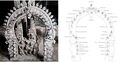 Display of all 28th nakshatras in silver arch with candles in Tirupperunthurai (Athmanathaswamy temple) near Aranthangi, India, 10th century CE. (SMH 2025).
 -
 Display of all 28th nakshatras in a door frame in Tirupperunthurai (Athmanathaswamy temple) near Aranthangi, India, 10th century CE. (SMH 2025).
 -
 reconstructed by Jones (1720)


Mythology
mnemonic tales and cultural significance
Weblinks
References
- References (general)





