Nandou (南斗)
Nandou
Authors: Boshun YANG, Susanne M Hoffmann, Eric Mamajek

Nándǒu (Southern Dipper南斗), also called Dou Xiu, is the eighth of the Twenty-eight Lunar Lodges and the first lodge of the Northern Black Tortoise group. It consists of six stars in the modern constellation Sagittarius. It has existed at least 2500 years, is one of the oldest asterisms in China.
Concordance, Etymology, History
The name Dou refers to a dipper, ladle, or measuring vessel; because this dipper lies in the southern part of the sky in contrast to Beidou, the Northern Dipper, it is called Nandou, the Southern Dipper.
-
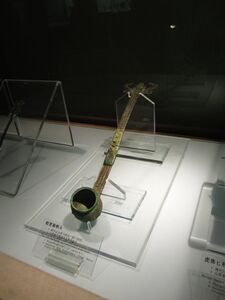 A dou (a type of water scooping vessel) from the Shang Dynasty with a snake-shaped handle, housed in the Shanxi Museum in Taiyuan
 -
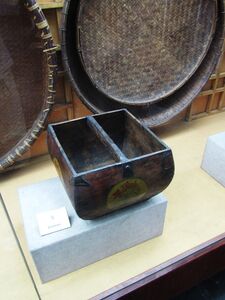 A dou (a type of rice measuring vessel) housed in the Li Hongzhang Memorial Hall in Hefei
_from_the_Shang_Dynasty_with_a_snake-shaped_handle,_housed_in_the_Shanxi_Museum_in_Taiyuan,.jpg)
_housed_in_the_Li_Hongzhang_Memorial_Hall_in_Hefei.jpg)
In official astrological literature Nandou was not merely a vessel-shaped figure. Its member stars were interpreted as a Celestial Temple, Heavenly Storehouse, Heavenly Treasury, celestial gate, imperial banner, and administrative pivot. The material image of a dipper was therefore reinterpretated as a wider symbolic system of imperial administration. This asterism was also regarded by some people as governing ranks, emoluments, lifespan, and military affairs.
In later popular and Daoist contexts, Nandou acquired the symbolic role of governing life or birth, paired with Beidou as governing death. Tombstone portraits unearthed from archaeological excavations often depict the scene of the Southern Dipper paired with the Northern Dipper. The story in Soushen ji, juan 3, about Guan Lu管辂 seeing two old men playing chess is often summarized as "the Northern Dipper registers death, the Southern Dipper registers life." This differs from the early institutional astrology of the Twenty-eight Lodges, but it possibly shows the older association of Nandou with the allotted lifespan was reorganized in medieval and later religious imagination, or conversely.
-
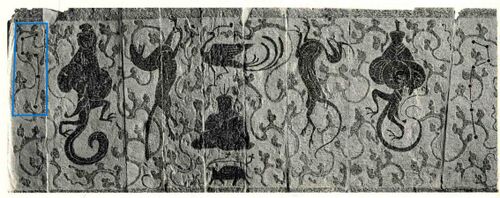 Rubbing of the Pictorial Stone Image of Four Symbols and Yellow Emperor (Eastern Han dynasty), Nandou is at the lest side
 -
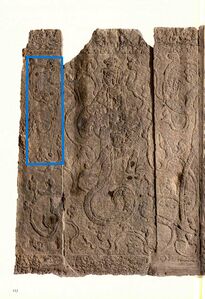 Nandou in the Pictorial Stone Image of Four Symbols and Yellow Emperor (Eastern Han dynasty)
,_Nandou_is_at_the_lest_side.jpg)
.jpg)
As a lunar mansion, Nandou often served as a positional reference in records of unusual celestial phenomena. One of the most important records is considered by some scholars to be the guest star record of SN 386.[1]
"Emperor Xiaowu of Jin, 11th year of the Taiyuan reign period, third month. There was a guest star in Nandou [LM8] that lasted until the 6th month (Jul 13 to Aug 10), when it disappeared"太元十一年三月,客星在南斗,至六月乃没。 (Jin shu, Tianwen zhi, ch. 13; Song shu, Tianwen zhi, ch. 25 according to Xu, Pankenier, Jiang 2000[3]).
![G7.7–3.7 A Young Supernova Remnant Probably Associated with the Guest Star in 386 CE (SN 386)[2]](/index.php/File:G7.7%E2%80%933.7_A_Young_Supernova_Remnant_Probably_Associated_with_the_Guest_Star_in_386_CE_(SN_386).jpg)
In addition, there are some other records of suspected supernovae/novae that occurred near Nandou; due to the early age, there are no corresponding records elsewhere in the world. Therefore, Nandou has played an important role in astrophysical research.
Identification of stars
The modern identification of the six stars of Nandou is relatively stable: ζ, τ, σ, φ, μ, and λ Sagittarii. Historical catalogues describe the internal form as a bowl (kui) and a handle (bing or biao). The determinative star is the fourth star of the bowl, φ Sagittarii; while Tang astronomer Yixing also mentioned that in Han dynasty the first star of the bowl was used as determinative star. Because the direction of numbering differs among catalogues, the table below is arranged by traditional asterism position, with Yi Shitong's common numbering indicated in parentheses.
| Star Names or Orders(Qing) | Mordern Corspondance |
|---|---|
| 1st | zeta Sgr |
| 2nd | tau Sgr |
| 3rd | sigma Sgr |
| 4th | phi Sgr (determinative) |
| 5th | mu Sgr |
| 6th | gamma Sgr |
Maps (Gallery)
| historical map | ||
|---|---|---|
 |
 |
 |
IAU Working Group on Star Names
In 2026, the name of the historical constellation "Nandou" was suggested to be used for one of the stars in this constellation. There are some Chinese celestial records of suspected supernovae/novae that occurred near Nandou; due to the early age, there are no corresponding records elsewhere in the world. Therefore, Nandou has played an important role in astrophysical research. Since phi Sgr is the determinative star of it, then this name should be applied to phi Sgr.
Decision: ...
References
- ↑ Susanne M Hoffmann, Nikolaus Vogt, Cataclysmic variables as possible counterparts of ancient Far Eastern guest stars, Monthly Notices of the Royal Astronomical Society, Volume 494, Issue 4, June 2020, Pages 5775–5786, https://doi.org/10.1093/mnras/staa1162
- ↑ Zhou P, Vink J, Li G, et al. G7. 7–3.7: A Young Supernova Remnant Probably Associated with the Guest Star in 386 CE (SN 386)[J]. The Astrophysical Journal Letters, 2018, 865(1): L6.





