Authors: Khalid Al-Ajaji, Susanne M Hoffmann, Roland Laffitte, Eric Mamajek, Youla Azkarrula, Ian Ridpath
Star chart of the Arabian asterism al-Rumh (الرُّمْح) as defined by al-Ṣūfī in the area of the constellation Boötes including the figure as described by al-Ṣūfī. (CC BY Khalid AlAjaji 2026).
Ideler (1809)[4] translates "Rumh el-râmih, Lanze des Lanzenträgers" (the lance of the lance-carrier) and mentions that some sources add "Sâk el-auwâ", the shinbone of Boötes. He also points out a mistake in Ulugh Beg's identification with stars in Hercules.
Star chart of the Arabian asterism al-Rumh (الرُّمْح) as defined by al-Ṣūfī in the area of Boötis constellation. (CC BY Khalid AlAjaji 2026).
Al-Rumḥ (The Spear)
In classical Arabic astronomy, al-Rumḥ (الرمح, "the lance" or "the spear") refers to an asterism associated with the star Arcturus (α Boötis). Historical interpretations of its composition and nomenclature vary between the philological Anwāʾ tradition and the astronomical tradition.
Overview and Etymology
The presence of this asterism is the defining factor in the naming of Arcturus as al-Simāk al-Rāmiḥ (السماك الرامح, "The Uplifted One Armed with a Spear"). This designation serves to distinguish it from the star Spica (α Virginis), known as al-Simāk al-A‘zal (السماك الأعزل, "The Unarmed Uplifted One"), so named because it lacks an associated weaponized asterism.
The term Simāk (from the root s-m-k, "to elevate") refers to the high meridian altitude these stars reach in the northern sky.
Historical Traditions
The Anwāʾ Tradition: Rāyat al-Simāk
Philologists and Anwāʾ authors, such as Ibn Qutaybah and al-Marzūqī, identified the "weapon" of the Lancer primarily as a single star, which they termed Rāyat al-Simāk ("The Banner of the Simāk").
Ibn Qutaybah accounts for the naming of the "Lancer" by identifying a small star situated near Arcturus:
"It was named 'The Lancer' because of a small star positioned near it called Rāyat al-Simāk (The Banner of the Simāk). Thus, it became 'The Lancer' by virtue of [the banner], while the other became 'The Unarmed' (al-A‘zal) because there is nothing before it." [6]
Al-Marzūqī provides a more specific spatial orientation, placing this star in relation to the constellation Corona Borealis al-Fakkah:
"When al-Fakkah reaches the meridian, or nears it... you will see al-Simāk al-Rāmiḥ (Arcturus) positioned before it. You will also see Rāyat al-Simāk [ε Boötis] behind it, situated between [Arcturus] and al-Fakkah. This is a star set apart from it, joined by another nearby star that resembles a streamer (‘adhabah) on a lance. For this reason, it is called 'The Lancer' (al-Rāmiḥ) and 'The Possessor of the Weapon' (Dhū al-Silāḥ), while the other Simāk is called 'The Unarmed' (al-A‘zal)." [7]
Al-Ṣūfī’s Synthesis: Al-Rumḥ and Al-Silāḥ (The Weapon)
In his astronomical book Kitāb al-Kawākib, al-Ṣūfī provides a more detailed celestial map, describing al-Rumḥ as a complex configuration of stars marking the head and the foot of the lance. He distinguishes the "Lancer" (Arcturus) from its armament (al-Silāḥ):
Star chart of the Arabian asterism al-Rumh (الرُّمْح) as defined by al-Ṣūfī in the area of the constellation Boötes including the figure as described by al-Ṣūfī. (CC BY Khalid AlAjaji 2026).
"As for the single [star] outside the figure [of Boötes], it is the bright red one located between its thighs... it is this which is called al-Simāk al-Rāmiḥ [α Boo]. The Arabs... called it Rāmiḥ (The Lancer) because they likened the sixteenth star on its thigh [ε Boo] and the twentieth star on its left leg [η Boo] to a lance (rumḥ) belonging to it. They likened the two close stars on the waist—the seventeenth and eighteenth [σ and ρ Boo]—to a streamer (‘adhabah) for the end of the lance where the sixteenth star is located; and they likened the twenty-first and twenty-second stars [τ and υ Boo] to a streamer for the end where the twentieth star is located." [8]
Al-Ṣūfī also identifies a broader group of faint stars not described by Ptolemy:
"The stars surrounding the Simāk among these stars [ζ, ο, ξ, and π Boo] are called by the Arabs al-Silāḥ (The Weapon). Sometimes the twentieth star on the left leg [η Boo] is specifically called al-Rumḥ (The Lance) on its own, while the two stars with it are called al-Silāḥ." [8]
Arabian constellation al-Simak with Lances and Armes (CC BY Roland Laffitte 2025).
Laffitte (2012[9], 2025[10]) treats Al-Rumh as an alternative name for Muphrid (η Boo) in the constellation al-Simākān, The Two Supporters, one armed, one disarmed:
Rumh. Ar. الرمح al-Rumḥ, ‘the Spear’, al-Ṣūfī > Lat. Alromh, Yehūda b. Mošè, Lancea, Apian. Later, al-Rumḥ, al-Qazwīnī, not transcribed by Ideler, who gives Rumḥal-Rāmiḥ according to al-Tīzīnī > ‘Rumh el-râmih’. Hence Ruma c/ Buttmann, ‘Al-Rumḥ’ p/ Allen, Nit. 02. Rumh al Ramih, Wiki/en
Adjacent Star Names of al-Simākān
Name
(orig.)
Name
translation
identification
(RL)
author
note
al-Rumḥ
the Lance
η Boo
Ṣūfī
Mirzam al-Simāk
the Predecessor of Simak
Marzūqī
Mufrad al-Rāmiḥ
The Isolated One of Alramech
Tīzīnī
Rāyat al-Simāk
the Standard of Simak
ε Boo
Qutayba
Tābiᶜ al-Simāk
the Follower of Simak
Ṣūfī
al-ᶜAḍaba
the Belt
ρσ Boo
Ṣūfī
al-Silāḥ
the Arms
τυ Boo
Ṣūfī
Discussion
Obviously, modern authors give different names and identifications.
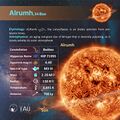
Alrumh, IAU star name, star profile card (CC BY M.Sadegh Faghanpour for IAU-WGSN).
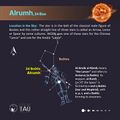
The name "Alrumh" (or similar) was suggested to WGSN in 2026, as there is a Chinese asterism of The Lance in the same area of the sky (but not exactly the same stars). The proposal was to give the name "The Lance" in two different languages to two stars in the area pointing to a random coincidence of similar names in the sky. The Lance is a longish object, covering an area - and it is held by a person (whose constellation covers an even larger area). The two stars identified with the al-Rumh (epsilon, eta Boo) already had IAU WGSN-adopted names (Izar and Muphrid, respectively). On April 15, 2026, WGSN adopted the name Alrumh for the star 34 Boo (HR 5490, HD 129712, HIP 71995, W Boo), which is part of the Al-Rumḥ asterism, and in the vicinity of Izar.
Alrumh (34 Boo) is a red giant star with spectral type M3-III (Keenan & McNeil 1989), and from its trigonometric parallax measured by the ESA Gaia mission one estimates its distance to be approximately 181 parsecs (Gaia Data Release 3). The star has a wide range of reported average V magnitudes: V=4.26 (Hipparcos, ESA 1997), V=4.81 (Bright Star Catalog 5th ed., Hoffleit & Warren 1991). This reflects the star's status as semi-regular variable star (also designated W Bootis) with photometric amplitudes of tenths of a magnitude and periodicity ranging from ~25 days to ~50 days. Further documentation of the star's complex photometric variability can be found in the study by Percy & Desjardins (1996; https://ui.adsabs.harvard.edu/abs/1996PASP..108..847P/abstract).
Alrumh profile card (CC BY M.Sadegh Faghanpour for IAU-WGSN).
Alrumh stick figure (CC BY M.Sadegh Faghanpour for IAU-WGSN).
Weblinks
Reference
↑Ibn Qutayba al-Dīnawarī, Abū Muḥammad ʿAbdallah b. Muslim. 1956. Kitāb al-anwāʾ (fī mawāsim al-ʿArab). Hyderabad: Maṭbaʿat Majlis Dāʾirat al-Maʿārif al-ʿUthmāniyya.
↑Kunitzsch, Paul. 1961. Untersuchungen zur Sternnomenklatur der Araber. Wiesbaden: Otto Harrassowitz.
↑al-Ṣūfī, Abū al-Ḥusayn ʿAbd al-Raḥmān b. ʿUmar. 1981. Kitāb ṣuwar al-kawākib al-thamāniya wa al-arbaʿīn. Beirut: Dār al-Āfāq al-Jadīda.
↑Ludwig Ideler (1809). "Untersuchungen Über Den Ursprung Und Die Bedeutung Der Sternnamen: Ein Beytrag Zur Geschichte Des Gerstirnten Himmels", reprint: Legare Street Press
↑Ibn Qutayba al-Dīnawarī, Abū Muḥammad ʿAbdallah b. Muslim. 1956. Kitāb al-anwāʾ (fī mawāsim al-ʿArab). Hyderabad: Maṭbaʿat Majlis Dāʾirat al-Maʿārif al-ʿUthmāniyya, p. 62.
↑Al-Marzūqī, Abū ʿAli Aḥmad b. Muḥammad b. al-Ḥassan (d. 1030). 2002. Al-Azminah wa al-amkinah (Times and Places). Critical edition by Dr. Mohammad Nayef al-Dulaymi. Beirut: World of Books, vol. 2, p. 343.
↑ 8.08.1Ibn al-Ṣūfī, Abū ʿali al-Ḥusayn b. ʿAbd al-Raḥmān. 2021. Urjuzat al-kawākib (The Poem of the Stars). Critical edition with commentary by Khalid al-Ajaji, digital edition. (online), p 232.


 Alrumh profile card (CC BY M.Sadegh Faghanpour for IAU-WGSN).
 Alrumh stick figure (CC BY M.Sadegh Faghanpour for IAU-WGSN).





