al-Qubba (القُبَّة)
Authors: Khalid Al-Ajaji, ASE Tech Team, Susanne M Hoffmann


| Asterism Info | |
| Native | القُبَّة |
|---|---|
| Translation | the dome or domed tent |
| Position (2000) | |
| Right ascension | 287.5073197 |
| Declination | -39.34079269 |
| Area | 0 sq. deg. |
| Stars | |
| Bright stars | 1 |
| Bayer/Flamsteed stars | 1 |
| Stars brighter than 3.00m | 0 |
| Brightest star | Alqubba (4.095m) |
| Taxonomy | |
| category of asterism | IAU-Star Name |
| IAU- constellations | CrA |
al-Qubba (Arabic: القُبَّة, , “the dome or domed tent”) is an Arab asterism that correspond to the stars of Corona Australis.
Alqubba is a modern IAU-star name for β CrA in Corona Australis since August 2026.
Provenance, Etymology, History

Variants
The indigenous Arabic name القُبَّة (al‑Qubba) is recorded by al‑Ṣūfī, Ibn Qutayba, and al‑Marzūqī. In later European and modern scholarly sources, it appears in a range of transliterated forms:
- AlKubba, Hyde. In VLUGH BEIGHI Tabulas Stellarum fixarum Commentarii. p. 68[1]
- El-kubba, Ideler. p. 281[2]
- al-kubba, Schjellerup p. 253[3]
- Al Ḳubbah, Allen. p. 173[4]
- al-qubba, Kunitzsch, entry 231, p. 95[5]
Etymology
al-Qubba (Arabic: القُبَّة), from the Arabic root (قبب). Lisān al-ʿArab defines al-Qubba as:
«القُبَّة مِنَ الخِيام: بيتٌ صَغِيرٌ مُسْتَدِيرٌ، وَهُوَ مِنْ بُيُوتِ الْعَرَبِ.»
The Qubba, among tents, is a small round tent; it is one of the traditional tent types of the Arabs.
Other texts from Islamic Ḥadīṯ mentions the qubba. In Ṣaḥīḥ Muslim:
«أَتَيْتُ النَّبِيَّ ﷺ بِمَكَّةَ وهو بالأبطَحِ في قُبَّةٍ له حَمراءَ مِن أدَمٍ.»
I came to the Prophet ﷺ at Mecca while he was in a red qubba of tanned leather, at al-Abṭaḥ.
Sources and Identification
Both Ibn Qutayba and al-Marzūqī place al-Qubba below Šawlat al-ʿaqrab (λ and υ Sco). Al-Ṣūfī identifies al-Qubba as the stars of Corona Australis because of their roundness and resemblance to a dome.
| Sources | Identification(s) |
|---|---|
| Ibn Qutayba (d. 276 H / 889)
Original Arabic (p. 73)[6] ثم “القُبَّةُ”، وهي أسفل من شَوْلَةِ العَقْرَبِ. ويقال للكواكب المتفرقة أسفل من شَوْلَةِ العَقْرَبِ: “الخَيْلُ”، وهي تسقط في القبلة. ووراء القُبَّةِ “الصُّرَدَانِ”.
Then al‑Qubba (the Dome), which lies below the Sting of Scorpius (Šawlat al-ʿaqrab). The scattered stars below the Sting of Scorpius are called “al-Khayl” (the Horses), and they set in the direction of the qiblah. Behind al-Qubbah are “al-Ṣuradān.” |
The rounded stars of al-Qubba are: θ, η1, ζ, δ, β, α, γ CrA.  |
Al-Marzūqī (d. 421 H / 1030) (vol 2, p. 346, 349)[7]
و[أسفل] من شَوْلَةِ العَقْرَبِ كواكب يقال لها: القُبَّةُ، [...] ووراء القُبَّةِ الصُّرَدَانِ، أحدهما يجري قريبا من الأفق والآخر فوقه بحياله.
And [below] the Sting of Scorpius are stars called “al-Qubba” (the Dome) […]. Behind al-Qubbah are “al-Ṣuradān”: one of them runs close to the horizon, and the other above it, aligned with it. | |
| Al-Ṣūfī (d. 376 H / 986)[8]
Original Arabic (description of Corona Australis) وأما العرب، فقد اختلفت الروايات عنها في هذه الكواكب، فروى قوم منهم أنها تُسَمِّي هذه الكواكب: القُبَّةَ؛ لاستدارتها، وزعموا أنها أسفل من شَوْلَةِ العَقْرَبِ، وليس هناك كواكب مستديرة تشبه القُبَّةَ غيرها، وزعم أكثرهم أن وراء القُبَّةِ الصُّرَدَيْنِ
As for the Arabs, the reports about these stars (Corona Australis) differ. Some relate that they call these stars “al-Qubba” (the Dome), because of their rounded form, and they claim that it lies below the Sting of Scorpius; and that there are no other rounded stars resembling a dome besides it. Most of them also assert that behind al-Qubbah are the two “al-Ṣuradān.” |
IAU Working Group Star Names
In 2026, the name Alqubba was suggest as a star name in the area that is covered by the historical asterism.
WGSN decided in August 2026 to name the star β CrA "Alqubba".
-
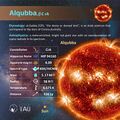 (CC BY M.Sadegh Faghanpour for IAU WGSN).
 -
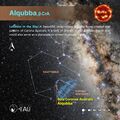 (CC BY M.Sadegh Faghanpour for IAU WGSN).

Weblinks
Bibliography
Lisān al-ʿarab[9], Kitāb al-Kawākib[8], Ibn Qutayba[6], Al-Marzūqī[7], Kunitzsch[5], Danielle Adams[10], Laffitte (2012[11], 2025[12]), Urjuzat al-Kawākib[13], Al-Ṯaqafī[14], Al-Farāhīdī[15], Al-Ṣūfī 1954[16] Ideler 1809[2], Schjellerup[3]
Reference
- ↑ Hyde, Thomas, Tabulæ Long[itudinis] ac Lat[itudinis] Stellarum Fixarum, Oxford: Henry Hall, 1665
- ↑ 2.0 2.1 Ideler, Ludwig, Untersuchungen über den Ursprung und die Bedeutung der Sternnamen,Berlin 1809
- ↑ 3.0 3.1 Ṣūfī, ʻAbd al-Raḥmān ibn 'Umar, 903-986. Description Des étoiles Fixes. traduction littérale avec des notes par H. C. F. C Schjellerup. St. Pétersbourg: Commissionnaires de lÁcadémie Impériale des sciences, 1874.
- ↑ Richard Hinckley Allen, Star Names — Their Lore and Meaning, Dover edition, 1963.
- ↑ 5.0 5.1 Kunitzsch, Paul. 1961. Untersuchungen zur Sternnomenklatur der Araber. Wiesbaden: Otto Harrassowitz.
- ↑ 6.0 6.1 أبو محمد عبد الله بن مسلم ابن قتيبة الدينوري المتوفى سنة 276هـ - 879م، كتاب الأنواء في مواسم العرب، دائرة المعارف العثمانية، حيدر أباد، الهند، 1375 هـ - 1956م.
Ibn Qutayba ad-Dīnawarī, abū Muḥammad ʿabd Allah b. Muslim. d. 276 A.H / 879 A.D., Kitābu'l-Anwāʾ (on Meteorology of the Arabs), Dairatu'l-Maʿarifi'l-Osmania, Hyderabad - India 1956 A.D./1375 A.H. - ↑ 7.0 7.1 الإمام أبو علي أحمد بن محمد بن الحسن المرزوقي (توفي سنة 421 هـ)، الأزمنة والأمكنة، تحقيق د. محمد نايف الدليمي، عالم الكتب، بيروت، لبنان، 1422 هـ.
Al-Marzūqī, Abū ʿAli Aḥmad b. Muḥammad b. al-Ḥassan (d. 1030), Al-Azminah wa al-Amkinah (Times and Places), Edition by Dr. Mohammad Nayef al-Dulaymi, (Arabic print of the original book in 2002, World of Books, Beirut, Lebanon). - ↑ 8.0 8.1 كتاب الكواكب لأبي الحسين عبد الرحمن بن عمر الرازي المعروف بالصوفي (291-376)، تحقيق خالد بن عبد الله العجاجي.
Book of the stars by al-Ṣūfī (died 986): Critical edition with commentary by Khalid al-Ajaji, digital edition, 2021. - ↑ لسان العرب، ابن منظور (توفي 711 هـ)
Ibn Manẓūr (d. 711 H/~1312 AD), Lisān al-ʿarab - ↑ Danielle Adams, Rain Stars Set, Lunar Stations Rise, 2018
- ↑ Roland Laffitte, Le ciel des Arabes, 2012
- ↑ Roland Laffitte, Nommer les étoile: 500 noms hérités des Arabes - Apport de l'uranographie arabe, Orient des Mots, 2025 (online)
- ↑ أرجوزة الكواكب لأبي علي الحسين بن عبد الرحمن بن عمر الرازي المعروف بابن الصوفي (ت بعد 400 ه، 1010م)، تحقيق خالد بن عبد الله العجاجي.
Poem of the stars by Ibn al-Ṣūfī (died after ~ 400H, 1010AD): Critical edition with commentary by Khalid al-Ajaji, digital edition, 2021. - ↑ عبد الله بن حسين بن عاصم الثقفي (توفي 403 هـ)، الأنواء والأزمنة، تحقيق: د. نوري حمودي القيسي، د. محمد نايف الدليمي، دار الجيل، بيروت، لبنان، 1416 هـ.
Al-Ṯaqafī, ʿabd Allah ibn Ḥusayn ibn ʿāṣim (d. 403 H/ ~1013 AD), Al-Anwaʾ wa al-Azmina, critical edition by Dr. Nūrī al-Qaysī and Dr. Moḥammad Nayef al-Dulaymī, Dar al-Jīl, Beirut, Lebanon, 1416 H/1996 AD. - ↑ أبو عبد الرحمن الخليل بن أحمد الفراهيدي (توفي 170 ه)، كتاب العين، 1400 – 1405 هـ.
Al-Farāhīdī, abū ʿAbd al-Raḥmān al-Ḫalīl b. Aḥmad (died ~ 786 AD), Kitab al-ʿayn, a lexicon titled: The book of ʿayn (Arabic letter العين), (Arabic print of the original book, 1980 – 1985). - ↑ أبو الحسين عبدالرحمن بن عمر الرازي المعروف بالصوفي (المتوفى سنة 376 هـ/986م)، كتاب صور الكواكب الثمانية والأربعين، الطبعة الأولى بمطبعة مجلس دائرة المعارف العثمانية، حيدر أباد الدكن، الهند، 1375 هـ - 1954 م.
Abūl-ḥusayn ʿabdur-Raḥmān aṣ-Ṣūfī. d. 376 A.H / 986 A.D., Ṣuwaru'l-Kawākib, The Dairatu'l-Maʿarifi'l-Osmania, Hyderabad - Deccan - India, 1373 A.H./1954 A.D.





