Jiantai (渐台)
Authors: Lyu Haocheng, Susanne M Hoffmann, Youla Azkarrula, Ian Ridpath
,_Jiantai_(lower)_and_Niandao_(upper_left).png)
| Asterism Info | |
| Native | 渐台 |
|---|---|
| Translation | Clepsydra Terrace |
| Position (2000) | |
| Right ascension | 283.6261779 |
| Declination | 36.89861991 |
| Area | 0 sq. deg. |
| Stars | |
| Bright stars | 1 |
| Bayer/Flamsteed stars | 1 |
| Stars brighter than 3.00m | 0 |
| Brightest star | Jiantai (4.3m) |
| Taxonomy | |
| category of asterism | IAU-Star Name |
| IAU- constellations | Lyr |


Jiàn Tái (Clepsydra Terrace, 渐台), Chinese constellation consists of 4 stars, belongs to the Ox (Niu) Lunar Mansion from the Gan school, and corresponds to the modern constellation Lyra. Jiantai is a terrace built near water, used for observing sundials, timing with water clocks, and establishing pitch pipes and temperaments. It is a symbol of astronomical timekeeping and musical pitch calibration.
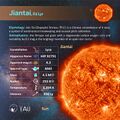
Since 2026, Jiantai is also a modern star name for Delta2 Lyrae.
Concordance, Etymology, History

A platform with four square sides is called 'tai' (台); if it has water below, it is called 'jian' (渐). Jiantai governs the gnomon, the water clock, and the affairs of pitch pipes and temperaments. Ganshi Zan (甘氏赞) says:
Jiantai guards the water clock and the gnomon.
Gande (甘德) said:
Jiantai is in charge of guarding the water clock, and calamities, as well as the Nine Regions (Jiuzhou) and their corresponding field allocations.
Jiantai is also "the courtyard where thousands of essences gather". Anomalies in different seasons correspond respectively to warfare (spring), funerals (summer), famine and floods (autumn), and banditry and punishments (winter). It is a constellation that ancient people observed to foretell national fortunes by watching the celestial seasons.
Identification of stars
| Star Names or Orders(Qing) | Ho PENG YOKE[1] | Yi Shitong[2]
Based on catalogue in 18th century |
Pan Nai[3]
based on Xinyixiangfayao Star Map |
Pan Nai[4]
based on catalogues in Yuan dynasty |
SUN X. & J. Kistemaker[5]
Han Dynasty |
Boshun Yang[6]
before Tang dynasty |
|---|---|---|---|---|---|---|
| 1st | δ2 Lyr | δ2 Lyr | δ2 Lyr | δ2 Lyr | δ2 Lyr | δ2 Lyr |
| 2nd | β Lyr | β Lyr | β Lyr | β Lyr | β Lyr | β Lyr (Determinative) |
| 3rd | γ Lyr | γ Lyr | γ Lyr (Determinative) | γ Lyr | γ Lyr | γ Lyr |
| 4th | ι Lyr | ι Lyr | ι Lyr | ι Lyr | ι Lyr | ι Lyr |
Maps (Gallery)
| historical map | modern identification
(Yang 2023) |
same in Stellarium 24.4 |
|---|---|---|
 |
.png) |
|
  |
.png) | |
.png) |
.png) |
 |
IAU Working Group on Star Names
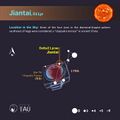
In 2026, the name of the historical constellation "Jiantai" was suggested to be used for δ2 Lyr in this constellation. This star was numbered as the first star in Jiantai constellation in the 18th century star catalog. The name was adopted in July 2026.
-
 WGSN
WGSN -
 WGSN
WGSN
References
- ↑ P.-Y. Ho, “Ancient And Mediaeval Observations of Comets and Novae in Chinese Sources,” Vistas in Astronomy, 5(1962), 127-225.
- ↑ Yi Shitong伊世同. Zhongxi Duizhao Hengxing Tubiao中西对照恒星图表1950. Beijing: Science Press.1981: 56.
- ↑ Pan Nai潘鼐. Zhongguo Hengxing Guance shi中国恒星观测史[M]. Shanghai: Xuelin Pree. 1989. p226.
- ↑ Pan Nai潘鼐. Zhongguo Hengxing Guance shi中国恒星观测史[M]. Shanghai: Xuelin Pree. 2009. p443.
- ↑ Sun Xiaochun. & Kistemaker J. The Chinese sky during the Han. Leiden: Brill. 1997, Pp241-6.
- ↑ B.-S. Yang杨伯顺, Zhongguo Chuantong Hengxing Guance Jingdu ji Xingguan Yanbian Yanjiu 中国传统恒星观测精度及星官演变研究 (A Research on the Accuracy of Chinese Traditional Star Observation and the Evolution of Constellations), PhD thesis, (Hefei: University of Science and Technology of China, 2023). 261.





