Dhaniṣṭhā (श्रविष्ठा)
Dhanishta
Authors: Susanne M Hoffmann, Shylaja, Youla Azkarrula

| Asterism Info | |
| Native | श्रविष्ठा |
|---|---|
| Romanisation | Dhanishta |
| IPA | /ʃɾə.ʋɪʂ.ʈʰaː/ |
| Translation | Dhaniṣṭhā |
| Position (2000) | |
| Right ascension | 308.3032203 to 311.6645826 |
| Declination | 10.08619213 to 16.12429395 |
| Area | 9.63 sq. deg. |
| Stars | |
| Bright stars | 10 |
| Bayer/Flamsteed stars | 9 |
| Stars brighter than 3.00m | 0 |
| Brightest star | Rotanev (3.63m) |
| Taxonomy | |
| category of asterism | constellation |
| IAU- constellations | Del |

Dhaniṣṭhā (धनिष्ठा ), "most famous", is an Indian name, used by the Indian Vedic tradition. Most of these names are roughly 3000 years old. They pre-date Hinduism but were taken over by it.
Etymology and History
Name Variants
- Dhaniṣṭhā
- Dhanishta
- Vāsava,
- Vasubha,
- Śraviṣṭhā ("the swiftest")
Origin of Constellation
The term "Dhaniṣṭhā" is a group of stars. The coordinates match with Beta Delphini. However, it can be associated with Gamma Delphini within the errors in the coordinates provided in the catalogue[1]. The listed magnitude is 3. The word Dhaniṣṭhā literally means "most famous" which may refer to the recognizable shape of stars of Delphinus that are identified here. An alternative name Śraviṣṭhā (श्रविष्ठा), is specifically mentioned in the Yajurveda for winter solstice. Its position to the north of ecliptic rakes up the question as to how this was accommodated in to the ecliptic.
Its depiction in the temple engraving as a group of stars fitted in almost square enclosure contrasts with the a huge jar containing exactly 100 small stars depicted by Jones. For whatever reason (not specified) here are exactly 100 stars in the jar (neighboring the "100 physicians"-asterism Śatabhiṣa in the sky) and they are only inside the jar. The depiction of Revati (रेवती) also is a jar with fewer star among which two are outside of the jar. There seems to be other variants too as in the Buddhist and Chinese depictions. Parāśara Tantra considered to be older by several centuries than 6th century recognises it as a bird's cage (Śakuni pañjara) with four stars.
The standard identification is the group of the brightest stars in Delphinus: α, β, γ, δ Delphini
Stars within the Constellation Area
| id | Label | IAU design. | description | Vmag |
|---|---|---|---|---|
| 1 | Rotanev | HIP 101769 | Constellation lines (Vertex) | 3.63 |
| 2 | Sualocin | HIP 101958 | Constellation lines (Vertex) | 3.8 |
| 3 | Aldulfin | HIP 101421 | Constellation lines (Vertex) | 4.03 |
| 4 | γ 2 Delphini | HIP 102532 | Constellation lines (Vertex) | 4.25 |
| 5 | δ Delphini | HIP 102281 | Inside the hull | 4.417 |
| 6 | κ Delphini | HIP 101916 | Constellation lines (Vertex) | 5.07 |
| 7 | ι Delphini | HIP 101800 | Inside the hull | 5.418 |
| 8 | θ Delphini | HIP 101882 | Inside the hull | 5.71 |
| 9 | 10 Del | HIP 102080 | Inside the hull | 5.998 |
| 10 | - | HIP 101966 | Inside the hull | 6.385 |
Transfer and Transformation of the Constellation
-
 Dhanishta nakshatra in Tirupperunthurai (Athmanathaswamy temple) near Aranthangi, India, 10th century CE. (SMH 2025).
 -
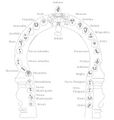 Display of all 28th nakshatras in silver arch with candles in Tirupperunthurai (Athmanathaswamy temple) near Aranthangi, India, 10th century CE. (SMH 2025).
 -
 Display of all 28th nakshatras in a door frame in Tirupperunthurai (Athmanathaswamy temple) near Aranthangi, India, 10th century CE. (SMH 2025).
 -
 Dhanishta Tibetean
 -
 Dhanishta Chinese
 -
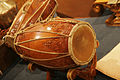 Dhanishta Indonesian drum
 -
 Dhanishta as reconstructed by Jones (1720).


Mythology
mnemonic tales and cultural significance
Weblinks
References
- ↑ Venketeswara R Pai and Shylaja B S, J. Astrophys. Astr. (2021) 42:113, https://doi.org/10.1007/s12036-021-09736-0Sadhan(a 0123458697().,-volV)FT3](0123456789().,-volV)