BI.GIR3: Difference between revisions
No edit summary |
No edit summary |
||
| (13 intermediate revisions by 4 users not shown) | |||
| Line 1: | Line 1: | ||
{{DISPLAYTITLE:<sup>ul</sup>BI.GIR<sub>3</sub>}} | {{DISPLAYTITLE:<sup>ul</sup>BI.GIR<sub>3</sub>}} | ||
Authors: {{PAGEAUTHORS}} | |||
---- | |||
<sup>ul</sup>BI.GIR<sub>3</sub> (𒌌𒁉𒄊) is the published reading of what may be a name for an asterism on a late-period astronomical/astrological drawing from Uruk; it isn't certain that this is a star or constellation name. | |||
< | == Concordance, Etymology, History<ref>[[Mesopotamian (All Terms)|Planetarium Babylonicum 2.0]], All Skies Encyclopaedia.</ref> == | ||
[[File:Texte astronomique seleucide.jpg|alt=photograph of clay tablet|thumb|Astronomical text - Seleucid period (330 BC - 138 BC) - Uruk (Warka). Contains astrological omens of a horoscopic type: some based on the birth of an individual and determining his future life; others relating to state affairs. (image from wikiCommons)]] | [[File:Texte astronomique seleucide.jpg|alt=photograph of clay tablet|thumb|Astronomical text - Seleucid period (330 BC - 138 BC) - Uruk (Warka). Contains astrological omens of a horoscopic type: some based on the birth of an individual and determining his future life; others relating to state affairs. (image from wikiCommons)]] | ||
<sup>ul</sup>BI.GIR<sub>3</sub> is the currently accepted reading for an asterism in the circular diagram [TCL 6, 13 i; Rochberg-Halton 1987b, 224-226]. | <sup>ul</sup>BI.GIR<sub>3</sub> is the currently accepted reading for an asterism in the circular diagram on the reverse of O176 [TCL<ref>Textes cunéiformes. Musée du Louvre, vol. 6, see. TU.</ref> 6, 13 i; Rochberg-Halton 1987b<ref>''Rochberg-Halton F.'' TCL 6 13: Mixed Traditions in Late Babylonian Astrology // ZA. 1987. Bd. 77. S. 207-228.</ref>, 224-226]. Photographs of the obverse and reverse of TCL 6 13 (O 176) in the ''Musées royaux d’art et d’histoire'' (Brussels) are available in Horowitz 2014<ref>Horowitz, W. 2014, The three stars each: the Astrolabes and related texts, Archiv für Orientforschung AfO Beiheft, 33.</ref>: pl. XXVIII-XXIX. The photographs (below) cannot confirm the reading given by Rochberg-Halton on the basis of the handcopy TCL 6 13. | ||
<gallery> | |||
Photographs of the obverse and reverse of TCL 6 13 (O 176) in the ''Musées royaux d’art et d’histoire'' (Brussels) are available in Horowitz 2014: pl. XXVIII-XXIX. | File:Texte astronomique seleucide.jpg|Astronomical text - Seleucid period (330 BC - 138 BC) - Uruk (Warka). Contains astrological omens of a horoscopic type: some based on the birth of an individual and determining his future life; others relating to state affairs. (image from wikiCommons) | ||
File:Astrolab Horowitz lastpage.jpg|Astrolab O176 = TCL 6 13 (Plate XXIX in Horowitz 2014). | |||
</gallery>It is not completely certain that this is a star name. | |||
== Historical Dictionaries == | |||
{| class="wikitable" | {| class="wikitable" | ||
|- | |- | ||
| Line 18: | Line 18: | ||
! scope="col" style="width: 40%;" | Gössmann (1950) | ! scope="col" style="width: 40%;" | Gössmann (1950) | ||
|- | |- | ||
| название созвездия (звезды?) в круглой диаграмме [TCL 6, 13 i; Rochberg-Halton 1987b, 224–226]. || | | название созвездия (звезды?) в круглой диаграмме [TCL 6, 13 i; Rochberg-Halton 1987b, 224–226]. ||not included | ||
|} | |} | ||
| Line 26: | Line 26: | ||
[[Category:Mesopotamian]] | [[Category:Mesopotamian]] | ||
[[Category:Sumerian]] | [[Category:Sumerian]] | ||
[[Category:West Asian]] | [[Category:West Asian]] [[Category:Asian]] | ||
[[Category:Eurasia]] | [[Category:Eurasia]] | ||
[[Category:Cuneiform]] | [[Category:Cuneiform]] [[Category:Generic Term]] [[Category:4work]] | ||
Latest revision as of 03:08, 20 May 2026
Authors: Susanne M Hoffmann, Gennady E. Kurtik, Euin Choung Kim, David Hilder, Robert van Gent, Wayne Horowitz, Youla Azkarrula
ulBI.GIR3 (𒌌𒁉𒄊) is the published reading of what may be a name for an asterism on a late-period astronomical/astrological drawing from Uruk; it isn't certain that this is a star or constellation name.
Concordance, Etymology, History[1]

ulBI.GIR3 is the currently accepted reading for an asterism in the circular diagram on the reverse of O176 [TCL[2] 6, 13 i; Rochberg-Halton 1987b[3], 224-226]. Photographs of the obverse and reverse of TCL 6 13 (O 176) in the Musées royaux d’art et d’histoire (Brussels) are available in Horowitz 2014[4]: pl. XXVIII-XXIX. The photographs (below) cannot confirm the reading given by Rochberg-Halton on the basis of the handcopy TCL 6 13.
-
 Astronomical text - Seleucid period (330 BC - 138 BC) - Uruk (Warka). Contains astrological omens of a horoscopic type: some based on the birth of an individual and determining his future life; others relating to state affairs. (image from wikiCommons)
 -
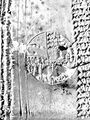 Astrolab O176 = TCL 6 13 (Plate XXIX in Horowitz 2014).

It is not completely certain that this is a star name.
Historical Dictionaries
| Kurtik (2022, b09) | Gössmann (1950) |
|---|---|
| название созвездия (звезды?) в круглой диаграмме [TCL 6, 13 i; Rochberg-Halton 1987b, 224–226]. | not included |
References
- ↑ Planetarium Babylonicum 2.0, All Skies Encyclopaedia.
- ↑ Textes cunéiformes. Musée du Louvre, vol. 6, see. TU.
- ↑ Rochberg-Halton F. TCL 6 13: Mixed Traditions in Late Babylonian Astrology // ZA. 1987. Bd. 77. S. 207-228.
- ↑ Horowitz, W. 2014, The three stars each: the Astrolabes and related texts, Archiv für Orientforschung AfO Beiheft, 33.