Blaze Star: Difference between revisions
No edit summary |
No edit summary |
||
| (28 intermediate revisions by 3 users not shown) | |||
| Line 1: | Line 1: | ||
[[File:EnglishMechanicAndMirrorOfScience1869 content hi.jpg|thumb| | Authors: {{PAGEAUTHORS}} | ||
The name "Blaze Star" as a nickname for T CrB | ---- | ||
[[File:EnglishMechanicAndMirrorOfScience1869 content hi.jpg|thumb|Screenshot of a page in the English Mechanic and Mirror Science, Sept 1869. Here, the name "Blaze Star, 1866" is chosen as a subheading]] | |||
{{Infobox constellation | |||
| name = Blaze Star | |||
| native = Blaze Star | |||
| translation = Blaze Star | |||
| pronounce = | |||
| IPA = | |||
| culture = IAU | |||
| RA = 239.8756759 | |||
| dec = 25.92017038 | |||
| areatotal = 0 | |||
| numbermainstars = 1 | |||
| numberbfstars = 1 | |||
| numberstarsplanets = | |||
| numberbrightstars = 0 | |||
| numbernearbystars = | |||
| brighteststarname = Blaze Star | |||
| starmagnitude = 10.247 | |||
| neareststarname = | |||
| stardistance = | |||
| numbermessierobjects = | |||
| meteorshowers = | |||
| bordering = CrB | |||
| notes = | |||
| cat = IAU-Star Name | |||
}} | |||
[[File:TCrB bsc1990-768x485.jpg|thumb|The variable star T CrB is included in the Yale Bright Star Catalog (HR 5859), here depicted in a star chart in Hoffmann (2017)<ref>Hoffmann, Susanne M (2017). Hipparchs Himmelsglobus – Ein Bindeglied in der babylonisch-griechischen Astrometrie?, Springer Research, Wiesbaden, New York, <nowiki>http://www.springer.com/de/book/9783658186821</nowiki></ref>.]] | |||
The name "Blaze Star" as a nickname for the eruptive variable T CrB ([https://simbad.cds.unistra.fr/simbad/sim-basic?Ident=T+CrB&submit=SIMBAD+search Simbad], [https://vsx.aavso.org/index.php?view=detail.top&oid=10602 VSX]) has been used since the 19th century. The symbiotic system in [[Corona Borealis]] consists of a red giant and a white dwarf, together normally 10.247 mag (V), prototype of the T CrB stars (see "[[Suggested Stellar Transients|Transients]]"). Occasionally, the system permits nova eruptions (surface eruptions on the white dwarf), which flare it up to mag 3 or 2. Although its usual brightness is below the detection limit of the human eye, the star is included in the Yale Bright Star Catalog because of its peak magnitude. | |||
==Concordance, Etymology, History== | ==Concordance, Etymology, History== | ||
=== Discovery === | |||
Late on the evening of May 12, 1866, the amateur astronomer John Birmingham of Tuam, Ireland, was on his way home from a friend’s house when he noticed a new star in the constellation Corona Borealis. He estimated it as being brighter than the constellation’s main star, α Coronae Borealis, which is magnitude 2.2. It had not been visible to the naked eye four hours earlier when the director of the Athens Observatory, Julius Schmidt, scanned the area, so must have shot to prominence very rapidly. Birmingham continued to observe it for another two hours but it showed no change in brightness. The nova was soon identified with a star of magnitude 9.5 in the Bonn survey, which made it clear that this “new star” was an eruption of a known one – in fact the first nova to be identified with an existing star. ([https://iopscience.iop.org/article/10.1086/125797/pdf Petit 1946, PDF]). [[File:Proctor1872 StarDepths blazeStar.png|thumb|"Blaze Star" in Proctor's note on "star depths" in 1872.<ref name=":0" />]] | |||
Back then, in 1866, people did not even know how stars work or where the Sun gets its energy from, let alone how stars evolve or why some of them change brightness. They saw it, recorded their observations – and didn't (yet) understand it. | |||
It was not until 1946 that the next bright flare was seen, and in the intervening period, apparently (almost) no one looked at this star – at least, there are no observation data in the data archive (but the light curve also begins in 1866 only after the flare has subsided (at 7 mag). | |||
'''Note:''' We have no less than two data points (nova light curves) from the star whose next eruption has been expected for 2024-6. One of these dates goes back to before the invention of electrical photometry (Potsdam, 1913), i.e., it is based solely on the estimates of experienced observers: a well-functioning method, but not using the same measurement method we use today. Contrary to everything taught in basic physics courses (or any laboratory course), we have no choice but to compare measurements that school physics teaches us are not comparable (common practice in astronomy). | |||
''' | === Occurrence of the Name === | ||
The nickname has been around since the late 19th century, and it has propagated in astronomy literature significantly since then. WGSN found that the first recorded use of the name Blaze Star for T CrB was in a lecture by the British spectroscopist William Allen Miller at a meeting of the British Association in 1869, and published in the ''English Mechanic''. The name was popularized by R. A. Proctor (1872, see [https://books.google.de/books?id=bLJXAAAAYAAJ&pg=PA378&dq=Coronae+%22Blaze+star%22&hl=en&newbks=1&newbks_redir=0&sa=X&redir_esc=y#v=onepage&q=Coronae%20%22Blaze%20star%22&f=true GoogleBooks])<ref name=":0">Proctor, Richard A. (1872). The star depths. The Mechanics' Magazine, 96, 378-379.</ref> and later his daughter Mary Proctor (1897, see [https://articles.adsabs.harvard.edu/pdf/1897PA......5...97P on adsabs], p.104). | |||
[[File:Blaze Star ProctorMary.png|thumb|Screenshot from [https://articles.adsabs.harvard.edu/pdf/1897PA......5...97P Mary Proctor's paper] (CC BY Ian Ridpath).]] | |||
Note that the [https://ui.adsabs.harvard.edu/search/fq=%7B!type%3Daqp%20v%3D%24fq_database%7D&fq_database=(database%3Aastronomy%20OR%20database%3Aphysics)&p_=0&q=%22Blaze%20Star%22&sort=date%20asc%2C%20bibcode%20asc earliest paper] [https://ui.adsabs.harvard.edu/search/fq=%7B!type%3Daqp%20v%3D%24fq_database%7D&fq_database=(database%3Aastronomy%20OR%20database%3Aphysics)&p_=0&q=%22Blaze%20Star%22&sort=date%20asc%2C%20bibcode%20asc in the 1880s] that speaks of a "Blazing Star" deals with Zeta Cassiopeiae (1886). Sara Schechner in the 1990s (e.g. [https://ui.adsabs.harvard.edu/#abs/1990taa..conf....9S/abstract Schechner 1990]) still uses the term in a general sense and not as a proper name. | |||
[[File:BlazeStar Capture.jpg|center|thumb|800x800px]] | |||
However, the name "Blaze Star" for the specific object in Corona Borealis is first found in the note in the [https://books.google.com/books?id=xj48AQAAMAAJ&pg=PA515 English Mechanic and Mirror Science in September 1869] (see top of this page). | |||
=== | === Expectations for next eruption === | ||
Three of the other T CrB-class star systems erupt somewhat more frequently: every 20 to 30 years, so that what the press tells us about the impending eruption may not be entirely reliable. We suspect that during the outburst, the star will have approximately the brightness (3 to 2 mag) of the North Star or the main star of a constellation (alf CrB, Alphecca), because this was the case in both documented observations. Many (50%) recurrent novae always erupt with the same brightness – but the peak brightness can also vary (the other 50%). Therefore, it cannot be completely ruled out that the star T CrB will not be quite as bright as last time (e.g., only 4 mag or even only 6 mag) or that it will be even brighter (up to Arcturus brightness) during its upcoming outburst: We will only know for sure when we see it. | Three of the other T CrB-class star systems erupt somewhat more frequently: every 20 to 30 years, so that what the press tells us about the impending eruption may not be entirely reliable. We suspect that during the outburst, the star will have approximately the brightness (3 to 2 mag) of the North Star or the main star of a constellation (alf CrB, [[Alphecca]]), because this was the case in both documented observations. Many (50%) recurrent novae always erupt with the same brightness – but the peak brightness can also vary (the other 50%). Therefore, it cannot be completely ruled out that the star T CrB will not be quite as bright as last time (e.g., only 4 mag or even only 6 mag) or that it will be even brighter (up to Arcturus brightness) during its upcoming outburst: We will only know for sure when we see it. | ||
=== Physics of Recurrent Novae === | === Physics of Recurrent Novae === | ||
<div style="float:right; margin:0 0 1em 1em;"> | |||
<youtube align=right>https://youtu.be/DB6IMc_g1QU</youtube> | |||
</div> | |||
A nova eruption is a surface eruption on a star in a cataclysmic binary star system. These are star systems in which the two stars orbit each other so closely that matter flows from the primary star (donor) to the companion star. The donor can be a red giant star, but it can also be a yellow main sequence star or even a white dwarf. In most cases, the receiving and occasionally erupting “star” is a white dwarf, i.e., the remnant of a sun-like star (i.e., no longer a star itself because it no longer gains energy through nuclear fusion in its interior). | A nova eruption is a surface eruption on a star in a cataclysmic binary star system. These are star systems in which the two stars orbit each other so closely that matter flows from the primary star (donor) to the companion star. The donor can be a red giant star, but it can also be a yellow main sequence star or even a white dwarf. In most cases, the receiving and occasionally erupting “star” is a white dwarf, i.e., the remnant of a sun-like star (i.e., no longer a star itself because it no longer gains energy through nuclear fusion in its interior). | ||
| Line 27: | Line 60: | ||
So we only have ten objects of this type that we can study in more detail in order to make further statistical statements about their behavior – and predictions! | So we only have ten objects of this type that we can study in more detail in order to make further statistical statements about their behavior – and predictions! | ||
In astronomy, the obvious characteristics of a system are used for classification. In the case of our recurrent novae, these would be the orbital period (period duration) | In astronomy, the obvious characteristics of a system are used for classification. In the case of our recurrent novae, these would be the orbital period (period duration) P<sub>orb</sub>, the amplitude A during eruption, the repetition time τ<sub>r</sub>, and the decay time t<sub>3</sub> from the maximum of 3 mag. The period depends on the size of the main star (donor): with a small donor, the orbiting dwarf star must be closer so that matter can flow over, and therefore it has a shorter period due to Kepler's laws. | ||
[[File:Nrec 3diagr-1024x239.jpg|center|frameless|1024x1024px|Characterization of the ten known recurrent novae: In T Pyx stars, the erupting star orbits a dwarf star (blue), in U Sco types it orbits a main sequence star (yellow), and in T CrB types it orbits a red giant (SMH 2024), published in Hoffmann and Vogt (2022)]] | [[File:Nrec 3diagr-1024x239.jpg|center|frameless|1024x1024px|Characterization of the ten known recurrent novae: In T Pyx stars, the erupting star orbits a dwarf star (blue), in U Sco types it orbits a main sequence star (yellow), and in T CrB types it orbits a red giant (SMH 2024), published in Hoffmann and Vogt (2022)]]Characterization of the ten known recurrent novae: In T Pyx stars, the erupting star orbits a dwarf star (blue), in U Sco types it orbits a main sequence star (yellow), and in T CrB types it orbits a red giant, published in Hoffmann and Vogt (2022)<ref>Hoffmann S.M. and Vogt N (2022): A Search for recurrent novae among Far Eastern guest stars, New Astronomy, Vol 92, 101722</ref>[[File:Nrec 3diagr 2.jpg|center|frameless|1024x1024px|recurrent novae, behaviour depending on classes, first published in Hoffmann and Vogt (2022).]] | ||
[[File:Nrec 3diagr 2.jpg|center|frameless|1024x1024px|recurrent novae, behaviour depending on classes, first published in Hoffmann and Vogt (2022).]] | |||
Characterization of nova behavior: The decay time for novae of the T CrB type is relatively short, i.e., the “new star” is only visible to the naked eye for a few days. The amplitude appears to be at the lower end of the possible range (compared to other systems), but with an outburst of 6 to 9 mag, a star that normally has 10 mag is certainly within the range of naked-eye visibility. The figure on the right shows how much the amplitude of the maximum varies among the individual star systems: it does not depend on the star type and can deviate significantly (by up to 4 mag) from the median mean (i.e., the most common case). | Characterization of nova behavior: The decay time for novae of the T CrB type is relatively short, i.e., the “new star” is only visible to the naked eye for a few days. The amplitude appears to be at the lower end of the possible range (compared to other systems), but with an outburst of 6 to 9 mag, a star that normally has 10 mag is certainly within the range of naked-eye visibility. The figure on the right shows how much the amplitude of the maximum varies among the individual star systems: it does not depend on the star type and can deviate significantly (by up to 4 mag) from the median mean (i.e., the most common case). | ||
| Line 35: | Line 67: | ||
=== Specifically on T CrB === | === Specifically on T CrB === | ||
In 2024/ 2025, | [[File:TCrB aavsoLCG2 2024.jpg|thumb|A light curve of T CrB based on the data archive of the [https://www.aavso.org/LCGv2/ AAVSO] (2024).]] | ||
In 2024/2025, press reports claimed that the star will erupt soon because the last eruption of T CrB was about 80 years ago, i.e., in 1946. If we think carefully about how many survey programs and systematic sky monitoring observation programs there were at the end of World War II, we can't think of many. At that time, there were no satellite telescopes, and the culture of observational astronomy consisted mainly of individual stargazers who, while observing their favourite objects, might have found an erupting star “by chance.” | |||
It was no different ''before'' World War II. So how do we know the recurrence period? It is clearly visible that there is a huge data gap between 1870 and 1930. | |||
==Mythology== | ==Mythology== | ||
no mythology | no mythology | ||
==IAU Working Group on Star Names== | ==IAU Working Group on Star Names== | ||
The name was discussed by the IAU WGSN in | The name was discussed by the IAU WGSN in 2024 due to the ongoing media hype on its due eruption. It was adopted in September 2025. <gallery> | ||
File:Blaze Star profileCard SadeghFaghanpour-IAU-WGSN.jpg|Blaze Star, profile card, (CC BY Sadegh Faganpour for WGSN 2025). | |||
File:Blaze Star stickfigure SadeghFaghanpour-IAU-WGSN.jpg|Blaze Star, stick figure, (CC BY Sadegh Faganpour for WGSN 2025). | |||
</gallery> | |||
== Weblinks == | == Weblinks == | ||
| Line 51: | Line 84: | ||
* | * | ||
== | == References == | ||
* [[References|References (general)]] | * [[References|References (general)]] | ||
* Ian Ridpath's website ([http://ianridpath.com/startales Star Tales] ) | * Ian Ridpath's website ([http://www.ianridpath.com/startales/coronaborealis.html#blaze Star Tales, Corona Borealis] ) | ||
[[Category:IAU-Star Name]] [[Category:Asterism]] | |||
[[Category:Star Name]] | [[Category:Star Name]] | ||
[[Category:Modern]] | [[Category:Transient]] [[Category:Stellar Transient]] | ||
[[Category:Modern]] | |||
[[Category:CrB]] | |||
Latest revision as of 18:22, 23 July 2026
Authors: Susanne M Hoffmann, Youla Azkarrula, Ian Ridpath

| Asterism Info | |
| Native | Blaze Star |
|---|---|
| Translation | Blaze Star |
| Position (2000) | |
| Right ascension | 239.8756759 |
| Declination | 25.92017038 |
| Area | 0 sq. deg. |
| Stars | |
| Bright stars | 1 |
| Bayer/Flamsteed stars | 1 |
| Stars brighter than 3.00m | 0 |
| Brightest star | Blaze Star (10.247m) |
| Taxonomy | |
| category of asterism | IAU-Star Name |
| IAU- constellations | CrB |

The name "Blaze Star" as a nickname for the eruptive variable T CrB (Simbad, VSX) has been used since the 19th century. The symbiotic system in Corona Borealis consists of a red giant and a white dwarf, together normally 10.247 mag (V), prototype of the T CrB stars (see "Transients"). Occasionally, the system permits nova eruptions (surface eruptions on the white dwarf), which flare it up to mag 3 or 2. Although its usual brightness is below the detection limit of the human eye, the star is included in the Yale Bright Star Catalog because of its peak magnitude.
Concordance, Etymology, History
Discovery
Late on the evening of May 12, 1866, the amateur astronomer John Birmingham of Tuam, Ireland, was on his way home from a friend’s house when he noticed a new star in the constellation Corona Borealis. He estimated it as being brighter than the constellation’s main star, α Coronae Borealis, which is magnitude 2.2. It had not been visible to the naked eye four hours earlier when the director of the Athens Observatory, Julius Schmidt, scanned the area, so must have shot to prominence very rapidly. Birmingham continued to observe it for another two hours but it showed no change in brightness. The nova was soon identified with a star of magnitude 9.5 in the Bonn survey, which made it clear that this “new star” was an eruption of a known one – in fact the first nova to be identified with an existing star. (Petit 1946, PDF).

Back then, in 1866, people did not even know how stars work or where the Sun gets its energy from, let alone how stars evolve or why some of them change brightness. They saw it, recorded their observations – and didn't (yet) understand it.
It was not until 1946 that the next bright flare was seen, and in the intervening period, apparently (almost) no one looked at this star – at least, there are no observation data in the data archive (but the light curve also begins in 1866 only after the flare has subsided (at 7 mag).
Note: We have no less than two data points (nova light curves) from the star whose next eruption has been expected for 2024-6. One of these dates goes back to before the invention of electrical photometry (Potsdam, 1913), i.e., it is based solely on the estimates of experienced observers: a well-functioning method, but not using the same measurement method we use today. Contrary to everything taught in basic physics courses (or any laboratory course), we have no choice but to compare measurements that school physics teaches us are not comparable (common practice in astronomy).
Occurrence of the Name
The nickname has been around since the late 19th century, and it has propagated in astronomy literature significantly since then. WGSN found that the first recorded use of the name Blaze Star for T CrB was in a lecture by the British spectroscopist William Allen Miller at a meeting of the British Association in 1869, and published in the English Mechanic. The name was popularized by R. A. Proctor (1872, see GoogleBooks)[2] and later his daughter Mary Proctor (1897, see on adsabs, p.104).

Note that the earliest paper in the 1880s that speaks of a "Blazing Star" deals with Zeta Cassiopeiae (1886). Sara Schechner in the 1990s (e.g. Schechner 1990) still uses the term in a general sense and not as a proper name.

However, the name "Blaze Star" for the specific object in Corona Borealis is first found in the note in the English Mechanic and Mirror Science in September 1869 (see top of this page).
Expectations for next eruption
Three of the other T CrB-class star systems erupt somewhat more frequently: every 20 to 30 years, so that what the press tells us about the impending eruption may not be entirely reliable. We suspect that during the outburst, the star will have approximately the brightness (3 to 2 mag) of the North Star or the main star of a constellation (alf CrB, Alphecca), because this was the case in both documented observations. Many (50%) recurrent novae always erupt with the same brightness – but the peak brightness can also vary (the other 50%). Therefore, it cannot be completely ruled out that the star T CrB will not be quite as bright as last time (e.g., only 4 mag or even only 6 mag) or that it will be even brighter (up to Arcturus brightness) during its upcoming outburst: We will only know for sure when we see it.
Physics of Recurrent Novae
A nova eruption is a surface eruption on a star in a cataclysmic binary star system. These are star systems in which the two stars orbit each other so closely that matter flows from the primary star (donor) to the companion star. The donor can be a red giant star, but it can also be a yellow main sequence star or even a white dwarf. In most cases, the receiving and occasionally erupting “star” is a white dwarf, i.e., the remnant of a sun-like star (i.e., no longer a star itself because it no longer gains energy through nuclear fusion in its interior).
In most cases, we know of at most one eruption as a classic nova from these cataclysmic (or symbiotic) systems. However, there are 30 stars (as of May 5, 2024) that are known or suspected to be “recurrent” novae; twelve of them are outside the Milky Way (galaxy), eight are uncertain.
So we only have ten objects of this type that we can study in more detail in order to make further statistical statements about their behavior – and predictions!
In astronomy, the obvious characteristics of a system are used for classification. In the case of our recurrent novae, these would be the orbital period (period duration) Porb, the amplitude A during eruption, the repetition time τr, and the decay time t3 from the maximum of 3 mag. The period depends on the size of the main star (donor): with a small donor, the orbiting dwarf star must be closer so that matter can flow over, and therefore it has a shorter period due to Kepler's laws.

Characterization of the ten known recurrent novae: In T Pyx stars, the erupting star orbits a dwarf star (blue), in U Sco types it orbits a main sequence star (yellow), and in T CrB types it orbits a red giant, published in Hoffmann and Vogt (2022)[3]

Characterization of nova behavior: The decay time for novae of the T CrB type is relatively short, i.e., the “new star” is only visible to the naked eye for a few days. The amplitude appears to be at the lower end of the possible range (compared to other systems), but with an outburst of 6 to 9 mag, a star that normally has 10 mag is certainly within the range of naked-eye visibility. The figure on the right shows how much the amplitude of the maximum varies among the individual star systems: it does not depend on the star type and can deviate significantly (by up to 4 mag) from the median mean (i.e., the most common case).
The problem is that the above facts are based on a relatively small sample size. While most of the information about stars, their stages of development, etc., which is derived from Hertzsprung-Russell diagrams, is based on millions/billions of star data, we only have about ten recurrent novae in the Milky Way. The few others recently discovered in the LMC and the Andromeda galaxy may have different properties and are therefore not included in the statistics. So, compared to other astronomical data, these statistics are on rather shaky ground.
Specifically on T CrB

In 2024/2025, press reports claimed that the star will erupt soon because the last eruption of T CrB was about 80 years ago, i.e., in 1946. If we think carefully about how many survey programs and systematic sky monitoring observation programs there were at the end of World War II, we can't think of many. At that time, there were no satellite telescopes, and the culture of observational astronomy consisted mainly of individual stargazers who, while observing their favourite objects, might have found an erupting star “by chance.”
It was no different before World War II. So how do we know the recurrence period? It is clearly visible that there is a huge data gap between 1870 and 1930.
Mythology
no mythology
IAU Working Group on Star Names
The name was discussed by the IAU WGSN in 2024 due to the ongoing media hype on its due eruption. It was adopted in September 2025.
-
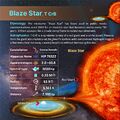 Blaze Star, profile card, (CC BY Sadegh Faganpour for WGSN 2025).
 -
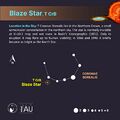 Blaze Star, stick figure, (CC BY Sadegh Faganpour for WGSN 2025).


Weblinks
References
- References (general)
- Ian Ridpath's website (Star Tales, Corona Borealis )
- ↑ Hoffmann, Susanne M (2017). Hipparchs Himmelsglobus – Ein Bindeglied in der babylonisch-griechischen Astrometrie?, Springer Research, Wiesbaden, New York, http://www.springer.com/de/book/9783658186821
- ↑ 2.0 2.1 Proctor, Richard A. (1872). The star depths. The Mechanics' Magazine, 96, 378-379.
- ↑ Hoffmann S.M. and Vogt N (2022): A Search for recurrent novae among Far Eastern guest stars, New Astronomy, Vol 92, 101722





