Pabilsang: Difference between revisions
No edit summary |
No edit summary |
||
| (8 intermediate revisions by 4 users not shown) | |||
| Line 1: | Line 1: | ||
{{distinguish|PA.BIL.SAG}} | {{distinguish|PA.BIL.SAG}} | ||
[[File:Pabilsang profileCard SadeghFaghanpour-IAU-WGSN.jpg|thumb|Pabilsang profile card (CC BY M.Sadegh Faghanpour for IAU-WGSN).]] | |||
Authors: {{PAGEAUTHORS}} | Authors: {{PAGEAUTHORS}} | ||
---- | ---- | ||
{{Infobox constellation | |||
Pabilsang is a modern star name adopted by the International Astronomical Union in the IAU-Catalog of Star Names (IAU-CSN). Its origin is Sumerian. It is the name of the star | | name = Pabilsang | ||
| native = Pabilsaĝ | |||
| translation = the oldest name of Sagittarius, a Sumerian god. | |||
| pronounce = | |||
| IPA = | |||
| culture = IAU | |||
| RA = 283.7797394 | |||
| dec = -22.67128379 | |||
| areatotal = 0 | |||
| numbermainstars = 1 | |||
| numberbfstars = 1 | |||
| numberstarsplanets = | |||
| numberbrightstars = 0 | |||
| numbernearbystars = | |||
| brighteststarname = Pabilsang | |||
| starmagnitude = 4.98 | |||
| neareststarname = | |||
| stardistance = | |||
| numbermessierobjects = | |||
| meteorshowers = | |||
| bordering = Sgr | |||
| notes = | |||
| cat = IAU-Star Name | |||
}} | |||
Pabilsang is a modern star name adopted by the International Astronomical Union in the IAU-Catalog of Star Names (IAU-CSN). Its origin is Sumerian. It is the name of the star ν<sup>2</sup> Sgr in constellation [[Sagittarius]]. | |||
== Concordance, Etymology, History == | == Concordance, Etymology, History == | ||
| Line 13: | Line 38: | ||
For details on the historical constellation see [[PA.BIL.SAG]] for the cuneiform literature and [[Sagittarius]] for the Greco-Latin one. | For details on the historical constellation see [[PA.BIL.SAG]] for the cuneiform literature and [[Sagittarius]] for the Greco-Latin one. | ||
Spelling | '''Spelling:''' | ||
* normally in Assyriology Romanised: PA.BIL.SAG | * normally in Assyriology Romanised: '''PA.BIL.SAG''' | ||
* in the syllabic form the scientific Romanisation is Pabilsaĝ, with "ĝ" indication the nasal pronunciation ŋ | * in the syllabic form the scientific Romanisation is '''Pabilsaĝ''', with "ĝ" indication the nasal pronunciation ŋ | ||
* The IAU, therefore, spells it "Pabilsang" to come closest to what is considered standard in Assyriology at the time of the adoption of the name. Still, the pronunciation of Sumerian is difficult to reconstruct and might be subject to change of research opinion. | * The IAU, therefore, spells it "'''Pabilsang'''" to come closest to what is considered standard in Assyriology at the time of the adoption of the name. Still, the pronunciation of Sumerian is difficult to reconstruct and might be subject to change of research opinion. | ||
==Mythology== | ==Mythology== | ||
| Line 23: | Line 48: | ||
==IAU Working Group on Star Names== | ==IAU Working Group on Star Names== | ||
The name was discussed and adopted by the IAU WGSN in August 2026. | The name '''Pabilsang''' was discussed and adopted by the IAU WGSN in August 2026 for the star designated [https://simbad.cds.unistra.fr/simbad/sim-id?Ident=nu02+Sgr nu2 Sgr (35 Sgr, HR 7120, HD 175190, HIP 92845, Gaia DR3 4075701763795658240)]. The star has apparent V magnitude 4.98 and lies 88 parsecs away, and is situated about 2 arcminutes north of the globular cluster NGC 6717 in Sagittarius, and only about 10 arcminutes north of the Ecliptic. | ||
Pabilsang is a red giant of spectral type K3- II-III: CN1 Ba1, as classified by [https://ui.adsabs.harvard.edu/abs/1989ApJS...71..245K/abstract Keenan & McNeil (1989)], meaning it is a bright giant or giant star showing enhanced cyanogen and barium. So-called '[[wikipedia:Barium_star|barium stars]]' likely accreted material enriched in s-process elements from a companion that had been undergone its asymptotic giant branch stage, and which is now likely to be an undetected white dwarf companion. While a distant companion 10 arcseconds away in the Gaia data was reported by [https://ui.adsabs.harvard.edu/abs/2020ApJS..247...66H/abstract Hartmann & Lepine (2020)] -- the 15th magnitude star nu02 Sgr B (Gaia DR3 4075701729424047232) -- its colors and brightness are consistent with being a red dwarf star. As "B" is a main sequence star separated by this is could not be the culprit responsible for enriching nu2 Sgr with barium. However, multiple studies have noted that the radial velocity and proper motion measurements for nu2 Sgr suggest that it has a closer companion (e.g. [https://ui.adsabs.harvard.edu/abs/2005AJ....129.2420M/abstract Makarov 2005], [https://ui.adsabs.harvard.edu/abs/2014A%26A...561A.126D/abstract de Medieros et al. 2014]), however it does not appear that an orbit has ever been published, nor mass or brightness constraints on the companion. The fact that nu2 Sgr is a barium-rich giant would suggest that the perturbations in radial velocity and astrometry are due to a white dwarf companion, which used to be the more massive component in the system. So the nu2 Sgr system is likely to be at least a triple, and WGSN adopts '''Pabilsang''' for the red giant primary star. Note that the star nu1 Sgr is unrelated to the nu2 Sgr system. | |||
<gallery> | <gallery> | ||
File: | File:Pabilsang profileCard SadeghFaghanpour-IAU-WGSN.jpg|Pabilsang profile card (CC BY M.Sadegh Faghanpour for IAU-WGSN). | ||
File: | File:Pabilsang stickfigure SadeghFaghanpour-IAU-WGSN.jpg|Pabilsang stick figure (CC BY M.Sadegh Faghanpour for IAU-WGSN); see [[PA.BIL.SAG]] | ||
File:Sgr Pabilsag seal Wallenfels1993.png|PA.BIL.SAG on seal from Uruk (Wallenfels 1993) | |||
File:Sgr DenderaEckig GZotti.JPG|PA.BIL.SAG in Dendera, Egypt | |||
File:Sgr DenderaCirc Louvre.JPG|PA.BIL.SAG in Dendera, Egypt | |||
File:Pabilsag-over-MA2GUR8.png|PA.BIL.SAG in Stellarium sky culture "Babylonian MUL.APIN" (CC BY Jessica Gullberg 2022). | |||
File:Sgr dendera stellarium.jpg|PA.BIL.SAG of Dendera mapped to the stars (Stellarium, SMH 2022). | |||
</gallery> | </gallery> | ||
| Line 33: | Line 65: | ||
== Weblinks == | == Weblinks == | ||
* | * SIMBAD page for nu2 Sgr: https://simbad.cds.unistra.fr/simbad/sim-id?Ident=nu02+Sgr | ||
== Reference == | == Reference == | ||
* [[References|References (general)]] | * [[References|References (general)]] | ||
* [[References (Medieval and Early Modern)|References (early modern)]] | * [[References (Medieval and Early Modern)|References (early modern)]] | ||
* Ian Ridpath's | * Ian Ridpath's ''Star Tales'' ([http://www.ianridpath.com/startales/sagittarius.html Sagittarius] ) | ||
[[Category:Asterism]] | [[Category:Asterism]] | ||
| Line 45: | Line 77: | ||
[[Category:Eurasia]] | [[Category:Eurasia]] | ||
[[Category:West Asian]] [[Category:Asian]][[Category:Modern]] | [[Category:West Asian]] [[Category:Asian]][[Category:Modern]] | ||
[[Category:Sgr]] | |||
Latest revision as of 17:29, 2 September 2026

Authors: Susanne M Hoffmann, Eric Mamajek, ASE Tech Team
| Asterism Info | |
| Native | Pabilsaĝ |
|---|---|
| Translation | the oldest name of Sagittarius, a Sumerian god. |
| Position (2000) | |
| Right ascension | 283.7797394 |
| Declination | -22.67128379 |
| Area | 0 sq. deg. |
| Stars | |
| Bright stars | 1 |
| Bayer/Flamsteed stars | 1 |
| Stars brighter than 3.00m | 0 |
| Brightest star | Pabilsang (4.98m) |
| Taxonomy | |
| category of asterism | IAU-Star Name |
| IAU- constellations | Sgr |
Pabilsang is a modern star name adopted by the International Astronomical Union in the IAU-Catalog of Star Names (IAU-CSN). Its origin is Sumerian. It is the name of the star ν2 Sgr in constellation Sagittarius.
Concordance, Etymology, History

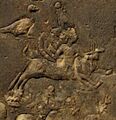
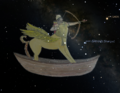
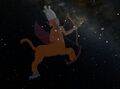
The ancient Mesopotamian god PA.BIL.SAG in Sumerian is the city god of Larak. He is drawn as a mixed creature with a human body, a horse body and a scorpion tail (in addition to the horse tail), as well as elements of a bird body: in some versions, he has the legs of a bird, in other versions he has wings.
This mixed creature has no equivalent in the ancient Greek mythology/ religion and when the Greeks took over this constellation with the Mesopotamian zodiac, they renamed it according to its most prominent feature, "The Archer".
For details on the historical constellation see PA.BIL.SAG for the cuneiform literature and Sagittarius for the Greco-Latin one.
Spelling:
- normally in Assyriology Romanised: PA.BIL.SAG
- in the syllabic form the scientific Romanisation is Pabilsaĝ, with "ĝ" indication the nasal pronunciation ŋ
- The IAU, therefore, spells it "Pabilsang" to come closest to what is considered standard in Assyriology at the time of the adoption of the name. Still, the pronunciation of Sumerian is difficult to reconstruct and might be subject to change of research opinion.
Mythology
The realm of the original god is not entirely certain or might have varied over places and times. He was identified with Ninurta, particularly in his role as the husband of the healing goddess Gula. Ninurta, on the other hand, was a god of agriculture and war, the foremost son of the highest god of the Mesopotamian pantheon in the early 2nd millennium, Enlil.
IAU Working Group on Star Names
The name Pabilsang was discussed and adopted by the IAU WGSN in August 2026 for the star designated nu2 Sgr (35 Sgr, HR 7120, HD 175190, HIP 92845, Gaia DR3 4075701763795658240). The star has apparent V magnitude 4.98 and lies 88 parsecs away, and is situated about 2 arcminutes north of the globular cluster NGC 6717 in Sagittarius, and only about 10 arcminutes north of the Ecliptic.
Pabilsang is a red giant of spectral type K3- II-III: CN1 Ba1, as classified by Keenan & McNeil (1989), meaning it is a bright giant or giant star showing enhanced cyanogen and barium. So-called 'barium stars' likely accreted material enriched in s-process elements from a companion that had been undergone its asymptotic giant branch stage, and which is now likely to be an undetected white dwarf companion. While a distant companion 10 arcseconds away in the Gaia data was reported by Hartmann & Lepine (2020) -- the 15th magnitude star nu02 Sgr B (Gaia DR3 4075701729424047232) -- its colors and brightness are consistent with being a red dwarf star. As "B" is a main sequence star separated by this is could not be the culprit responsible for enriching nu2 Sgr with barium. However, multiple studies have noted that the radial velocity and proper motion measurements for nu2 Sgr suggest that it has a closer companion (e.g. Makarov 2005, de Medieros et al. 2014), however it does not appear that an orbit has ever been published, nor mass or brightness constraints on the companion. The fact that nu2 Sgr is a barium-rich giant would suggest that the perturbations in radial velocity and astrometry are due to a white dwarf companion, which used to be the more massive component in the system. So the nu2 Sgr system is likely to be at least a triple, and WGSN adopts Pabilsang for the red giant primary star. Note that the star nu1 Sgr is unrelated to the nu2 Sgr system.
-
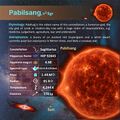 Pabilsang profile card (CC BY M.Sadegh Faghanpour for IAU-WGSN).
 -
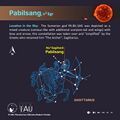 Pabilsang stick figure (CC BY M.Sadegh Faghanpour for IAU-WGSN); see PA.BIL.SAG
 -
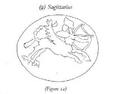 PA.BIL.SAG on seal from Uruk (Wallenfels 1993)
 -
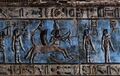 PA.BIL.SAG in Dendera, Egypt
 -
 PA.BIL.SAG in Dendera, Egypt
 -
 PA.BIL.SAG in Stellarium sky culture "Babylonian MUL.APIN" (CC BY Jessica Gullberg 2022).
 -
 PA.BIL.SAG of Dendera mapped to the stars (Stellarium, SMH 2022).


Weblinks
- SIMBAD page for nu2 Sgr: https://simbad.cds.unistra.fr/simbad/sim-id?Ident=nu02+Sgr
Reference
- References (general)
- References (early modern)
- Ian Ridpath's Star Tales (Sagittarius )





