Hydra: Difference between revisions
| (44 intermediate revisions by 5 users not shown) | |||
| Line 1: | Line 1: | ||
Authors: {{PAGEAUTHORS}} | |||
---- | |||
[[File:Hydra IAU.svg|alt=IAU Hydra chart|thumb|IAU Hydra chart]] | [[File:Hydra IAU.svg|alt=IAU Hydra chart|thumb|IAU Hydra chart]] | ||
One of the [[:Category:88_IAU-Constellations|88 IAU constellations]]. The name "Hydra" refers to a watersnake from Greek mythology. Still, the underlying constellation originally referred to a Babylonian creature that consisted of a dog-headed snake with wings, the [[MUŠ]]. | {{Infobox constellation | ||
| name = ʿˊΥδρος (Hydros) | |||
| native = ʿˊΥδρος | |||
| translation = Water Snake | |||
| pronounce = Hydros | |||
| IPA = | |||
| culture = Greek (Almagest) | |||
| RA = 129.4140311 to 211.59290829999998 | |||
| dec = -33.90812978 to 6.41880152 | |||
| areatotal = 1124.77 | |||
| numbermainstars = 171 | |||
| numberbfstars = 120 | |||
| numberstarsplanets = | |||
| numberbrightstars = 6 | |||
| numbernearbystars = | |||
| brighteststarname = [[Alphard]] | |||
| starmagnitude = 1.97 | |||
| neareststarname = | |||
| stardistance = | |||
| numbermessierobjects = | |||
| meteorshowers = | |||
| bordering = Hya, Sex, Cra, Crv, Vir | |||
| notes = | |||
| cat = Almagest constellation | |||
}} | |||
[[File:Hya+crt+crv stellarium mulapin.jpg|thumb|Babylonian predecessor of Hydra: MUŠ, a creature with a snake-body with a wing, a dog-head and front legs; painting by Jessica Gullberg, in Stellarium by Susanne M Hoffmann]] | |||
[[File:Leo+vir umzeichng4plani black.png|thumb|clay tablets VAT 7847+AO6448]] | |||
[[File:Hya+crt+crv stellarium farnese.jpg|thumb|Hydra (as a vessel) with Corvus and Crater on the Farnese Globe (2nd century CE), mapped to Stellarium by SMH 2021.]] | |||
One of the [[:Category:88_IAU-Constellations|88 IAU constellations]]. The name "Hydra" refers to a watersnake from Greek mythology. Still, the underlying constellation originally referred to a Babylonian creature that consisted of a dog-headed snake with wings, the [[MUŠ]].<ref name=":0">Hoffmann, Susanne M. Wie der Löwe an den Himmel kam. Franckh Kosmos Verlag, Stuttgart 2021</ref> For Aratos and Eratosthenes, the constellations Hydra, [[Corvus]], and [[Crater]] belong together; they form a super-constellation consisting of several figures. They tell a star legend whose main character is the raven, who is said to have carried the Hydra to Apollo. However, this contradicts the figure in the sky: the raven is tiny compared to the Hydra and looks more like it is riding on it. This legend testifies to the actually foreign origin of the constellation: The giant snake and the raven were adopted as an image from Mesopotamia. The description or listing of these figures is already documented in MUL.APIN in the 2nd millennium BCE. It is one of the few constellations for which there is even evidence of an engraving from Mesopotamia – although only from the Seleucid period, i.e., under Greek rule. | |||
==Etymology and History== | ==Etymology and History== | ||
The Greek constellation of the Water Snake is a derivative of the Babylonian constellation of the MUŠ-Dragon, a dog-headed creature with the body of a gigantic snake with front legs and wings. | The Greek constellation of the Water Snake is a derivative of the Babylonian constellation of the MUŠ-Dragon, a dog-headed creature with the body of a gigantic snake with front legs and wings. | ||
=== Origin of Constellation === | === Origin of Constellation === | ||
The Babylonian constellation is mentioned as early as 2nd millennium BCE; it occurs in lexical texts and texts of the Three Stars Each-genre. It is also mentioned in the first list (uranology) of MUL.APIN, where the Raven (or Crow) is mentioned at the tip of tail of the huge creature in the sky. | The Babylonian constellation is mentioned as early as 2nd millennium BCE;<ref name=":0" /> it occurs in lexical texts and texts of the Three Stars Each-genre. It is also mentioned in the first list (uranology) of MUL.APIN, where [[Corvus]], the Raven (or Crow) is mentioned at the tip of the tail of the huge creature in the sky. | ||
==== Babylonian ==== | |||
see | |||
* [[MUŠ|<sup>mul (d)</sup>MUŠ]] | |||
* [[MUŠ.ḪUŠ|<sup>(mul)</sup>MUŠ.ḪUŠ]] | |||
The Babylonian "serpent" has a dog's head, at least front legs (if not also hind legs), and wings. | |||
==== Egyptian ==== | |||
In Ptolemaic times (1st century BCE), when Egypt was ruled by the Romans, new Egyptian temples were built: a Chnum temple in Esna and a Hathor temple Dendera (south and north of Thebes/ Luxor). They display a cultural mixture of Babylonian and Egyptian constellations. | |||
<gallery> | |||
File:Leo+Com DenderaEckig GZotti.JPG|Leo (and Com); rectangular zodiac of Dendera | |||
File:Leo+Com+Hya DenderaCirc Louvre.JPG|Leo with Com, Hya, Crv, circular zodiac of Dendera (CC BY [https://collections.louvre.fr/en/ark:/53355/cl010028871 Musée du Louvre, Département des Antiquités égyptiennes]) | |||
File:Leo+Com DenderaCirc Louvre black inv.jpg|Constellation of a Lion with a Lady on its Tail in Leo+Coma Berenices on the circular Zodiac of Dendera, Egypt (drawing by SMH for Stellarium 2026). | |||
File:Hya DenderaCirc Louvre black inv.jpg|Constellation of a Serpent with a Bird in Hydra+Corvus on the circular Zodiac of Dendera, Egypt (drawing by SMH for Stellarium 2026). | |||
</gallery> | |||
==== Aratus ==== | ==== Aratus ==== | ||
The | [[File:Hya kugel smh2024.jpg|thumb|Constellation Hydra with Crater and Corvus on the Kugel Globe (1st century BCE), detail from drawing by SMH.<ref>Hoffmann, Susanne M (2025), Some Results on the Ancient Globes, Globe Studies – The Journal of the International Coronelli Society, 69, 4169.</ref>]]<blockquote>But yet another constellation sweeps across the horizon: they call it the Hydra. Like a living thing [445] it winds at great length, its head comes below the middle of the Crab, its coil under the Lion’s body, and its tail hangs over the Centaur himself. On its middle coil lies the Bowl, and on the last one the figure of a Raven that looks like one pecking the coil. [450] Yes, and there too Procyon shines brightly beneath the Twins. (Kidd 1997) </blockquote>For Aratus Pi Hya is part of the snake which can be derived from the simultaneously setting constellations (663). | ||
==== Eratosthenes ==== | |||
Eratosthenes in his Catasterismi gives two sections per constellation: First, he describes the story that led to the object/animal/god becoming a constellation. Then, he describes the positions of the stars in the figure. | |||
Pamias and Zucker (2013,<ref>Pamìas, Jordi und Zucker, Arnaud (2013). Ératosthènes de Cyrène: Catastérrismes, Belles Lettres, Paris</ref> 121-125): '''Hydra to which also belongs the Cup and the Raven''' | |||
<blockquote>'''Var. 1 (Περὶ τοῦ Ὕδρου, ἐφ ᾧ Κρατὴρ καὶ Κόραξ)''': This constellation has multiple meanings due to a remarkable event. The raven is associated with the cult of Apollo, as each god has a bird dedicated to them. As the gods were making a sacrifice, he was sent to fetch water from a spring to make a libation, for before the advent of wine, spring water was considered the most sacred of all; seeing a fig tree near the spring bearing unripe figs, he waited for them to ripen; after some time, when they were ripe and he had eaten the figs, realising that he had committed a sacrilege, he also seized the hydra that was in the spring and brought it along with the cup, claiming that the hydra had drunk the water from the spring day after day. But Apollo discovered the truth and imposed upon the raven a punishment commensurate with his fault: to be thirsty amongst men during this time of year, as Aristotle says in his books On the Animals; and Archelaus says much the same in his On the Particular Natures. | |||
'''Var. 2 (Ὕδρου ἐν ᾧ Κρατ<ὴρ καὶ Κόραξ>)''': This constellation is plural [a super-constellation] because of one remarkable event. The raven is associated with the cult of Apollo, as a bird is dedicated to each of the gods. As the gods were performing a sacrifice, he was sent to fetch water from a spring for a libation; seeing a fig tree near the spring bearing unripe figs, he waited for them to ripen; after some time, when they were ripe and he had eaten the figs, realising that he had committed a sacrilege, he also seized the hydra that was in the fountain and brought it along with the cup, claiming that the hydra had drunk the water from the spring day after day. But Apollo discovered what had happened and imposed upon the raven a punishment commensurate with his offence: to be thirsty amongst men during this time of year, as Aristotle states in his books On Animals. To leave a clear reminder of the sacrilege that had been committed against the gods, Apollo depicted and placed among the constellations the Hydra, the Crater, and the Raven, which cannot drink from it nor approach it. | |||
= | '''The Hydra''' has three bright stars at the tip of its head, six on its first coil, the last of which is bright, three on the second coil, four on the third, two on the fourth, and nine dim stars stretching from the fifth coil to the tail. Twenty-seven in all. | ||
'''Corvus''' is situated on the tail of Hydra and faces west. It has one dim star on its beak, two on its wing, two on its rump, and one at the tips of its legs. Seven in all. | |||
'''Crater''' is situated on Hydra, some distance from the coil, and is tilted towards the knees of Virgo. Crater has two dim stars on the rim, two in the centre of the Bowl, and two at the base. Six in total.</blockquote>'''Eratosthenes's star catalogue''' can be reconstructed from the list of stars he mentions in the last section of each of the constelllation descriptions. Hoffmann (2017)<ref name=":02">Hoffmann, S. M., <nowiki><i>Hipparchs Himmelsglobus</i></nowiki>. Springer Wiesbaden/ New York, 2017. doi:10.1007/978-3-658-18683-8.</ref> made such a catalogue and used it for computational comparison with Hipparchus's, Ptolemy's and Babylonian data; it is based on the edition and translation by Pamias and Geus (2007)<ref>Eratosthenes: Sternsagen, übersetzt von Pamìas, Jordi und Geus, Klaus, Verlag Utopica, Oberhaid 2007</ref> and presented here in English translation. | |||
{|class="wikitable" | |||
|+ | |||
!erat.Cat.ID | |||
!constStarID | |||
!starName | |||
!ident.Bayer | |||
!ident.HIP | |||
!certainty | |||
|- | |||
|655 | |||
|1 | |||
|three bright stars at the tip of the head [of the Water Serpent] | |||
|zeta Hya | |||
|43813 | |||
|1 | |||
|- | |||
|656 | |||
|2 | |||
|three bright stars at the tip of the head [of the Water Serpent] | |||
|eps Hya | |||
|43109 | |||
|1 | |||
|- | |||
|657 | |||
|3 | |||
|three bright stars at the tip of the head [of the Water Serpent] | |||
|delta Hya | |||
|42313 | |||
|1 | |||
|- | |||
|658 | |||
|4 | |||
|six on the first coil [of the Water Serpent] | |||
|omega Hya | |||
|44659 | |||
|1 | |||
|- | |||
|659 | |||
|5 | |||
|six on the first coil [of the Water Serpent] | |||
|theta Hya | |||
|45336 | |||
|1 | |||
|- | |||
|660 | |||
|6 | |||
|six on the first coil [of the Water Serpent] | |||
|tau1 Hya | |||
|46509 | |||
|1 | |||
|- | |||
|661 | |||
|7 | |||
|six on the first coil [of the Water Serpent] | |||
|tau2 Hya | |||
|46776 | |||
|1 | |||
|- | |||
|662 | |||
|8 | |||
|six on the first coil [of the Water Serpent] | |||
|iota Hya | |||
|47431 | |||
|1 | |||
|- | |||
|663 | |||
|9 | |||
|six on the first coil [of the Water Serpent]; of these, the last is bright | |||
|alpha Hya | |||
|46390 | |||
|1 | |||
|- | |||
|664 | |||
|10 | |||
|three on the second coil [of the Water Serpent] | |||
|lambda Hya | |||
|49841 | |||
|1 | |||
|- | |||
|665 | |||
|11 | |||
|three on the second coil [of the Water Serpent] | |||
|ups1 Hya | |||
|48356 | |||
|1 | |||
|- | |||
|666 | |||
|12 | |||
|three on the second coil [of the Water Serpent] | |||
|26 Hya | |||
|45751 | |||
|1 | |||
|- | |||
|667 | |||
|13 | |||
|four on the third [coil of the Water Serpent] | |||
| | |||
|48615 | |||
|2 | |||
|- | |||
|668 | |||
|14 | |||
|four on the third [coil of the Water Serpent] | |||
|mu Hya | |||
|51069 | |||
|2 | |||
|- | |||
|669 | |||
|15 | |||
|four on the third [coil of the Water Serpent] | |||
|phi Hya | |||
|52085 | |||
|2 | |||
|- | |||
|670 | |||
|16 | |||
|four on the third [coil of the Water Serpent] | |||
|nu Hya | |||
|52943 | |||
|2 | |||
|- | |||
|671 | |||
|17 | |||
|two on the fourth [coil of the Water Serpent] | |||
|xi Hya | |||
|56343 | |||
|2 | |||
|- | |||
|672 | |||
|18 | |||
|two on the fourth [coil of the Water Serpent] | |||
|chi1 Hya | |||
|54204 | |||
|2 | |||
|- | |||
|673 | |||
|19 | |||
|nine dim stars on the fifth coil [of the Water Serpent] extending to the tail | |||
| | |||
|57047 | |||
|2 | |||
|- | |||
|674 | |||
|20 | |||
|nine dim stars on the fifth coil [of the Water Serpent] extending to the tail | |||
| | |||
|55756 | |||
|2 | |||
|- | |||
|675 | |||
|21 | |||
|nine dim stars on the fifth coil [of the Water Serpent] extending to the tail | |||
| | |||
|55588 | |||
|2 | |||
|- | |||
|676 | |||
|22 | |||
|nine dim stars on the fifth coil [of the Water Serpent] extending to the tail | |||
|omikron Hya | |||
|56922 | |||
|2 | |||
|- | |||
|677 | |||
|23 | |||
|nine dim stars on the fifth coil [of the Water Serpent] extending to the tail | |||
|beta Hya | |||
|57936 | |||
|2 | |||
|- | |||
|678 | |||
|24 | |||
|nine dim stars on the fifth coil [of the Water Serpent] extending to the tail | |||
|alpha Crv | |||
|59199 | |||
|2 | |||
|- | |||
|679 | |||
|25 | |||
|nine dim stars on the fifth coil [of the Water Serpent] extending to the tail | |||
|beta Crv | |||
|61359 | |||
|2 | |||
|- | |||
|680 | |||
|26 | |||
|nine dim stars on the fifth coil [of the Water Serpent] extending to the tail | |||
|gam Hya | |||
|64962 | |||
|1 | |||
|- | |||
|681 | |||
|27 | |||
|nine dim stars on the fifth coil [of the Water Serpent] extending to the tail | |||
|pi Hya | |||
|68895 | |||
|1 | |||
|- | |||
|682 | |||
|1 | |||
|the Raven on its tail [of the Water Serpent] has a dim star on its beak [facing west] | |||
|alpha Crv | |||
|59199 | |||
|2 | |||
|- | |||
|683 | |||
|2 | |||
|the Raven[…] two on the wing | |||
|eps Crv | |||
|59316 | |||
|2 | |||
|- | |||
|684 | |||
|3 | |||
|the Raven[…] two on the wing | |||
|gam Crv | |||
|59803 | |||
|2 | |||
|- | |||
|685 | |||
|4 | |||
|the Raven[…] two on the tail | |||
|delta Crv | |||
|60965 | |||
|2 | |||
|- | |||
|686 | |||
|5 | |||
|the Raven[…] two on the tail | |||
|eta Crv | |||
|61174 | |||
|2 | |||
|- | |||
|687 | |||
|6 | |||
|the Raven[…] one on each tip of the foot | |||
|beta Crv | |||
|61359 | |||
|2 | |||
|- | |||
|688 | |||
|7 | |||
|the Raven[…] one on each tip of the foot | |||
|6 Crv | |||
|60425 | |||
|2 | |||
|- | |||
|689 | |||
|1 | |||
|the Cup [at a considerable distance from the first coil of the Hydra, inclined toward the knees of Virgo] has two dim stars on the rim | |||
|eps Crt | |||
|55687 | |||
|2 | |||
|- | |||
|690 | |||
|2 | |||
|the Cup has two dim stars on the rim | |||
|zeta Crt | |||
|57283 | |||
|2 | |||
|- | |||
|691 | |||
|3 | |||
|two in the middle [of the Cup] | |||
|delta Crt | |||
|55282 | |||
|1 | |||
|- | |||
|692 | |||
|4 | |||
|two in the middle [of the Cup] | |||
|gam Crt | |||
|55705 | |||
|1 | |||
|- | |||
|693 | |||
|5 | |||
|two near the bottom [of the Cup] | |||
|beta Crt | |||
|54682 | |||
|2 | |||
|- | |||
|694 | |||
|6 | |||
|two near the bottom [of the Cup] | |||
|alpha Crt | |||
|53740 | |||
|2 | |||
|} | |||
==== Hipparchus ==== | ==== Hipparchus ==== | ||
====== Rising & Setting ====== | |||
{| class="wikitable" | |||
|+ | |||
!Greek | |||
(Manitius 1894) | |||
!German | |||
(Manitius 1894) | |||
!English | |||
! | |||
|- | |||
| | |||
|weiter giebt Eudoxos auch die auf den sogenannten Kolurkreisen gelegenen Sterne an und behauptet, auf dem einen derselben liege die Mitte des Großen Bären, die Mitte des Kreises, der Nacken der Wasserschlange und von der Argo das Stück zwischen dem Hinterteil und dem Mastbaum; alsdann nach dem unsichtbaren Pol der Schwanz des südlichen Fisches, die Mitte des Steinbocks und die Mitte des Pfeils; endlich gehe er durch den Hals und den rechten Flügel des Schwans, durch die linke Hand des Kepheus, durch die Windung der Schlange und vorbei am Schwanze des Kleinen Bären. | |||
|Eudoxus also gives the stars situated on the so-called circles of Colur and claims that on one of them lies the centre of the Great Bear, the centre of the circle, the neck of '''the watersnake''' and the part of the Argo between the rump and the mast; then, after the invisible pole, the tail of the southern fish, the centre of Capricorn and the centre of the arrow; finally, it passes through the neck and the right wing of the swan, through the left hand of Cepheus, through the coil of the Snake and past the tail of the Little Bear. | |||
|Lib. I. Cap. XL § 9 . | |||
|- | |||
| | |||
|Ersichtlich macht er dies auch bei dem Aufgange der Fische, wo er sich also ausdrückt; nachdem er nämlich von der Wasserschlange gesagt, daß das Stück vom Kopfe bis zur ersten Windung, wenn der Wassermann im Aufgange begriffen ist, nicht mehr über dem Horizont sei, während den Rest ihres Körpers die Fische hinabführen. | |||
|He also makes this evident in the rising of the fishes, where he expresses himself thus; for after he has said of '''the watersnake''' that the part from the head to the first coil, when the Aquarius is in the act of rising, is no longer above the horizon, while the rest of its body is led down by the fishes. | |||
|Lib. II. Cap. I. § 24 | |||
|- | |||
| | |||
|Untergang des Perseus, mitkulminierend: | |||
Leo 5 1/2: Von der Wasserschlange der vierte von den vier hinter dem hellen nach Osten gelegenen (λ<sub>2</sub>), 1 Mbr. westlich des Meridians. | |||
|Setting of Perseus, co-culminating: | |||
Leo 5 1/2: Of '''the''' '''watersnake''' the fourth of the four behind the bright one to the east (λ<sub>2</sub>), 1 moon width west of the meridian. | |||
|Lib. II, Cap.VI. §15 | |||
|- | |||
| | |||
|Aufgang des Kentaur, mitkulminierend: | |||
Cnc 12°: Von der Wasserschlange der nachfolgende in der südlichen Kinnlade (η) | |||
|Rising of the centaur, co-culminating: | |||
Cnc 12°: From '''the watersnake''' of the following in the southern jaw (η) | |||
|Lib. III. Cap. I. § 4. | |||
|- | |||
| | |||
|Untergang Kleiner Hund, mitkulminierend: | |||
3 . Von der Wasserschlange der am Ende des Schwanzes (π). | |||
|Downfall Small dog, co-culminating: | |||
3 . From '''the watersnake''' at the end of the tail (π). | |||
|Lib. III. Cap. n. § 13 | |||
|- | |||
| | |||
|Aufgang der Jungfrau, mitkulminierend: | |||
2. Von der Wasserschlange der nördlichere von denen im Rachen (δ) , 1 Mbr. östlich des Meridians. | |||
|Rising of Virgo, co-culminating: | |||
2. of '''the watersnake''' the more northerly of those in the throat (δ), 1 moon width east of the meridian. | |||
|Lib. III. Cap. III. § 3 | |||
|- | |||
| | |||
|Aufgang des Skorpions, mitkulminierend: | |||
Von der Wasserschlange von den vieren nach dem hellsten [vor dem Becher] der dritte von Westen (ν<sup>2</sup> Hydrae) | |||
|Rising of the scorpion, co-culminating: | |||
Of '''the watersnake''' of the four after the brightest [before the cup] the third from the west (ν<sub>2</sub> Hydrae) | |||
|Lib. III. Cap. III. § 5. | |||
|} | |||
The mathematical astronomer mentions this constellation rising and setting. | The mathematical astronomer mentions this constellation rising and setting. | ||
{| class="wikitable" | |||
|+ | |||
!Greek | |||
!German | |||
(Manitius 1894) | |||
!English | |||
(from Manitius 1894) | |||
! | |||
|- | |||
| | |||
|Die Wasserschlange (Hydra). Aufgang von Cnc 18 1/2 Grad bis Lib 15 1/2 Grad, Mitkulmination Ari 2 1/2 Grad bis Cnc 18 Grad. | |||
* Anfang: Der nördlichere von denen im Rachen (δ). | |||
* Ende: Der am Ende des Schwanzes (π). | |||
* Ari 2 1/2° | |||
** Vom Perseus der nebelförmige im Sichelschwert (χh). | |||
** Der Knoten im Band der Fische (α), 1 Mbr. östlich des Meridians. | |||
** Der nachfolgende von den drei hellen im Kopfe des Widders (α), 1 Mbr. östlich des Meridians. | |||
* Cnc 18° | |||
** Vom Löwen der südlichere der vorangehenden von denen im Kopfe (λ). | |||
** Von der Argo der nördlichere von denen in der Mitte des Mastes ( o<sup>3</sup> Argus = γ Pyxidis Nauticae) | |||
Dauer des Aufgangs: 7 1/15 St. = 424m = 106°. | |||
|The water snake (Hydra). Rising from Cnc 18 1/2 degrees to Lib 15 1/2 degrees, co-culmination Ari 2 1/2 degrees to Cnc 18 degrees. | |||
* Beginning: The more northerly of those in the throat (δ). | |||
* End: The one at the end of the tail (π). | |||
* Ari 2 1/2° | |||
** From Perseus the nebulous one in the crescent sword (χh). | |||
** The node in the band of Pisces (α), 1 moon width east of the meridian. | |||
** The next of the three bright ones in the head of Aries (α), 1 moon width east of the meridian. | |||
* Cnc 18° | |||
** Of Leo the more southerly of the preceding of those in the head (λ). | |||
** Of the Argo the more northerly of those in the centre of the mast ( o3 Argus = γ Pyxidis Nauticae) | |||
Duration of the rise: 7 1/15 hours = 424<sup>m</sup> = 106°. | |||
|Lib III, Cap. I, §1 | |||
|- | |||
| | |||
|'''Die Wasserschlange (Hydra).''' Untergang von Gem 29° bis Vir 11°; Mitkulmination Lib 18 1/2 Grad bis Sgr 18 1/2 Grad. | |||
* Anfang: Der südlichere von denen im Raben (σ). | |||
* Ende: Der am Ende des Schwanzes (π). | |||
* Lib 18 1/2 | |||
** Vom Drachen der drittletzte helle im Schwanze (α), 1 Mbr. westlich des Meridians. | |||
** Vom Bootes der helle im Gürtel (ε). | |||
** Von den Scheren der vor dem hellen am Ende der nördlichen Schere vorangehende (δ). | |||
** Von der Wasserschlange der am Ende des Schwanzes (γ Librae ), 1 Mbr. westlich des Meridians. | |||
* Sgr 18 1/2 | |||
** Vom Drachen die südlichere Schläfe (γ). | |||
** Von der Schlange des Ophiuchos der am Ende des Schwanzes (θ). | |||
** Vom Schützen der vorangehende von denen im Obergewande (d). | |||
Dauer des Untergangs: 4 St. = 240<sup>m</sup> = 60°. | |||
|'''The watersnake (Hydra).''' Setting from Gem 29° to Vir 11°; co-culmination Lib 18 1/2 degrees to Sgr 18 1/2 degrees. | |||
* Beginning: The more southerly of those in the raven (σ). | |||
* End: The one at the end of the tail (π). | |||
* Lib 18 1/2 | |||
** Of the kite the third last light in the tail (α), 1 Mbr. west of the meridian. | |||
** Of the Bootes the bright one in the belt (ε). | |||
** Of the scissors, the one preceding the bright one at the end of the northern scissors (δ). | |||
** Of the water snake the one at the end of the tail (γ Librae ), 1 Mbr. west of the meridian. | |||
* Sgr 18 1/2 | |||
** Of the dragon the more southern temple (γ). | |||
** Of the serpent of Ophiuchus, that at the end of the tail (θ). | |||
** Of the archer the preceding one of those in the upper garment (d). | |||
Duration of the setting: 4 hours = 240<sup>m</sup> = 60°. | |||
|Lib. III. Cap. II. § 1. | |||
|} | |||
* | ====== Star at the Tip of the Tail ====== | ||
* the last star rising is the one at the tip of the tail (ὁ ἐν ἄκρᾳ τῇ οὐρᾷ) | * | ||
* the last star rising is the one at the tip of the tail (ὁ ἐν ἄκρᾳ τῇ οὐρᾷ). | |||
Dauer des Aufgangs : 7 1/15 St. = 424m = 106°. | |||
====== Hipparchus's "lost" star Catalogue ====== | |||
The star catalogue of Hipparchus is not preserved. Yet, several scholars have reconstructed it in the past century: Vogt (1925)<ref>Vogt, H., “Versuch einer Wiederherstellung von Hipparchs Fixsternver zeichnis”, <nowiki><i>Astronomische Nachrichten</i></nowiki>, vol. 224, no. 2, Wiley, p. 17, 1925. doi:10.1002/asna.19252240202.</ref>, Grasshoff (1990)<ref>Graßhoff, G., <nowiki><i>The History of Ptolemy's Star Catalogue</i></nowiki>, Springer, New York, 1990 </ref>, Hoffmann (2017)<ref>Hoffmann, S. M., <nowiki><i>Hipparchs Himmelsglobus</i></nowiki>. Springer Wiesbaden/ New York, 2017. doi:10.1007/978-3-658-18683-8.</ref> and Glover (2026)<ref>Glover, E. (2026). ''The Astronomy of Hipparchus'', Cambridge University Press</ref>. Grasshoff's catalogue and computations are not published digitally, Hoffmann published three versions of the Manitius+Hoffmann<ref>Hipparchus's Lost Star Catalogue (1/2 reconstructed) (Hoffmann, 2017) in VizieR</ref> star lists in the CDS [https://vizier.unistra.fr/ VizieR] "catalog of catalogs", and Glover printed the star lists constellationwise in his book. | |||
{|class="wikitable" | |||
|+ Hipparchus's star in Aquarius (Glover 2026) | |||
!hipp.Cat.ID | |||
!constStarID | |||
!starName | |||
!ident.Bayer | |||
!ident.HIP | |||
!concordance | |||
|- | |||
|322 | |||
|1 | |||
| | |||
|α Hya | |||
|46390 | |||
|CPAE | |||
|- | |||
|323 | |||
|2 | |||
| | |||
|β Hya | |||
|57936 | |||
|CPAE | |||
|- | |||
|324 | |||
|3 | |||
| | |||
|γ Hya | |||
|64962 | |||
|CPAE | |||
|- | |||
|325 | |||
|4 | |||
| | |||
|δ Hya | |||
|42313 | |||
|CPAE | |||
|- | |||
|326 | |||
|5 | |||
| | |||
|ε Hya | |||
|43109 | |||
|CPAE | |||
|- | |||
|327 | |||
|6 | |||
| | |||
|ζ Hya | |||
|43813 | |||
|CPAE | |||
|- | |||
|328 | |||
|7 | |||
| | |||
|η Hya | |||
|42799 | |||
|CPAE | |||
|- | |||
|329 | |||
|8 | |||
| | |||
|θ Hya | |||
|45336 | |||
|CPAE | |||
|- | |||
|330 | |||
|9 | |||
| | |||
|ι Hya | |||
|47431 | |||
|CPAE | |||
|- | |||
|331 | |||
|10 | |||
| | |||
|κ Hya | |||
|47452 | |||
|CPAE | |||
|- | |||
|332 | |||
|11 | |||
| | |||
|λ Hya | |||
|49841 | |||
|CPAE | |||
|- | |||
|333 | |||
|12 | |||
| | |||
|μ Hya | |||
|51069 | |||
|CPAE | |||
|- | |||
|334 | |||
|13 | |||
| | |||
|ν Hya (Crt) | |||
|52943 | |||
|CPAE | |||
|- | |||
|335 | |||
|14 | |||
| | |||
|ξ Hya | |||
|56343 | |||
|CPAE | |||
|- | |||
|336 | |||
|15 | |||
| | |||
|ο Hya | |||
|56922 | |||
|CPAE | |||
|- | |||
|337 | |||
|16 | |||
| | |||
|π Hya | |||
|68895 | |||
|CPAE | |||
|- | |||
|338 | |||
|17 | |||
| | |||
|ρ Hya | |||
|43234 | |||
|CPAE | |||
|- | |||
|339 | |||
|18 | |||
| | |||
|σ Hya | |||
|42402 | |||
|CPAE | |||
|- | |||
|340 | |||
|19 | |||
| | |||
|τ Hya (τ1)* | |||
|46509 | |||
|CPAE | |||
|- | |||
|341 | |||
|20 | |||
| | |||
|τ Hya (τ2)* | |||
|46776 | |||
|CPAE | |||
|- | |||
|342 | |||
|21 | |||
| | |||
|υ Hya (υ1)* | |||
|48356 | |||
|CPAE | |||
|- | |||
|343 | |||
|22 | |||
| | |||
|υ Hya (υ2)* | |||
|49402 | |||
|CPAE | |||
|- | |||
|344 | |||
|23 | |||
| | |||
|χ1 Hya | |||
|54204 | |||
|CPAE | |||
|- | |||
|345 | |||
|24 | |||
| | |||
|ψ Hya | |||
|64166 | |||
|CPAE | |||
|- | |||
|346 | |||
|25 | |||
| | |||
|ω Hya | |||
|44659 | |||
|CPAE | |||
|- | |||
|347 | |||
|26 | |||
| | |||
|k Hya | |||
|70306 | |||
|CPAE | |||
|} | |||
==== Hyginus, Astronomica ==== | |||
<blockquote>This is the sign on which the Crow sits and over which the Bowl is placed. The following reason has been handed down: When Apollo was sacrificing, the crow, who was under his guardianship, was sent to a spring to get some pure water. Seeing several trees with their figs not yet ripe, he perched on one of them waiting for them to ripen. After some days when the figs had ripened and the crow had eaten some, Apollo, who was waiting, saw him come flying in haste with the bowl full of water. For this fault of tardiness Apollo, who had had to use other water because of the crow's delay, punished him in this way. As long as the figs are ripening, the crow cannot drink, because on those days he has a sore [?] throat,. So when the god wished to illustrate the thirst of the crow, he put the bowl among the constellations, and placed the water-snake underneath to delay the thirsty crow. For the crow seems to peck at the end of its tail to be allowed to go over to the bowl. | |||
Istros and several others have said that the Crow was Coronis, daughter of Phlegyas. She bore Aesculapius to Apollo, but after Ischys, son of Elatus, had lain with her, the crow, which had noted it, reported it to Apollo. For his unpleasant news Apollo changed him to black instead of his former white color, and transfixed Ischys with his arrows. | |||
About the Bowl Phylarchus writes this tale: In the Chersonnese near Troy where many have said the tomb of Protesilaus is located, there is a city, Elaeusa by name. When a certain Demophon was ruling there, a sudden plague fell on the land with a strange death-rate among the citizens. Demophon, greatly disturbed by this, sent to the oracle of Apollo seeking a remedy, and was told that every year one girl of noble rank should be sacrificed to their household gods. Demophon, passing over his own daughters, would choose by lot one of the daughters of the nobles, and kept doing this until his scheme offended a certain man of highest rank. He said he wouldn't allow his daughter to be entered in the drawing unless the daughters of the king were included. The king, angered by this, killed the noble's daughter without drawing of lots. This deed Mastusius, father of the girl, for a time out of patriotism pretended he did not resent, for the girl might have perished if the lots had been taken. Little by little, time led the king to forget. When the girl's father had shown himself to be on most friendly terms with the king, he said he was going to make a solemn sacrifice and invited the king and his daughters to join the celebration. The king, suspecting nothing, sent his daughters ahead; since he was busy with a state affair, he would come later. When this happened as Mastusius wished, he killed the king's daughters, and mixing their blood with wine in a bowl, bade it be given as a drink to the king on his arrival. The king asked for his daughters, and when he learned what had happened, he ordered Mastusius and the bowl to be thrown into the sea. The cape where he was thrown, to memorialize him is called Mastusian; the harbour still is called the Bowl. Astronomers of old pictured it in the stars, so that men might remember that no one can profit from an evil deed with impunity, nor can hostilities often be forgotten. Some, with Eratosthenes, say that it is the bowl Icarus used when he showed wine to men; others the jar into which Mars was thrown by Otus and Ephialtes. (Mary Ward 1960)</blockquote> | |||
=== Almagest === | === Almagest === | ||
| Line 31: | Line 712: | ||
!Greek | !Greek | ||
(Heiberg 18xx) | (Heiberg 18xx) | ||
! | |||
!English | !English | ||
(Toomer 1984) | (Toomer 1984) | ||
| Line 36: | Line 718: | ||
! | ! | ||
|- | |- | ||
|τῶν έν τῇ κεφαλῇ ε τῶν ἡγοvμένωv β ὁ vοτιώτερος ἐπὶ τῶv μυκτήρων | |||
|1 | |||
|The 5 stars in the head: the southernmost of the 2 advance ones, which is on the nostrils | |||
|sig Hya | |||
| | | | ||
|- | |||
|ὁ βορειότερος αὐτῶν καὶ ἐπάνω τοῦ ὀφθαλμοῦ | |||
|2 | |||
|The 5 stars in the head: the northernmost of these [2], which is above the eye | |||
|delta Hya | |||
| | | | ||
|- | |||
|τῶν ἑπομένων αὐτοῑς β ὁ βόρειος ῶς ἑπὶ τοῦ κρανίου | |||
|3 | |||
|The 5 stars in the head: the northernmost of the 2 to the rear of these, which is about on the skull | |||
|eps Hya | |||
| | |||
|- | |||
|ὁ vοτιώτερος αύτῶν καὶ ἑπὶ τοῦ χάσματος | |||
|4 | |||
|The 5 stars in the head: the southernmost of them, on the gaping jaws | |||
|eta Hya | |||
| | |||
|- | |||
|ὁ πᾶσιv ἑπόμεvος ὡς ἑπὶ τῆς γένvος | |||
|5 | |||
|The 5 stars in the head: the rearmost of all, about on the cheek | |||
|zet Hya | |||
| | |||
|- | |||
|τῶν ἐv τῇ έκφύσει του τραχήλου β ὁ ἡγούμενος | |||
|6 | |||
|The more advanced of the 2 stars in the place where the neck joins [the head] | |||
|omega Hya | |||
| | |||
|- | |||
|ὁ ἑπόμενος αὐτῶν | |||
|7 | |||
|The rearmost of them | |||
|theta Hya | |||
| | |||
|- | |||
|τῶν ἑξης ἐν τῇ καμπῇ τοῦ τραχήλου γ ὁ μέσος | |||
|8 | |||
|The middle star of the following three in the bend of the neck | |||
|tau<sup>2</sup> Hya | |||
| | |||
|- | |||
|ὁ ἑπόμενος τῶν γ | |||
|9 | |||
|The rearmost of the 3 | |||
|iota Hya | |||
| | |||
|- | |||
|ὁ νοτιώτατος αὐτῶν | |||
|10 | |||
|The southernmost of them | |||
|tau<sup>1</sup> Hya | |||
| | |||
|- | |||
|τῶν ἀπο νότου β συνεχῶν δ άμαvρος καὶ βόρειος | |||
|11 | |||
|The faint, northernmost star of the 2 close together to the south | |||
|BSC 3750 | |||
| | |||
|- | |||
|ὁ λαμρὸς τῶν β συνεχῶν | |||
|12 | |||
|The bright one of these two close stars | |||
|alpha Hya | |||
| | |||
|- | |||
|τῶν μετὰ τὴν καμπὴν ἑπομέvων γ ὁ ἡγούμενος | |||
|13 | |||
|The most advanced of the 3 stars to the rear, after the bend [in the neck] | |||
|kappa Hya | |||
| | |||
|- | |||
|ὁ μέσος αὐτῶν | |||
|14 | |||
|The middle one | |||
|upsilon<sup>1</sup> Hya | |||
| | |||
|- | |||
|ὁ έπόμενος τῶν τριῶν | |||
|15 | |||
|The rearmost of the three | |||
|upsilon<sup>2</sup> Hya | |||
| | |||
|- | |||
|τῶv ἑξῆς ὠς ἐπ' εὐθείας γ ὁ ἡγούμενος | |||
|16 | |||
|The most advanced of the next 3 stars almost on a straight line | |||
|mu Hya | |||
| | |||
|- | |||
|ὁ μέσος αυτῶν | |||
|17 | |||
|The middle one | |||
|phi Hya | |||
| | |||
|- | |||
|ὁ έπόμενος τῶv τριῶν | |||
|18 | |||
|The rearmost of the three | |||
|nu Hya | |||
| | |||
|- | |||
|τῶν μετὰ τὴν βάσιν τού Κρατῆρος β ὁ βορειότερος | |||
|19 | |||
|The northernmost of the 2 stars after [i.e. to the rear of] the base of Crater | |||
|beta Crt | |||
| | | | ||
|- | |||
|ὁ νοτιώτερος αυτῶν | |||
|20 | |||
|The southernmost of them | |||
|chi<sup>1</sup> Hya | |||
| | | | ||
|- | |- | ||
|τῶv μετα τούτους γ ὡς ἐν τριγώνῳ ὁ ἡγούμενος | |||
|21 | |||
|The most advanced of the 3 stars after these, as it were in a triangle | |||
|xi Hya | |||
| | | | ||
|- | |||
|ὁ μέσος αὐτῶν και νοτιώτερος | |||
|22 | |||
|The middle and southernmost one | |||
|omicron Hya | |||
| | | | ||
|- | |||
|ὁ έπόμενος τῶν τριῶv | |||
|23 | |||
|The rearmost of the three | |||
|beta Hya | |||
| | | | ||
|- | |||
|ὁ μετα τὸν Κόρκα ἐv τῷ παρούρῳ | |||
|24 | |||
|The star after Corvus, in the section by the tail | |||
|gamma Hya | |||
| | | | ||
|- | |- | ||
|ὁ ἐπ' ἄκρας τῆς οὐρᾶς | |||
|25 | |||
|The star on the tip of the tail | |||
|pi Hya | |||
| | | | ||
|- | |||
| colspan="3" |'''Stars round Hydra outside the constellation:''' | |||
| | | | ||
| | | | ||
|- | |||
|ὁ ἐκ μεσημβρίας τῆς κεφαλῆς | |||
|26 | |||
|The star to the south of the head | |||
|BSC 3314 | |||
| | | | ||
|- | |||
|ὁ ἐκ διαστήματος ἑπόμενος τοῑς ἐν τῷ τραχrjλῳ | |||
|27 | |||
|The star some distance to the rear of those in the neck [nos. 6-15] | |||
|epsilon Sex | |||
| | |||
|} | |||
===== Stars within the Constellation Area ===== | |||
{|class="wikitable sortable mw-collapsible" | |||
|+ | |||
|- | |||
! id | |||
! Label | |||
! IAU design. | |||
! description | |||
! Vmag | |||
|- | |||
| 1 | |||
| Alphard | |||
| HIP 46390 | |||
| Constellation lines | |||
| 1.97 | |||
|- | |||
| 2 | |||
| Gienah | |||
| HIP 59803 | |||
| Inside the hull | |||
| 2.58 | |||
|- | |||
| 3 | |||
| Kraz | |||
| HIP 61359 | |||
| Inside the hull | |||
| 2.64 | |||
|- | |||
| 4 | |||
| Algorab | |||
| HIP 60965 | |||
| Inside the hull | |||
| 2.94 | |||
|- | |||
| 5 | |||
| ϵ Corvi | |||
| HIP 59316 | |||
| Inside the hull | |||
| 2.98 | |||
|- | |||
| 6 | |||
| γ Hydrae | |||
| HIP 64962 | |||
| Constellation lines (Vertex) | |||
| 3 | |||
|- | |||
| 7 | |||
| ζ Hydrae | |||
| HIP 43813 | |||
| Constellation lines | |||
| 3.1 | |||
|- | |||
| 8 | |||
| ν Hydrae | |||
| HIP 52943 | |||
| Constellation lines (Vertex) | |||
| 3.11 | |||
|- | |||
| 9 | |||
| π Hydrae | |||
| HIP 68895 | |||
| Constellation lines (Vertex) | |||
| 3.28 | |||
|- | |||
| 10 | |||
| Ashlesha | |||
| HIP 43109 | |||
| Constellation lines | |||
| 3.38 | |||
|- | |||
| 11 | |||
| δ Crateris | |||
| HIP 55282 | |||
| Inside the hull | |||
| 3.56 | |||
|- | |||
| 12 | |||
| λ Hydrae | |||
| HIP 49841 | |||
| Inside the hull | |||
| 3.61 | |||
|- | |||
| 13 | |||
| μ Hydrae | |||
| HIP 51069 | |||
| Constellation lines | |||
| 3.81 | |||
|- | |||
| 14 | |||
| θ Hydrae | |||
| HIP 45336 | |||
| Constellation lines (Vertex) | |||
| 3.91 | |||
|- | |||
| 15 | |||
| Ukdah | |||
| HIP 47431 | |||
| Inside the hull | |||
| 3.91 | |||
|- | |||
| 16 | |||
| Alchiba | |||
| HIP 59199 | |||
| Inside the hull | |||
| 4.01 | |||
|- | |||
| 17 | |||
| γ Crateris | |||
| HIP 55705 | |||
| Inside the hull | |||
| 4.06 | |||
|- | |||
| 18 | |||
| Alkes | |||
| HIP 53740 | |||
| Inside the hull | |||
| 4.07 | |||
|- | |||
| 19 | |||
| Zhang | |||
| HIP 48356 | |||
| Constellation lines | |||
| 4.11 | |||
|- | |||
| 20 | |||
| δ Hydrae | |||
| HIP 42313 | |||
| Constellation lines (Vertex) | |||
| 4.131 | |||
|- | |||
| 21 | |||
| η Hydrae | |||
| HIP 42799 | |||
| Constellation lines (Vertex) | |||
| 4.3 | |||
|- | |||
| 22 | |||
| ρ Hydrae | |||
| HIP 43234 | |||
| Inside the hull | |||
| 4.337 | |||
|- | |||
| 23 | |||
| Minchir | |||
| HIP 42402 | |||
| Constellation lines (Vertex) | |||
| 4.43 | |||
|- | |||
| 24 | |||
| β Crateris | |||
| HIP 54682 | |||
| Inside the hull | |||
| 4.449 | |||
|- | |||
| 25 | |||
| τ 2 Hydrae | |||
| HIP 46776 | |||
| Constellation lines (Vertex) | |||
| 4.548 | |||
|- | |||
| 26 | |||
| υ 2 Hydrae | |||
| HIP 49402 | |||
| Constellation lines (Vertex) | |||
| 4.588 | |||
|- | |||
| 27 | |||
| τ 1 Hydrae | |||
| HIP 46509 | |||
| Constellation lines | |||
| 4.6 | |||
|- | |||
| 28 | |||
| ζ Crateris | |||
| HIP 57283 | |||
| Inside the hull | |||
| 4.706 | |||
|- | |||
| 29 | |||
| ϵ Crateris | |||
| HIP 55687 | |||
| Inside the hull | |||
| 4.802 | |||
|- | |||
| 30 | |||
| U Hya | |||
| HIP 52009 | |||
| Inside the hull | |||
| 4.82 | |||
|- | |||
| 31 | |||
| ϕ 3 Hydrae | |||
| HIP 52085 | |||
| Constellation lines | |||
| 4.903 | |||
|- | |||
| 32 | |||
| ψ Hydrae | |||
| HIP 64166 | |||
| Inside the hull | |||
| 4.934 | |||
|- | |||
| 33 | |||
| R Hya | |||
| HIP 65835 | |||
| Inside the hull | |||
| 4.97 | |||
|- | |||
| 34 | |||
| ω Hydrae | |||
| HIP 44659 | |||
| Constellation lines | |||
| 4.981 | |||
|- | |||
| 35 | |||
| κ Hydrae | |||
| HIP 47452 | |||
| Constellation lines | |||
| 5.052 | |||
|- | |||
| 36 | |||
| λ Crateris | |||
| HIP 55598 | |||
| Inside the hull | |||
| 5.09 | |||
|- | |||
| 37 | |||
| II Hya | |||
| HIP 57613 | |||
| Inside the hull | |||
| 5.11 | |||
|- | |||
| 38 | |||
| η Crateris | |||
| HIP 58188 | |||
| Inside the hull | |||
| 5.16 | |||
|- | |||
| 39 | |||
| ζ Corvi | |||
| HIP 60189 | |||
| Inside the hull | |||
| 5.21 | |||
|- | |||
| 40 | |||
| 23 Hya | |||
| HIP 45527 | |||
| Inside the hull | |||
| 5.23 | |||
|- | |||
| 41 | |||
| ϵ Sextantis | |||
| HIP 50414 | |||
| Inside the hull | |||
| 5.24 | |||
|- | |||
| 42 | |||
| - | |||
| HIP 53252 | |||
| Inside the hull | |||
| 5.24 | |||
|- | |||
| 43 | |||
| 31 Crt | |||
| HIP 58587 | |||
| Inside the hull | |||
| 5.264 | |||
|- | |||
| 44 | |||
| 303 G. Hya | |||
| HIP 58082 | |||
| Inside the hull | |||
| 5.272 | |||
|- | |||
| 45 | |||
| 200 G. Hya | |||
| HIP 49809 | |||
| Inside the hull | |||
| 5.296 | |||
|- | |||
| 46 | |||
| - | |||
| HIP 46404 | |||
| Inside the hull | |||
| 5.32 | |||
|- | |||
| 47 | |||
| 328 G. Hya | |||
| HIP 61621 | |||
| Inside the hull | |||
| 5.41 | |||
|- | |||
| 48 | |||
| * gam Sex A | |||
| HIP 48437 | |||
| Inside the hull | |||
| 5.43 | |||
|- | |||
| 49 | |||
| - | |||
| HIP 52737 | |||
| Inside the hull | |||
| 5.44 | |||
|- | |||
| 50 | |||
| 330 G. Hya | |||
| HIP 62131 | |||
| Inside the hull | |||
| 5.454 | |||
|- | |||
| 51 | |||
| * bet Hya B | |||
| HIP 57936 | |||
| Constellation lines | |||
| 5.47 | |||
|- | |||
| 52 | |||
| 3 Crv | |||
| HIP 59394 | |||
| Inside the hull | |||
| 5.47 | |||
|- | |||
| 53 | |||
| ι Crateris | |||
| HIP 56802 | |||
| Inside the hull | |||
| 5.48 | |||
|- | |||
| 54 | |||
| - | |||
| HIP 54029 | |||
| Inside the hull | |||
| 5.511 | |||
|- | |||
| 55 | |||
| 33 Hya | |||
| HIP 46982 | |||
| Inside the hull | |||
| 5.548 | |||
|- | |||
| 56 | |||
| - | |||
| HR 3750 | |||
| Inside the hull | |||
| 5.56 | |||
|- | |||
| 57 | |||
| - | |||
| HIP 51046 | |||
| Inside the hull | |||
| 5.56 | |||
|- | |||
| 58 | |||
| 28 Hya | |||
| HIP 46221 | |||
| Inside the hull | |||
| 5.579 | |||
|- | |||
| 59 | |||
| 225 G. Hya | |||
| HIP 51491 | |||
| Inside the hull | |||
| 5.58 | |||
|- | |||
| 60 | |||
| * 17 Crt A | |||
| HIP 56280 | |||
| Inside the hull | |||
| 5.58 | |||
|- | |||
| 61 | |||
| 195 G. Hya | |||
| HIP 49569 | |||
| Inside the hull | |||
| 5.582 | |||
|- | |||
| 62 | |||
| 18 Sex | |||
| HIP 49865 | |||
| Inside the hull | |||
| 5.618 | |||
|- | |||
| 63 | |||
| 92 G. Hya | |||
| HIP 44356 | |||
| Inside the hull | |||
| 5.627 | |||
|- | |||
| 64 | |||
| - | |||
| HIP 61015 | |||
| Inside the hull | |||
| 5.63 | |||
|- | |||
| 65 | |||
| - | |||
| HIP 53316 | |||
| Inside the hull | |||
| 5.651 | |||
|- | |||
| 66 | |||
| 6 Crv | |||
| HIP 60425 | |||
| Inside the hull | |||
| 5.658 | |||
|- | |||
| 67 | |||
| 333 G. Hya | |||
| HIP 62500 | |||
| Inside the hull | |||
| 5.658 | |||
|- | |||
| 68 | |||
| * 17 Crt B | |||
| HIP 56280 | |||
| Inside the hull | |||
| 5.671 | |||
|- | |||
| 69 | |||
| 236 G. Hya | |||
| HIP 51933 | |||
| Inside the hull | |||
| 5.71 | |||
|- | |||
| 70 | |||
| 351 G. Hya | |||
| HIP 66400 | |||
| Inside the hull | |||
| 5.78 | |||
|- | |||
| 71 | |||
| 41 Sex | |||
| HIP 52980 | |||
| Inside the hull | |||
| 5.791 | |||
|- | |||
| 72 | |||
| 357 G. Hya | |||
| HIP 67143 | |||
| Inside the hull | |||
| 5.795 | |||
|- | |||
| 73 | |||
| - | |||
| HIP 59728 | |||
| Inside the hull | |||
| 5.807 | |||
|- | |||
| 74 | |||
| - | |||
| HIP 56078 | |||
| Inside the hull | |||
| 5.813 | |||
|- | |||
| 75 | |||
| - | |||
| HIP 52948 | |||
| Inside the hull | |||
| 5.842 | |||
|- | |||
| 76 | |||
| 300 G. Hya | |||
| HIP 57841 | |||
| Inside the hull | |||
| 5.85 | |||
|- | |||
| 77 | |||
| - | |||
| HIP 53778 | |||
| Inside the hull | |||
| 5.857 | |||
|- | |||
| 78 | |||
| 329 G. Hya | |||
| HIP 61720 | |||
| Inside the hull | |||
| 5.866 | |||
|- | |||
| 79 | |||
| - | |||
| HIP 53723 | |||
| Inside the hull | |||
| 5.879 | |||
|- | |||
| 80 | |||
| - | |||
| HIP 58158 | |||
| Inside the hull | |||
| 5.893 | |||
|- | |||
| 81 | |||
| 17 Sex | |||
| HIP 49812 | |||
| Inside the hull | |||
| 5.901 | |||
|- | |||
| 82 | |||
| κ Crateris | |||
| HIP 55874 | |||
| Inside the hull | |||
| 5.923 | |||
|- | |||
| 83 | |||
| 25 Sex | |||
| HIP 50885 | |||
| Inside the hull | |||
| 5.97 | |||
|- | |||
| 84 | |||
| - | |||
| HIP 60157 | |||
| Inside the hull | |||
| 5.97 | |||
|- | |||
| 85 | |||
| - | |||
| HIP 61688 | |||
| Inside the hull | |||
| 5.982 | |||
|- | |||
| 86 | |||
| 136 G. Hya | |||
| HIP 46288 | |||
| Inside the hull | |||
| 5.985 | |||
|- | |||
| 87 | |||
| ϕ 2 Hydrae | |||
| HIP 51905 | |||
| Inside the hull | |||
| 6.012 | |||
|- | |||
| 88 | |||
| 6 Sex | |||
| HIP 48341 | |||
| Inside the hull | |||
| 6.016 | |||
|- | |||
| 89 | |||
| 209 G. Hya | |||
| HIP 50536 | |||
| Inside the hull | |||
| 6.027 | |||
|- | |||
| 90 | |||
| - | |||
| HIP 61951 | |||
| Inside the hull | |||
| 6.03 | |||
|- | |||
| 91 | |||
| - | |||
| HIP 51302 | |||
| Inside the hull | |||
| 6.032 | |||
|- | |||
| 92 | |||
| - | |||
| HIP 56364 | |||
| Inside the hull | |||
| 6.044 | |||
|- | |||
| 93 | |||
| 243 G. Hya | |||
| HIP 52113 | |||
| Inside the hull | |||
| 6.045 | |||
|- | |||
| 94 | |||
| - | |||
| HIP 59895 | |||
| Inside the hull | |||
| 6.07 | |||
|- | |||
| 95 | |||
| - | |||
| HIP 50292 | |||
| Inside the hull | |||
| 6.075 | |||
|- | |||
| 96 | |||
| 322 G. Hya | |||
| HIP 60603 | |||
| Inside the hull | |||
| 6.081 | |||
|- | |||
| 97 | |||
| - | |||
| HIP 54214 | |||
| Inside the hull | |||
| 6.086 | |||
|- | |||
| 98 | |||
| - | |||
| HIP 49293 | |||
| Inside the hull | |||
| 6.097 | |||
|- | |||
| 99 | |||
| ψ Crateris | |||
| HIP 54742 | |||
| Inside the hull | |||
| 6.105 | |||
|- | |||
| 100 | |||
| 157 G. Hya | |||
| HIP 46869 | |||
| Inside the hull | |||
| 6.113 | |||
|- | |||
| 101 | |||
| 155 G. Hya | |||
| HIP 46840 | |||
| Inside the hull | |||
| 6.12 | |||
|- | |||
| 102 | |||
| - | |||
| HIP 57732 | |||
| Inside the hull | |||
| 6.122 | |||
|- | |||
| 103 | |||
| 153 G. Hya | |||
| HIP 46744 | |||
| Inside the hull | |||
| 6.123 | |||
|- | |||
| 104 | |||
| 154 G. Hya | |||
| HIP 46768 | |||
| Inside the hull | |||
| 6.124 | |||
|- | |||
| 105 | |||
| 146 G. Hya | |||
| HIP 46529 | |||
| Inside the hull | |||
| 6.126 | |||
|- | |||
| 106 | |||
| 10 Hya | |||
| HIP 42931 | |||
| Inside the hull | |||
| 6.127 | |||
|- | |||
| 107 | |||
| 217 G. Hya | |||
| HIP 50790 | |||
| Inside the hull | |||
| 6.13 | |||
|- | |||
| 108 | |||
| 81 G. Hya | |||
| HIP 43902 | |||
| Inside the hull | |||
| 6.131 | |||
|- | |||
| 109 | |||
| 105 G. Hya | |||
| HIP 45167 | |||
| Inside the hull | |||
| 6.131 | |||
|- | |||
| 110 | |||
| MO Hya | |||
| HIP 62788 | |||
| Inside the hull | |||
| 6.141 | |||
|- | |||
| 111 | |||
| - | |||
| HIP 56293 | |||
| Inside the hull | |||
| 6.16 | |||
|- | |||
| 112 | |||
| NS Hya | |||
| HIP 44738 | |||
| Inside the hull | |||
| 6.17 | |||
|- | |||
| 113 | |||
| TU Crv | |||
| HIP 61496 | |||
| Inside the hull | |||
| 6.184 | |||
|- | |||
| 114 | |||
| LV Hya | |||
| HIP 58272 | |||
| Inside the hull | |||
| 6.189 | |||
|- | |||
| 115 | |||
| VX Crt | |||
| HIP 56899 | |||
| Inside the hull | |||
| 6.19 | |||
|- | |||
| 116 | |||
| - | |||
| HIP 56901 | |||
| Inside the hull | |||
| 6.198 | |||
|- | |||
| 117 | |||
| - | |||
| HIP 51490 | |||
| Inside the hull | |||
| 6.2 | |||
|- | |||
| 118 | |||
| - | |||
| HIP 57079 | |||
| Inside the hull | |||
| 6.2 | |||
|- | |||
| 119 | |||
| 356 G. Hya | |||
| HIP 67071 | |||
| Inside the hull | |||
| 6.205 | |||
|- | |||
| 120 | |||
| - | |||
| HIP 49900 | |||
| Inside the hull | |||
| 6.225 | |||
|- | |||
| 121 | |||
| 245 G. Hya | |||
| HIP 52391 | |||
| Inside the hull | |||
| 6.228 | |||
|- | |||
| 122 | |||
| - | |||
| HIP 56245 | |||
| Inside the hull | |||
| 6.228 | |||
|- | |||
| 123 | |||
| 199 G. Hya | |||
| HIP 49802 | |||
| Inside the hull | |||
| 6.23 | |||
|- | |||
| 124 | |||
| 197 G. Hya | |||
| HIP 49689 | |||
| Inside the hull | |||
| 6.244 | |||
|- | |||
| 125 | |||
| 159 G. Hya | |||
| HIP 46893 | |||
| Inside the hull | |||
| 6.25 | |||
|- | |||
| 126 | |||
| * psi Crt A | |||
| HIP 54742 | |||
| Inside the hull | |||
| 6.25 | |||
|- | |||
| 127 | |||
| - | |||
| HIP 61270 | |||
| Inside the hull | |||
| 6.254 | |||
|- | |||
| 128 | |||
| - | |||
| HIP 58574 | |||
| Inside the hull | |||
| 6.255 | |||
|- | |||
| 129 | |||
| 147 G. Hya | |||
| HIP 46543 | |||
| Inside the hull | |||
| 6.257 | |||
|- | |||
| 130 | |||
| 144 G. Hya | |||
| HIP 46504 | |||
| Inside the hull | |||
| 6.27 | |||
|- | |||
| 131 | |||
| - | |||
| HIP 60809 | |||
| Inside the hull | |||
| 6.294 | |||
|- | |||
| 132 | |||
| - | |||
| HR 4935 | |||
| Inside the hull | |||
| 6.3 | |||
|- | |||
| 133 | |||
| 337 G. Hya | |||
| HIP 63243 | |||
| Inside the hull | |||
| 6.303 | |||
|- | |||
| 134 | |||
| - | |||
| HIP 50584 | |||
| Inside the hull | |||
| 6.308 | |||
|- | |||
| 135 | |||
| 37 Hya | |||
| HIP 47427 | |||
| Inside the hull | |||
| 6.32 | |||
|- | |||
| 136 | |||
| - | |||
| HIP 51490 | |||
| Inside the hull | |||
| 6.32 | |||
|- | |||
| 137 | |||
| - | |||
| HR 4935 | |||
| Inside the hull | |||
| 6.32 | |||
|- | |||
| 138 | |||
| - | |||
| HIP 48413 | |||
| Inside the hull | |||
| 6.329 | |||
|- | |||
| 139 | |||
| - | |||
| HIP 53259 | |||
| Inside the hull | |||
| 6.34 | |||
|- | |||
| 140 | |||
| - | |||
| HIP 54048 | |||
| Inside the hull | |||
| 6.343 | |||
|- | |||
| 141 | |||
| 71 G. Hya | |||
| HIP 43570 | |||
| Inside the hull | |||
| 6.35 | |||
|- | |||
| 142 | |||
| 172 G. Hya | |||
| HIP 47454 | |||
| Inside the hull | |||
| 6.356 | |||
|- | |||
| 143 | |||
| - | |||
| HIP 53849 | |||
| Inside the hull | |||
| 6.36 | |||
|- | |||
| 144 | |||
| - | |||
| HIP 50552 | |||
| Inside the hull | |||
| 6.361 | |||
|- | |||
| 145 | |||
| 50 G. Hya | |||
| HIP 42854 | |||
| Inside the hull | |||
| 6.362 | |||
|- | |||
| 146 | |||
| - | |||
| HIP 54749 | |||
| Inside the hull | |||
| 6.378 | |||
|- | |||
| 147 | |||
| 34 Hya | |||
| HIP 47249 | |||
| Inside the hull | |||
| 6.39 | |||
|- | |||
| 148 | |||
| - | |||
| HIP 61208 | |||
| Inside the hull | |||
| 6.39 | |||
|- | |||
| 149 | |||
| * gam Sex B | |||
| HIP 48437 | |||
| Inside the hull | |||
| 6.4 | |||
|- | |||
| 150 | |||
| 332 G. Hya | |||
| HIP 62448 | |||
| Inside the hull | |||
| 6.405 | |||
|- | |||
| 151 | |||
| 308 G. Hya | |||
| HIP 58436 | |||
| Inside the hull | |||
| 6.416 | |||
|- | |||
| 152 | |||
| - | |||
| HIP 48351 | |||
| Inside the hull | |||
| 6.42 | |||
|- | |||
| 153 | |||
| - | |||
| HIP 50893 | |||
| Inside the hull | |||
| 6.42 | |||
|- | |||
| 154 | |||
| - | |||
| HIP 56830 | |||
| Inside the hull | |||
| 6.42 | |||
|- | |||
| 155 | |||
| 320 G. Hya | |||
| HIP 60468 | |||
| Inside the hull | |||
| 6.42 | |||
|- | |||
| 156 | |||
| 364 G. Hya | |||
| HIP 68224 | |||
| Inside the hull | |||
| 6.42 | |||
|- | |||
| 157 | |||
| 54 G. Hya | |||
| HIP 42981 | |||
| Inside the hull | |||
| 6.43 | |||
|- | |||
| 158 | |||
| 274 G. Hya | |||
| HIP 54703 | |||
| Inside the hull | |||
| 6.43 | |||
|- | |||
| 159 | |||
| 294 G. Hya | |||
| HIP 57001 | |||
| Inside the hull | |||
| 6.44 | |||
|- | |||
| 160 | |||
| 258 G. Hya | |||
| HIP 53387 | |||
| Inside the hull | |||
| 6.444 | |||
|- | |||
| 161 | |||
| 166 G. Hya | |||
| HIP 47242 | |||
| Inside the hull | |||
| 6.46 | |||
|- | |||
| 162 | |||
| - | |||
| HIP 48839 | |||
| Inside the hull | |||
| 6.46 | |||
|- | |||
| 163 | |||
| 299 G. Hya | |||
| HIP 57749 | |||
| Inside the hull | |||
| 6.477 | |||
|- | |||
| 164 | |||
| 348 G. Hya | |||
| HIP 65969 | |||
| Inside the hull | |||
| 6.478 | |||
|- | |||
| 165 | |||
| 233 G. Hya | |||
| HIP 51852 | |||
| Inside the hull | |||
| 6.479 | |||
|- | |||
| 166 | |||
| 297 G. Hya | |||
| HIP 57507 | |||
| Inside the hull | |||
| 6.48 | |||
|- | |||
| 167 | |||
| - | |||
| HIP 59742 | |||
| Inside the hull | |||
| 6.49 | |||
|- | |||
| 168 | |||
| 346 G. Hya | |||
| HIP 65682 | |||
| Inside the hull | |||
| 6.49 | |||
|- | |||
| 169 | |||
| - | |||
| HIP 50693 | |||
| Inside the hull | |||
| 6.499 | |||
|- | |||
| 170 | |||
| - | |||
| HIP 51656 | |||
| Inside the hull | |||
| 6.5 | |||
|- | |||
| 171 | |||
| 342 G. Hya | |||
| HIP 64375 | |||
| Inside the hull | |||
| 6.5 | |||
|} | |} | ||
=== Transfer and Transformation of the Constellation === | === Transfer and Transformation of the Constellation === | ||
<gallery> | <gallery> | ||
File:Hya+crt+crv stellarium mulapin.jpg| | File:Hya+crt+crv stellarium mulapin.jpg|The Babylonian version of the "Hydra and Corvus" super-constellation does not contain a cup or jar. Visualized in Stellarium (drawing by Jessica Gullberg) | ||
File:Cnc Hya KAKSISA stellarium.jpg| | File:Cnc Hya KAKSISA stellarium.jpg|The lonely star in front of the dragon-head (Procyon) rised simultaneously with the faint stars of The Crab in ancient Babylon. Procyon and the head / foot of the dragon may serve as a replacement for Cancer | ||
File:Leo+vir umzeichng4plani black.png|Leo and Virgo above the MUŠ-Dragon, two claytablet drawings from the Seleucid era (roughly 2nd century BCE), CC BY SMH based upon the drawings by E. Weidner (1967) and Thureau-Dangin (1922). | File:Leo+vir umzeichng4plani black.png|Leo and Virgo above the MUŠ-Dragon, two claytablet drawings from the Seleucid era (roughly 2nd century BCE), CC BY SMH based upon the drawings by E. Weidner (1967) and Thureau-Dangin (1922). | ||
File:Hya+crt+crv stellarium farnese.jpg|The Greeks introduced a Crater atop the snake. On the Farnese Globe, the body of the snake forms a vessel for Corvus and Crater. | File:Hya+crt+crv stellarium farnese.jpg|The Greeks introduced a Crater atop the snake. On the Farnese Globe, the body of the snake forms a vessel for Corvus and Crater. | ||
File:Sidney Hall - Urania's Mirror - Noctua, Corvus, Crater, Sextans Uraniæ, Hydra, Felis, Lupus, Centaurus, Antlia Pneumatica, Argo Navis, and Pyxis Nautica.jpg|In early modern time, some scholars extended the snake-body of Hydra beyond pi Hydrae and placed a second bird ([[Solitaire]] or [[Noctua]]) at this new end. | File:Hydra Corvus et Crater - Mercator.jpeg|Hydra with Crater and Corvus on the Mercator Globe (1551) | ||
File:Sidney Hall - Urania's Mirror - Noctua, Corvus, Crater, Sextans Uraniæ, Hydra, Felis, Lupus, Centaurus, Antlia Pneumatica, Argo Navis, and Pyxis Nautica.jpg|In early modern time, some scholars extended the snake-body of Hydra beyond pi Hydrae and placed a second bird ([[Solitaire]] or [[Noctua]]) at this new end. | |||
File:H.A. Rey's stick figure stellarium-040.png|(1952) H.A. Rey's stick figure of Hydra | |||
File:O. Hlad's stick figure stellarium-040.png|(1988) O. Hlad's stick figure of Hydra | |||
File:Stellarium-071-Alm.png|Reconstruction of Stickfigure based on the depiction of Almagest (100-170 CE). CC-BY Susanne Hoffmann in Stellarium. | |||
File:Stellarium-070-Far.png|Image of the Farnese Globe (2nd century CE) taken by Susanne Hoffmann and imported into Stellarium. | |||
</gallery> | </gallery> | ||
=== Arabic === | |||
[[File:Hya RL2026.png|thumb|Hydra in Laffitte (2025, 365). ''Fig. 77 : Ὕδρη / Hydrē'', « l’Hydre », ''et Κρατήρ'' / ''Kratēr'', « la Coupe »,]] | |||
''– al-Šuğā<sup>c</sup>,'' « le Gros Serpent », et ''al-Bāṭiyya'', « la Petite Jarre » (''ap.'' ''Urania’s Mirror'')<ref>Roland Laffitte (2025). 550 noms hérités des Arabes. </ref> | |||
'''''Dhanab al Shuja''''' ''(γ Hya : 2,99) /'' '''ذنب الشجع''' | |||
Recently introduced, this name is the Arabic ''Ḏanab'' ''al-Šuğā<sup>c</sup>'', ‘the Tail of the Hydra’, in an Arabic or Persian catalogue using Greek formatting and as yet unidentified. NB : We have ''fī aṣal al-ḏanab'', ‘at the root of the tail,’ and ''<sup>c</sup>and al-ḏanab'', ‘at the tail,’ π/ γ Hya, and ''<sup>c</sup>alā ṭaraf al-ḏanab'', ‘at the tip of the tail,’ π/ γ Hya, c/ the translators of Ptolemy, then al-Ṣūfī and al-Battānī, but ''Ṭarf al-ḏanab'', ‘the tip of the tail’, c/ al-Bīrūnī. However, this name does not appear in any known text. Abs. c/ Allen. ''Dhanab'' ''al-Shuja'', Pultar, ''Dhanab'' ''al-Shuja'' and ''Cauda Hydrae.'' | |||
== Mythology == | == Mythology == | ||
=== Greek/ Greco-Roman folklore === | === Greek/ Greco-Roman folklore === | ||
Eratosthenes recounts that the raven was sent by the gods to fetch water for a sacrifice. As long as there was no wine, spring water was considered the most sacred drink. However, on its way, the raven saw a fig tree with green fruit, waited there until they ripened, and ate its fill of the delicious figs. In order to have an excuse for the delay to the gods, he grabbed the water snake in the spring, carried it together with the crater to the gods, and claimed that it had drunk the water he had been sent to fetch. | |||
Apollo, a god of light, divination, and truth, saw through the deception. He punished the raven by condemning it to live among humans and suffer from thirst for a similar length of time. He also placed the image of the raven in the sky, together with the crater and the water snake, as a warning against deception and slander. | |||
While the water snake is innocent in Eratosthenes' version, according to another legend, the Hydra is the monster that was fought and defeated by Heracles. The story is part of the Hercules myth, but the constellation Hercules is far away from the Hydra and has nothing to do with either the raven or the crater. This seems to be a later ancient (Roman?) reinterpretation, because Eratosthenes' version does not seem particularly convincing when looking at the sky. | |||
=== Babylonian belief === | === Babylonian belief === | ||
| Line 73: | Line 1,961: | ||
* name in the Almagest: ὁ ἐπ᾽ἄκρας τῆς οὐρᾶς (the one at the end of the tail) | * name in the Almagest: ὁ ἐπ᾽ἄκρας τῆς οὐρᾶς (the one at the end of the tail) | ||
The Greek term ἄκρᾳ can be translated as "at the farthest point" or "at the end" (or " | The Greek term ἄκρᾳ can be translated as "at the farthest point" or "at the end" (or "highest" which doesn't apply here). | ||
== Weblink == | == Weblink == | ||
* [https://iconographic.warburg.sas.ac.uk/category/vpc-taxonomy-017075 Warburg Institute Iconographic Database – Hydra] | |||
* | * Ian Ridpath's ''Star Tales'' – [http://www.ianridpath.com/startales/hydra.html Hydra] | ||
== References == | == References == | ||
| Line 86: | Line 1,974: | ||
* [[References (Medieval and Early Modern)|References (medieval)]] | * [[References (Medieval and Early Modern)|References (medieval)]] | ||
[[Category:Eurasia]] [[Category:Constellation]] [[Category:Almagest]] [[Category:Mesopotamian]] [[Category:West Asian]] [[Category:Modern]] | [[Category:Eurasia]] [[Category:Constellation]] [[Category:Almagest]] [[Category:Mesopotamian]] [[Category:West Asian]] [[Category:Asian]] [[Category:Modern]] | ||
[[Category:88 IAU-Constellations]] | [[Category:88 IAU-Constellations]] [[Category:Hya]] | ||
Latest revision as of 03:50, 25 September 2026
Authors: Susanne M Hoffmann, Youla Azkarrula, Doris Vickers, Roland Laffitte, Ian Ridpath

| Asterism Info | |
| Native | ʿˊΥδρος |
|---|---|
| Romanisation | Hydros |
| Translation | Water Snake |
| Position (2000) | |
| Right ascension | 129.4140311 to 211.59290829999998 |
| Declination | -33.90812978 to 6.41880152 |
| Area | 1124.77 sq. deg. |
| Stars | |
| Bright stars | 171 |
| Bayer/Flamsteed stars | 120 |
| Stars brighter than 3.00m | 6 |
| Brightest star | Alphard (1.97m) |
| Taxonomy | |
| category of asterism | Almagest constellation |
| IAU- constellations | Hya, Sex, Cra, Crv, Vir |


One of the 88 IAU constellations. The name "Hydra" refers to a watersnake from Greek mythology. Still, the underlying constellation originally referred to a Babylonian creature that consisted of a dog-headed snake with wings, the mul (d)MUŠ.[1] For Aratos and Eratosthenes, the constellations Hydra, Corvus, and Crater belong together; they form a super-constellation consisting of several figures. They tell a star legend whose main character is the raven, who is said to have carried the Hydra to Apollo. However, this contradicts the figure in the sky: the raven is tiny compared to the Hydra and looks more like it is riding on it. This legend testifies to the actually foreign origin of the constellation: The giant snake and the raven were adopted as an image from Mesopotamia. The description or listing of these figures is already documented in MUL.APIN in the 2nd millennium BCE. It is one of the few constellations for which there is even evidence of an engraving from Mesopotamia – although only from the Seleucid period, i.e., under Greek rule.
Etymology and History
The Greek constellation of the Water Snake is a derivative of the Babylonian constellation of the MUŠ-Dragon, a dog-headed creature with the body of a gigantic snake with front legs and wings.
Origin of Constellation
The Babylonian constellation is mentioned as early as 2nd millennium BCE;[1] it occurs in lexical texts and texts of the Three Stars Each-genre. It is also mentioned in the first list (uranology) of MUL.APIN, where Corvus, the Raven (or Crow) is mentioned at the tip of the tail of the huge creature in the sky.
Babylonian
see
The Babylonian "serpent" has a dog's head, at least front legs (if not also hind legs), and wings.
Egyptian
In Ptolemaic times (1st century BCE), when Egypt was ruled by the Romans, new Egyptian temples were built: a Chnum temple in Esna and a Hathor temple Dendera (south and north of Thebes/ Luxor). They display a cultural mixture of Babylonian and Egyptian constellations.
-
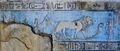 Leo (and Com); rectangular zodiac of Dendera
 -
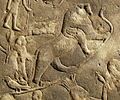 Leo with Com, Hya, Crv, circular zodiac of Dendera (CC BY Musée du Louvre, Département des Antiquités égyptiennes)
 -
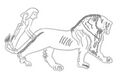 Constellation of a Lion with a Lady on its Tail in Leo+Coma Berenices on the circular Zodiac of Dendera, Egypt (drawing by SMH for Stellarium 2026).
 -
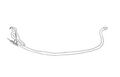 Constellation of a Serpent with a Bird in Hydra+Corvus on the circular Zodiac of Dendera, Egypt (drawing by SMH for Stellarium 2026).


Aratus

But yet another constellation sweeps across the horizon: they call it the Hydra. Like a living thing [445] it winds at great length, its head comes below the middle of the Crab, its coil under the Lion’s body, and its tail hangs over the Centaur himself. On its middle coil lies the Bowl, and on the last one the figure of a Raven that looks like one pecking the coil. [450] Yes, and there too Procyon shines brightly beneath the Twins. (Kidd 1997)
For Aratus Pi Hya is part of the snake which can be derived from the simultaneously setting constellations (663).
Eratosthenes
Eratosthenes in his Catasterismi gives two sections per constellation: First, he describes the story that led to the object/animal/god becoming a constellation. Then, he describes the positions of the stars in the figure.
Pamias and Zucker (2013,[3] 121-125): Hydra to which also belongs the Cup and the Raven
Var. 1 (Περὶ τοῦ Ὕδρου, ἐφ ᾧ Κρατὴρ καὶ Κόραξ): This constellation has multiple meanings due to a remarkable event. The raven is associated with the cult of Apollo, as each god has a bird dedicated to them. As the gods were making a sacrifice, he was sent to fetch water from a spring to make a libation, for before the advent of wine, spring water was considered the most sacred of all; seeing a fig tree near the spring bearing unripe figs, he waited for them to ripen; after some time, when they were ripe and he had eaten the figs, realising that he had committed a sacrilege, he also seized the hydra that was in the spring and brought it along with the cup, claiming that the hydra had drunk the water from the spring day after day. But Apollo discovered the truth and imposed upon the raven a punishment commensurate with his fault: to be thirsty amongst men during this time of year, as Aristotle says in his books On the Animals; and Archelaus says much the same in his On the Particular Natures.
Var. 2 (Ὕδρου ἐν ᾧ Κρατ<ὴρ καὶ Κόραξ>): This constellation is plural [a super-constellation] because of one remarkable event. The raven is associated with the cult of Apollo, as a bird is dedicated to each of the gods. As the gods were performing a sacrifice, he was sent to fetch water from a spring for a libation; seeing a fig tree near the spring bearing unripe figs, he waited for them to ripen; after some time, when they were ripe and he had eaten the figs, realising that he had committed a sacrilege, he also seized the hydra that was in the fountain and brought it along with the cup, claiming that the hydra had drunk the water from the spring day after day. But Apollo discovered what had happened and imposed upon the raven a punishment commensurate with his offence: to be thirsty amongst men during this time of year, as Aristotle states in his books On Animals. To leave a clear reminder of the sacrilege that had been committed against the gods, Apollo depicted and placed among the constellations the Hydra, the Crater, and the Raven, which cannot drink from it nor approach it.
The Hydra has three bright stars at the tip of its head, six on its first coil, the last of which is bright, three on the second coil, four on the third, two on the fourth, and nine dim stars stretching from the fifth coil to the tail. Twenty-seven in all.
Corvus is situated on the tail of Hydra and faces west. It has one dim star on its beak, two on its wing, two on its rump, and one at the tips of its legs. Seven in all.
Crater is situated on Hydra, some distance from the coil, and is tilted towards the knees of Virgo. Crater has two dim stars on the rim, two in the centre of the Bowl, and two at the base. Six in total.
Eratosthenes's star catalogue can be reconstructed from the list of stars he mentions in the last section of each of the constelllation descriptions. Hoffmann (2017)[4] made such a catalogue and used it for computational comparison with Hipparchus's, Ptolemy's and Babylonian data; it is based on the edition and translation by Pamias and Geus (2007)[5] and presented here in English translation.
| erat.Cat.ID | constStarID | starName | ident.Bayer | ident.HIP | certainty |
|---|---|---|---|---|---|
| 655 | 1 | three bright stars at the tip of the head [of the Water Serpent] | zeta Hya | 43813 | 1 |
| 656 | 2 | three bright stars at the tip of the head [of the Water Serpent] | eps Hya | 43109 | 1 |
| 657 | 3 | three bright stars at the tip of the head [of the Water Serpent] | delta Hya | 42313 | 1 |
| 658 | 4 | six on the first coil [of the Water Serpent] | omega Hya | 44659 | 1 |
| 659 | 5 | six on the first coil [of the Water Serpent] | theta Hya | 45336 | 1 |
| 660 | 6 | six on the first coil [of the Water Serpent] | tau1 Hya | 46509 | 1 |
| 661 | 7 | six on the first coil [of the Water Serpent] | tau2 Hya | 46776 | 1 |
| 662 | 8 | six on the first coil [of the Water Serpent] | iota Hya | 47431 | 1 |
| 663 | 9 | six on the first coil [of the Water Serpent]; of these, the last is bright | alpha Hya | 46390 | 1 |
| 664 | 10 | three on the second coil [of the Water Serpent] | lambda Hya | 49841 | 1 |
| 665 | 11 | three on the second coil [of the Water Serpent] | ups1 Hya | 48356 | 1 |
| 666 | 12 | three on the second coil [of the Water Serpent] | 26 Hya | 45751 | 1 |
| 667 | 13 | four on the third [coil of the Water Serpent] | 48615 | 2 | |
| 668 | 14 | four on the third [coil of the Water Serpent] | mu Hya | 51069 | 2 |
| 669 | 15 | four on the third [coil of the Water Serpent] | phi Hya | 52085 | 2 |
| 670 | 16 | four on the third [coil of the Water Serpent] | nu Hya | 52943 | 2 |
| 671 | 17 | two on the fourth [coil of the Water Serpent] | xi Hya | 56343 | 2 |
| 672 | 18 | two on the fourth [coil of the Water Serpent] | chi1 Hya | 54204 | 2 |
| 673 | 19 | nine dim stars on the fifth coil [of the Water Serpent] extending to the tail | 57047 | 2 | |
| 674 | 20 | nine dim stars on the fifth coil [of the Water Serpent] extending to the tail | 55756 | 2 | |
| 675 | 21 | nine dim stars on the fifth coil [of the Water Serpent] extending to the tail | 55588 | 2 | |
| 676 | 22 | nine dim stars on the fifth coil [of the Water Serpent] extending to the tail | omikron Hya | 56922 | 2 |
| 677 | 23 | nine dim stars on the fifth coil [of the Water Serpent] extending to the tail | beta Hya | 57936 | 2 |
| 678 | 24 | nine dim stars on the fifth coil [of the Water Serpent] extending to the tail | alpha Crv | 59199 | 2 |
| 679 | 25 | nine dim stars on the fifth coil [of the Water Serpent] extending to the tail | beta Crv | 61359 | 2 |
| 680 | 26 | nine dim stars on the fifth coil [of the Water Serpent] extending to the tail | gam Hya | 64962 | 1 |
| 681 | 27 | nine dim stars on the fifth coil [of the Water Serpent] extending to the tail | pi Hya | 68895 | 1 |
| 682 | 1 | the Raven on its tail [of the Water Serpent] has a dim star on its beak [facing west] | alpha Crv | 59199 | 2 |
| 683 | 2 | the Raven[…] two on the wing | eps Crv | 59316 | 2 |
| 684 | 3 | the Raven[…] two on the wing | gam Crv | 59803 | 2 |
| 685 | 4 | the Raven[…] two on the tail | delta Crv | 60965 | 2 |
| 686 | 5 | the Raven[…] two on the tail | eta Crv | 61174 | 2 |
| 687 | 6 | the Raven[…] one on each tip of the foot | beta Crv | 61359 | 2 |
| 688 | 7 | the Raven[…] one on each tip of the foot | 6 Crv | 60425 | 2 |
| 689 | 1 | the Cup [at a considerable distance from the first coil of the Hydra, inclined toward the knees of Virgo] has two dim stars on the rim | eps Crt | 55687 | 2 |
| 690 | 2 | the Cup has two dim stars on the rim | zeta Crt | 57283 | 2 |
| 691 | 3 | two in the middle [of the Cup] | delta Crt | 55282 | 1 |
| 692 | 4 | two in the middle [of the Cup] | gam Crt | 55705 | 1 |
| 693 | 5 | two near the bottom [of the Cup] | beta Crt | 54682 | 2 |
| 694 | 6 | two near the bottom [of the Cup] | alpha Crt | 53740 | 2 |
Hipparchus
Rising & Setting
| Greek
(Manitius 1894) |
German
(Manitius 1894) |
English | |
|---|---|---|---|
| weiter giebt Eudoxos auch die auf den sogenannten Kolurkreisen gelegenen Sterne an und behauptet, auf dem einen derselben liege die Mitte des Großen Bären, die Mitte des Kreises, der Nacken der Wasserschlange und von der Argo das Stück zwischen dem Hinterteil und dem Mastbaum; alsdann nach dem unsichtbaren Pol der Schwanz des südlichen Fisches, die Mitte des Steinbocks und die Mitte des Pfeils; endlich gehe er durch den Hals und den rechten Flügel des Schwans, durch die linke Hand des Kepheus, durch die Windung der Schlange und vorbei am Schwanze des Kleinen Bären. | Eudoxus also gives the stars situated on the so-called circles of Colur and claims that on one of them lies the centre of the Great Bear, the centre of the circle, the neck of the watersnake and the part of the Argo between the rump and the mast; then, after the invisible pole, the tail of the southern fish, the centre of Capricorn and the centre of the arrow; finally, it passes through the neck and the right wing of the swan, through the left hand of Cepheus, through the coil of the Snake and past the tail of the Little Bear. | Lib. I. Cap. XL § 9 . | |
| Ersichtlich macht er dies auch bei dem Aufgange der Fische, wo er sich also ausdrückt; nachdem er nämlich von der Wasserschlange gesagt, daß das Stück vom Kopfe bis zur ersten Windung, wenn der Wassermann im Aufgange begriffen ist, nicht mehr über dem Horizont sei, während den Rest ihres Körpers die Fische hinabführen. | He also makes this evident in the rising of the fishes, where he expresses himself thus; for after he has said of the watersnake that the part from the head to the first coil, when the Aquarius is in the act of rising, is no longer above the horizon, while the rest of its body is led down by the fishes. | Lib. II. Cap. I. § 24 | |
| Untergang des Perseus, mitkulminierend:
Leo 5 1/2: Von der Wasserschlange der vierte von den vier hinter dem hellen nach Osten gelegenen (λ2), 1 Mbr. westlich des Meridians. |
Setting of Perseus, co-culminating:
Leo 5 1/2: Of the watersnake the fourth of the four behind the bright one to the east (λ2), 1 moon width west of the meridian. |
Lib. II, Cap.VI. §15 | |
| Aufgang des Kentaur, mitkulminierend:
Cnc 12°: Von der Wasserschlange der nachfolgende in der südlichen Kinnlade (η) |
Rising of the centaur, co-culminating:
Cnc 12°: From the watersnake of the following in the southern jaw (η) |
Lib. III. Cap. I. § 4. | |
| Untergang Kleiner Hund, mitkulminierend:
3 . Von der Wasserschlange der am Ende des Schwanzes (π). |
Downfall Small dog, co-culminating:
3 . From the watersnake at the end of the tail (π). |
Lib. III. Cap. n. § 13 | |
| Aufgang der Jungfrau, mitkulminierend:
2. Von der Wasserschlange der nördlichere von denen im Rachen (δ) , 1 Mbr. östlich des Meridians. |
Rising of Virgo, co-culminating:
2. of the watersnake the more northerly of those in the throat (δ), 1 moon width east of the meridian. |
Lib. III. Cap. III. § 3 | |
| Aufgang des Skorpions, mitkulminierend:
Von der Wasserschlange von den vieren nach dem hellsten [vor dem Becher] der dritte von Westen (ν2 Hydrae) |
Rising of the scorpion, co-culminating:
Of the watersnake of the four after the brightest [before the cup] the third from the west (ν2 Hydrae) |
Lib. III. Cap. III. § 5. |
The mathematical astronomer mentions this constellation rising and setting.
| Greek | German
(Manitius 1894) |
English
(from Manitius 1894) |
|
|---|---|---|---|
Die Wasserschlange (Hydra). Aufgang von Cnc 18 1/2 Grad bis Lib 15 1/2 Grad, Mitkulmination Ari 2 1/2 Grad bis Cnc 18 Grad.
Dauer des Aufgangs: 7 1/15 St. = 424m = 106°. |
The water snake (Hydra). Rising from Cnc 18 1/2 degrees to Lib 15 1/2 degrees, co-culmination Ari 2 1/2 degrees to Cnc 18 degrees.
Duration of the rise: 7 1/15 hours = 424m = 106°. |
Lib III, Cap. I, §1 | |
Die Wasserschlange (Hydra). Untergang von Gem 29° bis Vir 11°; Mitkulmination Lib 18 1/2 Grad bis Sgr 18 1/2 Grad.
Dauer des Untergangs: 4 St. = 240m = 60°. |
The watersnake (Hydra). Setting from Gem 29° to Vir 11°; co-culmination Lib 18 1/2 degrees to Sgr 18 1/2 degrees.
Duration of the setting: 4 hours = 240m = 60°. |
Lib. III. Cap. II. § 1. |
Star at the Tip of the Tail
- the last star rising is the one at the tip of the tail (ὁ ἐν ἄκρᾳ τῇ οὐρᾷ).
Dauer des Aufgangs : 7 1/15 St. = 424m = 106°.
Hipparchus's "lost" star Catalogue
The star catalogue of Hipparchus is not preserved. Yet, several scholars have reconstructed it in the past century: Vogt (1925)[6], Grasshoff (1990)[7], Hoffmann (2017)[8] and Glover (2026)[9]. Grasshoff's catalogue and computations are not published digitally, Hoffmann published three versions of the Manitius+Hoffmann[10] star lists in the CDS VizieR "catalog of catalogs", and Glover printed the star lists constellationwise in his book.
| hipp.Cat.ID | constStarID | starName | ident.Bayer | ident.HIP | concordance |
|---|---|---|---|---|---|
| 322 | 1 | α Hya | 46390 | CPAE | |
| 323 | 2 | β Hya | 57936 | CPAE | |
| 324 | 3 | γ Hya | 64962 | CPAE | |
| 325 | 4 | δ Hya | 42313 | CPAE | |
| 326 | 5 | ε Hya | 43109 | CPAE | |
| 327 | 6 | ζ Hya | 43813 | CPAE | |
| 328 | 7 | η Hya | 42799 | CPAE | |
| 329 | 8 | θ Hya | 45336 | CPAE | |
| 330 | 9 | ι Hya | 47431 | CPAE | |
| 331 | 10 | κ Hya | 47452 | CPAE | |
| 332 | 11 | λ Hya | 49841 | CPAE | |
| 333 | 12 | μ Hya | 51069 | CPAE | |
| 334 | 13 | ν Hya (Crt) | 52943 | CPAE | |
| 335 | 14 | ξ Hya | 56343 | CPAE | |
| 336 | 15 | ο Hya | 56922 | CPAE | |
| 337 | 16 | π Hya | 68895 | CPAE | |
| 338 | 17 | ρ Hya | 43234 | CPAE | |
| 339 | 18 | σ Hya | 42402 | CPAE | |
| 340 | 19 | τ Hya (τ1)* | 46509 | CPAE | |
| 341 | 20 | τ Hya (τ2)* | 46776 | CPAE | |
| 342 | 21 | υ Hya (υ1)* | 48356 | CPAE | |
| 343 | 22 | υ Hya (υ2)* | 49402 | CPAE | |
| 344 | 23 | χ1 Hya | 54204 | CPAE | |
| 345 | 24 | ψ Hya | 64166 | CPAE | |
| 346 | 25 | ω Hya | 44659 | CPAE | |
| 347 | 26 | k Hya | 70306 | CPAE |
Hyginus, Astronomica
This is the sign on which the Crow sits and over which the Bowl is placed. The following reason has been handed down: When Apollo was sacrificing, the crow, who was under his guardianship, was sent to a spring to get some pure water. Seeing several trees with their figs not yet ripe, he perched on one of them waiting for them to ripen. After some days when the figs had ripened and the crow had eaten some, Apollo, who was waiting, saw him come flying in haste with the bowl full of water. For this fault of tardiness Apollo, who had had to use other water because of the crow's delay, punished him in this way. As long as the figs are ripening, the crow cannot drink, because on those days he has a sore [?] throat,. So when the god wished to illustrate the thirst of the crow, he put the bowl among the constellations, and placed the water-snake underneath to delay the thirsty crow. For the crow seems to peck at the end of its tail to be allowed to go over to the bowl.
Istros and several others have said that the Crow was Coronis, daughter of Phlegyas. She bore Aesculapius to Apollo, but after Ischys, son of Elatus, had lain with her, the crow, which had noted it, reported it to Apollo. For his unpleasant news Apollo changed him to black instead of his former white color, and transfixed Ischys with his arrows.
About the Bowl Phylarchus writes this tale: In the Chersonnese near Troy where many have said the tomb of Protesilaus is located, there is a city, Elaeusa by name. When a certain Demophon was ruling there, a sudden plague fell on the land with a strange death-rate among the citizens. Demophon, greatly disturbed by this, sent to the oracle of Apollo seeking a remedy, and was told that every year one girl of noble rank should be sacrificed to their household gods. Demophon, passing over his own daughters, would choose by lot one of the daughters of the nobles, and kept doing this until his scheme offended a certain man of highest rank. He said he wouldn't allow his daughter to be entered in the drawing unless the daughters of the king were included. The king, angered by this, killed the noble's daughter without drawing of lots. This deed Mastusius, father of the girl, for a time out of patriotism pretended he did not resent, for the girl might have perished if the lots had been taken. Little by little, time led the king to forget. When the girl's father had shown himself to be on most friendly terms with the king, he said he was going to make a solemn sacrifice and invited the king and his daughters to join the celebration. The king, suspecting nothing, sent his daughters ahead; since he was busy with a state affair, he would come later. When this happened as Mastusius wished, he killed the king's daughters, and mixing their blood with wine in a bowl, bade it be given as a drink to the king on his arrival. The king asked for his daughters, and when he learned what had happened, he ordered Mastusius and the bowl to be thrown into the sea. The cape where he was thrown, to memorialize him is called Mastusian; the harbour still is called the Bowl. Astronomers of old pictured it in the stars, so that men might remember that no one can profit from an evil deed with impunity, nor can hostilities often be forgotten. Some, with Eratosthenes, say that it is the bowl Icarus used when he showed wine to men; others the jar into which Mars was thrown by Otus and Ephialtes. (Mary Ward 1960)
Almagest
| Greek
(Heiberg 18xx) |
English
(Toomer 1984) |
ident. | ||
|---|---|---|---|---|
| τῶν έν τῇ κεφαλῇ ε τῶν ἡγοvμένωv β ὁ vοτιώτερος ἐπὶ τῶv μυκτήρων | 1 | The 5 stars in the head: the southernmost of the 2 advance ones, which is on the nostrils | sig Hya | |
| ὁ βορειότερος αὐτῶν καὶ ἐπάνω τοῦ ὀφθαλμοῦ | 2 | The 5 stars in the head: the northernmost of these [2], which is above the eye | delta Hya | |
| τῶν ἑπομένων αὐτοῑς β ὁ βόρειος ῶς ἑπὶ τοῦ κρανίου | 3 | The 5 stars in the head: the northernmost of the 2 to the rear of these, which is about on the skull | eps Hya | |
| ὁ vοτιώτερος αύτῶν καὶ ἑπὶ τοῦ χάσματος | 4 | The 5 stars in the head: the southernmost of them, on the gaping jaws | eta Hya | |
| ὁ πᾶσιv ἑπόμεvος ὡς ἑπὶ τῆς γένvος | 5 | The 5 stars in the head: the rearmost of all, about on the cheek | zet Hya | |
| τῶν ἐv τῇ έκφύσει του τραχήλου β ὁ ἡγούμενος | 6 | The more advanced of the 2 stars in the place where the neck joins [the head] | omega Hya | |
| ὁ ἑπόμενος αὐτῶν | 7 | The rearmost of them | theta Hya | |
| τῶν ἑξης ἐν τῇ καμπῇ τοῦ τραχήλου γ ὁ μέσος | 8 | The middle star of the following three in the bend of the neck | tau2 Hya | |
| ὁ ἑπόμενος τῶν γ | 9 | The rearmost of the 3 | iota Hya | |
| ὁ νοτιώτατος αὐτῶν | 10 | The southernmost of them | tau1 Hya | |
| τῶν ἀπο νότου β συνεχῶν δ άμαvρος καὶ βόρειος | 11 | The faint, northernmost star of the 2 close together to the south | BSC 3750 | |
| ὁ λαμρὸς τῶν β συνεχῶν | 12 | The bright one of these two close stars | alpha Hya | |
| τῶν μετὰ τὴν καμπὴν ἑπομέvων γ ὁ ἡγούμενος | 13 | The most advanced of the 3 stars to the rear, after the bend [in the neck] | kappa Hya | |
| ὁ μέσος αὐτῶν | 14 | The middle one | upsilon1 Hya | |
| ὁ έπόμενος τῶν τριῶν | 15 | The rearmost of the three | upsilon2 Hya | |
| τῶv ἑξῆς ὠς ἐπ' εὐθείας γ ὁ ἡγούμενος | 16 | The most advanced of the next 3 stars almost on a straight line | mu Hya | |
| ὁ μέσος αυτῶν | 17 | The middle one | phi Hya | |
| ὁ έπόμενος τῶv τριῶν | 18 | The rearmost of the three | nu Hya | |
| τῶν μετὰ τὴν βάσιν τού Κρατῆρος β ὁ βορειότερος | 19 | The northernmost of the 2 stars after [i.e. to the rear of] the base of Crater | beta Crt | |
| ὁ νοτιώτερος αυτῶν | 20 | The southernmost of them | chi1 Hya | |
| τῶv μετα τούτους γ ὡς ἐν τριγώνῳ ὁ ἡγούμενος | 21 | The most advanced of the 3 stars after these, as it were in a triangle | xi Hya | |
| ὁ μέσος αὐτῶν και νοτιώτερος | 22 | The middle and southernmost one | omicron Hya | |
| ὁ έπόμενος τῶν τριῶv | 23 | The rearmost of the three | beta Hya | |
| ὁ μετα τὸν Κόρκα ἐv τῷ παρούρῳ | 24 | The star after Corvus, in the section by the tail | gamma Hya | |
| ὁ ἐπ' ἄκρας τῆς οὐρᾶς | 25 | The star on the tip of the tail | pi Hya | |
| Stars round Hydra outside the constellation: | ||||
| ὁ ἐκ μεσημβρίας τῆς κεφαλῆς | 26 | The star to the south of the head | BSC 3314 | |
| ὁ ἐκ διαστήματος ἑπόμενος τοῑς ἐν τῷ τραχrjλῳ | 27 | The star some distance to the rear of those in the neck [nos. 6-15] | epsilon Sex | |
Stars within the Constellation Area
| id | Label | IAU design. | description | Vmag |
|---|---|---|---|---|
| 1 | Alphard | HIP 46390 | Constellation lines | 1.97 |
| 2 | Gienah | HIP 59803 | Inside the hull | 2.58 |
| 3 | Kraz | HIP 61359 | Inside the hull | 2.64 |
| 4 | Algorab | HIP 60965 | Inside the hull | 2.94 |
| 5 | ϵ Corvi | HIP 59316 | Inside the hull | 2.98 |
| 6 | γ Hydrae | HIP 64962 | Constellation lines (Vertex) | 3 |
| 7 | ζ Hydrae | HIP 43813 | Constellation lines | 3.1 |
| 8 | ν Hydrae | HIP 52943 | Constellation lines (Vertex) | 3.11 |
| 9 | π Hydrae | HIP 68895 | Constellation lines (Vertex) | 3.28 |
| 10 | Ashlesha | HIP 43109 | Constellation lines | 3.38 |
| 11 | δ Crateris | HIP 55282 | Inside the hull | 3.56 |
| 12 | λ Hydrae | HIP 49841 | Inside the hull | 3.61 |
| 13 | μ Hydrae | HIP 51069 | Constellation lines | 3.81 |
| 14 | θ Hydrae | HIP 45336 | Constellation lines (Vertex) | 3.91 |
| 15 | Ukdah | HIP 47431 | Inside the hull | 3.91 |
| 16 | Alchiba | HIP 59199 | Inside the hull | 4.01 |
| 17 | γ Crateris | HIP 55705 | Inside the hull | 4.06 |
| 18 | Alkes | HIP 53740 | Inside the hull | 4.07 |
| 19 | Zhang | HIP 48356 | Constellation lines | 4.11 |
| 20 | δ Hydrae | HIP 42313 | Constellation lines (Vertex) | 4.131 |
| 21 | η Hydrae | HIP 42799 | Constellation lines (Vertex) | 4.3 |
| 22 | ρ Hydrae | HIP 43234 | Inside the hull | 4.337 |
| 23 | Minchir | HIP 42402 | Constellation lines (Vertex) | 4.43 |
| 24 | β Crateris | HIP 54682 | Inside the hull | 4.449 |
| 25 | τ 2 Hydrae | HIP 46776 | Constellation lines (Vertex) | 4.548 |
| 26 | υ 2 Hydrae | HIP 49402 | Constellation lines (Vertex) | 4.588 |
| 27 | τ 1 Hydrae | HIP 46509 | Constellation lines | 4.6 |
| 28 | ζ Crateris | HIP 57283 | Inside the hull | 4.706 |
| 29 | ϵ Crateris | HIP 55687 | Inside the hull | 4.802 |
| 30 | U Hya | HIP 52009 | Inside the hull | 4.82 |
| 31 | ϕ 3 Hydrae | HIP 52085 | Constellation lines | 4.903 |
| 32 | ψ Hydrae | HIP 64166 | Inside the hull | 4.934 |
| 33 | R Hya | HIP 65835 | Inside the hull | 4.97 |
| 34 | ω Hydrae | HIP 44659 | Constellation lines | 4.981 |
| 35 | κ Hydrae | HIP 47452 | Constellation lines | 5.052 |
| 36 | λ Crateris | HIP 55598 | Inside the hull | 5.09 |
| 37 | II Hya | HIP 57613 | Inside the hull | 5.11 |
| 38 | η Crateris | HIP 58188 | Inside the hull | 5.16 |
| 39 | ζ Corvi | HIP 60189 | Inside the hull | 5.21 |
| 40 | 23 Hya | HIP 45527 | Inside the hull | 5.23 |
| 41 | ϵ Sextantis | HIP 50414 | Inside the hull | 5.24 |
| 42 | - | HIP 53252 | Inside the hull | 5.24 |
| 43 | 31 Crt | HIP 58587 | Inside the hull | 5.264 |
| 44 | 303 G. Hya | HIP 58082 | Inside the hull | 5.272 |
| 45 | 200 G. Hya | HIP 49809 | Inside the hull | 5.296 |
| 46 | - | HIP 46404 | Inside the hull | 5.32 |
| 47 | 328 G. Hya | HIP 61621 | Inside the hull | 5.41 |
| 48 | * gam Sex A | HIP 48437 | Inside the hull | 5.43 |
| 49 | - | HIP 52737 | Inside the hull | 5.44 |
| 50 | 330 G. Hya | HIP 62131 | Inside the hull | 5.454 |
| 51 | * bet Hya B | HIP 57936 | Constellation lines | 5.47 |
| 52 | 3 Crv | HIP 59394 | Inside the hull | 5.47 |
| 53 | ι Crateris | HIP 56802 | Inside the hull | 5.48 |
| 54 | - | HIP 54029 | Inside the hull | 5.511 |
| 55 | 33 Hya | HIP 46982 | Inside the hull | 5.548 |
| 56 | - | HR 3750 | Inside the hull | 5.56 |
| 57 | - | HIP 51046 | Inside the hull | 5.56 |
| 58 | 28 Hya | HIP 46221 | Inside the hull | 5.579 |
| 59 | 225 G. Hya | HIP 51491 | Inside the hull | 5.58 |
| 60 | * 17 Crt A | HIP 56280 | Inside the hull | 5.58 |
| 61 | 195 G. Hya | HIP 49569 | Inside the hull | 5.582 |
| 62 | 18 Sex | HIP 49865 | Inside the hull | 5.618 |
| 63 | 92 G. Hya | HIP 44356 | Inside the hull | 5.627 |
| 64 | - | HIP 61015 | Inside the hull | 5.63 |
| 65 | - | HIP 53316 | Inside the hull | 5.651 |
| 66 | 6 Crv | HIP 60425 | Inside the hull | 5.658 |
| 67 | 333 G. Hya | HIP 62500 | Inside the hull | 5.658 |
| 68 | * 17 Crt B | HIP 56280 | Inside the hull | 5.671 |
| 69 | 236 G. Hya | HIP 51933 | Inside the hull | 5.71 |
| 70 | 351 G. Hya | HIP 66400 | Inside the hull | 5.78 |
| 71 | 41 Sex | HIP 52980 | Inside the hull | 5.791 |
| 72 | 357 G. Hya | HIP 67143 | Inside the hull | 5.795 |
| 73 | - | HIP 59728 | Inside the hull | 5.807 |
| 74 | - | HIP 56078 | Inside the hull | 5.813 |
| 75 | - | HIP 52948 | Inside the hull | 5.842 |
| 76 | 300 G. Hya | HIP 57841 | Inside the hull | 5.85 |
| 77 | - | HIP 53778 | Inside the hull | 5.857 |
| 78 | 329 G. Hya | HIP 61720 | Inside the hull | 5.866 |
| 79 | - | HIP 53723 | Inside the hull | 5.879 |
| 80 | - | HIP 58158 | Inside the hull | 5.893 |
| 81 | 17 Sex | HIP 49812 | Inside the hull | 5.901 |
| 82 | κ Crateris | HIP 55874 | Inside the hull | 5.923 |
| 83 | 25 Sex | HIP 50885 | Inside the hull | 5.97 |
| 84 | - | HIP 60157 | Inside the hull | 5.97 |
| 85 | - | HIP 61688 | Inside the hull | 5.982 |
| 86 | 136 G. Hya | HIP 46288 | Inside the hull | 5.985 |
| 87 | ϕ 2 Hydrae | HIP 51905 | Inside the hull | 6.012 |
| 88 | 6 Sex | HIP 48341 | Inside the hull | 6.016 |
| 89 | 209 G. Hya | HIP 50536 | Inside the hull | 6.027 |
| 90 | - | HIP 61951 | Inside the hull | 6.03 |
| 91 | - | HIP 51302 | Inside the hull | 6.032 |
| 92 | - | HIP 56364 | Inside the hull | 6.044 |
| 93 | 243 G. Hya | HIP 52113 | Inside the hull | 6.045 |
| 94 | - | HIP 59895 | Inside the hull | 6.07 |
| 95 | - | HIP 50292 | Inside the hull | 6.075 |
| 96 | 322 G. Hya | HIP 60603 | Inside the hull | 6.081 |
| 97 | - | HIP 54214 | Inside the hull | 6.086 |
| 98 | - | HIP 49293 | Inside the hull | 6.097 |
| 99 | ψ Crateris | HIP 54742 | Inside the hull | 6.105 |
| 100 | 157 G. Hya | HIP 46869 | Inside the hull | 6.113 |
| 101 | 155 G. Hya | HIP 46840 | Inside the hull | 6.12 |
| 102 | - | HIP 57732 | Inside the hull | 6.122 |
| 103 | 153 G. Hya | HIP 46744 | Inside the hull | 6.123 |
| 104 | 154 G. Hya | HIP 46768 | Inside the hull | 6.124 |
| 105 | 146 G. Hya | HIP 46529 | Inside the hull | 6.126 |
| 106 | 10 Hya | HIP 42931 | Inside the hull | 6.127 |
| 107 | 217 G. Hya | HIP 50790 | Inside the hull | 6.13 |
| 108 | 81 G. Hya | HIP 43902 | Inside the hull | 6.131 |
| 109 | 105 G. Hya | HIP 45167 | Inside the hull | 6.131 |
| 110 | MO Hya | HIP 62788 | Inside the hull | 6.141 |
| 111 | - | HIP 56293 | Inside the hull | 6.16 |
| 112 | NS Hya | HIP 44738 | Inside the hull | 6.17 |
| 113 | TU Crv | HIP 61496 | Inside the hull | 6.184 |
| 114 | LV Hya | HIP 58272 | Inside the hull | 6.189 |
| 115 | VX Crt | HIP 56899 | Inside the hull | 6.19 |
| 116 | - | HIP 56901 | Inside the hull | 6.198 |
| 117 | - | HIP 51490 | Inside the hull | 6.2 |
| 118 | - | HIP 57079 | Inside the hull | 6.2 |
| 119 | 356 G. Hya | HIP 67071 | Inside the hull | 6.205 |
| 120 | - | HIP 49900 | Inside the hull | 6.225 |
| 121 | 245 G. Hya | HIP 52391 | Inside the hull | 6.228 |
| 122 | - | HIP 56245 | Inside the hull | 6.228 |
| 123 | 199 G. Hya | HIP 49802 | Inside the hull | 6.23 |
| 124 | 197 G. Hya | HIP 49689 | Inside the hull | 6.244 |
| 125 | 159 G. Hya | HIP 46893 | Inside the hull | 6.25 |
| 126 | * psi Crt A | HIP 54742 | Inside the hull | 6.25 |
| 127 | - | HIP 61270 | Inside the hull | 6.254 |
| 128 | - | HIP 58574 | Inside the hull | 6.255 |
| 129 | 147 G. Hya | HIP 46543 | Inside the hull | 6.257 |
| 130 | 144 G. Hya | HIP 46504 | Inside the hull | 6.27 |
| 131 | - | HIP 60809 | Inside the hull | 6.294 |
| 132 | - | HR 4935 | Inside the hull | 6.3 |
| 133 | 337 G. Hya | HIP 63243 | Inside the hull | 6.303 |
| 134 | - | HIP 50584 | Inside the hull | 6.308 |
| 135 | 37 Hya | HIP 47427 | Inside the hull | 6.32 |
| 136 | - | HIP 51490 | Inside the hull | 6.32 |
| 137 | - | HR 4935 | Inside the hull | 6.32 |
| 138 | - | HIP 48413 | Inside the hull | 6.329 |
| 139 | - | HIP 53259 | Inside the hull | 6.34 |
| 140 | - | HIP 54048 | Inside the hull | 6.343 |
| 141 | 71 G. Hya | HIP 43570 | Inside the hull | 6.35 |
| 142 | 172 G. Hya | HIP 47454 | Inside the hull | 6.356 |
| 143 | - | HIP 53849 | Inside the hull | 6.36 |
| 144 | - | HIP 50552 | Inside the hull | 6.361 |
| 145 | 50 G. Hya | HIP 42854 | Inside the hull | 6.362 |
| 146 | - | HIP 54749 | Inside the hull | 6.378 |
| 147 | 34 Hya | HIP 47249 | Inside the hull | 6.39 |
| 148 | - | HIP 61208 | Inside the hull | 6.39 |
| 149 | * gam Sex B | HIP 48437 | Inside the hull | 6.4 |
| 150 | 332 G. Hya | HIP 62448 | Inside the hull | 6.405 |
| 151 | 308 G. Hya | HIP 58436 | Inside the hull | 6.416 |
| 152 | - | HIP 48351 | Inside the hull | 6.42 |
| 153 | - | HIP 50893 | Inside the hull | 6.42 |
| 154 | - | HIP 56830 | Inside the hull | 6.42 |
| 155 | 320 G. Hya | HIP 60468 | Inside the hull | 6.42 |
| 156 | 364 G. Hya | HIP 68224 | Inside the hull | 6.42 |
| 157 | 54 G. Hya | HIP 42981 | Inside the hull | 6.43 |
| 158 | 274 G. Hya | HIP 54703 | Inside the hull | 6.43 |
| 159 | 294 G. Hya | HIP 57001 | Inside the hull | 6.44 |
| 160 | 258 G. Hya | HIP 53387 | Inside the hull | 6.444 |
| 161 | 166 G. Hya | HIP 47242 | Inside the hull | 6.46 |
| 162 | - | HIP 48839 | Inside the hull | 6.46 |
| 163 | 299 G. Hya | HIP 57749 | Inside the hull | 6.477 |
| 164 | 348 G. Hya | HIP 65969 | Inside the hull | 6.478 |
| 165 | 233 G. Hya | HIP 51852 | Inside the hull | 6.479 |
| 166 | 297 G. Hya | HIP 57507 | Inside the hull | 6.48 |
| 167 | - | HIP 59742 | Inside the hull | 6.49 |
| 168 | 346 G. Hya | HIP 65682 | Inside the hull | 6.49 |
| 169 | - | HIP 50693 | Inside the hull | 6.499 |
| 170 | - | HIP 51656 | Inside the hull | 6.5 |
| 171 | 342 G. Hya | HIP 64375 | Inside the hull | 6.5 |
Transfer and Transformation of the Constellation
-
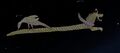 The Babylonian version of the "Hydra and Corvus" super-constellation does not contain a cup or jar. Visualized in Stellarium (drawing by Jessica Gullberg)
 -
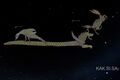 The lonely star in front of the dragon-head (Procyon) rised simultaneously with the faint stars of The Crab in ancient Babylon. Procyon and the head / foot of the dragon may serve as a replacement for Cancer
 -
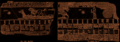 Leo and Virgo above the MUŠ-Dragon, two claytablet drawings from the Seleucid era (roughly 2nd century BCE), CC BY SMH based upon the drawings by E. Weidner (1967) and Thureau-Dangin (1922).
 -
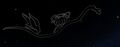 The Greeks introduced a Crater atop the snake. On the Farnese Globe, the body of the snake forms a vessel for Corvus and Crater.
 -
 Hydra with Crater and Corvus on the Mercator Globe (1551)
 -

-
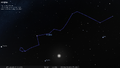 (1952) H.A. Rey's stick figure of Hydra
 -
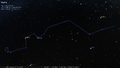 (1988) O. Hlad's stick figure of Hydra
 -
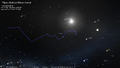 Reconstruction of Stickfigure based on the depiction of Almagest (100-170 CE). CC-BY Susanne Hoffmann in Stellarium.
 -
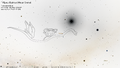 Image of the Farnese Globe (2nd century CE) taken by Susanne Hoffmann and imported into Stellarium.


Arabic

– al-Šuğāc, « le Gros Serpent », et al-Bāṭiyya, « la Petite Jarre » (ap. Urania’s Mirror)[11]
Dhanab al Shuja (γ Hya : 2,99) / ذنب الشجع
Recently introduced, this name is the Arabic Ḏanab al-Šuğāc, ‘the Tail of the Hydra’, in an Arabic or Persian catalogue using Greek formatting and as yet unidentified. NB : We have fī aṣal al-ḏanab, ‘at the root of the tail,’ and cand al-ḏanab, ‘at the tail,’ π/ γ Hya, and calā ṭaraf al-ḏanab, ‘at the tip of the tail,’ π/ γ Hya, c/ the translators of Ptolemy, then al-Ṣūfī and al-Battānī, but Ṭarf al-ḏanab, ‘the tip of the tail’, c/ al-Bīrūnī. However, this name does not appear in any known text. Abs. c/ Allen. Dhanab al-Shuja, Pultar, Dhanab al-Shuja and Cauda Hydrae.
Mythology
Greek/ Greco-Roman folklore
Eratosthenes recounts that the raven was sent by the gods to fetch water for a sacrifice. As long as there was no wine, spring water was considered the most sacred drink. However, on its way, the raven saw a fig tree with green fruit, waited there until they ripened, and ate its fill of the delicious figs. In order to have an excuse for the delay to the gods, he grabbed the water snake in the spring, carried it together with the crater to the gods, and claimed that it had drunk the water he had been sent to fetch.
Apollo, a god of light, divination, and truth, saw through the deception. He punished the raven by condemning it to live among humans and suffer from thirst for a similar length of time. He also placed the image of the raven in the sky, together with the crater and the water snake, as a warning against deception and slander.
While the water snake is innocent in Eratosthenes' version, according to another legend, the Hydra is the monster that was fought and defeated by Heracles. The story is part of the Hercules myth, but the constellation Hercules is far away from the Hydra and has nothing to do with either the raven or the crater. This seems to be a later ancient (Roman?) reinterpretation, because Eratosthenes' version does not seem particularly convincing when looking at the sky.
Babylonian belief
IAU WGSN
The star pi Hydrae is very important in history as it is one of the keywitnesses for transfer from Hipparchus to Ptolemy.
- name in Hipparchus: ὁ ἐν ἄκρᾳ τῇ οὐρᾷ (the one at the farthest point of the tail)
- name in the Almagest: ὁ ἐπ᾽ἄκρας τῆς οὐρᾶς (the one at the end of the tail)
The Greek term ἄκρᾳ can be translated as "at the farthest point" or "at the end" (or "highest" which doesn't apply here).
Weblink
- Warburg Institute Iconographic Database – Hydra
- Ian Ridpath's Star Tales – Hydra
References
- ↑ 1.0 1.1 Hoffmann, Susanne M. Wie der Löwe an den Himmel kam. Franckh Kosmos Verlag, Stuttgart 2021
- ↑ Hoffmann, Susanne M (2025), Some Results on the Ancient Globes, Globe Studies – The Journal of the International Coronelli Society, 69, 4169.
- ↑ Pamìas, Jordi und Zucker, Arnaud (2013). Ératosthènes de Cyrène: Catastérrismes, Belles Lettres, Paris
- ↑ Hoffmann, S. M., <i>Hipparchs Himmelsglobus</i>. Springer Wiesbaden/ New York, 2017. doi:10.1007/978-3-658-18683-8.
- ↑ Eratosthenes: Sternsagen, übersetzt von Pamìas, Jordi und Geus, Klaus, Verlag Utopica, Oberhaid 2007
- ↑ Vogt, H., “Versuch einer Wiederherstellung von Hipparchs Fixsternver zeichnis”, <i>Astronomische Nachrichten</i>, vol. 224, no. 2, Wiley, p. 17, 1925. doi:10.1002/asna.19252240202.
- ↑ Graßhoff, G., <i>The History of Ptolemy's Star Catalogue</i>, Springer, New York, 1990
- ↑ Hoffmann, S. M., <i>Hipparchs Himmelsglobus</i>. Springer Wiesbaden/ New York, 2017. doi:10.1007/978-3-658-18683-8.
- ↑ Glover, E. (2026). The Astronomy of Hipparchus, Cambridge University Press
- ↑ Hipparchus's Lost Star Catalogue (1/2 reconstructed) (Hoffmann, 2017) in VizieR
- ↑ Roland Laffitte (2025). 550 noms hérités des Arabes.





