Reret: Difference between revisions
No edit summary |
|||
| (42 intermediate revisions by 3 users not shown) | |||
| Line 1: | Line 1: | ||
Authors: {{PAGEAUTHORS}} | Authors: {{PAGEAUTHORS}} | ||
---- | ---- | ||
[[File: | |||
Reret, ''rrt'', The Hippotamus, is an Egyptian constellation, preserved in the 2nd millennium BCE. Based on Ramesside Star Clocks,<ref>Neugebauer, O. and Parker, R. A., 1969. ''Egyptian Astronomical Texts'', vol. III. Providence: Brown University.</ref><ref>Leitz, Ch., 1995. Altägyptische Sternuhren. OLA, 62. Leuven: Peeters.</ref> it is known that it covers | [[File:Hippo-hi Zodiaque de Dendéra - Musée du Louvre Antiquités Egyptiennes D 38 ; E 13482.gif|thumb|Detail from the circular zodiac of Dendera with the Hippo Goddess next to the Bull's Thigh (photo: Musée du Louvre, GIF SMH).]] | ||
[[File:Taweret Amulet MET 21.6.47 EGDP021762.jpg|thumb|Taweret Amulet MET 21.6.47 EGDP021762 (CC0, wikicommons)]] | |||
Reret, ''rrt'', The Hippotamus, is an Egyptian constellation, preserved in the 2nd millennium BCE. It is also called Isis Djamet. Based on Ramesside Star Clocks,<ref>Neugebauer, O. and Parker, R. A., 1969. ''Egyptian Astronomical Texts'', vol. III. Providence: Brown University.</ref><ref name=":3">Leitz, Ch., 1995. Altägyptische Sternuhren. OLA, 62. Leuven: Peeters.</ref> it is known that it covers 5 RA-hours.<ref name=":1">Petrie W.M.F. (1940). Wisdom of the Egyptians. London.</ref> Reret / Isis-Dajamet is one of the most important constellations of ancient Egyptian skies present in all celestial diagrams and in mythology, as in the Book of Day and Night in the vault of the burial chamber in the tomb of Ramesses VI where teh texts mention Isis in the form of Reret handling two mooring posts, where Meskhetyu (the leg of Seth) is fixed with two chains of gold so that it can not travel through the sky. | |||
==Concordance, Etymology, History== | ==Concordance, Etymology, History== | ||
Reret is depicted as a bipedal hippopotamus in a fashion virtually identical to Ipy or Taweret, from whom she is distinguished by her astral associations. She is a goddess of fertility and childbirth. [[File:Reret IsisDjamet.png|thumb|Reret in hieroglyphs]] | |||
'''Variants''' | '''Variants''' | ||
| Line 12: | Line 15: | ||
=== Sources === | === Sources === | ||
[[File:Stars in Reret+itsPole Belmonte2003-tab2 RSC.png|thumb|Stars in the Egyptian constellation | [[File:RamesssideStarClocks-schemaBelmonte2003.jpeg|thumb|Ramessside Star Clocks schematically, fig. 1 in Belmonte (2003)<ref name=":0" />]] | ||
Ramesside Star Clocks (RSC) are ceiling paintings in some tombs in the Valley of Kings, Egypt, from the Ramesside Period.<ref>Marshall Clagett (1989). Ancient Egyptian Science: Calendars, clocks, and astronomy. American Philosophical Society.</ref> They are not actually used star clocks but information on stars in transit (probably through the meridian) provided in tabular layout. | [[File:EarliestRepo RSC Lepsius1842-45.jpg|thumb|Earliest reproduction of a Ramesside Star Clock as one of the Egyptian astronomical ceilings in Neues Museum Berlin by Lepsius (1850); Staatliche Museen zu Berlin – Ägyptisches Museum und Papyrussammlung.]] | ||
[[File:Rrt-hippoGoddess_sarcophagus_NeuesMusBerlin%2Bdraw.gif|thumb|Constellation "'''Reret'''" depicted on a sarcophagus, represented by 9 asterisks (Staatliche Museen zu Berlin – Ägyptisches Museum und Papyrussammlung, ÄM 7.)]] | |||
[[File:Stars in Reret+itsPole Belmonte2003-tab2 RSC.png|thumb|Stars in the Egyptian constellation Reret mentioned in the RSCs (CC BY Belmonte 2003<ref name=":0">Belmonte, J. A., 2003. The Ramesside star clocks and the ancient Egyptian constellations. In M. Blomberg, P. E. Blomberg and G. Henriksson (Eds.), ''Calendars, Symbols, and Orientations: Legacies of Astronomy in Culture'' (pp. 57–65). ''Uppsala Astronomical Observatory report'', 59. Uppsala Ocarina Books.</ref>, tab. 2).]] | |||
The constellation is mentioned in the Ramesside Star Clocks (RSC) and identified by right ascension. Ramesside Star Clocks (RSC) are ceiling paintings in some tombs in the Valley of Kings, Egypt, from the Ramesside Period.<ref>Marshall Clagett (1989). Ancient Egyptian Science: Calendars, clocks, and astronomy. American Philosophical Society.</ref> They are not actually used star clocks but information on stars in transit (probably through the meridian) provided in tabular layout. It was assumed that they depict a practice in ancient Egypt to measure time by the, most likely, meridian or close to meridian transit of stars. These hour stars were single stars in a few cases or belong to constellations, some of them very large, of Egyptian sky maps. | |||
There has been two dedicated approaches including an attempt to identify these hour stars: Leitz (1995)<ref name=":3" /> and Belmonte (2003)<ref name=":0" />. Pioneers Neugebauer and Parker (1969)<ref>Neugebauer, O. and Parker, R. A., 1969. ''Egyptian Astronomical Texts'', vol. III. Providence: Brown University.</ref> thought this was a worthless exercise. | |||
Leitz (1995)<ref name=":3" /> followed N&P hypothesis of stars transiting close to the southern horizon and reached a solution which for Belmonte (2003) was not satisfactory for various reasons. These are amply discussed in Lull and Belmonte (2006 & 2009)<ref name=":2">Belmonte, J.A. and Lull, J., 2023. Astronomy in ancient Egypt: a cultural perspective. Cham: Springer.</ref>. This new hypothesis suggests that several RSC constellations were located in the northern skies such as the Giant (Nekht), the She-Hippo (Reret), the Mooring Post (Menyt) and the Bird (Apdu), among others of lesser entity (see also Davies, 1985<ref>Davis, V. L., 1985. Identifying Ancient Egyptian Constellations. ''Journal of the History of Astronomy'', ''16'', 102–104.</ref>). | |||
There are | === Individual Stars / Body Parts === | ||
Belmonte and Lull (2023)<ref name=":2" /> suggest the identification of Reret with a "Large area near the Pole covering from Lyra to Boötes Vega is a form of Isis". There are 9 stars related to Reret named in the Ramesside Star Clocks (RSC)<ref name=":0" />. | |||
Nine star names are given in the RSC and nine stars are drawn for Reret on the sarcophagus in Berlin (see image on the right). | |||
{| class="wikitable" | {| class="wikitable" | ||
|+ | |+ | ||
!Star / Asterism Name | ! colspan="2" |Star / Asterism Name | ||
(transliteration) | (transliteration) | ||
!Translation | !Translation | ||
| Line 25: | Line 39: | ||
!ident. (Belmonte 2003) | !ident. (Belmonte 2003) | ||
|- | |- | ||
|''rd n rrt'' | |||
| | | | ||
|Foot of the hippopotamus | |Foot of the hippopotamus | ||
| Line 31: | Line 46: | ||
|rho Boo | |rho Boo | ||
|- | |- | ||
|''rdwy n rrt<sub>4</sub>'' | |||
| | | | ||
|Feet of the hippopotamus | |Feet of the hippopotamus | ||
| Line 37: | Line 53: | ||
|[[Izar]] -eps Boo- (12.1) & rho Boo (11.9) | |[[Izar]] -eps Boo- (12.1) & rho Boo (11.9) | ||
|- | |- | ||
|''pd n rrt'' | |||
| | | | ||
|Knee of the hippopotamus | |Knee of the hippopotamus | ||
|198 | |198 | ||
|13.2 | |13.2 | ||
| | |[[Alphecca]] (13.5), | ||
|- | |- | ||
|''ḥry-ỉb mnty=s'' | |||
| | | | ||
|Middle of her thighs | |Middle of her thighs | ||
|206 | |206 | ||
|13.7 | |13.7 | ||
| | |[[Alphecca]] (13.5) & CrB | ||
|- | |- | ||
|''b3ḥ n rrt<sub>5</sub>'' | |||
| | | | ||
|Vulva of the hippopotamus | |Vulva of the hippopotamus | ||
| Line 55: | Line 74: | ||
|Between [[Corona Borealis|Corona Bor]] & [[Hercules]] | |Between [[Corona Borealis|Corona Bor]] & [[Hercules]] | ||
|- | |- | ||
| | |''ḫpd n rrt<sub>4</sub>'' | ||
|[[Khepdenreret]] | |||
|Buttocks of the hippopotamus | |Buttocks of the hippopotamus | ||
|219 | |219 | ||
| Line 61: | Line 81: | ||
|eps Her (14.8) & zet Her (14.5) | |eps Her (14.8) & zet Her (14.5) | ||
|- | |- | ||
|''mndt nt rrt6'' | |||
| | | | ||
|Breast of the hippopotamus | |Breast of the hippopotamus | ||
| Line 67: | Line 88: | ||
|pi Her (15.3) | |pi Her (15.3) | ||
|- | |- | ||
|''ns=s'' | |||
| | | | ||
|Her tongue | |Her tongue | ||
| Line 73: | Line 95: | ||
|[[Rastaban]] - bet Dra- (16.2) | |[[Rastaban]] - bet Dra- (16.2) | ||
|- | |- | ||
|''šwty nt rrt<sub>6</sub>'' | |||
| | | | ||
|The 2 feathers of hippopotamus | |The 2 feathers of hippopotamus | ||
| Line 78: | Line 101: | ||
|16.7 | |16.7 | ||
|[[Lyra]] with [[Vega]] (16.7) | |[[Lyra]] with [[Vega]] (16.7) | ||
|} | |} | ||
=== Identification(s) === | |||
[[File:Rrt+mnt IAUstarNames stellarium.jpg|thumb|Reret and Menit on Stellarium map, with the two IAU-star names [[Khepdenreret]] and [[Tepiamenit]] (CC BY WGSN).]] | |||
=== Other Identification(s) === | |||
* "..." (Belmonte 2003)<ref name=":0" /> | * "..." (Belmonte 2003)<ref name=":0" /> | ||
* "..." (Belmonte & Lull 2023)<ref | * "..." (Belmonte & Lull 2023)<ref name=":2" /> | ||
* Petrie's drawing also extends across this area | * Petrie's drawing also extends across this area | ||
* The circular zodiac in Dendera the image is drawn .... An accurate identification is not possible but it matches the suggestions above. | * The circular zodiac in Dendera the image is drawn .... An accurate identification is not possible but it matches the suggestions above. | ||
==Mythology== | === Transformations & Image Variants === | ||
<gallery> | |||
File:Eg const pole1250BCE stellarium.jpg|Hippopotamus of Denderah, (probably wrongly) coloured image, mapped to the Stellarium star chart | |||
File:Fig 4 45 Petrie1940 sky.jpg|Star map of the Egyptian Sky for the Ramesside Star Clocks. Petrie W.M.F. (1940)<ref name=":1" />. Wisdom of the Egyptians. London, fig. 4.45. | |||
File:Egypt Rert stellarium-RSC.jpg|Egyptian constellation Reret, The Female Hippotamus, identified with Ramesside Star Clocks, mapped to Stellarium (CC BY Petrie 1940, SMH 2026). For this screenshot the time and date settings are Alexandria -1180. | |||
File:Rrt-hippoGoddess sarcophagus NeuesMusBerlin.jpg|Constellation "'''Reret'''" depicted on Nectanebo's sarcophagus, represented by 9 asterisks, seba, (Staatliche Museen zu Berlin – Ägyptisches Museum und Papyrussammlung, ÄM 7.) | |||
File:Rrt+mnt IAUstarNames stellarium.jpg|Reret and Menit on Stellarium map, with the two IAU-star names Khepdenreret and Tepiamenit (CC BY WGSN). | |||
File:Reret+SethThigh DenderaEckig GZotti.JPG|Reret and the Thigh of Seth; rectangular zodiac of Dendera | |||
File:Reret+Menit DenderaCirc Louvre.JPG|Reret & Menit, circular zodiac of Dendera (CC BY [https://collections.louvre.fr/en/ark:/53355/cl010028871 Musée du Louvre, Département des Antiquités égyptiennes]) | |||
File:Reret+Menit etal-NMB ramesseum.jpg|Rert & Menit in Egyptian astronomical ceiling, reproduced in Neues Museum Berlin by Lepsius (1850); Staatliche Museen zu Berlin – Ägyptisches Museum und Papyrussammlung. | |||
File:Reret+Menit etal-NMB.jpg|Rert & Menit in Egyptian astronomical ceiling, reproduced in Neues Museum Berlin by Lepsius (1850); Staatliche Museen zu Berlin – Ägyptisches Museum und Papyrussammlung. | |||
File:Reret+Menit DenderaCirc Louvre black inv.jpg|Super-Constellation of Reret and Menit on the circular Zodiac of Dendera, Egypt (drawing by SMH for Stellarium 2026). | |||
</gallery> | |||
== Religion/ Tales/ Mythology == | |||
[[File:Reret+SethThigh DenderaEckig GZotti.JPG|thumb|Reret and the Thigh of Seth; rectangular zodiac of Dendera ]] | |||
Reret was primarily a household goddess rather than a state deity with large temples. Her principal functions were: Guarding pregnant women during labor, protecting newborn children, repelling demons and malevolent spirits, assisting in rebirth and regeneration. Amulets and figurines of Reret/Taweret were commonly placed in homes, on beds, and in birth chambers.astronomical aspect. She was associated with the northern circumpolar stars, particularly the constellation Draco, Bootes and Hercules. | |||
As a celestial goddess, she was called '''Mistress of the Horizon''' and watched over the heavens. The ancient Egyptians regarded the circumpolar stars as “imperishable” because they never set below the horizon. These stars symbolized eternal life, making Reret a guardian not only of childbirth but also of cosmic order and immortality. | |||
==IAU Working Group on Star Names== | ==IAU Working Group on Star Names== | ||
The name "Reret" suggested to be considered by the IAU WGSN in 2023. Reret extends for | The name "Reret" suggested to be considered by the IAU WGSN in 2023. Reret extends for four hours of RA (from the RSCs) and is probably close to the celestial north pole in the late 2nd millennium BCE. The figure is huge and no single (faint) star can be justified to bear this culturally very important name. Hence, the WGSN chose to represent the figure with a more specific name | ||
... (not to apply/ to apply the name to a neighbouring star/ to ...) in the IAU-CSN. | |||
== Weblinks == | == Weblinks == | ||
* | * [https://www.smb.museum/museen-einrichtungen/aegyptisches-museum-und-papyrussammlung/sammeln-forschen/sammlung/ Staatliche Museen zu Berlin - Ägyptisches Museum und Papyrussammlung] | ||
== Reference == | == Reference == | ||
| Line 141: | Line 149: | ||
[[Category:Asterism]] | [[Category:Asterism]] | ||
[[Category:Constellation]] | [[Category:Constellation]] | ||
[[Category:Africa]] | [[Category:Africa]] [[Category:North Africa]] | ||
[[Category:Egyptian]] | [[Category:Egyptian]] | ||
[[Category:Boo]][[Category:CrB]] | [[Category:Boo]][[Category:CrB]] | ||
[[Category: | [[Category:Dra]] | ||
Latest revision as of 10:36, 24 September 2026
Authors: Susanne M Hoffmann, Juan Antonio Belmonte Avilés, Youla Azkarrula


Reret, rrt, The Hippotamus, is an Egyptian constellation, preserved in the 2nd millennium BCE. It is also called Isis Djamet. Based on Ramesside Star Clocks,[1][2] it is known that it covers 5 RA-hours.[3] Reret / Isis-Dajamet is one of the most important constellations of ancient Egyptian skies present in all celestial diagrams and in mythology, as in the Book of Day and Night in the vault of the burial chamber in the tomb of Ramesses VI where teh texts mention Isis in the form of Reret handling two mooring posts, where Meskhetyu (the leg of Seth) is fixed with two chains of gold so that it can not travel through the sky.
Concordance, Etymology, History
Reret is depicted as a bipedal hippopotamus in a fashion virtually identical to Ipy or Taweret, from whom she is distinguished by her astral associations. She is a goddess of fertility and childbirth.

Variants
- rrt
- Reret
- Rert
Sources


The constellation is mentioned in the Ramesside Star Clocks (RSC) and identified by right ascension. Ramesside Star Clocks (RSC) are ceiling paintings in some tombs in the Valley of Kings, Egypt, from the Ramesside Period.[5] They are not actually used star clocks but information on stars in transit (probably through the meridian) provided in tabular layout. It was assumed that they depict a practice in ancient Egypt to measure time by the, most likely, meridian or close to meridian transit of stars. These hour stars were single stars in a few cases or belong to constellations, some of them very large, of Egyptian sky maps.
There has been two dedicated approaches including an attempt to identify these hour stars: Leitz (1995)[2] and Belmonte (2003)[4]. Pioneers Neugebauer and Parker (1969)[6] thought this was a worthless exercise.
Leitz (1995)[2] followed N&P hypothesis of stars transiting close to the southern horizon and reached a solution which for Belmonte (2003) was not satisfactory for various reasons. These are amply discussed in Lull and Belmonte (2006 & 2009)[7]. This new hypothesis suggests that several RSC constellations were located in the northern skies such as the Giant (Nekht), the She-Hippo (Reret), the Mooring Post (Menyt) and the Bird (Apdu), among others of lesser entity (see also Davies, 1985[8]).
Individual Stars / Body Parts
Belmonte and Lull (2023)[7] suggest the identification of Reret with a "Large area near the Pole covering from Lyra to Boötes Vega is a form of Isis". There are 9 stars related to Reret named in the Ramesside Star Clocks (RSC)[4].
Nine star names are given in the RSC and nine stars are drawn for Reret on the sarcophagus in Berlin (see image on the right).
| Star / Asterism Name
(transliteration) |
Translation | RA (degr) | RA (h) | ident. (Belmonte 2003) | |
|---|---|---|---|---|---|
| rd n rrt | Foot of the hippopotamus | rho Boo | |||
| rdwy n rrt4 | Feet of the hippopotamus | 180 | 12.0 | Izar -eps Boo- (12.1) & rho Boo (11.9) | |
| pd n rrt | Knee of the hippopotamus | 198 | 13.2 | Alphecca (13.5), | |
| ḥry-ỉb mnty=s | Middle of her thighs | 206 | 13.7 | Alphecca (13.5) & CrB | |
| b3ḥ n rrt5 | Vulva of the hippopotamus | 211 | 14.0 | Between Corona Bor & Hercules | |
| ḫpd n rrt4 | Khepdenreret | Buttocks of the hippopotamus | 219 | 14.6 | eps Her (14.8) & zet Her (14.5) |
| mndt nt rrt6 | Breast of the hippopotamus | 228 | 15.2 | pi Her (15.3) | |
| ns=s | Her tongue | 240 | 16.0 | Rastaban - bet Dra- (16.2) | |
| šwty nt rrt6 | The 2 feathers of hippopotamus | 250 | 16.7 | Lyra with Vega (16.7) | |

Other Identification(s)
- "..." (Belmonte 2003)[4]
- "..." (Belmonte & Lull 2023)[7]
- Petrie's drawing also extends across this area
- The circular zodiac in Dendera the image is drawn .... An accurate identification is not possible but it matches the suggestions above.
Transformations & Image Variants
-
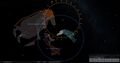 Hippopotamus of Denderah, (probably wrongly) coloured image, mapped to the Stellarium star chart
 -
![Star map of the Egyptian Sky for the Ramesside Star Clocks. Petrie W.M.F. (1940)[3]. Wisdom of the Egyptians. London, fig. 4.45.](/images/thumb/e/e8/Fig_4_45_Petrie1940_sky.jpg/98px-Fig_4_45_Petrie1940_sky.jpg) Star map of the Egyptian Sky for the Ramesside Star Clocks. Petrie W.M.F. (1940)[3]. Wisdom of the Egyptians. London, fig. 4.45.
Star map of the Egyptian Sky for the Ramesside Star Clocks. Petrie W.M.F. (1940)[3]. Wisdom of the Egyptians. London, fig. 4.45. -
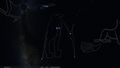 Egyptian constellation Reret, The Female Hippotamus, identified with Ramesside Star Clocks, mapped to Stellarium (CC BY Petrie 1940, SMH 2026). For this screenshot the time and date settings are Alexandria -1180.
 -
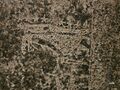 Constellation "Reret" depicted on Nectanebo's sarcophagus, represented by 9 asterisks, seba, (Staatliche Museen zu Berlin – Ägyptisches Museum und Papyrussammlung, ÄM 7.)
 -
 Reret and Menit on Stellarium map, with the two IAU-star names Khepdenreret and Tepiamenit (CC BY WGSN).
 -
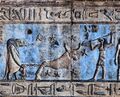 Reret and the Thigh of Seth; rectangular zodiac of Dendera
 -
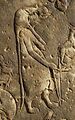 Reret & Menit, circular zodiac of Dendera (CC BY Musée du Louvre, Département des Antiquités égyptiennes)
 -
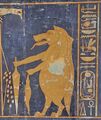 Rert & Menit in Egyptian astronomical ceiling, reproduced in Neues Museum Berlin by Lepsius (1850); Staatliche Museen zu Berlin – Ägyptisches Museum und Papyrussammlung.
 -
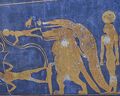 Rert & Menit in Egyptian astronomical ceiling, reproduced in Neues Museum Berlin by Lepsius (1850); Staatliche Museen zu Berlin – Ägyptisches Museum und Papyrussammlung.
 -
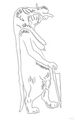 Super-Constellation of Reret and Menit on the circular Zodiac of Dendera, Egypt (drawing by SMH for Stellarium 2026).

![Star map of the Egyptian Sky for the Ramesside Star Clocks. Petrie W.M.F. (1940)[3]. Wisdom of the Egyptians. London, fig. 4.45.](/index.php/File:Fig_4_45_Petrie1940_sky.jpg)


Religion/ Tales/ Mythology

Reret was primarily a household goddess rather than a state deity with large temples. Her principal functions were: Guarding pregnant women during labor, protecting newborn children, repelling demons and malevolent spirits, assisting in rebirth and regeneration. Amulets and figurines of Reret/Taweret were commonly placed in homes, on beds, and in birth chambers.astronomical aspect. She was associated with the northern circumpolar stars, particularly the constellation Draco, Bootes and Hercules.
As a celestial goddess, she was called Mistress of the Horizon and watched over the heavens. The ancient Egyptians regarded the circumpolar stars as “imperishable” because they never set below the horizon. These stars symbolized eternal life, making Reret a guardian not only of childbirth but also of cosmic order and immortality.
IAU Working Group on Star Names
The name "Reret" suggested to be considered by the IAU WGSN in 2023. Reret extends for four hours of RA (from the RSCs) and is probably close to the celestial north pole in the late 2nd millennium BCE. The figure is huge and no single (faint) star can be justified to bear this culturally very important name. Hence, the WGSN chose to represent the figure with a more specific name
... (not to apply/ to apply the name to a neighbouring star/ to ...) in the IAU-CSN.
Weblinks
Reference
- References (general)
- References (early modern)
- Ian Ridpath's website (Star Tales )
- ↑ Neugebauer, O. and Parker, R. A., 1969. Egyptian Astronomical Texts, vol. III. Providence: Brown University.
- ↑ 2.0 2.1 2.2 Leitz, Ch., 1995. Altägyptische Sternuhren. OLA, 62. Leuven: Peeters.
- ↑ 3.0 3.1 Petrie W.M.F. (1940). Wisdom of the Egyptians. London.
- ↑ 4.0 4.1 4.2 4.3 4.4 Belmonte, J. A., 2003. The Ramesside star clocks and the ancient Egyptian constellations. In M. Blomberg, P. E. Blomberg and G. Henriksson (Eds.), Calendars, Symbols, and Orientations: Legacies of Astronomy in Culture (pp. 57–65). Uppsala Astronomical Observatory report, 59. Uppsala Ocarina Books.
- ↑ Marshall Clagett (1989). Ancient Egyptian Science: Calendars, clocks, and astronomy. American Philosophical Society.
- ↑ Neugebauer, O. and Parker, R. A., 1969. Egyptian Astronomical Texts, vol. III. Providence: Brown University.
- ↑ 7.0 7.1 7.2 Belmonte, J.A. and Lull, J., 2023. Astronomy in ancient Egypt: a cultural perspective. Cham: Springer.
- ↑ Davis, V. L., 1985. Identifying Ancient Egyptian Constellations. Journal of the History of Astronomy, 16, 102–104.





