Shakata: Difference between revisions
No edit summary |
infobox and cat |
||
| (17 intermediate revisions by 2 users not shown) | |||
| Line 1: | Line 1: | ||
{{DISPLAYTITLE:Śakata}} | {{DISPLAYTITLE:Śakata}} | ||
{{distinguish|Rohini}} | |||
Authors: {{PAGEAUTHORS}} | Authors: {{PAGEAUTHORS}} | ||
---- | ---- | ||
[[File:Guida alle costellazioni - Aldebaran.png|thumb|Hyades star cluster (CC BY Roberto Mura)]] | [[File:Guida alle costellazioni - Aldebaran.png|thumb|Hyades star cluster (CC BY Roberto Mura)]] | ||
{{Infobox constellation | |||
| name = Shakata | |||
| native = रोहिणीशकट | |||
| translation = the Cart of Rohini | |||
| pronounce = | |||
| IPA = | |||
| culture = IAU | |||
| RA = 67.10987462 | |||
| dec = 16.35967495 | |||
| areatotal = 0 | |||
| numbermainstars = 1 | |||
| numberbfstars = 1 | |||
| numberstarsplanets = | |||
| numberbrightstars = 0 | |||
| numbernearbystars = | |||
| brighteststarname = Shakata | |||
| starmagnitude = 4.969 | |||
| neareststarname = | |||
| stardistance = | |||
| numbermessierobjects = | |||
| meteorshowers = | |||
| bordering = Tau | |||
| notes = | |||
| cat = IAU-Star Name | |||
}} | |||
[[File:Shakatapaint.jpg|thumb|Cart in the Hyades (CC BY B. S. Shylaja)]] | [[File:Shakatapaint.jpg|thumb|Cart in the Hyades (CC BY B. S. Shylaja)]] | ||
{{Infobox constellation | |||
| name = Rohini's Cart (रोहिणीशकट) | |||
| native = रोहिणीशकट | |||
| translation = Cart | |||
| pronounce = Śakata | |||
| IPA = /ʃakata/ | |||
| culture = Sanskrit | |||
| RA = 231.9573086 to 240.3606872 | |||
| dec = 26.06839286 to 31.35897752 | |||
| areatotal = 30.39 | |||
| numbermainstars = 9 | |||
| numberbfstars = 8 | |||
| numberstarsplanets = | |||
| numberbrightstars = 1 | |||
| numbernearbystars = | |||
| brighteststarname = [[Alphecca]] | |||
| starmagnitude = 2.24 | |||
| neareststarname = | |||
| stardistance = | |||
| numbermessierobjects = | |||
| meteorshowers = | |||
| bordering = CrB | |||
| notes = | |||
| cat = constellation | |||
}} | |||
'''Śakata''', ''Rohiṇīśakaṭa'' (रोहिणीशकट)'','' [[Rohini]]'s Cart, is a traditional constellation, an Indian name for the [[Hyades]] in [[Taurus]]. Its age is unknown. | |||
'''Shakata''' is a '''modern star name''' adopted by the International Astronomical Union in the IAU-Catalog of Star Names (IAU-CSN), which honours this ancient Indian constellation. It is the name of the star 75 Tau in constellation [[Taurus]]. | |||
==Concordance, Etymology, History== | ==Concordance, Etymology, History== | ||
| Line 14: | Line 67: | ||
Hyades group is called Rohini Shakata - the cart of Rohini. When the moon or any planet is within the V-shape of Hyades it is called ''Rohini shakata bheda'' (cutting Rohini's cart). | Hyades group is called Rohini Shakata - the cart of Rohini. When the moon or any planet is within the V-shape of Hyades it is called ''Rohini shakata bheda'' (cutting Rohini's cart). | ||
[[File:Kugel_aur+tau.JPG|thumb|Kugel Globe: Auriga | [[File:Kugel_aur+tau.JPG|thumb|Kugel Globe: Taurus with a deity in a chariot, overlapping the area of modern Taurus+Auriga (drawing by SMH 2024)<ref>Hoffmann (2025), Some Results on the Ancient Globes, Globe Studies – The Journal of the International Coronelli Society, 69, 4169.</ref>]] | ||
The only historical image preserved in astronomical context is the engraving on the Kugel Globe. | The only historical image preserved in an astronomical context is the engraving on the [[Kugel Globe]] that was proven of Indian origin by WGSN (2025)<ref>Susanne M. Hoffmann,* Khalid AlAjaji, B.S. Shylaja, Yang Boshun, Danielle Adams, Eric Mamajek, Ian Ridpath, Paul Baki, Juan Antonio Belmonte Avilés, Sze-Leung Cheung, Daniel Cunnama, Jörg Matthias Determann, M. Sadegh Faghanpour, Steven Gullberg, Duane Hamacher, Roland Laffitte, Alejandro M. López, Javier Mejuto, Thierry Montmerle, Clive Ruggles, Shi Yunli, Doris Vickers, Sun Xiaochun, and Hitoshi Yamaoka (2025). The IAU Working Group on Star Names (WGSN): '''Research Finds in 2025'''. ''Journal of Astronomical History and Heritage'', 28(4), 1026–1038 (2025).</ref>. | ||
=== Origin of Constellation === | === Origin of Constellation === | ||
The word śakaṭa means a cart. Hyades is referred to as ''Rohiṅī śakaṭa'' - the cart of ''Rohiṅī''. We find references to the cart of ''Rohiṅī'' (Aldebaran) in many Sanskrit texts. ''Rohiṅī'' is one of the 27 | The word śakaṭa means a cart. Hyades is referred to as ''Rohiṅī śakaṭa'' - the cart of ''Rohiṅī''. We find references to the cart of ''Rohiṅī'' (Aldebaran) in many Sanskrit texts. ''Rohiṅī'' is one of the 27 asterisms used extensively as a ''nakṣatra;'' it is a single-star asterism. The V-shaped pattern of Hyades is the ''śakaṭa''. | ||
However, the context where this name appears provides the clue. All texts have a chapter called ''grahayuti'', the mutual conjunctions of moon and planets and / or with the stars. The procedures are provided to compute the event. In this context, ''śakaṭa- bheda'' is a special event. The word literally means cutting through the cart or breaking the cart. This essentially means that the moon / planet will be within the V-shape of Hyades. The earliest text to mention this ''śiṣydhīvriddhidatantra'' of Lalla (Chatterjee, 1981)<ref name=":0">Chatterjee, B, ''śiṣydhīvriddhidatantra of Lalla,'' 1981, Indian National Science Academy, New Delhi</ref>. It provides the condition for the event (''śakaṭa-bheda'') as the ''dhruvaka'' 1<sup>R</sup>|16°|40’ and ''śara'' 4°|30’ S. These can be approximated as ecliptic longitude and latitude for small values of the latitude. 1R refers to the unit of 30°, R for Rāśi, the zodiacal sign. Therefore, dhruvaka is 46° |40’[[File:Rohini_443.jpg|thumb| Stellarium image of the Hyades region for the year 443CE]]The Stellarium image of the Hyades region for the year 443CE. The date of ''śiṣydhīvriddhidatantra'' is assigned to be 8<sup>th</sup> century (Chattarjee, 1981)<ref name=":0" />. The precise date of the text is not known preventing the application of precession correction. There is also a clue that he was using a reference which was probably 400 years earlier to him, justifying the depiction shown. The fine tuning of the ecliptic longitude has been used so as to match with that given in the text. This clearly shows the marker within the V shape of the Hyades. | However, the context where this name appears provides the clue. All texts have a chapter called ''grahayuti'', the mutual conjunctions of moon and planets and / or with the stars. The procedures are provided to compute the event. In this context, ''śakaṭa- bheda'' is a special event. The word literally means cutting through the cart or breaking the cart. This essentially means that the moon / planet will be within the V-shape of Hyades. The earliest text to mention this ''śiṣydhīvriddhidatantra'' of Lalla (Chatterjee, 1981)<ref name=":0">Chatterjee, B, ''śiṣydhīvriddhidatantra of Lalla,'' 1981, Indian National Science Academy, New Delhi</ref>. It provides the condition for the event (''śakaṭa-bheda'') as the ''dhruvaka'' 1<sup>R</sup>|16°|40’ and ''śara'' 4°|30’ S. These can be approximated as ecliptic longitude and latitude for small values of the latitude. 1R refers to the unit of 30°, R for Rāśi, the zodiacal sign. Therefore, dhruvaka is 46° |40’[[File:Rohini_443.jpg|thumb| Stellarium image of the Hyades region for the year 443CE]]The Stellarium image of the Hyades region for the year 443CE. The date of ''śiṣydhīvriddhidatantra'' is assigned to be 8<sup>th</sup> century (Chattarjee, 1981)<ref name=":0" />. The precise date of the text is not known preventing the application of precession correction. There is also a clue that he was using a reference which was probably 400 years earlier to him, justifying the depiction shown. The fine tuning of the ecliptic longitude has been used so as to match with that given in the text. This clearly shows the marker within the V shape of the Hyades. | ||
| Line 34: | Line 87: | ||
=== Transfer and Transformation of the Constellation === | === Transfer and Transformation of the Constellation === | ||
<gallery> | |||
File:Chariot_KugelGlobe.png|Chariot on Kugel Globe (CC BY "private collection of Nicolas and Alexis Kugel", Paris). | |||
File:Kugel_aur+tau.JPG|Kugel Globe: Taurus with a deity in a cart, overlapping the area of modern Taurus+Auriga (drawing by SMH 2024)<ref>Hoffmann (2025), Some Results on the Ancient Globes, Globe Studies – The Journal of the International Coronelli Society, 69, 4169.</ref> | |||
File:Shakatapaint.jpg|thumb|Cart in the Hyades (CC BY B. S. Shylaja) | |||
File:Rohini nakshatras in Temple draw+lbl 4ase.jpg|[[Rohini]] nakshatra, 10th century temple | |||
File:4 Rohini draw.png|[[Rohini]] as reconstructed by Jones (1720) | |||
</gallery> | |||
== Religion/ Tales/ Mythology == | == Religion/ Tales/ Mythology == | ||
In Hindu tradition, Rohini Shakata Bheda is linked to stories like the, a, warning by Shani (Saturn) to Dashrath regarding the dire consequences of this crossing. A Rohini Shakata Bheda by Venus occurred in summer 2025, for example. | In Hindu tradition, Rohini Shakata Bheda is linked to stories like the, a, warning by Shani (Saturn) to Dashrath regarding the dire consequences of this crossing. A Rohini Shakata Bheda by Venus occurred in summer 2025, for example. | ||
== IAU Working Group on Star Names == | |||
The name was discussed and adopted by the IAU WGSN in 2026 im memory of this constellation. As a recommendation by the Indian members of the WGSN, a star in the middle area of the V-shaped pattern, as the Rohini Shakata Bheda is culturally important and represented in historical sources. The star 75 Tau was picked. | |||
75 Tauri is a single, orange-hued K-type star that generates energy by Helium-fusion. | |||
== Weblinks == | == Weblinks == | ||
| Line 47: | Line 112: | ||
[[Category:Indian]] [[Category:Asterism]] [[Category:Constellation]][[Category:Eurasia]][[Category:South Asian]] | [[Category:Indian]] [[Category:Asterism]] [[Category:IAU-Star Name]] [[Category:Constellation]][[Category:Eurasia]][[Category:South Asian]] [[Category:Asian]] | ||
[[Category:Tau]][[Category:Hyades]] | [[Category:Tau]][[Category:Hyades]] | ||
Latest revision as of 07:21, 19 August 2026
Authors: Susanne M Hoffmann, ASE Tech Team, Youla Azkarrula

| Asterism Info | |
| Native | रोहिणीशकट |
|---|---|
| Translation | the Cart of Rohini |
| Position (2000) | |
| Right ascension | 67.10987462 |
| Declination | 16.35967495 |
| Area | 0 sq. deg. |
| Stars | |
| Bright stars | 1 |
| Bayer/Flamsteed stars | 1 |
| Stars brighter than 3.00m | 0 |
| Brightest star | Shakata (4.969m) |
| Taxonomy | |
| category of asterism | IAU-Star Name |
| IAU- constellations | Tau |

| Asterism Info | |
| Native | रोहिणीशकट |
|---|---|
| Romanisation | Śakata |
| IPA | /ʃakata/ |
| Translation | Cart |
| Position (2000) | |
| Right ascension | 231.9573086 to 240.3606872 |
| Declination | 26.06839286 to 31.35897752 |
| Area | 30.39 sq. deg. |
| Stars | |
| Bright stars | 9 |
| Bayer/Flamsteed stars | 8 |
| Stars brighter than 3.00m | 1 |
| Brightest star | Alphecca (2.24m) |
| Taxonomy | |
| category of asterism | constellation |
| IAU- constellations | CrB |
Śakata, Rohiṇīśakaṭa (रोहिणीशकट), Rohiṇī (रोहिणी)'s Cart, is a traditional constellation, an Indian name for the Hyades in Taurus. Its age is unknown.
Shakata is a modern star name adopted by the International Astronomical Union in the IAU-Catalog of Star Names (IAU-CSN), which honours this ancient Indian constellation. It is the name of the star 75 Tau in constellation Taurus.
Concordance, Etymology, History
Variants
- Shakata
- Rohini Shakata
- Shakata Rohini
Hyades group is called Rohini Shakata - the cart of Rohini. When the moon or any planet is within the V-shape of Hyades it is called Rohini shakata bheda (cutting Rohini's cart).

The only historical image preserved in an astronomical context is the engraving on the Kugel Globe that was proven of Indian origin by WGSN (2025)[2].
Origin of Constellation
The word śakaṭa means a cart. Hyades is referred to as Rohiṅī śakaṭa - the cart of Rohiṅī. We find references to the cart of Rohiṅī (Aldebaran) in many Sanskrit texts. Rohiṅī is one of the 27 asterisms used extensively as a nakṣatra; it is a single-star asterism. The V-shaped pattern of Hyades is the śakaṭa.
However, the context where this name appears provides the clue. All texts have a chapter called grahayuti, the mutual conjunctions of moon and planets and / or with the stars. The procedures are provided to compute the event. In this context, śakaṭa- bheda is a special event. The word literally means cutting through the cart or breaking the cart. This essentially means that the moon / planet will be within the V-shape of Hyades. The earliest text to mention this śiṣydhīvriddhidatantra of Lalla (Chatterjee, 1981)[3]. It provides the condition for the event (śakaṭa-bheda) as the dhruvaka 1R|16°|40’ and śara 4°|30’ S. These can be approximated as ecliptic longitude and latitude for small values of the latitude. 1R refers to the unit of 30°, R for Rāśi, the zodiacal sign. Therefore, dhruvaka is 46° |40’

The Stellarium image of the Hyades region for the year 443CE. The date of śiṣydhīvriddhidatantra is assigned to be 8th century (Chattarjee, 1981)[3]. The precise date of the text is not known preventing the application of precession correction. There is also a clue that he was using a reference which was probably 400 years earlier to him, justifying the depiction shown. The fine tuning of the ecliptic longitude has been used so as to match with that given in the text. This clearly shows the marker within the V shape of the Hyades.
The other texts which specifically refer to this event are Grahalāghava, (16th century) by Ganeśa Daivajnya (Balachandra Rao and Padmaja, 2008)[4] and Samanta Chandrashekhara in Siddhānta Darpaṅa (19th century) (Upadhyaya, online source)[5]. The latter states that the event is decided by the maximum value of śara possible for the planets, which is the same as the orbital inclination. According to him the event śakaṭa-bheda is possible for only budha and śukra (Mercury and Venus), rarely possible for śani (with parama śara as 2°|29’) and impossible for mangala (Mars).
The drawing depicting the cart of Rohiṅī (drawn by B S Shylaja) for a sky theatre show in the planetarium.
Cultural Significance
Rohini Nakshatra is the bright star of the constellation of Taurus identified with the bright star Aldebaran.
Classical texts have a chapter on conjunctions of moon and planets with stars ; the details on calculations for the possibility of the moon/planet passing within the V of Hyades (shakata bheda ) are provided. Rohini Shakata Bheda is a rare, astronomical phenomenon where a planet, often Saturn or Mars, passes through or breaks this "wagon" formation.
Transfer and Transformation of the Constellation
-
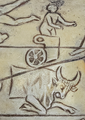 Chariot on Kugel Globe (CC BY "private collection of Nicolas and Alexis Kugel", Paris).
 -
![Kugel Globe: Taurus with a deity in a cart, overlapping the area of modern Taurus+Auriga (drawing by SMH 2024)[6]](/images/thumb/e/e4/Kugel_aur%2Btau.JPG/79px-Kugel_aur%2Btau.JPG) Kugel Globe: Taurus with a deity in a cart, overlapping the area of modern Taurus+Auriga (drawing by SMH 2024)[6]
Kugel Globe: Taurus with a deity in a cart, overlapping the area of modern Taurus+Auriga (drawing by SMH 2024)[6] -
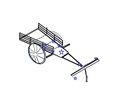 Cart in the Hyades (CC BY B. S. Shylaja)
 -
 Rohiṇī (रोहिणी) nakshatra, 10th century temple
 -
 Rohiṇī (रोहिणी) as reconstructed by Jones (1720)


Religion/ Tales/ Mythology
In Hindu tradition, Rohini Shakata Bheda is linked to stories like the, a, warning by Shani (Saturn) to Dashrath regarding the dire consequences of this crossing. A Rohini Shakata Bheda by Venus occurred in summer 2025, for example.
IAU Working Group on Star Names
The name was discussed and adopted by the IAU WGSN in 2026 im memory of this constellation. As a recommendation by the Indian members of the WGSN, a star in the middle area of the V-shaped pattern, as the Rohini Shakata Bheda is culturally important and represented in historical sources. The star 75 Tau was picked.
75 Tauri is a single, orange-hued K-type star that generates energy by Helium-fusion.
Weblinks
References
- References (general)
- ↑ Hoffmann (2025), Some Results on the Ancient Globes, Globe Studies – The Journal of the International Coronelli Society, 69, 4169.
- ↑ Susanne M. Hoffmann,* Khalid AlAjaji, B.S. Shylaja, Yang Boshun, Danielle Adams, Eric Mamajek, Ian Ridpath, Paul Baki, Juan Antonio Belmonte Avilés, Sze-Leung Cheung, Daniel Cunnama, Jörg Matthias Determann, M. Sadegh Faghanpour, Steven Gullberg, Duane Hamacher, Roland Laffitte, Alejandro M. López, Javier Mejuto, Thierry Montmerle, Clive Ruggles, Shi Yunli, Doris Vickers, Sun Xiaochun, and Hitoshi Yamaoka (2025). The IAU Working Group on Star Names (WGSN): Research Finds in 2025. Journal of Astronomical History and Heritage, 28(4), 1026–1038 (2025).
- ↑ 3.0 3.1 Chatterjee, B, śiṣydhīvriddhidatantra of Lalla, 1981, Indian National Science Academy, New Delhi
- ↑ Rao S and Uma S K, Grahalāghavam, With English Translation, Notes and Appendices, Indian National Science Academy, New Delhi, 2008.
- ↑ Updadhyaya, English Translation of Siddhanta Darpana, (on line source) https://ia803103.us.archive.org/9/items/1050-astrology-books/Arun%20Kumar_Upadhyaya_Siddhanta%20Darpana_Vol.2.pdf
- ↑ Hoffmann (2025), Some Results on the Ancient Globes, Globe Studies – The Journal of the International Coronelli Society, 69, 4169.





