Crux: Difference between revisions
No edit summary |
|||
| (4 intermediate revisions by 2 users not shown) | |||
| Line 2: | Line 2: | ||
---- | ---- | ||
[[File:Crux IAU.svg|alt=star chart|thumb|Crux star chart (IAU and Sky & Telescope magazine, Roger Sinnott & Rick Fienberg).]] | [[File:Crux IAU.svg|alt=star chart|thumb|Crux star chart (IAU and Sky & Telescope magazine, Roger Sinnott & Rick Fienberg).]] | ||
One of the [[:Category:88_IAU-Constellations|88 IAU constellations]]. In antiquity the four main stars were part of the constellation [[Centaurus]]. Specifically, Bayer's ''Uranometria'' 1603 shows a cross superimposed over the hind legs of Centaurus.<ref name=":1" /><ref>Hoffmann, Susanne M. Wie der Löwe an den Himmel kam. Franckh Kosmos Verlag, Stuttgart 2021</ref> Bayer certainly adopted this from the | One of the [[:Category:88_IAU-Constellations|88 IAU constellations]]. In antiquity the four main stars were part of the constellation [[Centaurus]]. Specifically, Bayer's ''Uranometria'' 1603 shows a cross superimposed over the hind legs of Centaurus.<ref name=":1" /><ref>Hoffmann, Susanne M. Wie der Löwe an den Himmel kam. Franckh Kosmos Verlag, Stuttgart 2021</ref> Bayer certainly adopted this from the globes of Petrus Plancius and Jodocus Hondius. An early mention (and drawing) of the cross from 1516 is preserved in letters by Vespucci's navigator Corsali to their sponsors, the de Medici family from Florence. Therefore, some scholars connect the invention to the "quattro stelle" in Dante Alighieri's Divine Comedy.<ref>Filippo Camerota, »Columbus and Vespucci; Echos of the Commedia in oceanic navigation«, in: '' From Hell to the Empyreum, Dante’s World between Science and Poetry,'' hrsg. von Filippo Camerota, Exhibition Catalog: Museo Galileo, Florence 2021, S. 104-5.</ref> The practical reason for the invention might have been navigation (triangulation of the celestial south pole). | ||
==Etymology and History== | ==Etymology and History== | ||
| Line 9: | Line 9: | ||
During the Portuguese voyages to India and the South Seas, the stars were used for navigation. The hind legs of the centaur was already pointing to the south celestial pole at the beginning of the 16th century and were therefore quite suitable for navigation. Andreas Corsali, an Italian who was travelling for the Medici merchant family and sailed from Lisbon to India in 1516, described the four stars as an incomparably beautiful celestial sign. No earlier mention of this figure is known. | During the Portuguese voyages to India and the South Seas, the stars were used for navigation. The hind legs of the centaur was already pointing to the south celestial pole at the beginning of the 16th century and were therefore quite suitable for navigation. Andreas Corsali, an Italian who was travelling for the Medici merchant family and sailed from Lisbon to India in 1516, described the four stars as an incomparably beautiful celestial sign. No earlier mention of this figure is known. | ||
For Corsali and others, the asterism was initially a navigational aid, but Christian cartographers and astronomers adopted this figure as a constellation of its own on their globes and maps. The idea obviously caught the spirit of the times, as Petrus Plancius had also renamed the Greek ship Argo Noah's Ark around 1600. Even before he was aware of the navigational aid, he had suggested grouping other stars in the southern sky to form a cross. This is where the desire for Christianisation and the necessities of ocean navigation came together. The constellation of the cross was finally introduced at the latest with its adoption in Bayer's ''Uranometria'' in 1603, which still provides one of the standard nomenclatures today. | For Corsali and others, the asterism was initially a navigational aid, but Christian cartographers and astronomers adopted this figure as a constellation of its own on their globes and maps. The idea obviously caught the spirit of the times, as Petrus Plancius had also renamed the Greek ship [[Argo]] Noah's Ark around 1600. Even before he was aware of the navigational aid, he had suggested grouping other stars in the southern sky to form a cross. This is where the desire for Christianisation and the necessities of ocean navigation came together. The constellation of the cross was finally introduced at the latest with its adoption in Bayer's ''Uranometria'' in 1603, which still provides one of the standard nomenclatures today. | ||
===Origin of Constellation=== | ===Origin of Constellation=== | ||
[[File:CRUX condemnationChapell Jerusalem.jpg|thumb|A cross in a Christian chapel with the endpoints marked (Jerusalem).]] | [[File:CRUX condemnationChapell Jerusalem.jpg|thumb|A cross in a Christian chapel with the endpoints marked (Jerusalem).]] | ||
[[File:Neri2026 Corsali fig1.jpeg|thumb|Corsali (1516) and its mapping Neri (2026)<ref name=":2" />, [https://www.sciengine.com/JAHH/doi/10.3724/SP.J.1440-2807.2026.02.10 JAHH]]] | |||
==== Corsali ==== | ==== Corsali ==== | ||
The navigator Corsali is regarded as a very well educated man who was proficient in both the Latin language and astronomy. He was in contact with the de Medici family and his letters<ref>Amerigo Vespucci'', Cronache epistolari, Lettere 1476-1508,'' hrsg. von Leandro Perini, Florenz 2013, S.92</ref> ''Lettera di Andrea Corsali allo Illustrissimo Signore Duca Iuliano de Medici, Venuta Dellindia del Mese di Octobre Nel M.D.XVI28F29'' (Letters from Andrea Corsali to the Most Reverend Sir Iuliano di Medici, arrived from India in October 1516)<ref name=":1">Ian Ridpath, [http://www.ianridpath.com/startales/crux.html Star Tales, Crux (Online Edition)]</ref> contain an early description and drawing of the constellation Crux. Significantly, both the de Medici family and Corsali came from Florence: Corsali was born in a smaller town only 20 kilometres southwest of the city. | The navigator Corsali is regarded as a very well educated man who was proficient in both the Latin language and astronomy. He was in contact with the de Medici family and his letters<ref>Amerigo Vespucci'', Cronache epistolari, Lettere 1476-1508,'' hrsg. von Leandro Perini, Florenz 2013, S.92</ref> ''Lettera di Andrea Corsali allo Illustrissimo Signore Duca Iuliano de Medici, Venuta Dellindia del Mese di Octobre Nel M.D.XVI28F29'' (Letters from Andrea Corsali to the Most Reverend Sir Iuliano di Medici, arrived from India in October 1516)<ref name=":1">Ian Ridpath, [http://www.ianridpath.com/startales/crux.html Star Tales, Crux (Online Edition)]</ref> contain an early description and drawing of the constellation Crux. Significantly, both the de Medici family and Corsali came from Florence: Corsali was born in a smaller town only 20 kilometres southwest of the city. | ||
Neri (2026) cites the original letter and provides an English translation:<ref name=":2">Davide Neri (2026). Andrea Corsali and the Discovery of the Southern Sky, Journal of Astronomical History and Heritage, 29(2), 416–426. https://doi.org/10.3724/SP.J.1440-2807.2026.02.10</ref><blockquote>Dapoi che partim mo da Lisbona navigammo sempre con prospero vento, non uscendo da scilocco e libeccio, e passando la linea equinoziale fummo in altura di trentasette gradi nell'altro emispero , a traverso di capo di Buona Speranza, (...)</blockquote><blockquote>In che luogo sia il polo antartico, per l altura de grad i, pigliammo il giorno col sole e ricontrammo la notte con l'astrolabio, ed evidentemente lo manifestano due nugolette di ragionevol grandezza, ch'intorno ad esso continuamente ora abbassandosi e ora alzandosi in moto circulare camminano, con una stella sempre nel mezzo, la qual con esse si volge lontana dal polo circa undici gradi . Sopra di queste apparisce '''una croce maravigliosa''' nel mezzo di cinque stelle, che la circondano (com'il Carro la Tramontana) con altre stelle, che con esse vanno intorno al po lo girandole lontano circa trenta gradi : e fa suo corso in 24 ore, ed è di tanta bellezza che non mi pare ad alcuno segno celeste doverla comparare, come nella forma qui di sotto appare.</blockquote>Translation:<ref name=":2" /><blockquote>After leaving Lisbon, we sailed with a favorable win d, on a course between the south east and south west winds, and crossing the equinoctial line, we reached 37 degrees in the opposite hemisphere , passing the Cape of Good Hope. (...) </blockquote><blockquote>During the day, we determined the altitude of the Antarctic Pole with the sun, by the altitude of the deg rees, and verified it at night with the astrolabe. This is clearly indicated by two small clouds of reasonable size, which revolve around it continuously, sometimes lowering and sometimes rising, with a star always in the center, which with them revolves around the Pole at about eleven degrees Above these a '''marvelous cross''' appears in the middle of five stars, which surround it (as the Little Bear does with our North Star) with other stars, which with the m [the five stars] go around the Pole, rotating about thirty degrees away: and it completes its course in 24 hours, and is of such beauty that it does not seem to me comparable to any celestial sign, as in the form that appears below.</blockquote> | |||
==== Dante ==== | |||
The formulation that Ridpath quotes above is strongly reminiscent of the formulation of the Florentine Dante Alighieri<ref>Vita and Works of Dante Alighieri, provided by the Italian Dante Society https://www.danteonline.it/index.html</ref><ref>Dante's Works online, provided by the Italian Dante Society: https://www.danteonline.it/opere/</ref> in his Comedia (Purg. I 23-24):<ref name=":0">[https://www.danteonline.it/opere/index.php?opera=Commedia%20-%20ed.%20Petrocchi Dante's Comedia , provided by the Italian Dante Society] </ref><blockquote> | The formulation that Ridpath quotes above is strongly reminiscent of the formulation of the Florentine Dante Alighieri<ref>Vita and Works of Dante Alighieri, provided by the Italian Dante Society https://www.danteonline.it/index.html</ref><ref>Dante's Works online, provided by the Italian Dante Society: https://www.danteonline.it/opere/</ref> in his Comedia (Purg. I 23-24):<ref name=":0">[https://www.danteonline.it/opere/index.php?opera=Commedia%20-%20ed.%20Petrocchi Dante's Comedia , provided by the Italian Dante Society] </ref><blockquote> | ||
| Line 21: | Line 26: | ||
* non viste mai fuor ch'a la prima gente. | * non viste mai fuor ch'a la prima gente. | ||
</blockquote>Since it is obvious that the educated Corsali knew his compatriot's tercines, it is assumed that he wanted to memorialise Dante's abstract imagination in his navigational stars. Corsali was thus inspired by Dante and the constellation Crux is Christian in two senses: on the one hand, it represents the symbol of Christianity, the cross of Jesus, and on the other, what Dante himself meant by it. Whether he had a specific pattern of stars, a constellation or an asterism, in mind is doubtful: In his time European voyages of discovery were not yet very common (it was the time when the Jesuit Marco Polo lived in China and thus initiated the exchange of knowledge with East Asia) and mapping of the southern starry sky had not yet taken place. Dante scholars assume that Dante himself meant these four stars primarily as a physical performance of the Christian cardinal virtues - whether they also had a non-allegorical meaning for him is disputed. With the four virtues, Christianity stands in the tradition of Greek antiquity (they are already documented in Plato), which is entirely in Dante's sense when he repeatedly attempts to demonstrate the virtuousness of pre-Christian authors. | </blockquote>Since it is obvious that the educated Corsali knew his compatriot's tercines, it is assumed that he wanted to memorialise Dante's abstract imagination in his navigational stars. Corsali was thus inspired by Dante and the constellation Crux is Christian in two senses: on the one hand, it represents the symbol of Christianity, the cross of Jesus, and on the other, what Dante himself meant by it. Whether he had a specific pattern of stars, a constellation or an asterism, in mind is doubtful: In his time European voyages of discovery were not yet very common (it was the time when the Jesuit Marco Polo lived in China and thus initiated the exchange of knowledge with East Asia) and mapping of the southern starry sky had not yet taken place. Dante scholars assume that Dante himself meant these four stars primarily as a physical performance of the Christian cardinal virtues - whether they also had a non-allegorical meaning for him is disputed. With the four virtues, Christianity stands in the tradition of Greek antiquity (they are already documented in Plato), which is entirely in Dante's sense when he repeatedly attempts to demonstrate the virtuousness of pre-Christian authors.[[File:Crux 4Dante stellarium.JPG|thumb|Ancient constellation "Centaurus" in Stellarium (Sky Culture: "Almagest") and the horizon of Florence in 1300 CE, the time of Dante Alighieri. Image published in Deutsches Dante-Jahrbuch 2023 (DOI [https://www.degruyterbrill.com/document/doi/10.1515/dante-2023-0002/html?lang=de 10.1515/dante-2023-0002]), DeGruyter. The feet of the centaur are always below the horizon.]] | ||
[[File:Crux 4Dante stellarium.JPG|thumb|Ancient constellation "Centaurus" in Stellarium (Sky Culture: "Almagest") and the horizon of Florence in 1300 CE, the time of Dante Alighieri. Image published in Deutsches Dante-Jahrbuch 2023 (DOI [https://www.degruyterbrill.com/document/doi/10.1515/dante-2023-0002/html?lang=de 10.1515/dante-2023-0002]), DeGruyter. The feet of the centaur are always below the horizon.]] | |||
In his Divine Comedia,<ref name=":0" /> Dante uses the starry sky as a kind of stage set.<ref>Hoffmann, S.M. und Blume, D. (2023): '''„'''’l volger del ciel'''“''' in Deutsches Dante-Jahrbuch: Dante und die Stadt. Kommunale Kultur und literarische Öffentlichkeit. Blume: “Dantes Sterne” (43-53), Hoffmann: “Planetarium Dantis” 1-42 (DOI 10.1515/dante-2023-0002), DeGruyter, 1-53</ref> He refers to it in several of his works like an eternal backdrop. In particular, the realm of his god, which he reaches at the end of his journey to the afterlife in the Comedia, is staged with the splendour of nature's jewellery on the velvet-black tent of the night. They are a perpetual guide on earth and, from Dante's point of view, disappear in hell. If black is the mourning colour of the Christian world, the darkness of the night has an oppressively gloomy effect. However, after a journey to hell, as Dante describes it, the stars appear as a ray of light, showing him that he has now reached a higher level (of realisation or even of consciousness in the encounter with Beatrice). | In his Divine Comedia,<ref name=":0" /> Dante uses the starry sky as a kind of stage set.<ref>Hoffmann, S.M. und Blume, D. (2023): '''„'''’l volger del ciel'''“''' in Deutsches Dante-Jahrbuch: Dante und die Stadt. Kommunale Kultur und literarische Öffentlichkeit. Blume: “Dantes Sterne” (43-53), Hoffmann: “Planetarium Dantis” 1-42 (DOI 10.1515/dante-2023-0002), DeGruyter, 1-53</ref> He refers to it in several of his works like an eternal backdrop. In particular, the realm of his god, which he reaches at the end of his journey to the afterlife in the Comedia, is staged with the splendour of nature's jewellery on the velvet-black tent of the night. They are a perpetual guide on earth and, from Dante's point of view, disappear in hell. If black is the mourning colour of the Christian world, the darkness of the night has an oppressively gloomy effect. However, after a journey to hell, as Dante describes it, the stars appear as a ray of light, showing him that he has now reached a higher level (of realisation or even of consciousness in the encounter with Beatrice). | ||
| Line 35: | Line 37: | ||
Like many things in Christianity, they can be traced back to much older Greek sources because they are basic human values. For example, they were also described by Aeschylus and Plato. Virgil accompanies Dante throughout his journey to the afterlife, even acting as Dante's guide. As Virgil (died 19 BCE) could not have been baptised a Christian, he is denied paradise according to Christian doctrine. This is one of the many aspects of Christianity that Dante criticizes in his Commedia: these virtues are - as he stresses - universal and not solely Christian. | Like many things in Christianity, they can be traced back to much older Greek sources because they are basic human values. For example, they were also described by Aeschylus and Plato. Virgil accompanies Dante throughout his journey to the afterlife, even acting as Dante's guide. As Virgil (died 19 BCE) could not have been baptised a Christian, he is denied paradise according to Christian doctrine. This is one of the many aspects of Christianity that Dante criticizes in his Commedia: these virtues are - as he stresses - universal and not solely Christian. | ||
====== Hipparchus's "lost" star Catalogue ====== | |||
Hipparchus mentions these stars but counts them towards Centaurus. | |||
The star catalogue of Hipparchus is not preserved. Yet, several scholars have reconstructed it in the past century: Vogt (1925)<ref>Vogt, H., “Versuch einer Wiederherstellung von Hipparchs Fixsternver zeichnis”, <nowiki><i>Astronomische Nachrichten</i></nowiki>, vol. 224, no. 2, Wiley, p. 17, 1925. doi:10.1002/asna.19252240202.</ref>, Grasshoff (1990)<ref>Graßhoff, G., <nowiki><i>The History of Ptolemy's Star Catalogue</i></nowiki>, Springer, New York, 1990 </ref>, Hoffmann (2017)<ref>Hoffmann, S. M., <nowiki><i>Hipparchs Himmelsglobus</i></nowiki>. Springer Wiesbaden/ New York, 2017. doi:10.1007/978-3-658-18683-8.</ref> and Glover (2026)<ref>Glover, E. (2026). ''The Astronomy of Hipparchus'', Cambridge University Press</ref>. Grasshoff's catalogue and computations are not published digitally, Hoffmann published three versions of the Manitius+Hoffmann<ref>Hipparchus's Lost Star Catalogue (1/2 reconstructed) (Hoffmann, 2017) in VizieR</ref> star lists in the CDS [https://vizier.unistra.fr/ VizieR] "catalog of catalogs", and Glover printed the star lists constellationwise in his book. | |||
{|class="wikitable" | |||
|+ Hipparchus's star in Aquarius (Glover 2026) | |||
!hipp.Cat.ID | |||
!constStarID | |||
!starName | |||
!ident.Bayer | |||
!ident.HIP | |||
!concordance | |||
|- | |||
|237 | |||
|1 | |||
| | |||
|α Cru (Cen) | |||
|60718 | |||
|CPAE | |||
|- | |||
|238 | |||
|2 | |||
| | |||
|β Cru (Cen) | |||
|62434 | |||
|CPAE | |||
|- | |||
|239 | |||
|3 | |||
| | |||
|γ Cru (Cen) | |||
|61084 | |||
|CPAE | |||
|- | |||
|240 | |||
|4 | |||
| | |||
|δ Cru (Cen) | |||
|59747 | |||
|CPAE | |||
|} | |||
==== Almagest ==== | ==== Almagest ==== | ||
| Line 76: | Line 122: | ||
|μ Cru | |μ Cru | ||
|} | |} | ||
===Transfer and Transformation of the Constellation=== | ===Transfer and Transformation of the Constellation=== | ||
<gallery> | <gallery> | ||
File:Centurus+Lupus Duerer.jpg|Cen+Lup on Duerer's map (1515) without Crux. | File:Centurus+Lupus Duerer.jpg|Cen+Lup on Duerer's map (1515) without Crux. | ||
File:Blaeu1602 Cha+Mus+Cru.JPG|Musca, Chamaeleon and Crux on Blaeu's first globe (1602) that is a copy of Plancius/ Hondius (1598). [https://collections.rmg.co.uk/mediaLib/360/media-360270/large.jpg RMG] | File:Blaeu1602 Cha+Mus+Cru.JPG|Musca, Chamaeleon and Crux on Blaeu's first globe (1602) that is a copy of Plancius/ Hondius (1598). [https://collections.rmg.co.uk/mediaLib/360/media-360270/large.jpg RMG] | ||
File:Blaeu1603 Cru+Mus+Cha.JPG|Musca, Chamaeleon and Crux on Blaeu (1603), the globe that is based on de Houtman's data. RMG | File:Blaeu1603 Cru+Mus+Cha.JPG|Musca, Chamaeleon and Crux on Blaeu (1603), the globe that is based on de Houtman's data. RMG | ||
File:Cen+Lup Mercator1551.jpg|Cen+Lup on the Mercator Globe (1551), without Crux. | File:Cen+Lup Mercator1551.jpg|Cen+Lup on the Mercator Globe (1551), without Crux. | ||
File:Cen+Lup+Crux Plancius.jpg|Cen+Lup on Plancius Globe gores 159x, probably the first depiction at all. | File:Cen+Lup+Crux Plancius.jpg|Cen+Lup on Plancius Globe gores 159x, probably the first depiction at all. | ||
| Line 86: | Line 133: | ||
File:Cen+Lup+Crux Habrecht1621.jpg|Cen+Lup on Habrecht's (1621) map with Crux. | File:Cen+Lup+Crux Habrecht1621.jpg|Cen+Lup on Habrecht's (1621) map with Crux. | ||
File:Crux inCenLup Royer south.jpg|Cen+Lup on Royer's planisphere (1679) with Crux. | File:Crux inCenLup Royer south.jpg|Cen+Lup on Royer's planisphere (1679) with Crux. | ||
File:H.A. Rey's stick figure stellarium-028.png|(1952) H.A. Rey's stick figure of Crux | |||
File:O. Hlad's stick figure stellarium-028.png|(1988) O. Hlad's stick figure of Crux | |||
</gallery> | </gallery> | ||
==Mythology== | ==Mythology== | ||
Latest revision as of 13:16, 26 August 2026
Authors: Susanne M Hoffmann, Youla Azkarrula, Ian Ridpath

One of the 88 IAU constellations. In antiquity the four main stars were part of the constellation Centaurus. Specifically, Bayer's Uranometria 1603 shows a cross superimposed over the hind legs of Centaurus.[1][2] Bayer certainly adopted this from the globes of Petrus Plancius and Jodocus Hondius. An early mention (and drawing) of the cross from 1516 is preserved in letters by Vespucci's navigator Corsali to their sponsors, the de Medici family from Florence. Therefore, some scholars connect the invention to the "quattro stelle" in Dante Alighieri's Divine Comedy.[3] The practical reason for the invention might have been navigation (triangulation of the celestial south pole).
Etymology and History

The stars of this figure were already recorded in ancient star catalogues, but no Christian symbol could be placed in the sky before the invention of Christianity. In antiquity, the stars belonged to the centaur (Centaurus), forming its hind legs.
During the Portuguese voyages to India and the South Seas, the stars were used for navigation. The hind legs of the centaur was already pointing to the south celestial pole at the beginning of the 16th century and were therefore quite suitable for navigation. Andreas Corsali, an Italian who was travelling for the Medici merchant family and sailed from Lisbon to India in 1516, described the four stars as an incomparably beautiful celestial sign. No earlier mention of this figure is known.
For Corsali and others, the asterism was initially a navigational aid, but Christian cartographers and astronomers adopted this figure as a constellation of its own on their globes and maps. The idea obviously caught the spirit of the times, as Petrus Plancius had also renamed the Greek ship Argo Noah's Ark around 1600. Even before he was aware of the navigational aid, he had suggested grouping other stars in the southern sky to form a cross. This is where the desire for Christianisation and the necessities of ocean navigation came together. The constellation of the cross was finally introduced at the latest with its adoption in Bayer's Uranometria in 1603, which still provides one of the standard nomenclatures today.
Origin of Constellation


Corsali
The navigator Corsali is regarded as a very well educated man who was proficient in both the Latin language and astronomy. He was in contact with the de Medici family and his letters[5] Lettera di Andrea Corsali allo Illustrissimo Signore Duca Iuliano de Medici, Venuta Dellindia del Mese di Octobre Nel M.D.XVI28F29 (Letters from Andrea Corsali to the Most Reverend Sir Iuliano di Medici, arrived from India in October 1516)[1] contain an early description and drawing of the constellation Crux. Significantly, both the de Medici family and Corsali came from Florence: Corsali was born in a smaller town only 20 kilometres southwest of the city.
Neri (2026) cites the original letter and provides an English translation:[4]
Dapoi che partim mo da Lisbona navigammo sempre con prospero vento, non uscendo da scilocco e libeccio, e passando la linea equinoziale fummo in altura di trentasette gradi nell'altro emispero , a traverso di capo di Buona Speranza, (...)
In che luogo sia il polo antartico, per l altura de grad i, pigliammo il giorno col sole e ricontrammo la notte con l'astrolabio, ed evidentemente lo manifestano due nugolette di ragionevol grandezza, ch'intorno ad esso continuamente ora abbassandosi e ora alzandosi in moto circulare camminano, con una stella sempre nel mezzo, la qual con esse si volge lontana dal polo circa undici gradi . Sopra di queste apparisce una croce maravigliosa nel mezzo di cinque stelle, che la circondano (com'il Carro la Tramontana) con altre stelle, che con esse vanno intorno al po lo girandole lontano circa trenta gradi : e fa suo corso in 24 ore, ed è di tanta bellezza che non mi pare ad alcuno segno celeste doverla comparare, come nella forma qui di sotto appare.
Translation:[4]
After leaving Lisbon, we sailed with a favorable win d, on a course between the south east and south west winds, and crossing the equinoctial line, we reached 37 degrees in the opposite hemisphere , passing the Cape of Good Hope. (...)
During the day, we determined the altitude of the Antarctic Pole with the sun, by the altitude of the deg rees, and verified it at night with the astrolabe. This is clearly indicated by two small clouds of reasonable size, which revolve around it continuously, sometimes lowering and sometimes rising, with a star always in the center, which with them revolves around the Pole at about eleven degrees Above these a marvelous cross appears in the middle of five stars, which surround it (as the Little Bear does with our North Star) with other stars, which with the m [the five stars] go around the Pole, rotating about thirty degrees away: and it completes its course in 24 hours, and is of such beauty that it does not seem to me comparable to any celestial sign, as in the form that appears below.
Dante
The formulation that Ridpath quotes above is strongly reminiscent of the formulation of the Florentine Dante Alighieri[6][7] in his Comedia (Purg. I 23-24):[8]
- a l'altro polo, e vidi quattro stelle
- non viste mai fuor ch'a la prima gente.
Since it is obvious that the educated Corsali knew his compatriot's tercines, it is assumed that he wanted to memorialise Dante's abstract imagination in his navigational stars. Corsali was thus inspired by Dante and the constellation Crux is Christian in two senses: on the one hand, it represents the symbol of Christianity, the cross of Jesus, and on the other, what Dante himself meant by it. Whether he had a specific pattern of stars, a constellation or an asterism, in mind is doubtful: In his time European voyages of discovery were not yet very common (it was the time when the Jesuit Marco Polo lived in China and thus initiated the exchange of knowledge with East Asia) and mapping of the southern starry sky had not yet taken place. Dante scholars assume that Dante himself meant these four stars primarily as a physical performance of the Christian cardinal virtues - whether they also had a non-allegorical meaning for him is disputed. With the four virtues, Christianity stands in the tradition of Greek antiquity (they are already documented in Plato), which is entirely in Dante's sense when he repeatedly attempts to demonstrate the virtuousness of pre-Christian authors.

In his Divine Comedia,[8] Dante uses the starry sky as a kind of stage set.[9] He refers to it in several of his works like an eternal backdrop. In particular, the realm of his god, which he reaches at the end of his journey to the afterlife in the Comedia, is staged with the splendour of nature's jewellery on the velvet-black tent of the night. They are a perpetual guide on earth and, from Dante's point of view, disappear in hell. If black is the mourning colour of the Christian world, the darkness of the night has an oppressively gloomy effect. However, after a journey to hell, as Dante describes it, the stars appear as a ray of light, showing him that he has now reached a higher level (of realisation or even of consciousness in the encounter with Beatrice).
It is commonly assumed that his "quattro stelle" are symbols for the four cardinal virtues:
- prudence,
- justice,
- valour and
- temperance.
Like many things in Christianity, they can be traced back to much older Greek sources because they are basic human values. For example, they were also described by Aeschylus and Plato. Virgil accompanies Dante throughout his journey to the afterlife, even acting as Dante's guide. As Virgil (died 19 BCE) could not have been baptised a Christian, he is denied paradise according to Christian doctrine. This is one of the many aspects of Christianity that Dante criticizes in his Commedia: these virtues are - as he stresses - universal and not solely Christian.
Hipparchus's "lost" star Catalogue
Hipparchus mentions these stars but counts them towards Centaurus.
The star catalogue of Hipparchus is not preserved. Yet, several scholars have reconstructed it in the past century: Vogt (1925)[10], Grasshoff (1990)[11], Hoffmann (2017)[12] and Glover (2026)[13]. Grasshoff's catalogue and computations are not published digitally, Hoffmann published three versions of the Manitius+Hoffmann[14] star lists in the CDS VizieR "catalog of catalogs", and Glover printed the star lists constellationwise in his book.
| hipp.Cat.ID | constStarID | starName | ident.Bayer | ident.HIP | concordance |
|---|---|---|---|---|---|
| 237 | 1 | α Cru (Cen) | 60718 | CPAE | |
| 238 | 2 | β Cru (Cen) | 62434 | CPAE | |
| 239 | 3 | γ Cru (Cen) | 61084 | CPAE | |
| 240 | 4 | δ Cru (Cen) | 59747 | CPAE |
Almagest
In Ptolemy's Almagest, the stars of Crux form the hind legs of Centaurus.
| id | Greek
(Heiberg 1898) |
English
(Toomer 1984) |
ident. |
|---|---|---|---|
| 31 | ὁ ἐπὶ τῆς ἀγκύλης τοῦ δεξιοῦ ποδός | The star on the knee-bend of the right [hind] leg | γ Cru |
| 32 | ὁ ἐν τῷ σφυρῷ τοῦ αὐτοῦ ποδός | The star in the hock of the same leg | β Cru |
| 33 | ὁ ὑπὸ τὴν ἀγκύληη τοῦ ἀριστεροῦ ποδός | The star under the knee-bend of the left [hind] leg | δ Cru |
| 34 | ὁ ἐπὶ τοῦ βατραχίου τοῦ αὐτοῦ ποδός | The star on the frog of the hoof on the same leg | α Cru |
| 37 | ὁ ἐκτὸς ὑπὸ τὸν δεξιὸν ὀπισθόποδα | The star outside, under the right hind leg | μ Cru |
Transfer and Transformation of the Constellation
-
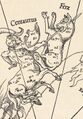 Cen+Lup on Duerer's map (1515) without Crux.
 -
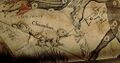 Musca, Chamaeleon and Crux on Blaeu's first globe (1602) that is a copy of Plancius/ Hondius (1598). RMG
 -
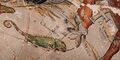 Musca, Chamaeleon and Crux on Blaeu (1603), the globe that is based on de Houtman's data. RMG
 -
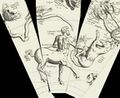 Cen+Lup on the Mercator Globe (1551), without Crux.
 -
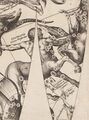 Cen+Lup on Plancius Globe gores 159x, probably the first depiction at all.
 -
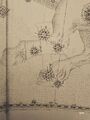 Crux, The Cross, carefully drawn across the hind legs of The Centaur in Bayer (1603).
 -
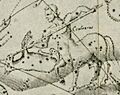 Cen+Lup on Habrecht's (1621) map with Crux.
 -
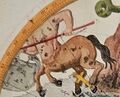 Cen+Lup on Royer's planisphere (1679) with Crux.
 -
 (1952) H.A. Rey's stick figure of Crux
 -
 (1988) O. Hlad's stick figure of Crux


Mythology
The cross is actually an ancient instrument of torture and should therefore have no place in the sky.
-
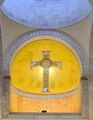 A cross in a Christian chapel with the endpoints marked (Jerusalem)
 -
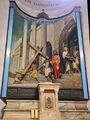 The torture prior to the crucifixion of Jesus
 -
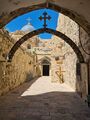 Many crosses in the Christian quarter of old town Jerusalem (SMH 2023). Sometimes, the different designs of the crosses indicat different orders.


For Christians, however, the cross on which Jesus was nailed symbolises his resurrection and the redemption of all people from their sins. It is a sign of hope, symbolising a new beginning and the start of a better world.
The commonly assumed connection of the four points of the cross to the four cardinal virtues can be traced back far beyond Christianity; they are also found in many Greco-Roman philosophies, e.g. prominently in Plato.
Weblinks
References
- ↑ 1.0 1.1 Ian Ridpath, Star Tales, Crux (Online Edition)
- ↑ Hoffmann, Susanne M. Wie der Löwe an den Himmel kam. Franckh Kosmos Verlag, Stuttgart 2021
- ↑ Filippo Camerota, »Columbus and Vespucci; Echos of the Commedia in oceanic navigation«, in: From Hell to the Empyreum, Dante’s World between Science and Poetry, hrsg. von Filippo Camerota, Exhibition Catalog: Museo Galileo, Florence 2021, S. 104-5.
- ↑ 4.0 4.1 4.2 Davide Neri (2026). Andrea Corsali and the Discovery of the Southern Sky, Journal of Astronomical History and Heritage, 29(2), 416–426. https://doi.org/10.3724/SP.J.1440-2807.2026.02.10
- ↑ Amerigo Vespucci, Cronache epistolari, Lettere 1476-1508, hrsg. von Leandro Perini, Florenz 2013, S.92
- ↑ Vita and Works of Dante Alighieri, provided by the Italian Dante Society https://www.danteonline.it/index.html
- ↑ Dante's Works online, provided by the Italian Dante Society: https://www.danteonline.it/opere/
- ↑ 8.0 8.1 Dante's Comedia , provided by the Italian Dante Society
- ↑ Hoffmann, S.M. und Blume, D. (2023): „’l volger del ciel“ in Deutsches Dante-Jahrbuch: Dante und die Stadt. Kommunale Kultur und literarische Öffentlichkeit. Blume: “Dantes Sterne” (43-53), Hoffmann: “Planetarium Dantis” 1-42 (DOI 10.1515/dante-2023-0002), DeGruyter, 1-53
- ↑ Vogt, H., “Versuch einer Wiederherstellung von Hipparchs Fixsternver zeichnis”, <i>Astronomische Nachrichten</i>, vol. 224, no. 2, Wiley, p. 17, 1925. doi:10.1002/asna.19252240202.
- ↑ Graßhoff, G., <i>The History of Ptolemy's Star Catalogue</i>, Springer, New York, 1990
- ↑ Hoffmann, S. M., <i>Hipparchs Himmelsglobus</i>. Springer Wiesbaden/ New York, 2017. doi:10.1007/978-3-658-18683-8.
- ↑ Glover, E. (2026). The Astronomy of Hipparchus, Cambridge University Press
- ↑ Hipparchus's Lost Star Catalogue (1/2 reconstructed) (Hoffmann, 2017) in VizieR






