Ashvini: Difference between revisions
No edit summary |
No edit summary |
||
| (One intermediate revision by the same user not shown) | |||
| Line 8: | Line 8: | ||
| translation = Aśvini | | translation = Aśvini | ||
| pronounce = Ashvini | | pronounce = Ashvini | ||
| IPA = | | IPA = ɐʃʋiːniː | ||
| culture = Indian_nakshatras | | culture = Indian_nakshatras | ||
| RA = 28.38255387 to 34.53137755 | | RA = 28.38255387 to 34.53137755 | ||
| Line 18: | Line 18: | ||
| numberbrightstars = 2 | | numberbrightstars = 2 | ||
| numbernearbystars = | | numbernearbystars = | ||
| brighteststarname = Hamal | | brighteststarname = [[Hamal]] | ||
| starmagnitude = 2.01 | | starmagnitude = 2.01 | ||
| neareststarname = | | neareststarname = | ||
Latest revision as of 04:36, 9 July 2026
Authors: Susanne M Hoffmann, Youla Azkarrula

| Asterism Info | |
| Native | अश्विनी |
|---|---|
| Romanisation | Ashvini |
| IPA | ɐʃʋiːniː |
| Translation | Aśvini |
| Position (2000) | |
| Right ascension | 28.38255387 to 34.53137755 |
| Declination | 17.81755601 to 23.46241755 |
| Area | 18.61 sq. deg. |
| Stars | |
| Bright stars | 10 |
| Bayer/Flamsteed stars | 9 |
| Stars brighter than 3.00m | 2 |
| Brightest star | Hamal (2.01m) |
| Taxonomy | |
| category of asterism | constellation |
| IAU- constellations | Ari |

Aśvini (अश्विनी) is the name of an Indian twin deity that is asscoiated with the first nakshatra. As gods they initially represent physicians; as asterism they are associated with the star β and γ Arietis in Aries. However, the oldest reconstruction of the image shows a horse head with three stars, suggesting that α Arietis might also have belonged to the asterism.
Etymology and History
Name Variant:
- Adya,
- Asva,
- Asvi,
- Dasra,
- Hari,
- Haya,
- Turaga,
- Turanaga,
- Vaaji

Origin of Constellation
Asvini actually means "twin horse-man". It is mythologically associated with twin physicians of the Gods and as an astrism represented with a horse head. All alternative names of the nakshatra mean "horse" and so does the word “aśva” (अश्व) .
Identification
β, γ Arietis are certain,
(perhaps also α Ari in some variants, as sometimes three stars are drawn)
| Ashvini
Vedic |
Ashvini in
Tirupperunthurai |
Ashvini
Chinese |
Ashvini
(Jones 1790) | |
|---|---|---|---|---|
| ≥ 2 stars | 6 stars | 3 stars | 3 stars |
Stars within the Constellation Area
| id | Label | HIP | description | Vmag |
|---|---|---|---|---|
| 1 | Hamal | HIP 9884 | Constellation lines (Vertex) | 2.01 |
| 2 | Sheratan | HIP 8903 | Constellation lines (Vertex) | 2.65 |
| 3 | Mesarthim | HIP 8832 | Constellation lines (Vertex) | 4.52 |
| 4 | * gam01 Ari | HIP 8832 | Constellation lines (Vertex) | 4.589 |
| 5 | κ Arietis | HIP 9836 | Inside the hull | 5.019 |
| 6 | ι Arietis | HIP 9110 | Constellation lines (Vertex) | 5.105 |
| 7 | η Arietis | HIP 10306 | Constellation lines | 5.2 |
| 8 | θ Arietis | HIP 10732 | Constellation lines (Vertex) | 5.572 |
| 9 | 15 Ari | HIP 10155 | Inside the hull | 5.688 |
| 10 | - | HIP 9307 | Inside the hull | 5.892 |
Transfer and Transformation of the Constellation
-
 Ashvini 10th century CE
 -
 Ashvini Tibetean
 -
 Ashvini (Chinese)
 -
 Ashvini reconstructed by Jones (1720).
 -
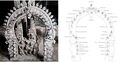 Display of all 28th nakshatra in silver arch with candles in Tirupperunthurai (Athmanathaswamy temple) near Aranthangi, India, 10th century CE. (SMH 2025).
 -
 Display of all 28th nakshatra in a door frame in Tirupperunthurai (Athmanathaswamy temple) near Aranthangi, India, 10th century CE. (SMH 2025).


Mythology
mnemonic tales and cultural significance
Weblinks
References
- References (general)





