Uñallamacha: Difference between revisions
No edit summary |
infobox |
||
| (4 intermediate revisions by 2 users not shown) | |||
| Line 3: | Line 3: | ||
---- | ---- | ||
[[File:JessicasPaintings web 006.jpg|thumb|Yaqana, the She-Llama. The image depicts another llama, the mother-llama, breast-feeding her baby ("5") is no.4; Milky Way with Inka Dark Constellations (CC BY Jessica and Steven R. Gullberg).]] | [[File:JessicasPaintings web 006.jpg|thumb|Yaqana, the She-Llama. The image depicts another llama, the mother-llama, breast-feeding her baby ("5") is no.4; Milky Way with Inka Dark Constellations (CC BY Jessica and Steven R. Gullberg).]] | ||
{{Infobox constellation | |||
| name = Uñallamacha | |||
| native = Uñallamacha | |||
| translation = The Baby Llama | |||
| pronounce = | |||
| IPA = | |||
| culture = IAU | |||
| RA = 259.2730909 | |||
| dec = -44.77859556 | |||
| areatotal = 0 | |||
| numbermainstars = 1 | |||
| numberbfstars = 1 | |||
| numberstarsplanets = | |||
| numberbrightstars = 0 | |||
| numbernearbystars = | |||
| brighteststarname = Uñallamacha | |||
| starmagnitude = 6.487 | |||
| neareststarname = | |||
| stardistance = | |||
| numbermessierobjects = | |||
| meteorshowers = | |||
| bordering = Sco | |||
| notes = | |||
| cat = IAU-Star Name | |||
}} | |||
[[File:Llama and baby llama greet us at Wiñaywayna.jpg|thumb|Llama and baby llama at Wiñaywayna (CC BY Bex Walton)]] | [[File:Llama and baby llama greet us at Wiñaywayna.jpg|thumb|Llama and baby llama at Wiñaywayna (CC BY Bex Walton)]] | ||
[[File:Uñallamacha profileCard SadeghFaghanpour-IAU.jpg|thumb|Uñallamacha profile card (CC BY Sadegh Faghanpour for IAU WGSN).]] | |||
[[File:Urquchillay stickfigure2 SadeghFaghanpour-IAU-WGSN.jpg|thumb|Uñallamacha stick figure (CC BY Sadegh Faghanpour for IAU WGSN).]] | |||
Uñallamacha, The Baby Llama, is an Inka dark constellation. Uñallamacha is the baby llama and forms a super-constellation with [[Yaqana]], the mother llama. As a constellation, he is represented in the area between [[Centaurus]] and [[Scorpius]]. As an Inka constellation, it has been used in South America. | Uñallamacha, The Baby Llama, is an Inka dark constellation. Uñallamacha is the baby llama and forms a super-constellation with [[Yaqana]], the mother llama. As a constellation, he is represented in the area between [[Centaurus]] and [[Scorpius]]. As an Inka constellation, it has been used in South America. | ||
| Line 11: | Line 38: | ||
==== Spelling Variants ==== | ==== Spelling Variants ==== | ||
* | *Uñallamacha | ||
*Unallamacha (Simbad spelling of the star name without diacritics) | |||
*Yacana (is the Spanish spelling, depreciated today to overcome colonialism) | |||
=== Origin of Constellation === | === Origin of Constellation === | ||
Llamas figure prominently in many aspects of Inka culture and this celestial figure was thought to animate the llamas on the Earth. Yaqana is a constellation much larger than Hanpatu or Yutu and dominates the Inkas’ dark constellation section of the Milky Way. Yaqana is situated between Centaurus and Scorpius. The prominent stars α and β Centauri serve as the llama’s eyes and as such are known as ''Llamacñawin'', the “eyes of the llama.” Below Yaqana is a smaller dark constellation called Uñallamacha that is said to be a cria, a baby llama, suckling its mother. | Llamas figure prominently in many aspects of Inka culture and this celestial figure was thought to animate the llamas on the Earth. Yaqana is a constellation much larger than Hanpatu or Yutu and dominates the Inkas’ dark constellation section of the Milky Way. Yaqana is situated between Centaurus and Scorpius. The prominent stars α and β Centauri serve as the llama’s eyes and as such are known as ''Llamacñawin'', the “eyes of the llama.” Below Yaqana is a smaller dark constellation called Uñallamacha that is said to be a cria, a baby llama, suckling its mother. | ||
| Line 20: | Line 49: | ||
==== Identifications ==== | ==== Identifications ==== | ||
Depending on the season and context, the term "Yaqana" is identified with a dark cloud in the Milky Way. | Depending on the season and context, the term "Yaqana" is identified with a dark cloud in the Milky Way. Her baby is also formed of a (smaller) dark cloud. | ||
=== Sources, Transfer and Transformation of the Constellation === | === Sources, Transfer and Transformation of the Constellation === | ||
There are no specific stars mentioned in the constellation of the Uñallamacha, as it is a dark constellation. | |||
{| class="wikitable" | {| class="wikitable" | ||
|+ | |+ | ||
| Line 31: | Line 60: | ||
|- | |- | ||
|''Llamacñawin'' | |''Llamacñawin'' | ||
|“eyes of the llama.” | |“eyes of the llama.” referring to [[Yaqana]] | ||
|α and β Centauri | |α and β Centauri | ||
|} | |} | ||
===Image Variants: Transfer and Transformation=== | ===Image Variants: Transfer and Transformation=== | ||
== Mythology == | == Mythology == | ||
mnemonic tales and cultural significance | mnemonic tales and cultural significance | ||
| Line 169: | Line 184: | ||
| align="right" |6.49 | | align="right" |6.49 | ||
|} | |} | ||
== IAU Working Group on Star Names == | |||
In 2026, WGSN adopted the name '''Uñallamacha''' for the star [https://simbad.cds.unistra.fr/simbad/sim-id?Ident=HD+155985 HIP 84556 (HD 155985, ALS 4013)]. The star has apparent V magnitude 6.49, and is an intrinsically luminous B0.5Ib "blue supergiant" star, whose Gaia DR3 parallax is consistent with a distance of approximately 1075 parsecs. Consistent with its adoption for the name of an Inka dark constellation, the star is strongly affected by intervening interstellar dust, with its light reddened by color excess E(B-V) = 0.49 magnitudes (see e.g. [https://ui.adsabs.harvard.edu/abs/2024A%26A...689A.270P Paunzen] [https://ui.adsabs.harvard.edu/abs/2024A%26A...689A.270P et al. 2024]), and attenuated in the V band by about 1.5 magnitudes. <gallery> | |||
File:Urquchillay_stickfigure2_SadeghFaghanpour-IAU-WGSN.jpg|link=|Yaqana and Uñallamacha constellations (CC BY Sadegh Faghanpour for IAU WGSN). | |||
File:Yaqana_stickfigure_SadeghFaghanpour-IAU-WGSN.jpg|link=|Yaqana stick figure (CC BY Sadegh Faghanpour for IAU WGSN). | |||
File:Urquchillay_stickfigure_SadeghFaghanpour-IAU-WGSN_(2).jpg|link=|Uñallamacha stick figure (CC BY Sadegh Faghanpour for IAU WGSN). | |||
File:Uñallamacha_profileCard_SadeghFaghanpour-IAU.jpg|link=|Uñallamacha profile card (CC BY Sadegh Faghanpour for IAU WGSN). | |||
File:Yaqana_profileCard_SadeghFaghanpour-IAU-WGSN.jpg|link=|Yaqana profile card (CC BY Sadegh Faghanpour for IAU WGSN). | |||
File:Yaqana2_stickfigure_SadeghFaghanpour-IAU-WGSN.jpg|Yaqana star name in stick figure of Norma (CC BY Sadegh Faghanpour for IAU WGSN). | |||
</gallery> | |||
== References == | == References == | ||
Latest revision as of 07:17, 19 August 2026
Authors: Youla Azkarrula, Susanne M Hoffmann, Eric Mamajek, ASE Tech Team

| Asterism Info | |
| Native | Uñallamacha |
|---|---|
| Translation | The Baby Llama |
| Position (2000) | |
| Right ascension | 259.2730909 |
| Declination | -44.77859556 |
| Area | 0 sq. deg. |
| Stars | |
| Bright stars | 1 |
| Bayer/Flamsteed stars | 1 |
| Stars brighter than 3.00m | 0 |
| Brightest star | Uñallamacha (6.487m) |
| Taxonomy | |
| category of asterism | IAU-Star Name |
| IAU- constellations | Sco |


Uñallamacha, The Baby Llama, is an Inka dark constellation. Uñallamacha is the baby llama and forms a super-constellation with Yaqana, the mother llama. As a constellation, he is represented in the area between Centaurus and Scorpius. As an Inka constellation, it has been used in South America.
Since 2026, Uñallamacha is also a modern IAU-star name for the star HIP 84556. To keep the heritage of this ancient constellation and the culture that created it, it was suggested to the WGSN to pick the faintest star in the area of these dark clouds that is still above the threshold of naked eye visibility: cultural names are given to the IAU to stars brighter than 6.5 mag in V-band.
Provenance, Etymology, History
Spelling Variants
- Uñallamacha
- Unallamacha (Simbad spelling of the star name without diacritics)
- Yacana (is the Spanish spelling, depreciated today to overcome colonialism)
Origin of Constellation
Llamas figure prominently in many aspects of Inka culture and this celestial figure was thought to animate the llamas on the Earth. Yaqana is a constellation much larger than Hanpatu or Yutu and dominates the Inkas’ dark constellation section of the Milky Way. Yaqana is situated between Centaurus and Scorpius. The prominent stars α and β Centauri serve as the llama’s eyes and as such are known as Llamacñawin, the “eyes of the llama.” Below Yaqana is a smaller dark constellation called Uñallamacha that is said to be a cria, a baby llama, suckling its mother.
These constellations are two of the dark constellations. According to oral traditions in the Qosqo area, Yaqana’s eyes (llamaqñawin) were Alpha and Beta Centauri, and Yaqana (a llama) with a long neck is swimming in a river of stars. It is easy to look the sky and see the constellation and also see the baby llama that breastfeeding.
This celestial figure was thought to animate llamas on the Earth and has strong significance in Inka culture.
Identifications
Depending on the season and context, the term "Yaqana" is identified with a dark cloud in the Milky Way. Her baby is also formed of a (smaller) dark cloud.
Sources, Transfer and Transformation of the Constellation
There are no specific stars mentioned in the constellation of the Uñallamacha, as it is a dark constellation.
| Source | Identification | |
|---|---|---|
| Llamacñawin | “eyes of the llama.” referring to Yaqana | α and β Centauri |
Image Variants: Transfer and Transformation
Mythology
mnemonic tales and cultural significance
Weblinks
All HIP Stars within this constellation

Stars within the Constellation Area
| id | Label | IAU design. | description | Vmag |
|---|---|---|---|---|
| 1 | HIP 84143 | 3.33 | ||
| 2 | HIP 82729 | 3.62 | ||
| 3 | HIP 82729 | 4.79 | ||
| 4 | HIP 84033 | 5.08 | ||
| 5 | HIP 81702 | 5.65 | ||
| 6 | HIP 81733 | 5.68 | ||
| 7 | HIP 84690 | 5.74 | ||
| 8 | HIP 82716 | 5.84 | ||
| 9 | HIP 82650 | 6.06 | ||
| 10 | HIP 83481 | 6.06 | ||
| 11 | HIP 83650 | 6.18 | ||
| 12 | HIP 83216 | 6.22 | ||
| 13 | HIP 81847 | 6.27 | ||
| 14 | HIP 83594 | 6.27 | ||
| 15 | HIP 82091 | 6.47 | ||
| 16 | HIP 83202 | 6.49 | ||
| 17 | HIP 84556 | 6.49 |
IAU Working Group on Star Names
In 2026, WGSN adopted the name Uñallamacha for the star HIP 84556 (HD 155985, ALS 4013). The star has apparent V magnitude 6.49, and is an intrinsically luminous B0.5Ib "blue supergiant" star, whose Gaia DR3 parallax is consistent with a distance of approximately 1075 parsecs. Consistent with its adoption for the name of an Inka dark constellation, the star is strongly affected by intervening interstellar dust, with its light reddened by color excess E(B-V) = 0.49 magnitudes (see e.g. Paunzen et al. 2024), and attenuated in the V band by about 1.5 magnitudes.
-
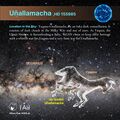 Yaqana and Uñallamacha constellations (CC BY Sadegh Faghanpour for IAU WGSN).
 -
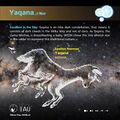 Yaqana stick figure (CC BY Sadegh Faghanpour for IAU WGSN).
 -
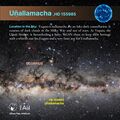 Uñallamacha stick figure (CC BY Sadegh Faghanpour for IAU WGSN).
 -
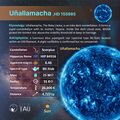 Uñallamacha profile card (CC BY Sadegh Faghanpour for IAU WGSN).
 -
 Yaqana profile card (CC BY Sadegh Faghanpour for IAU WGSN).
 -
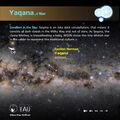 Yaqana star name in stick figure of Norma (CC BY Sadegh Faghanpour for IAU WGSN).

References
- References (general)