Al-Samaka al-Ṣuġrā: Difference between revisions
Created new page for Arabic asterism al-Samaka al-Ṣuġrā. |
No edit summary |
||
| (6 intermediate revisions by 2 users not shown) | |||
| Line 3: | Line 3: | ||
Authors: {{PAGEAUTHORS}} | Authors: {{PAGEAUTHORS}} | ||
---- | ---- | ||
[[File: | |||
'''al-Samaka al-Ṣuġrā''' (Arabic: السمكة الصغرى), [the Smaller Fish] is an Arabic name for an asterism forming a fish shape in Lacerta and Andromeda. | [[File:Alsamaka alsugra chart.png|thumb|Star chart of the Arabian asterism ''al-Samaka al-Ṣuġrā'' (السمكة الصغرى). (CC BY Khalid AlAjaji 2026).]] | ||
'''al-Samaka al-Ṣuġrā''' (Arabic: السمكة الصغرى), [the Smaller Fish] is an Arabic name for an asterism forming a fish shape in Lacerta and Andromeda. | |||
In 2026, the IAU adopted the abbreviated form [[Alsamaka]] as a modern star name. | |||
==Provenance, Etymology, History== | ==Provenance, Etymology, History== | ||
[[File:And_asSufi_MSGotha.jpg|thumb|Andromeda with a fish next to her in a 15th century copy of as-Sufi's Book of Fixed Stars (Forschungsbibliothek Gotha).]] | |||
'''Name Variants''' | '''Name Variants''' | ||
| Line 56: | Line 60: | ||
The identification is considered confident, as the discription and location by ibn ʿĀṣim al-Thaqafī is clear. | The identification is considered confident, as the discription and location by ibn ʿĀṣim al-Thaqafī is clear. | ||
== Transfer and Transformations == | |||
Here we display variants of the image <gallery> | |||
File:And_asSufi_MSGotha.jpg|Andromeda with a fish next to her in a 15th century copy of as-Sufi's Book of Fixed Stars (Forschungsbibliothek Gotha). | |||
File:And+horse+camel_ArabianSky.png|And with fish beneath; al-Sufi AH 519/ 1125 CE, Museum of Islamic Art in Doha, Qatar. MS.2.1998 | |||
File:Sufi74v_beduinConst_Fish+Camel+Horse.jpg|Bodleian Library MS. Huntington 212, from Mosul 1170 | |||
</gallery> | |||
==IAU Working Group Star Names== | ==IAU Working Group Star Names== | ||
| Line 92: | Line 103: | ||
[[Category:Arabic]] | [[Category:Arabic]] | ||
[[Category:Asterism]][[Category:Constellation]] | [[Category:Asterism]][[Category:Constellation]] | ||
[[Category: | [[Category:Lac]] | ||
[[Category:And]] | |||
Latest revision as of 11:06, 16 August 2026
Authors: Khalid Al-Ajaji, Susanne M Hoffmann

al-Samaka al-Ṣuġrā (Arabic: السمكة الصغرى), [the Smaller Fish] is an Arabic name for an asterism forming a fish shape in Lacerta and Andromeda.
In 2026, the IAU adopted the abbreviated form al-Samaka (السمكة ) as a modern star name.
Provenance, Etymology, History

Name Variants
- The indigenous Arabic name السَّمَكَة الصُّغْرَى (al-Samaka al-Ṣuġrā) is recorded by Ibn Qutayba and ibn ʿāṣim al-Ṯaqafī.
- al-samaka al-ṣughrā, Danielle Adams[1]. The asterism and its name were not discussed in other consulted later European and modern scholarly sources.[2][3][4][5][6][7][8].
Etymology
al-Samaka al-Ṣuġrā (Arabic السمكة الصغرى, the Smaller Fish) is derived from the Arabic root (سمك), referring to a fish and al-Ṣuġrā from the Arabic root (صغر) meaning the smaller. Lisan alʿarab defines al-Samaka:[9]
«سمك: السَّمَكُ: الحُوتُ مِنْ خَلْق الْمَاءِ، وَاحِدَتُهُ سَمَكَة، وجمعُ السَّمَكِ سِماكٌ وسُمُوكٌ. والسَّمَكَةُ: بُرْجٌ فِي السَّمَاءِ مِنْ بُرُوج الفَلَك.»
- English
“Samak: al-samak is the fish, a creature of the water; its singular is samakah. The plurals of samak are simāk and sumūk. Al-samakah also denotes a constellation in the sky among the constellations of the celestial sphere.”
Sources and Identification
-
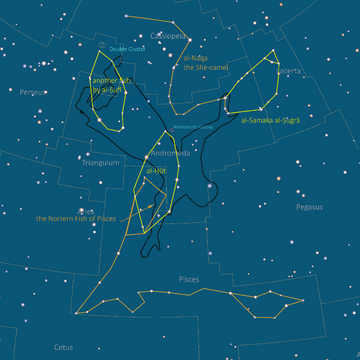 Al-Samaka al-Ṣuġrā and other fish around al-Naqa. image made by Stellarium (CC BY Khalid AlAjaji 2026).

- The Smaller Fish
Ibn Qutayba mentioned a group of stars called al-Samakah al-Ṣuġrā (“the Smaller Fish”) in the region of the constellation al-Musalsalah (“Andromeda”), and said that it lies to the north and that the Moon may sometimes deviate and descend upon it. His description is somewhat inconsistent. Ibn Qutayba says in his description of the lunar mansions:
Then comes al-Ḥūt (“the Fish/Whale”, the 28th Lunar Mansion), which consists of many stars in the shape of a fish. In one of its two sides in the belly is a bright star called Baṭn al-Samaka (“the Belly of the Fish”, β And), also called Qalb al-Ḥūt (“the Heart of the Fish”); and al-Ḥūt may also be called al-Rišāʾ (“the well Cord/Rope”). [...] Sometimes the Moon may deviate and descend upon al-Samaka al-Ṣuġrā, which is upper to the north, resembling the figure of the al-Ḥūt, though broader and shorter. It lies below the neck of the Camel and below al-Kaff al-Ǧaḏmāʾ. p. 84[10]
al-Kaff al-Ǧaḏmāʾ (the Left Palm of al-Ṯurayyā) lies far to the south of this region, while al-Ḥūt is below al-Kaff al-Ḫaḍīb (the Right Henna-dyed Palm of al-Ṯurayyā), not below al-Kaff al-Ǧaḏmāʾ. He said it is in the north and that the Moon may sometimes deviate and descend upon it, but this is not possible, since it lies farther north than the lunar mansions. The correct description is what ibn ʿĀṣim al-Thaqafī transmitted, when he said:
The head of al-Ḥūt (the Fish) lies in the chest of the Camel, and the Camel, in its form, resembles a lean, slender riding animal with a thin neck and a small head. Thus, the stars of the Camel’s neck begin at the hump, then descend until they align with the head of al-Ḥūt (the Fish), then rise again with the curve of the neck until they take the form of a head beneath al-Samaka al-Ṣuġrā (the Smaller Fish). Al-Samaka al-Ṣuġrā is another Fish, whose tail is the Camel’s head; it is shorter and broader than the lower Fish. It is also said that the wrist of al-Ṯurayyā, which we said is like a patch of cloud (the Double cluster NGC 869 and NGC 884), is a branding mark on the Camel’s thigh. As for al-Kaff al-Ǧaḏmāʾ, it lies below al-Šaraṭayn (α, β Ari) and to its right are scattered stars called al-Baqar, which join al-Ṯurayyā. p. 84[11]
Al-Thaqafī thus stated that al-Samaka al-Ṣuġrā lies above the Camel’s head, and that al-Kaff al-Ǧaḏmāʾ lies below al-Šaraṭayn. Al-Samaka al-Ṣuġrā is also described by al-Marzūqī, though he does not name it explicitly. He says:
The head of al-Ḥūt (the Fish) lies in the chest of the Camel, and it is like the form of a fish, except that it is large. Among it is a star that is the brightest of them, called Qalb al-Ḥūt. Above the Camel’s head is another fish, and the Camel’s head is its tail; it is shorter and broader than the lower Fish. vol. 2, p. 344[12]
Al-Marzūqī here refers to two fish: one is the well-known al-Ḥūt, also called al-Rishāʾ, among whose stars is Qalb al-Ḥūt; as noted, its head is in the Camel’s chest. The second lies above the Camel’s head, and its tail is the stars of the Camel’s head. This description matches the Small Fish mentioned by Ibn ʿĀṣim al-Thaqafī.
- Another Fish
Al-Ṣūfī also mentioned another fish in the constellation al-Musalsala (Andromeda), below al-Rishāʾ and rising after it. He said:
There is another fish beneath the Camel’s belly, formed from two lines of stars emerging from the two close stars at the knee-bend of the left leg in the figure of al-Musalsalah. [...] They widen gradually toward the middle of the fish, then narrow again toward the cloudy patch at the wrist of al-Ṯurayyā (the Double cluster NGC 869 and NGC 884). The two close stars are at its mouth, and the patch is at its tail. The position of al-ʿanāq in this fish is like the position of the bright star on the left side of the woman’s figure in the other fish, and this one resembles a fish more closely than the other. The head of the Fish lies to the north and its tail to the south, whereas the head of this one lies to the south and its tail to the north. al-Musalsala[13]
Thus we see that there are four fish: two in al-Musalsalah, namely the Moon-Mansion al-Ḥūt and the other fish described by al-Ṣūfī; a third that shares some stars of the Camel’s head, namely al-Samakah al-Ṣuġrā; and a fourth, the northern fish of the two Pisces. These four fish surround the Camel, as though the Camel had become a creature in the sea, transformed from a ship in the desert into a ship in water.
Stars Identification
The asterism of al-Samaka al-Ṣuġrā” is composed of two curved lines of stars that both extend from β Lacertae and meet again at ι Andromedae, thereby outlining the figure of a fish. One line is: β, 4, 5, 11 Lac, ο, ι And, while the opposite line is: β, 9 Lac, 7, λ, κ, ι And.
The identification is considered confident, as the discription and location by ibn ʿĀṣim al-Thaqafī is clear.
Transfer and Transformations
Here we display variants of the image
-
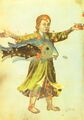 Andromeda with a fish next to her in a 15th century copy of as-Sufi's Book of Fixed Stars (Forschungsbibliothek Gotha).
 -
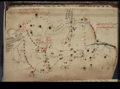 And with fish beneath; al-Sufi AH 519/ 1125 CE, Museum of Islamic Art in Doha, Qatar. MS.2.1998
 -
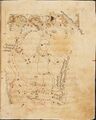 Bodleian Library MS. Huntington 212, from Mosul 1170


IAU Working Group Star Names
In 2026, the name al-Samaka (or any spelling variant) was suggested as a star name in the area that is covered by the historical asterism. It is suggested to be used for β Lac.
Weblinks
- Stellarium https://stellarium.org/
Reference
- ↑ Danielle Adams, Rain Stars Set, Lunar Stations Rise, 2018
- ↑ Hyde, Thomas, Tabulæ Long[itudinis] ac Lat[itudinis] Stellarum Fixarum, Oxford: Henry Hall, 1665
- ↑ Ideler, Ludwig, Untersuchungen über den Ursprung und die Bedeutung der Sternnamen,Berlin 1809
- ↑ Ṣūfī, ʻAbd al-Raḥmān ibn 'Umar, 903-986. Description Des étoiles Fixes. traduction littérale avec des notes par H. C. F. C Schjellerup. St. Pétersbourg: Commissionnaires de lÁcadémie Impériale des sciences, 1874.
- ↑ Richard Hinckley Allen, Star Names — Their Lore and Meaning, Dover edition, 1963.
- ↑ Kunitzsch, Paul. 1961. Untersuchungen zur Sternnomenklatur der Araber. Wiesbaden: Otto Harrassowitz.
- ↑ Roland Laffitte, Le ciel des Arabes, 2012
- ↑ Roland Laffitte, Nommer les étoile: 500 noms hérités des Arabes - Apport de l'uranographie arabe, Orient des Mots, 2025 (online)
- ↑ لسان العرب، ابن منظور (توفي 711 هـ)
Ibn Manẓūr (d. 711 H/~1312 AD), Lisān al-ʿarab - ↑ أبو محمد عبد الله بن مسلم ابن قتيبة الدينوري المتوفى سنة 276هـ - 879م، كتاب الأنواء في مواسم العرب، دائرة المعارف العثمانية، حيدر أباد، الهند، 1375 هـ - 1956م.
IBN QUTAYBA AD-DĪNAWARĪ, ABŪ MUḤAMMAD ʿABDULLAH B. MUSLIM. d. 276 A.H / 879 A.D., KITĀBU'L-ANWĀʾ (on Meteorology of the Arabs), DAIRATU'L-MAʿARIFI'L-OSMANIA, Hyderabad - INDIA 1956 A.D./1375 A.H. - ↑ عبد الله بن حسين بن عاصم الثقفي (توفي 403 هـ)، الأنواء والأزمنة، تحقيق: د. نوري حمودي القيسي، د. محمد نايف الدليمي، دار الجيل، بيروت، لبنان، 1416 هـ.
Al-Ṯaqafī, ʿabd Allah ibn Ḥusayn ibn ʿāṣim (d. 403 H/ ~1013 AD), Al-Anwaʾ wa al-Azmina, critical edition by Dr. Nūrī al-Qaysī and Dr. Moḥammad Nayef al-Dulaymī, Dar al-Jīl, Beirut, Lebanon, 1416 H/1996 AD. - ↑ الإمام أبو علي أحمد بن محمد بن الحسن المرزوقي (توفي سنة 421 هـ)، الأزمنة والأمكنة، تحقيق د. محمد نايف الدليمي، عالم الكتب، بيروت، لبنان، 1422 هـ.
Al-Marzūqī, Abū ʿAli Aḥmad b. Muḥammad b. al-Ḥassan (d. 1030), Al-Azminah wa al-Amkinah (Times and Places), Edition by Dr. Mohammad Nayef al-Dulaymi, (Arabic print of the original book in 2002, World of Books, Beirut, Lebanon). - ↑ كتاب الكواكب لأبي الحسين عبد الرحمن بن عمر الرازي المعروف بالصوفي (291-376)، تحقيق خالد بن عبد الله العجاجي.
Book of the stars by al-Ṣūfī (died 986): Critical edition with commentary by Khalid al-Ajaji, digital edition, 2021.