Sterrennacht: Difference between revisions
infobox |
No edit summary |
||
| (One intermediate revision by the same user not shown) | |||
| Line 2: | Line 2: | ||
Authors: IAU-WGSN Etymology Group, {{PAGEAUTHORS}} | Authors: IAU-WGSN Etymology Group, {{PAGEAUTHORS}} | ||
---- | ---- | ||
[[File:Sterrennacht profileCard SadeghFaghanpour-IAU-WGSN.jpg|thumb|Sterrennacht profile card (CC BY Sadegh Faghanpour for IAU WGSN).]] | |||
{{Infobox constellation | {{Infobox constellation | ||
| name = Sterrennacht | | name = Sterrennacht | ||
| Line 27: | Line 28: | ||
| cat = IAU-Star Name | | cat = IAU-Star Name | ||
}} | }} | ||
[[File:Sterrennacht stickfigure SadeghFaghanpour-IAU-WGSN.jpg|thumb|Sterrennacht stick figure (CC BY Sadegh Faghanpour for IAU WGSN).]] | |||
Sterrennacht is a modern star name adopted by the International Astronomical Union in the IAU-Catalog of Star Names (IAU-CSN). Its origin is Dutch. It is the name of HAT-P-6 in constellation And. | Sterrennacht is a modern star name adopted by the International Astronomical Union in the IAU-Catalog of Star Names (IAU-CSN). Its origin is Dutch. It is the name of HAT-P-6 in constellation And. | ||
| Line 32: | Line 34: | ||
The Sterrennacht (Starry Night) is a world-famous painting by Dutch grand master Van Gogh that was painted in France in 1889 and now belongs to the permanent collection of New York's Museum of Modern Art. | The Sterrennacht (Starry Night) is a world-famous painting by Dutch grand master Van Gogh that was painted in France in 1889 and now belongs to the permanent collection of New York's Museum of Modern Art. | ||
[[File:Van Gogh - Starry Night - Google Art Project.jpg|center|frameless|688x688px|''The Starry Night'' (van Gogh 1889). This file is from Wikimedia Commons and may be used by other projects.]] | |||
It is unknown what exactly the image depicts and if it is a real, observed scene at all. However, in 2026 a team of researchers suggested an interpretation of the Hyades and Venus rising in this landscape (article in "[https://www.nature.com/articles/s41598-026-73025-5 Scientific Reports]" of "Nature" magazine).<ref>Kim, E.Jh., Kang, S., Song, J. ''et al.'' The actual sky of Van Gogh’s ''Starry Night'': a multidisciplinary reconstruction. ''Sci Rep'' '''16''', 31109 (2026). <nowiki>https://doi.org/10.1038/s41598-026-73025-5</nowiki></ref> Many other scholars doubt this interpretation.<ref>Victoria Corless (2026). Did Venus and the Hyades Star Cluster Inspire Van Gogh’s ‘The Starry Night’? in [https://skyandtelescope.org/astronomy-news/did-venus-and-the-hyades-star-cluster-inspire-van-goghs-the-starry-night/ Sky and Telescope]</ref> | |||
==Mythology== | ==Mythology== | ||
==IAU Working Group on Star Names== | ==IAU Working Group on Star Names== | ||
The name was adopted by the IAU WGSN on 2019/12/17. | The name was adopted by the IAU WGSN on 2019/12/17. <gallery> | ||
File:Sterrennacht profileCard SadeghFaghanpour-IAU-WGSN.jpg|Sterrennacht profile card (CC BY Sadegh Faghanpour for IAU WGSN). | |||
File:Sterrennacht stickfigure SadeghFaghanpour-IAU-WGSN.jpg|Sterrennacht stick figure (CC BY Sadegh Faghanpour for IAU WGSN). | |||
File:Sterrennacht-Planet profileCard SadeghFaghanpour-IAU-WGSN.jpg|exoplanet of "Sterrennacht" named Nachtwacht (CC BY Sadegh Faghanpour for IAU WGSN). | |||
</gallery> | |||
==Weblinks== | ==Weblinks== | ||
Latest revision as of 07:20, 9 November 2026
Authors: IAU-WGSN Etymology Group, Susanne M Hoffmann, Youla Azkarrula

| Asterism Info | |
| Native | The Sterrennacht |
|---|---|
| Translation | Starry Night |
| Position (2000) | |
| Right ascension | 354.774209 |
| Declination | 42.465973 |
| Area | 0 sq. deg. |
| Stars | |
| Bright stars | 1 |
| Bayer/Flamsteed stars | 1 |
| Stars brighter than 3.00m | 0 |
| Brightest star | Sterrennacht (10.54m) |
| exoplanets | 1 (Nachtwacht) |
| Taxonomy | |
| category of asterism | IAU-Star Name |
| IAU- constellations | And |

Sterrennacht is a modern star name adopted by the International Astronomical Union in the IAU-Catalog of Star Names (IAU-CSN). Its origin is Dutch. It is the name of HAT-P-6 in constellation And.
Etymology and History
The Sterrennacht (Starry Night) is a world-famous painting by Dutch grand master Van Gogh that was painted in France in 1889 and now belongs to the permanent collection of New York's Museum of Modern Art.

It is unknown what exactly the image depicts and if it is a real, observed scene at all. However, in 2026 a team of researchers suggested an interpretation of the Hyades and Venus rising in this landscape (article in "Scientific Reports" of "Nature" magazine).[1] Many other scholars doubt this interpretation.[2]
Mythology
IAU Working Group on Star Names
The name was adopted by the IAU WGSN on 2019/12/17.
-
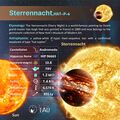 Sterrennacht profile card (CC BY Sadegh Faghanpour for IAU WGSN).
-
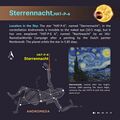 Sterrennacht stick figure (CC BY Sadegh Faghanpour for IAU WGSN).
-
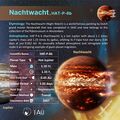 exoplanet of "Sterrennacht" named Nachtwacht (CC BY Sadegh Faghanpour for IAU WGSN).

Weblinks
- Website of the IAU WGSN: https://exopla.net/
Reference
- References (general)
- 2019 IAU100 NameExoWorlds
- ↑ Kim, E.Jh., Kang, S., Song, J. et al. The actual sky of Van Gogh’s Starry Night: a multidisciplinary reconstruction. Sci Rep 16, 31109 (2026). https://doi.org/10.1038/s41598-026-73025-5
- ↑ Victoria Corless (2026). Did Venus and the Hyades Star Cluster Inspire Van Gogh’s ‘The Starry Night’? in Sky and Telescope